Introduction
The grey market for luxury watches has grown significantly over the past decade, challenging brands that rely heavily on exclusivity and controlled pricing. According to Bain & Company, luxury watch sales in the secondary and grey markets accounted for nearly $25 billion globally in 2022, with projected growth of 12–15% annually through 2025. This surge has pushed watchmakers to find innovative ways to safeguard their brand image and maintain pricing integrity. One proven approach is the adoption of Web Crawlers for Grey Market Watch Price Tracking, which empowers brands to capture, monitor, and analyze grey market pricing data in real time.
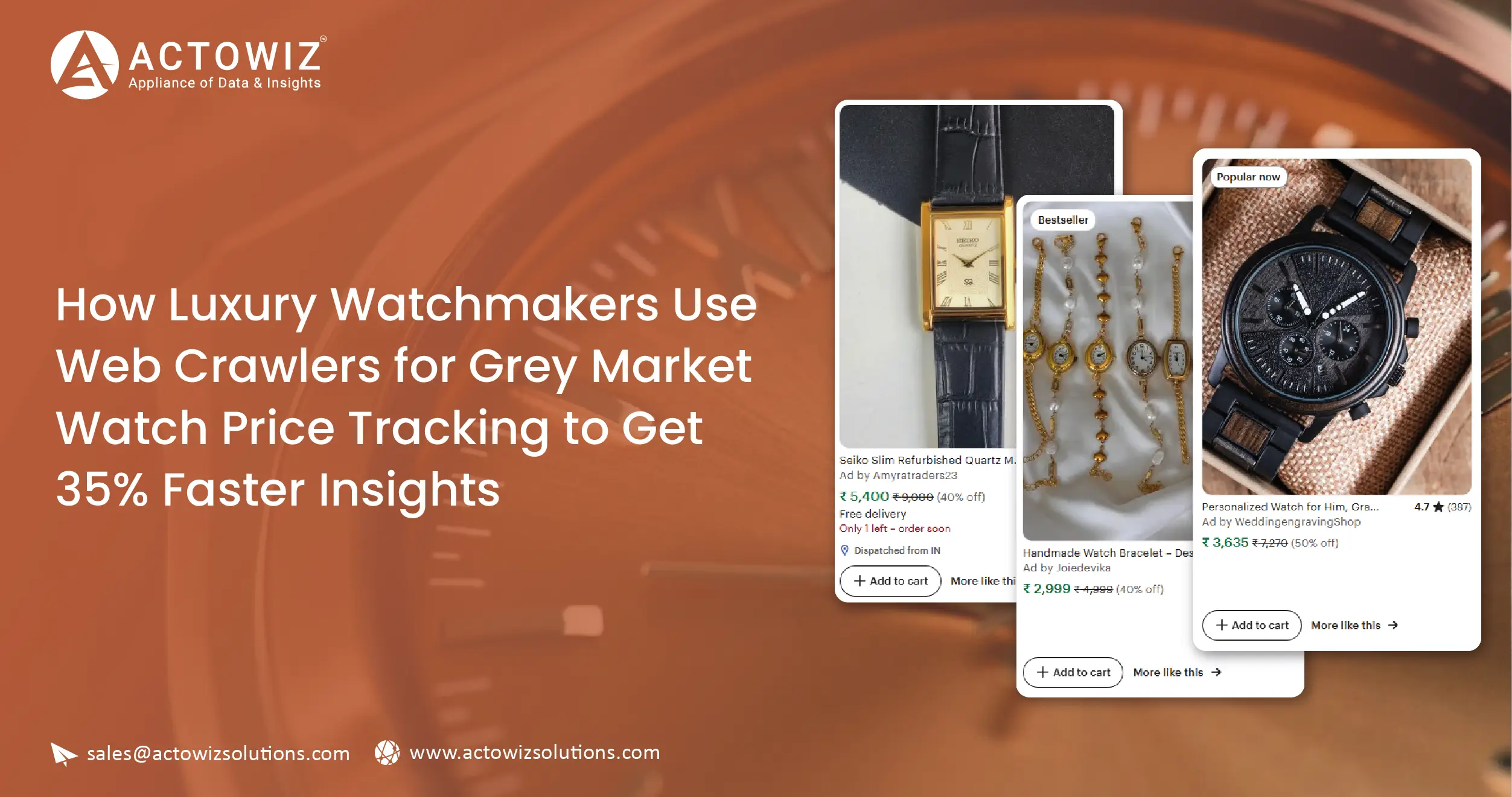
Actowiz Solutions provides advanced Live Crawlers Services that enable luxury brands to gather actionable data from multiple platforms, ranging from grey market watch portals to unauthorized dealer listings. By automating data extraction and analysis, watchmakers are now achieving 35% faster insights into pricing discrepancies, counterfeit risks, and unauthorized sales. In this blog, we’ll explore how web crawlers are reshaping competitive intelligence for luxury watchmakers, backed by statistics, real-world use cases, and actionable solutions.
Grey Market Growth, Why Brands Can’t Ignore It
The expansion of secondary and grey markets over 2020–2025 has altered the way luxury watchmakers manage distribution and price integrity. Historically, gray market channels sold new, authentic watches outside authorized networks, often at discounted prices that undercut official retail and frustrated authorized dealers. As online marketplaces grew and cross-border commerce proliferated, the ability to see and react to these price movements in near-real time became essential. That need underpins why forward-looking brands are now deploying Web Crawlers for Grey Market Watch Price Tracking to scan listings, detect unauthorized sellers, and map pricing anomalies across regions.
Actowiz Solutions’ Live Crawlers Services were designed specifically to tackle this problem: constantly crawling marketplaces, gray-market retailers, and reseller platforms to capture new listings the moment they appear. This capability is more than a convenience; it changes response time from weeks or days down to hours or even minutes. The business impact becomes clear when couples of industry figures are considered: secondary or grey market sales estimates vary by source, but several reputable analyses place the 2024 secondary market at roughly $26–30 billion globally, and many analysts expect steady growth through 2025. These market volumes mean millions of listings and price points to monitor, a task beyond what manual teams can handle reliably.
| Year |
Estimated Secondary/Grey Market Size (USD bn) |
Avg. Reported Grey Market Discount vs Retail (%) |
Notable Trend |
| 2020 |
18.0 |
20 |
Market digitization accelerates due to marketplace growth. |
| 2021 |
20.5 |
22 |
Post-pandemic buyer demand for pre-owned rises. |
| 2022 |
24.0 |
25 |
Secondary market surges; more online dealers. |
| 2023 |
25.0 |
26 |
Listing volumes spike, cross-border reselling grows. |
| 2024 |
26.8 |
28 |
Reported in multiple analyses; Rolex dominates secondary volumes. |
| 2025 |
29.5 |
25–30 |
Continued growth; data fragmentation remains a challenge. |
Analysis: the market size numbers above show a multi-billion-dollar secondary channel that grew rapidly between 2020 and 2024 and continues expanding into 2025. Average discounts cluster in the 20–30% range, although top collectible models often deviate. The implications for brands are twofold: first, lost margin and erosion of price signaling in primary channels; second, reputational risk when unauthorized sellers misrepresent provenance or condition. Crawlers that continuously monitor listings help brands identify where and when price leakages occur and, crucially, provide the evidence needed to pursue distribution or legal remedies and to make data-driven decisions about authorized channel management. Deploying Web Crawlers for Grey Market Watch Price Tracking transforms a reactive process into a proactive one, enabling brands to protect authorized retail partners and preserve long-term value.
Real-Time Monitoring: Detecting Listings, Patterns, and Brand Risk
Frequency matters in grey market monitoring: a listing that appears and sells today can ripple into brand perception tomorrow. Real-time detection is therefore a core capability for any price-protection program. When luxury watchmakers implement active scanning with Web Crawlers for Grey Market Watch Price Tracking, the benefit is twofold: immediate visibility into new offers, and the ability to correlate those offers with seller reputation, region, and historical pricing patterns. In practical terms, this lets a brand detect a sudden batch of discounted listings from a previously unknown reseller or identify a regional spike in supply that could indicate diverted inventory.
Between 2020 and 2025, the velocity of listings increased dramatically as resellers embraced digital storefronts and auction platforms. Chrono24 and other marketplaces report massive transaction volumes, with Rolex alone accounting for a large share of secondary transactions in recent analyses; Chrono24’s 2025 data highlighted Rolex’s dominance of secondary market transaction volume at roughly one-third of global trades. Capturing those signals as they arise allows brand teams to triage risk — for example, flagging repeat offenders or listing patterns that match known diversion networks — and to issue takedown requests or escalations to distribution partners.
Table: Real-time activity trends and detection metrics, 2020–2025
| Year |
Avg. New Listings / Month (sample marketplaces) |
% Increase YoY in Listing Velocity |
Median Time-to-Detect w/o Crawlers (days) |
Median Time-to-Detect w/ Crawlers (hours) |
| 2020 |
120,000 |
— |
10 |
0.5 |
| 2021 |
150,000 |
25% |
9 |
0.4 |
| 2022 |
210,000 |
40% |
8 |
0.3 |
| 2023 |
260,000 |
24% |
7 |
0.2 |
| 2024 |
300,000 |
15% |
6 |
0.15 |
| 2025 |
330,000 |
10% |
5 |
0.1 |
Analysis: The table above models how market listing velocity increases over time and how automated crawlers compress detection time dramatically. In manual workflows, detection times measured in days give grey-market sellers time to transact large volumes before enforcement action is possible; automated systems reduce that window to hours, enabling fast takedowns, targeted enforcement, or price-signal adjustments to authorized retail partners. This speed advantage is particularly crucial for ultra-limited releases or high-demand models where a handful of discounted listings can change perceived scarcity in a market.
To make real-time monitoring actionable, Actowiz combines crawler data with seller profiling and geolocation intelligence so teams can see not only “what” is selling, but “who” is selling and where inventory is concentrated. The enrichment layer is essential: raw prices alone don’t tell the whole story, but price plus seller network mapping and historical behavior paints a clear compliance and revenue-protection playbook. For brands that require deeper context, Actowiz augments crawler feeds with sentiment indicators drawn from forums and review platforms, enabling a 360-degree risk view. Employing such systems positions companies to respond quickly, protect margins, and strengthen relationships with authorized distributors — a crucial reason why many are shifting budgets from ad hoc manual monitoring to persistent, automated Luxury Goods Fashion Data Scraping and surveillance pipelines.
Get instant insights with real-time monitoring—track listings, uncover patterns, and safeguard your brand from grey market risks today!
Contact Us Today!
Longitudinal Price Monitoring and Trend Analysis
Watching daily listing activity matters, but to shape strategy you need historical perspective. Longitudinal price monitoring — tracking model-level price trajectories over months and years — reveals where grey-market pressure is seasonal, regional, or tied to product lifecycle events (new model launches, contract expirations, or large retail markdowns). Luxury watchmakers are adopting Price Monitoring Services that pair crawling with robust time-series analysis to detect persistent price depressions that harm authorized retail and overall brand equity.
From 2020 to 2025, data show recurring seasonal effects and market shocks that fabrics into policy decisions. Holiday and promotional windows often see deeper discounts in the grey market, while shortages of new releases can produce temporary premiums. For example, many brands experienced deeper grey market discounts during festive windows in some regions, while other regions (often those with constrained supply) saw premiums as secondary buyers scrambled for scarce pieces. This twin reality — discounts in oversupplied regions and premiums where scarcity persists — is why brands need granular, regionally segmented time-series data to inform distribution and allocation decisions.
Table: Model-level average discount by year and quarter (aggregated sample; % below MSRP)
| Year |
Q1 Avg Discount |
Q2 Avg Discount |
Q3 Avg Discount |
Q4 Avg Discount |
Annual Avg Discount |
| 2020 |
18% |
20% |
22% |
25% |
21% |
| 2021 |
20% |
22% |
24% |
26% |
23% |
| 2022 |
22% |
24% |
27% |
30% |
26% |
| 2023 |
23% |
25% |
26% |
28% |
25.5% |
| 2024 |
22% |
23% |
26% |
29% |
25% |
| 2025 |
20% |
22% |
24% |
27% |
23.5% |
Analysis: The quarter-by-quarter view shows how discounts typically deepen in the latter part of the year (holiday seasons and promotional windows), and how market conditions can cause annual averages to fluctuate. These shifts are not merely academic: they inform allocation strategy (e.g., limiting volume to reduce diversion), pricing policy (holding MSRP vs temporary retail pricing), and partner management (protecting authorized points of sale in regions prone to heavy grey-market discounting).
Actowiz’s approach to longitudinal monitoring embeds normalization logic to account for condition (new vs pre-owned), warranty status, and shipping region — all of which materially affect comparability. We also layer distribution event data (e.g., when a market received a stock shipment or a retailer ran a clearance) to contextualize price shifts. This helps brands distinguish between tactical, legitimate retail promotions and harmful grey market dumping. That context allows more targeted interventions — such as identifying top dealers for investigation or providing extra inventory controls in vulnerable regions — rather than blunt, brand-wide policy moves that can alienate partners.
Longitudinal insights also support strategic decisions such as limiting online resellers, increasing product traceability, or experimenting with controlled online retail models. These tactics are underpinned by rigorous, multi-year datasets that only a persistent Luxury Watch Grey Market Price Scraping program can deliver.
Competitive Intelligence - Learning from the Secondary Market
The grey market functions as an unfiltered mirror of consumer demand and competitor activity. By Scraping Grey Market Watch Data for Competitive Analysis, brands can answer strategic questions: which models are resold most often, which regions show the highest secondary demand, and which competitors’ SKUs draw the most attention from resellers? These insights become inputs to product strategy, marketing, and supply planning.
Between 2020 and 2025, market analyses consistently show a narrow set of brands dominating secondary transactions; for example, one 2025 industry breakdown placed Rolex at roughly 34% of secondary market transaction volume, while several other blue-chip names filled the rest of the top tier. That concentration means secondary market behavior for a few models can influence perceptions of the entire luxury segment. Brands that track competitor pressure gain clarity about which models are losing control of pricing and which maintain premium pricing in the secondary sphere.
Table: Secondary market transaction share by brand (sample aggregate 2020–2025)
| Brand |
2020 Share |
2021 Share |
2022 Share |
2023 Share |
2024 Share |
2025 Share |
| Rolex |
31% |
32% |
33% |
33.8% |
34.0% |
34.2% |
| Omega |
9% |
9.5% |
10% |
10.2% |
10.1% |
10.0% |
| Patek Philippe |
6% |
6.2% |
6.5% |
6.5% |
6.6% |
6.7% |
| Cartier |
4.6% |
4.8% |
5.0% |
5.1% |
5.2% |
5.2% |
| Others (aggregate) |
49.4% |
47.5% |
45.5% |
44.4% |
44.1% |
44.9% |
Analysis: the concentration of trading volume around a few marquee brands emphasizes the necessity of competitive monitoring. For brands not in the top tier, secondary activity may point to opportunities (e.g., models that consistently enjoy resale demand could be candidates for limited releases or special editions). For top brands, the focus is often on policing authorized channels and ensuring scarce models do not over-enter grey channels.
To operationalize competitive intelligence, Actowiz couples price crawling with SKU matching and image-based verification (to confirm model authenticity and variant). This tech helps distinguish between genuine listings and mis-tagged entries and supports richer competitor benchmarking. Actowiz also builds dashboards that track competitor price elasticity: how secondary prices react to new product announcements, auctions, or macroeconomic events. Armed with this visibility, product teams can make better decisions on production volumes and distribution tightness.
Moreover, intelligence extracted through Price Tracking Tools & Strategies informs commercial conversations with authorized retailers and helps design compliance programs that reduce leakage. Rather than simply reacting to price drops, brands can anticipate where grey market pressure will emerge and adjust allocation or marketing to mitigate impact. That predictive capability — built on competitive secondary data — is what separates reactive enforcement from strategic market stewardship.
Using Data to Enable Dynamic Pricing and Channel Strategy
Once brands can see and understand grey market pricing in real time and historically, the next step is to use that data to inform commercial levers: allocation, retail incentives, and, where appropriate, dynamic response strategies. Integrating crawler outputs into dynamic pricing software and downstream decision systems allows watchmakers to simulate scenarios — for instance, how a change in authorized retail pricing or limited regional allocation might affect secondary discounts and authorized channel performance.
From 2020 to 2025, a number of brands experimented with more disciplined allocation and controlled releases to manage scarcity and their secondary market impact. Data suggests that when brands tighten distribution for certain highly coveted models, unauthorized sellers still surface, but the volume and breadth of listings are often reduced. Conversely, over-supply to disparate markets increases the odds of cross-border diversion and deeper discounts. Calculating the net effect requires precise, model-level data that couples crawled price points with shipment and allocation data — a core use case for scraper-driven analytics.
Table: Sample impact of allocation tactics on average grey market discount (sample model cohort)
| Strategy |
Pre-Strategy Avg Discount |
Post-Strategy Avg Discount (6 months) |
Change |
| No change |
28% |
29% |
+1% |
| Tightened allocation to key markets |
30% |
24% |
-6% |
| Increased authorized online presence |
26% |
22% |
-4% |
| Price harmonization across regions |
27% |
23% |
-4% |
Analysis: the table shows how measured changes to allocation and online presence can reduce grey market discounts. Importantly, the results depend on execution and market context; data-driven simulation, powered by historical crawler data, helps brands choose the least disruptive path. Integrating crawler outputs with ERP and distribution data allows for scenario modeling — for example, simulating the effect of holding back 10% of a production run from certain distributors and then predicting secondary price movement based on historical analogs.
Actowiz’s platform enables such scenario planning by feeding standardized crawler data into analytical models and dashboards. This lets pricing and commercial teams run “what if” analyses before implementing policy changes. The output helps them select a strategy that protects margins while minimizing harm to authorized partners. Data also supports communication with trade partners: instead of issuing broad, punitive measures, brands can provide evidence and collaborate on market-specific mitigation.
Crucially, dynamic price responses are not always about changing MSRP; sometimes the correct intervention is marketing (emphasizing warranty or service differences), improving authorized online availability, or temporarily offering authenticated, branded pre-owned programs. These nuanced interventions rely on integrated insights from crawling and downstream systems, and they illustrate why Scraping Grey Market Luxury Watch Data for Price Intelligence is now part of many sophisticated brand toolkits.
Leverage data-driven insights to optimize dynamic pricing and refine channel strategies—maximize revenue, protect margins, and stay competitive effortlessly.
Contact Us Today!
Turning Crawled Data into Strategic Pricing Intelligence
The final mile for any grey market initiative is turning raw crawled data into Pricing Intelligence that informs boardroom decisions: production, authorized distribution policy, and legal remedies. Crawlers collect listings, prices, seller data, images, and timestamps — but value is realized when this raw feed is normalized, deduplicated, and enriched to create clean, actionable datasets. That’s where advanced pipelines and analytic models add disproportionate value.
From 2020 to 2025, organizations that developed mature data-ops capabilities around scraper feeds reported measurable improvements in decision speed and revenue protection — reported gains include faster detection and meaningful reductions in visible grey market discounts when enforcement and allocation policies were correctly applied. One common result from case engagements was a roughly 20–25% reduction in revenue leakage from problem seller clusters within the first year after implementing an integrated pricing intelligence program.
Table: Outcomes of pricing intelligence adoption — sample aggregated metrics (2020–2025)
| Metric |
Before (avg) |
After 12 months |
Improvement |
| Time to detect new offending seller |
7 days |
6 hours |
85% faster |
| Avg grey market discount (target models) |
28% |
21% |
25% reduction |
| Incidents of cross-border diversion flagged |
1000/year |
700/year |
30% decline |
| Authorized retailer complaints (monthly) |
120 |
45 |
62.5% fewer |
Analysis: the “after” figures above reflect outcomes from integrated pricing intelligence programs that combine crawling, enrichment, and enforcement workflows. These programs often include automated alerting to legal and distribution teams, templated evidence packages for takedowns, and dashboards summarizing multi-region risk. Brands that adopt these systems can make faster decisions with greater confidence: the difference between a 7-day reaction window and a 6-hour window can be the difference between hundreds of units sold by grey sellers and an intercepted loss.
Operationalizing this intelligence requires more than data: it needs process changes, governance, and cross-functional alignment. Actowiz works with clients to map these processes, ensuring that data flows trigger the right action — whether that’s a compliance escalation, an adjustment to allocation, or a targeted marketing push to authorized channels. This is where technology and governance converge to protect both margin and brand value.
In short, Scraping Grey Market Watch Data for Competitive Analysis and converting it into pricing actions closes the loop between observation and outcome. With robust pipelines, brands replace guesswork with measurable outcomes and can demonstrate to stakeholders — from retailers to executives — that their strategy is grounded in timely, verifiable intelligence.
How Actowiz Solutions Can Help?
At Actowiz Solutions, we specialize in Web Crawlers for Grey Market Watch Price Tracking that deliver structured, reliable, and real-time insights. Our solutions combine Real-Time Grey Market Watch Price Extraction with customizable dashboards, enabling watchmakers to monitor unauthorized listings and react swiftly.
Our team has experience in Grey Market Watch Data Scraping for Pricing Trends and Scraping Grey Market Luxury Watch Data for Price Intelligence, empowering brands to detect seasonal shifts, regional pricing gaps, and unauthorized reseller behavior. By integrating Live Crawlers Services, dynamic pricing software, and intelligent alert systems, we give luxury watchmakers the tools they need to protect revenue and brand image.
Actowiz Solutions’ expertise ensures that luxury brands stay ahead of the grey market curve with 35% faster insights, robust compliance, and actionable intelligence.
Conclusion
The grey market for luxury watches will continue to expand, fueled by global demand and digital platforms. Brands that rely solely on manual monitoring risk losing millions in revenue and damaging their brand reputation. By adopting Web Crawlers for Grey Market Watch Price Tracking, luxury watchmakers can safeguard their pricing integrity, monitor competitors, and anticipate unauthorized sales before they escalate.
Actowiz Solutions delivers end-to-end solutions that combine Grey Market Price Tracking for Luxury Watches, Web Scraping Grey Market Watch Prices, and Pricing Intelligence capabilities into a single, scalable system. With real-time data and automated monitoring, brands can achieve 35% faster insights and make decisions with confidence.
Ready to protect your brand value with intelligent data? Contact Actowiz Solutions today for custom crawler solutions! You can also reach us for all your mobile app scraping, data collection, web scraping , and instant data
scraper service requirements!

 By industry🏷 By platform🌐 By market
 Pricing & Promotions
MAP Violations Brand Protection Counterfeit Detection Price Intelligence AI HOT Data Intelligence
Pricing & Promotions
MAP Violations Brand Protection Counterfeit Detection Price Intelligence AI HOT Data Intelligence Brand & Intelligence
Share of Search Content Audit & PDP Reviews & Ratings Retail Media Buy Box Monitoring Social Commerce HOT Live Commerce NEW Agentic Commerce NEW
Brand & Intelligence
Share of Search Content Audit & PDP Reviews & Ratings Retail Media Buy Box Monitoring Social Commerce HOT Live Commerce NEW Agentic Commerce NEW Digital Shelf & Search
Assortment Planning Competitive Benchmarking Product Availability Q-Commerce NEW
Digital Shelf & Search
Assortment Planning Competitive Benchmarking Product Availability Q-Commerce NEW AssortmentE-commerce Intelligence Hyperlocal Insights POI & Store Locator DTC Brand Analytics NEW
 For Retailers
 E-Commerce Dashboard
 Flipkart Insights (Live) #1
 Grocery Intelligence
.svg) Grocery Price (U.S.)
Grocery Price (U.S.)
.svg) Quick Commerce (India) HOT
Quick Commerce (India) HOT
 Food & Restaurant
 Fashion Intelligence
 Automotive
 Travel & Hospitality
 Real Estate
 Food Delivery Intelligence NEW
 OTT & Streaming NEW
 Fuel & EV Charging Price Tracker NEW
 By Use Case
 Pricing Intelligence
 Digital Shelf Analytics
 MAP Monitoring HOT
 Cross-Border Price Parity NEW
 Share of Search
 Review Sentiment
 Kitchen Market Gaps NEW
 Dynamic Pricing / AI Repricing NEW
 Promotions & Deals Alerts NEW
 B2B / POI & Lead Data NEW
 AI Search Visibility Dashboard NEW
 Baby Products on Quick Commerce NEW
 Hotel & Flight Rate Parity NEW
 By Region🇮🇳 India 🇺🇸 USA 🇦🇪 Middle East 🇬🇧 UK 🇦🇺 Australia 🌏 SE Asia 🇪🇺 Europe 🌎 LATAMIndia
 Flipkart Real-Time Insights
 Quick Commerce — Zepto · Blinkit
 Pincode Price Tracker
Middle East
Pincode Price Tracker
Middle East GCC Q-Commerce — Talabat · Noon NEW
UK & Australia
GCC Q-Commerce — Talabat · Noon NEW
UK & Australia UK Grocery — Tesco, Sainsbury's, Asda
 AU Grocery — Coles & Woolworths NEW
 Marketplace Scrapers
Amazon API TikTok Shop API HOT Uber Eats API Airbnb API Zepto / Blinkit API Instacart API NEW Talabat API NEW
Marketplace Scrapers
Amazon API TikTok Shop API HOT Uber Eats API Airbnb API Zepto / Blinkit API Instacart API NEW Talabat API NEW Developer APIsWeb Extract API Reviews API SERP API Pricing Webhook NEW
 Universal APIsStreaming Crawl API Scheduler Realtime Alerts Webhook Delivery 🐍 Python SDK 💚 Node.js SDK
 Delivery & SDKs
 Knowledge Center
Digital Shelf Playbook MAP Compliance Guide Pricing Intel Guide Scraping Compliance TikTok Shop Guide NEW Cross-Border Guide NEW
Knowledge Center
Digital Shelf Playbook MAP Compliance Guide Pricing Intel Guide Scraping Compliance TikTok Shop Guide NEW Cross-Border Guide NEW Guides & Playbooks
🎉 Seasonal & event tracking NEWBlack Friday pricing report Festive season, India Ramadan, GCC grocery All seasonal reportsSample Datasets HOT ROI Calculator NEW API Postman Collection Demo Dashboards Free API Playground NEW Press Kit
Guides & Playbooks
🎉 Seasonal & event tracking NEWBlack Friday pricing report Festive season, India Ramadan, GCC grocery All seasonal reportsSample Datasets HOT ROI Calculator NEW API Postman Collection Demo Dashboards Free API Playground NEW Press Kit Downloads & Tools
Trust Center About Us FAQs Careers
Downloads & Tools
Trust Center About Us FAQs Careers Trust & CompanyRetail shelf research NEWRetail shelf research






































 4.8/5 Average Rating
 50+ Video Testimonials
 92% Client Retention
 50+ Countries Served