Medicine pricing
Published pricing, unit-normalised.
- OTC and published prescription pricing
- Price per unit dose
- Own-label versus branded flag
- Promotional and multi-buy pricing
- Price change events with dates

Scalable web, app and AI-powered collection across 40+ countries.
All services → By industry
Repricing driven by competitor moves rather than a weekly review.
Explore → Pricing & Promotions
 Brand & Intelligence
 Digital Shelf & Search
 Assortment
 For Retailers
Which solution fits?
Talk to ExpertTalabat, Careem Quik and Noon Minutes across 18 GCC cities.
Launch Demo →Tesco, Sainsbury's, Asda, Morrisons and Aldi, daily.
Get Early Access → By Industry
 E-Commerce Dashboard
 Flipkart Insights (Live) #1
 Grocery Intelligence
.svg) Grocery Price (U.S.)
Grocery Price (U.S.)
.svg) Quick Commerce (India) HOT
Quick Commerce (India) HOT
 Food & Restaurant
 Fashion Intelligence
 Automotive
 Travel & Hospitality
 Real Estate
 Food Delivery Intelligence NEW
 OTT & Streaming NEW
 Fuel & EV Charging Price Tracker NEW
 By Use Case
 Pricing Intelligence
 Digital Shelf Analytics
 MAP Monitoring HOT
 Cross-Border Price Parity NEW
 Share of Search
 Review Sentiment
 Kitchen Market Gaps NEW
 Dynamic Pricing / AI Repricing NEW
 Promotions & Deals Alerts NEW
 B2B / POI & Lead Data NEW
 AI Search Visibility Dashboard NEW
 Baby Products on Quick Commerce NEW
 Hotel & Flight Rate Parity NEW
 By Region
 Flipkart Real-Time Insights
 Quick Commerce — Zepto · Blinkit
 Pincode Price Tracker
 GCC Q-Commerce — Talabat · Noon NEW
 UK Grocery — Tesco, Sainsbury's, Asda
 AU Grocery — Coles & Woolworths NEW
Sources we already run pipelines against. Download a real sample from any of them.
Browse coverage → Marketplace Scrapers
 Developer APIs
 Universal APIs
 Delivery & SDKs
Fixed monthly retainer, named engineer, no per-request metering.
Managed Data API → Knowledge Center
 Guides & Playbooks
 Downloads & Tools
 Trust & Company
Scalable web, app and AI-powered collection across 40+ countries.
All 58 services → By industryRepricing driven by competitor moves rather than a weekly review.
Explore → Pricing & Promotions
Brand & Intelligence
Digital Shelf & Search
Assortment For RetailersWhich solution fits?
Talk to ExpertSources we already run pipelines against. Download a real sample from any of them.
Browse coverage →Talabat, Careem Quik and Noon Minutes across 18 GCC cities.
Launch Demo →Tesco, Sainsbury's, Asda, Morrisons and Aldi, daily.
Get Early Access → By Industry
E-Commerce Dashboard
Flipkart Insights (Live) #1
Grocery Intelligence
Grocery Price (U.S.)
Quick Commerce (India) HOT
Food & Restaurant
Fashion Intelligence
Automotive
Travel & Hospitality
Real Estate
Food Delivery Intelligence NEW
OTT & Streaming NEW
Fuel & EV Charging Price Tracker NEW
By Use Case
Pricing Intelligence
Digital Shelf Analytics
MAP Monitoring HOT
Cross-Border Price Parity NEW
Share of Search
Review Sentiment
Kitchen Market Gaps NEW
Dynamic Pricing / AI Repricing NEW
Promotions & Deals Alerts NEW
B2B / POI & Lead Data NEW
AI Search Visibility Dashboard NEW
Baby Products on Quick Commerce NEW
Hotel & Flight Rate Parity NEW
By Region Flipkart Real-Time Insights
Quick Commerce — Zepto · Blinkit
Pincode Price Tracker
GCC Q-Commerce — Talabat · Noon NEW
UK Grocery — Tesco, Sainsbury's, Asda
AU Grocery — Coles & Woolworths NEW
Marketplace Scrapers
Developer APIs Universal APIs Delivery & SDKsFixed monthly retainer, named engineer, no per-request metering.
Managed Data API → Knowledge Center
Guides & Playbooks
Downloads & Tools
Trust & CompanyMedicine and provider data, with patient data categorically excluded.
This is the category where a vendor's boundaries matter more than its coverage. Everything useful here sits in published pricing, availability and directory data. Nothing useful requires touching a patient record, and we will not.
Free pilot on your own sources, returned in 48 hours. No card, no trial clock — and you keep the sample data either way.
Last verified 5 August 2026 by the Actowiz Solutions Data Engineering team.
Healthcare and pharmacy data scraping covers the commercial and reference layer of healthcare: medicine pricing and availability at online pharmacies, product attributes such as active ingredient and strength, provider and facility directories, and published price transparency disclosures.
This category needs its boundaries stated before its capabilities, because the sensitive data is adjacent to the useful data and the distinction is not always obvious to buyers.
The same active ingredient appears at multiple strengths, in multiple forms, in packs from 12 to 96. Comparing pack prices across those is meaningless. We parse active ingredient, strength, form and pack count, then compute price per unit dose — which is the only basis on which a pharmacy pricing comparison holds.
OTC and pharmacy retail pricing is the largest use case. Price transparency file extraction is the most technically demanding.
Published pricing, unit-normalised.
The fields that make comparison valid.
The earliest public shortage indicator.
Public reference data.
Regulated disclosure files, structured.
The competitive picture.
A managed engagement, not a tool licence. We own the pipeline and everything that breaks in it.
Every engagement delivers a documented schema. These are the core fields; the full dictionary runs to 110+ and is agreed during scoping.
| Field | Type | What it captures | Refresh |
|---|---|---|---|
product_key |
string | Cross-retailer product identity based on ingredient, strength, form and pack | Every run |
retailer / product_name |
string | Pharmacy and the product as listed | Daily |
active_ingredient / strength |
string / decimal | Parsed active ingredient and strength, required for valid comparison | Weekly |
form / pack_count |
enum / int | Dose form and pack count, parsed rather than left in the title | Weekly |
classification |
enum | Regulatory classification such as GSL, P or POM, or the local equivalent | Weekly |
is_own_label |
boolean | Whether the product is a pharmacy own-label line competing with branded equivalents | Weekly |
price / price_per_unit |
decimal | Listed price and computed price per unit dose | Daily |
in_stock / qty_limit |
boolean / int | Availability and any per-order quantity limit, which signals supply pressure | Daily |
requires_pharmacist |
boolean | Whether purchase requires pharmacist supervision as displayed | Weekly |
facility_key / facility_type |
string / enum | Provider directory identity and facility classification | Monthly |
gross_charge / cash_price / source_ref |
decimal / string | Published transparency charges with row-level source reference | Per file version |
Price per unit dose is computed from parsed strength and pack count, not taken from retailer display. A pack price comparison across different strengths and pack sizes is not a comparison at all, which is why this field exists.
Healthcare regulation differs sharply by market, which determines what is publishable and therefore collectable.
Prescription medicine pricing is publishable in some markets and restricted in others. We collect only what a market permits to be published publicly, and we state per market what that excludes rather than implying uniform coverage. Request a source we don't list →
We deliver into 40+ countries. These are the markets where this particular service is requested most, and the reason demand concentrates there.
| Market | Why demand concentrates here |
|---|---|
| United Kingdom | Large online pharmacy sector with extensive own-label ranges, making unit-normalised branded versus own-label indexing especially valuable. |
| United States | Published hospital price transparency files plus a large retail pharmacy market, though prescription pricing rules differ by state. |
| Germany & Netherlands | Mature mail-order pharmacy markets with strong published pricing and heavy price competition. |
| India & GCC | Fast-growing online pharmacy sectors with broad published pricing and frequent availability volatility. |
We run production collection across 40+ countries. Coverage depth varies by market and by source, so we confirm what is actually available for your specific markets during scoping rather than claiming uniform global coverage. Ask about a market we don't list →
Pharmacy retail and pharma commercial teams dominate, with insurers and health tech growing.
Competitor pricing across thousands of SKUs at differing strengths and pack sizes cannot be compared without unit normalisation.
Daily competitor pricing with price per unit dose computed, own-label flagged and indexed against branded equivalents.
Category margin
OTC and published retail pricing for your products and competitors is fragmented across retailers and markets.
Unit-normalised pricing for your portfolio and competitor set by retailer and market, with own-label encroachment tracked.
Retail price realisation
Supply pressure appears as stock-outs and quantity limits across pharmacies before it appears in any formal channel.
Availability monitoring with out-of-stock duration and quantity limits across retailers, aggregated as an early supply signal.
Shortage detection lead time
Published price transparency files are large, unstructured and inconsistent between facilities.
Structured price transparency data with row-level source references, comparable across facilities and file versions.
Network pricing accuracy
Your product needs current medicine pricing and provider directory coverage, and maintaining that collection is not your differentiator.
A maintained pricing and directory feed with unit normalisation and change detection, delivered on schedule.
Data freshness SLA
Medicine price research needs unit-comparable longitudinal data rather than periodic survey snapshots.
Longitudinal unit-normalised price panels by ingredient, strength and market with documented methodology.
Analysis coverage
Four patterns, with the outcome each is judged on.
Prices are collected across pharmacies with active ingredient, strength, form and pack count parsed, and price per unit dose computed, so comparison holds across differing pack architectures.
Outcome: Pricing decisions made on genuinely comparable unit economics rather than pack prices.
Pharmacy own-label lines are identified and indexed against comparable branded products by ingredient and strength, per category and retailer.
Outcome: Own-label encroachment quantified per category before it appears in share data.
Stock status, out-of-stock duration and per-order quantity limits are monitored across retailers, since quantity limits in particular appear early when supply tightens.
Outcome: Supply pressure visible days or weeks ahead of formal shortage notifications.
Published hospital standard charge files are parsed into comparable rows with item descriptions normalised and row-level source references retained across file versions.
Outcome: Facility price comparison possible on a consistent basis rather than per-file manual review.
Clients rarely permit naming. These are real engagement shapes with identifying detail removed, so you can judge whether the work resembles your situation.
Category pricing compared pack prices across retailers, but competitors stocked different strengths and pack counts, so the comparison measured pack architecture rather than price.
Unit dose normalisation from parsed active ingredient, strength, form and pack count, with own-label flagged and indexed to branded equivalents.
Pricing decisions moved onto genuinely comparable unit economics for the first time.
The team tracked its own retail pricing but had no systematic view of pharmacy own-label equivalents entering its categories.
Own-label identification via retailer-specific brand mappings with price indexing against branded equivalents by ingredient and strength, refreshed weekly.
Own-label entry was detected at listing rather than after share had already shifted.
Examples are anonymised at client request. Named references are available on request under NDA. See published case studies →
Before you commit to anything, we run this service against your own sources and send you the output. If the coverage isn't there, the sample will show you that too — which is the point. We would rather lose the deal at the pilot than at month three.
Same collection pipeline and same QA underneath. The difference is who holds the schedule and how the data reaches you.
We own the collection, the QA and the delivery. You receive clean data on a schedule and never touch a scraper.
Best fit: Teams who need the data, not the infrastructure.
The same collection pipeline exposed as an authenticated REST endpoint your systems query directly.
Best fit: Product and engineering teams building on live data.
A defined pull for a specific question — market sizing, diligence, a pitch, a one-off audit.
Best fit: Research, strategy and diligence work with a deadline.
Every engagement is quoted individually, because the honest answer depends on your scope: how many sources, how many records, how often, and how the data reaches you. We scope it with you, run a free pilot on your own sources, and then quote a fixed monthly figure — no per-request metering and no overage billing when volumes move. Request a quote and you will have a number after one call.
Unit normalisation and price transparency file parsing are where in-house builds in this sector usually stop.
| Consideration | In-house scraping team | Generic proxy / DIY tool | Actowiz managed feed |
|---|---|---|---|
| Time to first usable data | 6–12 weeks of engineering before anything is trustworthy | Days, but output needs manual cleanup before use | Free pilot in 48 hours, production in 5–10 business days |
| Who fixes it when a source changes | Your engineers, at the cost of their roadmap | You do — tools report failures, they don't resolve them | We do, same business day, inside the retainer |
| Data quality assurance | Whatever your team has time to build | None beyond HTTP success | Schema validation plus sampled human QA on every run |
| Compliance documentation | Rarely produced, then requested urgently by legal | Not provided; terms risk sits with you | Sources, method and lawful basis documented for review |
| Accountability | Distributed across a team with other priorities | A support ticket queue | A named engineer and an account owner |
| True annual cost | Engineer salaries, proxies, hosting, ongoing maintenance | Low licence fee plus significant hidden analyst time | One fixed monthly retainer, quoted after scoping |
Most vendor pages lead with what they can do. In healthcare that ordering is wrong, because the first question a serious buyer's compliance function asks is not what you collect — it is what you refuse to.
Health data carries the strictest treatment in essentially every privacy regime, and the exposure attaches to whoever holds and uses it — which would be you. A vendor willing to blur this line is a liability rather than a supplier, and their willingness to blur it for you means they will blur it about you.
There is also a practical point: none of the commercially valuable work in this category needs patient data. Pricing, availability, own-label positioning, supply signals and directory reference data are all published information. The interesting problems here are normalisation and parsing, not access.
Provide a written methodology document identifying every source and exactly what is collected from it, plus a DPA before signature. In healthcare, that document is usually what makes the purchase possible, and we prepare it as a matter of course rather than on request.
Several jurisdictions now require healthcare facilities to publish standard charges. The files are public. They are also, in practice, extremely difficult to use, which is why structured versions have real value.
We parse each file to a consistent row structure, normalise item descriptions against a code taxonomy where codes are present, classify charge types explicitly rather than blending them, and retain a row-level source_ref pointing at the originating file and row.
Versions are retained so change detection works across republications. And where a facility's file is genuinely too ambiguous to classify a charge type confidently, the row carries a flag rather than a guess — because a misclassified negotiated rate presented as a cash price is worse than an acknowledged gap in a payer analysis.
Scope is vetted for regulatory publishability per market first, and we state what that excludes before contracting.
You send us target sites, regions, SKUs or keywords. We return a field-level schema proposal, coverage estimate and refresh recommendation — usually within two working days.
We extract a real sample from your actual targets so you can inspect field fill rates, edge cases and match quality before any commitment.
Our engineers build extractors, then wire validation rules: type checks, range checks, duplicate detection and golden-record comparison against a manually verified subset.
Feeds run at your chosen cadence and land in the warehouse or bucket you already use. Schema changes are versioned and announced before they ship.
We watch coverage drift, fill rates and source changes daily. A named engineer owns your account, and layout breaks are fixed by us — not queued for you.
JSON, JSONL, CSV, Parquet or XLSX, delivered to Amazon S3, Google Cloud Storage, Azure Blob, SFTP, Snowflake, BigQuery, Databricks or a REST/GraphQL endpoint. Webhooks fire on completion, and every batch ships with a manifest containing row counts, schema version and QA results so your pipeline can fail loudly instead of silently ingesting a bad file.
We collect only publicly published healthcare commerce and reference data. We categorically do not collect patient records, individual health information, prescription data relating to identifiable people, content behind patient or clinician authentication, or practitioner personal contact details. A written methodology document and DPA are provided before signature.
These are contractual, not marketing copy. They appear in the engagement document.
| Commitment | What we hold ourselves to |
|---|---|
| Pilot turnaround | A real sample from your own sources within 48 hours of scoping, at no cost. |
| Go-live | Production collection running within 5–10 business days of sign-off. |
| Delivery punctuality | 99.5% on-schedule delivery, measured monthly and reported to you. |
| Breakage response | Source layout changes triaged same business day; critical sources inside 4 hours. |
| Data quality | Schema validation on every run plus sampled human QA before any delivery leaves us. |
| Escalation | A named engineer and an account owner, not a shared ticket queue. |
| Change requests | Field additions and source changes handled inside the retainer, not re-quoted. |
| Exit | Your historical data exported in full on request. No lock-in, no export fee. |
Plain definitions of the terms used on this page, so procurement and legal reviewers are working from the same vocabulary as your data team.
What pharmacy, pharma and payer teams ask during evaluation.
No. Not for any client, at any price, in any jurisdiction. Patient records, individual health information, prescription data relating to identifiable people, and anything behind patient or clinician authentication are categorically excluded.
This is not caution for its own sake. Health data carries the strictest treatment in essentially every privacy regime and the exposure attaches to whoever holds it — which would be you. A vendor willing to blur this line will also blur it about you.
Where a market permits them to be published publicly, yes. Some jurisdictions publish prescription pricing openly; others restrict it, and in those markets the data does not exist publicly to collect.
We assess this per market during scoping and state what it excludes rather than implying uniform coverage. Over-the-counter pricing is publishable almost everywhere and is where most of this work sits.
Because the same active ingredient appears at multiple strengths, in multiple forms, in packs from 12 to 96. A pack price comparison across those combinations is not a comparison — it is noise with the appearance of precision.
We parse active ingredient, strength, form and pack count, then compute price per unit dose ourselves rather than taking retailer-displayed unit prices, which are inconsistently calculated. Our parse rate is around 97.6% and we report where it fails, which clusters in compound and topical products.
They are a useful early signal rather than a prediction. Two patterns matter: out-of-stock spreading across multiple unrelated retailers at once, and per-order quantity limits appearing, which pharmacies often impose before stock actually runs out.
Quantity limits are the earlier indicator in our experience, which is why we capture qty_limit as its own field. This is observational evidence of retail-level pressure, not visibility into manufacturing or distribution, and we would not present it as the latter.
Yes, and it is one of the more valuable things we do in this category. The files are public and mandated but published in inconsistent formats with variable item descriptions and mixed charge types, often running to hundreds of thousands of rows.
We parse to a consistent structure, classify charge types explicitly, normalise descriptions against code taxonomies where codes exist, and retain row-level source references plus prior versions so change detection works. Rows too ambiguous to classify confidently are flagged rather than guessed.
Professional registration and practice information from public registers, yes — name as registered, registration number, specialty, practice address, registration status. These are public professional facts published deliberately.
We do not collect personal contact details, personal social media, or build individual profiles beyond what a public professional register contains. Patient reviews naming clinical detail about an individual are excluded from deliverables even where publicly posted.
Own-label lines are flagged and indexed against comparable branded products matched on active ingredient, strength and form. Identification uses retailer-specific brand mappings rather than name matching, since many pharmacy own-label brands do not carry the retailer's name.
This is often the most commercially interesting output for pharma clients, because own-label competition in OTC categories is intense and the price index between own-label and branded drives category strategy directly.
We collect publicly accessible product and pricing pages without accounts or credentials, which is the same position as any retail pricing collection. Pharmacy retail terms often restrict automated access and we say so rather than glossing over it.
What differs in healthcare is the sensitivity of adjacent data, which is why our exclusions are categorical rather than case-by-case. You receive a written methodology document per source and a DPA before signature, which in this sector is usually what allows the purchase to proceed.
We quote individually. The drivers are retailer or facility count, product scope, market count, and whether price transparency file parsing is included — that last one is labour-intensive because file structures vary per facility.
A defined OTC category across several pharmacies at daily refresh sits at the lighter end. Multi-market pricing plus price transparency structuring across many facilities sits considerably higher. One scoping call, a free pilot on your own category within 48 hours, then a fixed monthly quote. Request a quote.
Send us a category or product list. We return unit-normalised pricing with own-label flagged and availability signals within 48 hours.
Free pilot, no card, no obligation. Our patient data exclusion is absolute and is in the methodology document.Our web scraping expertise is relied on by 4,000+ global enterprises including Zomato, Tata Consumer, Subway, and Expedia — helping them turn web data into growth.
Watch how businesses like yours are using Actowiz data to drive growth.
 4.8/5 Average Rating
 50+ Video Testimonials
 92% Client Retention
 50+ Countries Served
From Zomato to Expedia — see why global leaders trust us with their data.
Backed by automation, data volume, and enterprise-grade scale — we help businesses from startups to Fortune 500s extract competitive insights across the USA, UK, UAE, and beyond.


 Product Matching
 Attribute Tagging
 Content Optimization
 Sentiment Analysis
 Prompt-Based Reporting
We partner with agencies, system integrators, and technology platforms to deliver end-to-end solutions across the retail and digital shelf ecosystem.


.webp)
Use this web data RFP checklist to define scope, sources, fields, SLA, QA and pricing models, then score vendors fairly.

Sensitive Skin Skincare Product Data API helps brands track cleansers, serums, moisturizers, and sunscreens with structured product data.
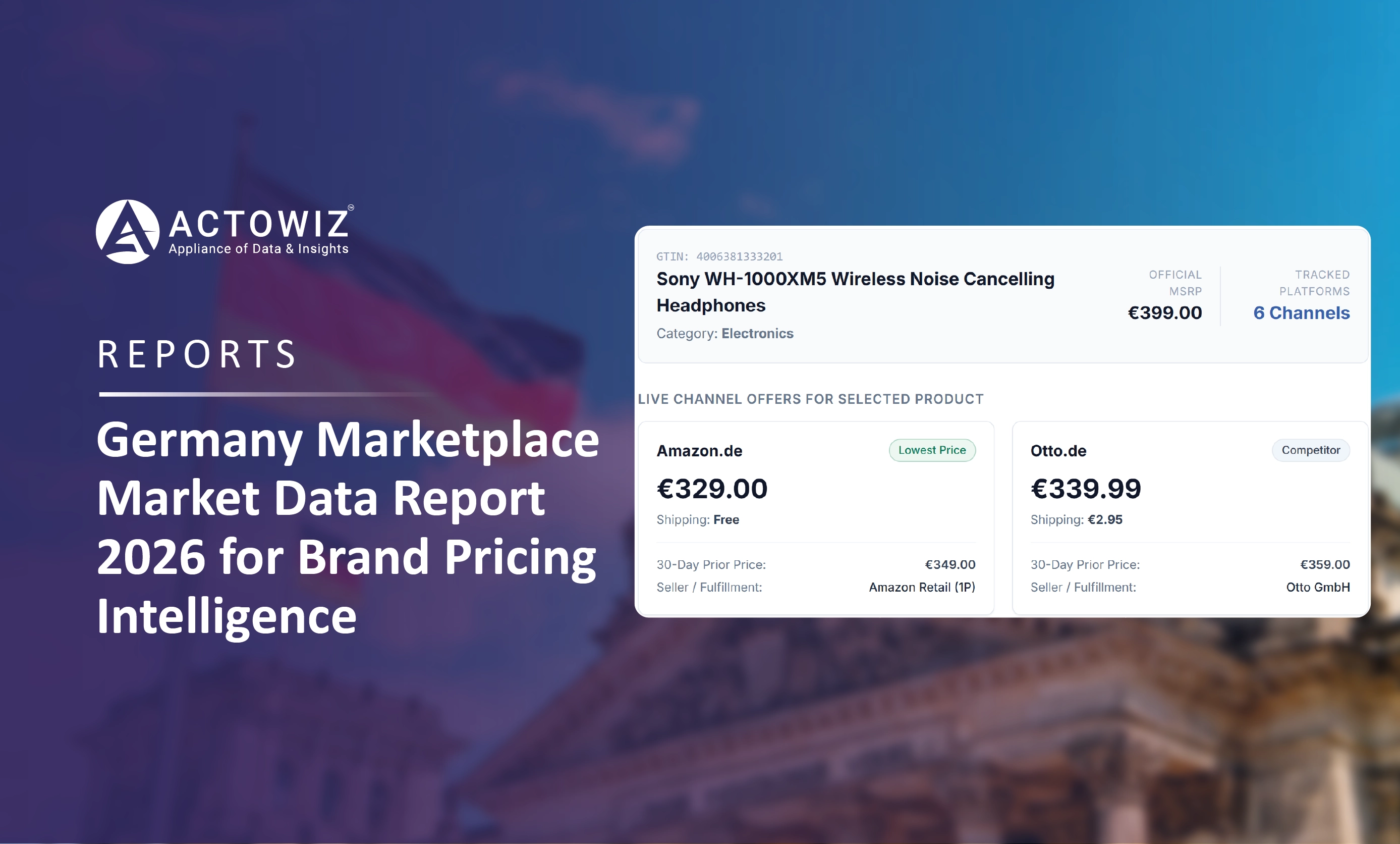
German marketplace data report 2026: online retail size, Amazon.de, Otto, Kaufland and Zalando price signals, PAngV rules and peak seasons.
Whether you're a startup or a Fortune 500 — we have the right plan for your data needs.