Text content
Every descriptive text field, with length, structure and formatting captured as separate attributes.
- Title, subtitle, brand block
- Bullet points with count and order
- Long description word count and HTML
- Specification and attribute tables

Scalable web, app and AI-powered collection across 40+ countries.
All services → By industry
Repricing driven by competitor moves rather than a weekly review.
Explore → Pricing & Promotions
 Brand & Intelligence
 Digital Shelf & Search
 Assortment
 For Retailers
Which solution fits?
Talk to ExpertTalabat, Careem Quik and Noon Minutes across 18 GCC cities.
Launch Demo →Tesco, Sainsbury's, Asda, Morrisons and Aldi, daily.
Get Early Access → By Industry
 E-Commerce Dashboard
 Flipkart Insights (Live) #1
 Grocery Intelligence
.svg) Grocery Price (U.S.)
Grocery Price (U.S.)
.svg) Quick Commerce (India) HOT
Quick Commerce (India) HOT
 Food & Restaurant
 Fashion Intelligence
 Automotive
 Travel & Hospitality
 Real Estate
 Food Delivery Intelligence NEW
 OTT & Streaming NEW
 Fuel & EV Charging Price Tracker NEW
 By Use Case
 Pricing Intelligence
 Digital Shelf Analytics
 MAP Monitoring HOT
 Cross-Border Price Parity NEW
 Share of Search
 Review Sentiment
 Kitchen Market Gaps NEW
 Dynamic Pricing / AI Repricing NEW
 Promotions & Deals Alerts NEW
 B2B / POI & Lead Data NEW
 AI Search Visibility Dashboard NEW
 Baby Products on Quick Commerce NEW
 Hotel & Flight Rate Parity NEW
 By Region
 Flipkart Real-Time Insights
 Quick Commerce — Zepto · Blinkit
 Pincode Price Tracker
 GCC Q-Commerce — Talabat · Noon NEW
 UK Grocery — Tesco, Sainsbury's, Asda
 AU Grocery — Coles & Woolworths NEW
Sources we already run pipelines against. Download a real sample from any of them.
Browse coverage → Marketplace Scrapers
 Developer APIs
 Universal APIs
 Delivery & SDKs
Fixed monthly retainer, named engineer, no per-request metering.
Managed Data API → Knowledge Center
 Guides & Playbooks
 Downloads & Tools
 Trust & Company
Scalable web, app and AI-powered collection across 40+ countries.
All 58 services → By industryRepricing driven by competitor moves rather than a weekly review.
Explore → Pricing & Promotions
Brand & Intelligence
Digital Shelf & Search
Assortment For RetailersWhich solution fits?
Talk to ExpertSources we already run pipelines against. Download a real sample from any of them.
Browse coverage →Talabat, Careem Quik and Noon Minutes across 18 GCC cities.
Launch Demo →Tesco, Sainsbury's, Asda, Morrisons and Aldi, daily.
Get Early Access → By Industry
E-Commerce Dashboard
Flipkart Insights (Live) #1
Grocery Intelligence
Grocery Price (U.S.)
Quick Commerce (India) HOT
Food & Restaurant
Fashion Intelligence
Automotive
Travel & Hospitality
Real Estate
Food Delivery Intelligence NEW
OTT & Streaming NEW
Fuel & EV Charging Price Tracker NEW
By Use Case
Pricing Intelligence
Digital Shelf Analytics
MAP Monitoring HOT
Cross-Border Price Parity NEW
Share of Search
Review Sentiment
Kitchen Market Gaps NEW
Dynamic Pricing / AI Repricing NEW
Promotions & Deals Alerts NEW
B2B / POI & Lead Data NEW
AI Search Visibility Dashboard NEW
Baby Products on Quick Commerce NEW
Hotel & Flight Rate Parity NEW
By Region Flipkart Real-Time Insights
Quick Commerce — Zepto · Blinkit
Pincode Price Tracker
GCC Q-Commerce — Talabat · Noon NEW
UK Grocery — Tesco, Sainsbury's, Asda
AU Grocery — Coles & Woolworths NEW
Marketplace Scrapers
Developer APIs Universal APIs Delivery & SDKsFixed monthly retainer, named engineer, no per-request metering.
Managed Data API → Knowledge Center
Guides & Playbooks
Downloads & Tools
Trust & CompanyThat score your digital shelf, SKU by SKU.
Most brands find out their retailer listings are wrong from a screenshot in a Slack thread. This service replaces that with a scored audit that runs every week.
Free pilot on your own sources, returned in 48 hours. No card, no trial clock — and you keep the sample data either way.
Last verified 5 August 2026 by the Actowiz Solutions Data Engineering team.
Content and media data is the descriptive and visual layer of a product listing, captured as structured fields rather than as a page screenshot. It covers text content (title, bullets, description, specification tables), visual assets (images, their count and resolution, videos, 360° spins), enhanced modules (Amazon A+ content, retailer-specific rich content), and customer-generated content (review text, ratings distribution, Q&A).
A digital shelf audit compares what is actually published against what should be published. That comparison is the whole value. Extracting a product title is trivial; knowing that the title on a particular retailer violates your brand's naming convention, that two required lifestyle images are missing, and that the hero image is the previous packaging generation — that is what lets a content team fix something.
Content degrades quietly. A retailer's PIM ingests your syndicated feed and truncates bullets to fit a template. A category migration drops your video. A reseller uploads their own photography. Packaging changes and old pack shots remain live for months. None of this triggers an alert anywhere, and none of it appears in a sales report until conversion has already suffered.
Actowiz scores every listing against the standard you define — required image count, minimum resolution, mandatory bullet count, title format, video presence, enhanced-content presence — and delivers a per-SKU score plus the specific fields that failed. Your content team receives a prioritised worklist instead of a data dump, which is the difference between a report that gets read and one that gets fixed.
Audit everything, or monitor only the dimensions your brand guidelines actually enforce.
Every descriptive text field, with length, structure and formatting captured as separate attributes.
Not just image URLs — the properties that determine whether the imagery meets standard.
The formats that most affect conversion and are most often missing.
Retailer-specific rich modules, captured module by module rather than as one blob.
Customer-generated content as text, not just as a star average.
The layer that turns extraction into action.
Collection, scoring and prioritisation — we deliver a fix list, not a data dump.
Every engagement delivers a documented schema. These are the core fields; the full dictionary is agreed during scoping.
| Field | Type | What it captures | Refresh |
|---|---|---|---|
sku / retailer_domain |
string | Your identifier and the normalised source domain for joining | Every run |
title / title_compliant |
string / boolean | Published title and whether it matches your naming convention | Daily to weekly |
bullets |
array | Ordered bullet list as published, with count and character length per bullet | Daily to weekly |
description_html / word_count |
string / int | Long description as published plus computed length | Weekly |
image_count / image_min_px |
int | Number of images and the resolution of the smallest one | Daily to weekly |
hero_image_match |
boolean | Whether the primary image matches your current master asset by perceptual hash | Weekly |
video_present / video_count |
boolean / int | Presence and count of video assets on the listing | Weekly |
enhanced_content |
boolean / object | A+ or rich content presence, with module types and ordering | Weekly |
review_text |
array | Full customer review text with rating, date and verified-purchase flag | Daily to weekly |
content_score / grade |
int / enum | 0–100 completeness score against your standard, plus letter grade | Every run |
failed_checks |
array | Specific checks that failed with reason codes, forming the remediation worklist | Every run |
Image assets can be downloaded to your own S3 or GCS bucket alongside the metadata feed, with perceptual hashes computed so you can detect unauthorised or outdated imagery automatically.
Content templates differ enormously between retailers, so each extractor is built and maintained per site rather than generically.
Brand-owned D2C sites and distributor catalogues are equally supported for content consistency checks across your own estate. Request a source we don't list →
We deliver into 40+ countries. These are the markets where this particular service is requested most, and the reason demand concentrates there.
| Market | Why demand concentrates here |
|---|---|
| United States | Marketplace content standards drive conversion directly; audits are near-continuous. |
| United Kingdom & Germany | Multi-retailer listings for the same SKU diverge quickly without auditing. |
| Australia & Canada | Smaller retailer bases where a single bad listing carries outsized revenue weight. |
| India & Southeast Asia | Rapid marketplace expansion with inconsistent content enforcement. |
We run production collection across 40+ countries. Coverage depth varies by market and by source, so we confirm what is actually available for your specific markets during scoping rather than claiming uniform global coverage. Ask about a market we don't list →
Content audits are bought by the people held accountable for conversion on listings they don't directly control.
You are accountable for content quality across nine retailers but can only spot-check a handful of listings manually each week, so problems surface via sales dips.
A scored audit of every SKU on every retailer, refreshed weekly, with a prioritised worklist of exactly which fields failed on which listing.
Content compliance %
Syndicated content is published, but you have no proof it arrived intact — truncated bullets and dropped images are discovered by accident.
Field-level comparison between what you syndicated and what the retailer actually published, with diff reporting per SKU.
Syndication fidelity
Old packaging imagery and superseded claims stay live on retailer sites long after a relaunch, creating brand and sometimes regulatory exposure.
Perceptual-hash matching of every hero image against your current master asset, flagging outdated packaging automatically.
Asset accuracy %
Listing quality directly drives search rank and conversion, but you manage thousands of SKUs and cannot audit them by hand.
Automated scoring against marketplace content requirements, highlighting the SKUs where a content fix has the highest ranking upside.
Listing quality score
Review text holds product feedback at scale, but it is trapped across hundreds of retailer pages in unusable form.
Full review text extraction with ratings distribution and verified-purchase flags, delivered ready for topic modelling or LLM analysis.
Insight cycle time
Training or grounding a product model needs clean text and imagery, but web-sourced content arrives as messy HTML with inconsistent encoding.
Clean, encoding-normalised text with markup stripped, plus image assets with hashes, delivered in Parquet for direct embedding.
Model data readiness
Four patterns, with measured outcomes.
Every SKU on every retailer is scored against your content standard, and the results roll up into a retailer-by-retailer and category-by-category scorecard. Because failures carry reason codes, the same report serves both the executive summary and the content team's actual worklist.
Outcome: Content remediation prioritised by revenue impact rather than by whoever complained most recently.
Your syndicated content feed is compared field by field against what each retailer actually published. Truncated bullets, dropped images, reordered modules and stripped formatting are identified per SKU per retailer, with the diff attached.
Outcome: Evidence-backed escalation to retailer content teams instead of anecdotal complaints.
Hero images are matched by perceptual hash against your current master asset library. Listings still showing superseded packaging, discontinued variants or retired claims are flagged automatically, which matters most in regulated categories.
Outcome: Faster removal of non-current imagery and reduced regulatory exposure after relaunches.
Full review text across your products and your competitors' is extracted with ratings, dates and verified-purchase flags, then delivered as clean text ready for topic modelling, sentiment analysis or LLM summarisation.
Outcome: Product development and claims decisions informed by thousands of reviews rather than a sampled few hundred.
Clients rarely permit naming. These are real engagement shapes with identifying detail removed, so you can judge whether the work resembles your situation.
A packaging refresh rolled out across retailers inconsistently. Some listings still showed discontinued packaging, and nobody had a systematic way to check.
Weekly digital shelf audit across eight retailers with perceptual-hash image matching against the approved asset set, plus content scoring against the brand's own standards.
Outdated hero images identified across a significant share of listings within the first audit cycle.
Products were absent from retailer filtered search results because attributes such as dimensions and energy rating were incomplete on many listings.
Attribute completeness scoring per SKU per retailer, with a remediation list prioritised by category traffic and revenue exposure.
A ranked fix list replaced ad-hoc spot checks; attribute gaps were closed retailer by retailer.
Examples are anonymised at client request. Named references are available on request under NDA. See published case studies →
Before you commit to anything, we run this service against your own sources and send you the output. If the coverage isn't there, the sample will show you that too — which is the point. We would rather lose the deal at the pilot than at month three.
Same collection pipeline and same QA underneath. The difference is who holds the schedule and how the data reaches you.
We own the collection, the QA and the delivery. You receive clean data on a schedule and never touch a scraper.
Best fit: Teams who need the data, not the infrastructure.
The same collection pipeline exposed as an authenticated REST endpoint your systems query directly.
Best fit: Product and engineering teams building on live data.
A defined pull for a specific question — market sizing, diligence, a pitch, a one-off audit.
Best fit: Research, strategy and diligence work with a deadline.
Every engagement is quoted individually, because the honest answer depends on your scope: how many sources, how many records, how often, and how the data reaches you. We scope it with you, run a free pilot on your own sources, and then quote a fixed monthly figure — no per-request metering and no overage billing when volumes move. Request a quote and you will have a number after one call.
Manual digital shelf audits are the most commonly abandoned internal process we see.
| Consideration | In-house scraping team | Generic proxy / DIY tool | Actowiz managed feed |
|---|---|---|---|
| Time to first usable data | 6–12 weeks of engineering before anything is trustworthy | Days, but output needs manual cleanup before use | Free pilot in 48 hours, production in 5–10 business days |
| Who fixes it when a source changes | Your engineers, at the cost of their roadmap | You do — tools report failures, they don't resolve them | We do, same business day, inside the retainer |
| Data quality assurance | Whatever your team has time to build | None beyond HTTP success | Schema validation plus sampled human QA on every run |
| Compliance documentation | Rarely produced, then requested urgently by legal | Not provided; terms risk sits with you | Sources, method and lawful basis documented for review |
| Accountability | Distributed across a team with other priorities | A support ticket queue | A named engineer and an account owner |
| True annual cost | Engineer salaries, proxies, hosting, ongoing maintenance | Low licence fee plus significant hidden analyst time | One fixed monthly retainer, quoted after scoping |
Content completeness is one of the few digital shelf levers that is entirely within a brand's control and does not require a price concession. Retailers publish their own guidance on it — image count minimums, bullet requirements, video recommendations — precisely because listings that meet those standards convert better and return less.
The problem is not knowing that content matters. It is knowing which of your thousands of listings currently fall short, on which retailer, and in what specific way. That is a measurement problem, and it is the one a content audit feed solves.
Most clients pair content audits with pricing and product data so that a single dashboard shows both the commercial and the content state of every listing.
Product content is the highest-value text in retail for machine learning purposes, and the hardest to obtain cleanly. Titles and descriptions carry attribute information no structured feed contains. Review text carries genuine consumer language about product performance. Images carry packaging, variant and claim information.
Tell us during scoping if the destination is a model rather than a dashboard — the delivery design differs substantially, and retrofitting it later is more expensive than specifying it upfront.
Your brand content standard is configured during the pilot, so scoring reflects your rules from the first production run.
You send us target sites, regions, SKUs or keywords. We return a field-level schema proposal, coverage estimate and refresh recommendation — usually within two working days.
We extract a real sample from your actual targets so you can inspect field fill rates, edge cases and match quality before any commitment.
Our engineers build extractors, then wire validation rules: type checks, range checks, duplicate detection and golden-record comparison against a manually verified subset.
Feeds run at your chosen cadence and land in the warehouse or bucket you already use. Schema changes are versioned and announced before they ship.
We watch coverage drift, fill rates and source changes daily. A named engineer owns your account, and layout breaks are fixed by us — not queued for you.
JSON, JSONL, CSV, Parquet or XLSX, delivered to Amazon S3, Google Cloud Storage, Azure Blob, SFTP, Snowflake, BigQuery, Databricks or a REST/GraphQL endpoint. Webhooks fire on completion, and every batch ships with a manifest containing row counts, schema version and QA results so your pipeline can fail loudly instead of silently ingesting a bad file. Image assets are delivered as files to your bucket with a metadata sidecar.
We collect only publicly accessible information, respect robots directives and rate limits, never bypass authentication or paywalls, and never scrape personal data outside a documented lawful basis. Each engagement includes a written collection methodology, source list and retention policy your legal and procurement teams can review before signature.
These are contractual, not marketing copy. They appear in the engagement document.
| Commitment | What we hold ourselves to |
|---|---|
| Pilot turnaround | A real sample from your own sources within 48 hours of scoping, at no cost. |
| Go-live | Production collection running within 5–10 business days of sign-off. |
| Delivery punctuality | 99.5% on-schedule delivery, measured monthly and reported to you. |
| Breakage response | Source layout changes triaged same business day; critical sources inside 4 hours. |
| Data quality | Schema validation on every run plus sampled human QA before any delivery leaves us. |
| Escalation | A named engineer and an account owner, not a shared ticket queue. |
| Change requests | Field additions and source changes handled inside the retainer, not re-quoted. |
| Exit | Your historical data exported in full on request. No lock-in, no export fee. |
Plain definitions of the terms used on this page, so procurement and legal reviewers are working from the same vocabulary as your data team.
What buyers ask during evaluation.
Yes — that is one of the most common reasons clients buy this service. We compare the published listing against your syndicated source content field by field, and report differences as a diff: truncated bullets, reordered modules, stripped formatting, substituted images, altered titles.
Because the comparison runs on every audit cycle, you also get change detection over time: content that was correct last week and is wrong this week is flagged as a regression rather than presented as a fresh problem.
We compute perceptual hashes for every image on the listing and compare them against your master asset library, which you provide during onboarding. Perceptual hashing tolerates resizing and recompression but still distinguishes genuinely different images, so a resized version of your current pack shot matches while last year's packaging does not.
Listings showing superseded packaging, discontinued variants or unauthorised third-party photography are flagged with the offending image URL attached. This matters most in food, beverage, supplements and cosmetics, where pack claims are regulated.
Yes, module by module rather than as a single block. We capture whether enhanced content is present, which module types are used, their ordering, whether a comparison chart is included, and whether the listing links to a brand store. Premium A+ features are detected separately from standard A+.
This requires rendering pages in a headless browser because much rich content loads client-side — one of the main reasons generic scrapers miss it entirely.
We quote every digital shelf auditing engagement individually, because a real number depends on scope: source count, record volume, refresh frequency and delivery method. Anyone quoting you a price before understanding those four things is guessing.
Scope here is usually SKU count multiplied by retailer count, plus whether image comparison and A+ content auditing are included.
The process is short: one scoping call, a free pilot on your own sources within 48 hours, then a fixed monthly quote. No per-request metering, no overage billing, and field or source additions are handled inside the retainer rather than re-quoted. Request a quote.
Yes, and we recommend it. Default thresholds exist so you have something to start from, but scoring is only useful when it reflects your actual guidelines. During onboarding you specify required image count, minimum resolution, mandatory bullet count and format, title conventions per retailer, whether video is required, and category-specific rules.
Rules can differ per retailer and per category, because requirements genuinely do. Amazon's image standards are not Tesco's, and treating them identically produces a score nobody trusts.
Less often than price. Content changes on a scale of weeks, not hours. Our usual recommendation: weekly for your priority SKUs and any retailer with a history of content problems, monthly for the long tail, and an on-demand run after any syndication push or product relaunch.
Daily is available and occasionally justified — during a major launch, or when actively remediating with a retailer — but for steady-state monitoring it mostly generates unchanged records.
Both, and competitor content audits are a distinct and popular use case. Comparing your content completeness against the category leader's, or seeing which competitors have adopted video and enhanced content where you haven't, is often more actionable than auditing your own listings in isolation.
Competitor review text at category scale also supports product development work: thousands of reviews on rival products reveal failure modes and unmet needs that your own review base cannot.
Yes. Asset download to your own S3, GCS or Azure bucket is a standard option. Files arrive with stable naming, the source URL, capture timestamp and perceptual hash in a metadata sidecar, so the assets remain usable after retailer CDN URLs expire — which they routinely do.
This matters for anyone building a historical asset archive, running vision models, or needing evidence of what was published on a specific date.
Priced on SKU count, retailer count and audit frequency, with image asset download and review text extraction as add-ons because both carry meaningful storage and bandwidth cost.
A weekly audit of a few thousand SKUs across a focused retailer set sits at the lighter end of our range. Full-catalogue audits across many retailers with asset download and full review history sit considerably higher. We quote a fixed monthly figure after scoping, and the pilot sample is free.
Send us a SKU list and your retailer set. We return a scored content audit with image comparison within 48 hours, at no cost.
Free pilot, no obligation, no card. You'll have a fixed monthly quote after one scoping call.Our web scraping expertise is relied on by 4,000+ global enterprises including Zomato, Tata Consumer, Subway, and Expedia — helping them turn web data into growth.
Watch how businesses like yours are using Actowiz data to drive growth.
 4.8/5 Average Rating
 50+ Video Testimonials
 92% Client Retention
 50+ Countries Served
From Zomato to Expedia — see why global leaders trust us with their data.
Backed by automation, data volume, and enterprise-grade scale — we help businesses from startups to Fortune 500s extract competitive insights across the USA, UK, UAE, and beyond.


 Product Matching
 Attribute Tagging
 Content Optimization
 Sentiment Analysis
 Prompt-Based Reporting
We partner with agencies, system integrators, and technology platforms to deliver end-to-end solutions across the retail and digital shelf ecosystem.


Quick Commerce GCC Dashboard 2026 delivers market, pricing, competitor, assortment, and demand insights for smarter quick-commerce decisions across GCC markets.
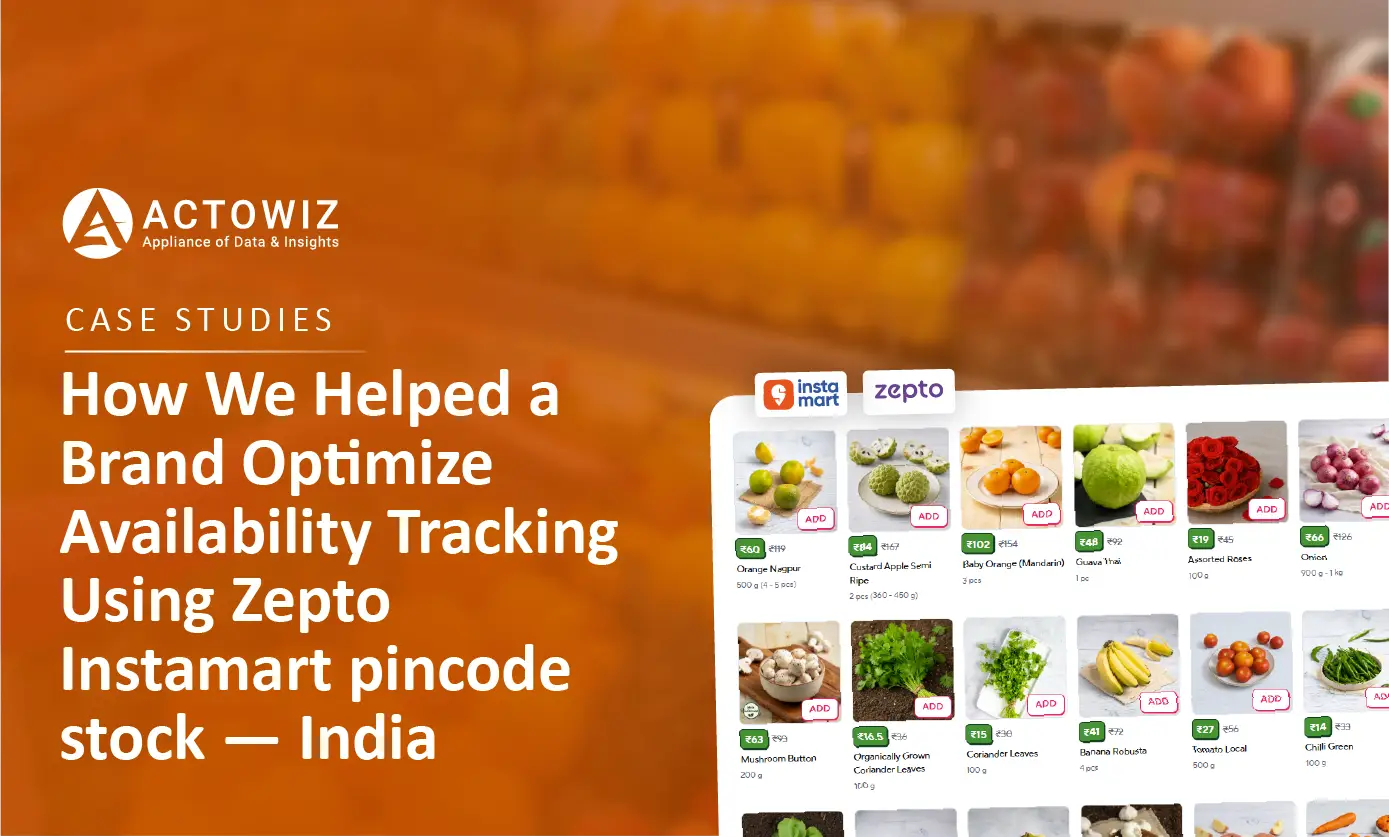
Track product availability across Indian pincodes with Zepto/Instamart pincode stock — India for better inventory, assortment, and regional insights.

Actowiz Solutions' 2026 AI training data market report — demand drivers, pricing models, sourcing trends, compliance economics & what data buyers should know.
Whether you're a startup or a Fortune 500 — we have the right plan for your data needs.