Obscure & regional sources
Real value, no template.
- Regional distributor and dealer portals
- Municipal and local registers
- Trade body and association directories
- Single-country platforms
- Legacy sites with no modern structure

Scalable web, app and AI-powered collection across 40+ countries.
All services →Repricing driven by competitor moves rather than a weekly review.
Explore → Pricing & Promotions
 Brand & Intelligence
 Digital Shelf & Search
 Assortment
 For Retailers
Which solution fits?
Talk to ExpertTalabat, Careem Quik and Noon Minutes across 18 GCC cities.
Launch Demo →Tesco, Sainsbury's, Asda, Morrisons and Aldi, daily.
Get Early Access → E-Commerce Dashboard
 Flipkart Insights (Live) #1
 Grocery Intelligence
.svg) Grocery Price (U.S.)
Grocery Price (U.S.)
.svg) Quick Commerce (India) HOT
Quick Commerce (India) HOT
 Food & Restaurant
 Fashion Intelligence
 Automotive
 Travel & Hospitality
 Real Estate
 Food Delivery Intelligence NEW
 OTT & Streaming NEW
 By Use Case
 Pricing Intelligence
 Digital Shelf Analytics
 MAP Monitoring HOT
 Cross-Border Price Parity NEW
 Share of Search
 Review Sentiment
 Kitchen Market Gaps NEW
 Dynamic Pricing / AI Repricing NEW
 Promotions & Deals Alerts NEW
 B2B / POI & Lead Data NEW
 By Region
 Flipkart Real-Time Insights
 Quick Commerce — Zepto · Blinkit
 Pincode Price Tracker
 GCC Q-Commerce — Talabat · Noon NEW
 UK Grocery — Tesco, Sainsbury's, Asda
 AU Grocery — Coles & Woolworths NEW
Sources we already run pipelines against. Download a real sample from any of them.
Browse coverage → Marketplace Scrapers
 Developer APIs
 Universal APIs
 Delivery & SDKs
Fixed monthly retainer, named engineer, no per-request metering.
Managed Data API → Knowledge Center
 Guides & Playbooks
 Downloads & Tools
 Trust & Company
Scalable web, app and AI-powered collection across 40+ countries.
All 58 services →Repricing driven by competitor moves rather than a weekly review.
Explore → Pricing & Promotions
Brand & Intelligence
Digital Shelf & Search
Assortment For RetailersWhich solution fits?
Talk to ExpertSources we already run pipelines against. Download a real sample from any of them.
Browse coverage →Talabat, Careem Quik and Noon Minutes across 18 GCC cities.
Launch Demo →Tesco, Sainsbury's, Asda, Morrisons and Aldi, daily.
Get Early Access → E-Commerce Dashboard
Flipkart Insights (Live) #1
Grocery Intelligence
Grocery Price (U.S.)
Quick Commerce (India) HOT
Food & Restaurant
Fashion Intelligence
Automotive
Travel & Hospitality
Real Estate
Food Delivery Intelligence NEW
OTT & Streaming NEW
By Use Case
Pricing Intelligence
Digital Shelf Analytics
MAP Monitoring HOT
Cross-Border Price Parity NEW
Share of Search
Review Sentiment
Kitchen Market Gaps NEW
Dynamic Pricing / AI Repricing NEW
Promotions & Deals Alerts NEW
B2B / POI & Lead Data NEW
By Region Flipkart Real-Time Insights
Quick Commerce — Zepto · Blinkit
Pincode Price Tracker
GCC Q-Commerce — Talabat · Noon NEW
UK Grocery — Tesco, Sainsbury's, Asda
AU Grocery — Coles & Woolworths NEW
Marketplace Scrapers
Developer APIs Universal APIs Delivery & SDKsFixed monthly retainer, named engineer, no per-request metering.
Managed Data API → Knowledge Center
Guides & Playbooks
Downloads & Tools
Trust & CompanyFor the sources and schemas nobody has a template for.
Most of what we build is not on a menu. A client needs eleven obscure regional sources joined to their internal product hierarchy, delivered in a schema their warehouse already expects. That is not a template problem, and pretending it is produces a dataset nobody can use.
Free pilot on your own sources, returned in 24 hours. No card, no trial clock — and you keep the sample data either way.
Last verified 5 August 2026 by the Actowiz Solutions Data Engineering team.
Custom data extraction is what we build when the requirement does not match a product. It covers the sources nobody has templated, the formats that are not web pages, and the schemas that exist only inside your business.
Custom work fails most often through optimistic scoping rather than through engineering. A source list of eleven typically contains nine that are straightforward, one that is partially achievable, and one that has no lawful route at all.
Quoting the eleven as though they are equivalent produces a project that misses its scope. So we classify each source before quoting: feasible, partial with the limitation stated, or not feasible with the reason. That assessment is free and it is the deliverable of the first 24 hours.
Almost always one of three things: the data sits behind a login with no lawful route, the source publishes nothing that contains the field you want, or a licence covers the content. It rarely means technically difficult — difficulty is a cost question, not a feasibility one.
The common thread is that no catalogue entry fits, so scope is written rather than selected.
Real value, no template.
Where the data is not a web page.
Output that fits what you already have.
Connecting external data to internal records.
Where an ongoing feed would be waste.
Sources that defeated a previous attempt.
A managed engagement, not a tool licence. We own the pipeline and everything that breaks in it.
Two artefacts: the written scope agreed before build, and output in your own schema. The scope document is what prevents drift.
| Field | Type | What it captures | Refresh |
|---|---|---|---|
Written scope document |
artefact | Sources, fields, feasibility classification per source, method and stated limits | Before build |
Per-source feasibility |
enum | feasible, partial or not_feasible, with the reason recorded for each | Before quoting |
Target schema definition |
artefact | Your data model, field names, types, units and null conventions | Before build |
Join key and match method |
string | Which of your keys we join on and how matching is performed | Before build |
Output records |
your schema | Delivered in your data model rather than ours, so nothing downstream changes | Per delivery |
match_confidence |
decimal | Where matching to your records is involved, a confidence score you threshold | Per record |
source_ref |
string | Document, page or URL reference for traceability, particularly on document extraction | Per record |
unmatched_report |
artefact | Records that could not be matched to your master, listed rather than silently dropped | Per delivery |
QA report |
artefact | Coverage, fill rates and validation results per delivery | Per delivery |
Method documentation |
artefact | How each source is accessed and what is excluded, for your legal file | Per engagement |
Handover pack |
artefact | Collection design documentation, provided on request if you internalise later | On request |
Unmatched records are reported rather than dropped. A custom feed that silently discards what it could not match to your master looks cleaner and hides the exact population you need to investigate.
Illustrative rather than exhaustive. If your requirement is not here, that is normal for this service.
Every engagement begins with a per-source feasibility assessment. Where a source has no lawful route we say so and remove it from scope rather than quoting it and delivering nothing. Request a source we don't list →
We deliver into 40+ countries. These are the markets where this particular service is requested most, and the reason demand concentrates there.
| Market | Why demand concentrates here |
|---|---|
| Germany & United Kingdom | Large industrial and B2B supplier bases made up of regional portals and PDF catalogues that no vendor has templated. |
| United States | Broad demand for one-time project work supporting diligence, market sizing and corporate development. |
| European Union | Multi-country regional sources and municipal registers where single-country platforms require bespoke handling. |
| India & Southeast Asia | Fast-growing businesses with awkward legacy sources and multilingual catalogues that defeat standard templates. |
We run production collection across 40+ countries. Coverage depth varies by market and by source, so we confirm what is actually available for your specific markets during scoping rather than claiming uniform global coverage. Ask about a market we don't list →
Teams whose requirement is specific enough that no catalogue entry fits.
Your supplier and competitor universe is regional portals and PDF catalogues that no vendor has templated.
Bespoke extraction across those sources with per-source feasibility stated upfront and output in your existing schema.
Sources covered
External data arrives in vendor schemas and every new source means downstream rework.
Output delivered in your data model, joined on your internal keys, so nothing downstream changes when a source is added.
Integration effort per source
A one-off question needs data that no ongoing feed would justify.
Fixed-scope project with a written method, single delivery and a QA report, priced as a project rather than a retainer.
Time to answer
Supplier pricing sits in PDF catalogues with a different structure from every supplier.
Document extraction with page-level references, matched to your internal SKU master with confidence scoring.
Spend visibility
Your team spent a quarter on a source and gave up, and the requirement has not gone away.
A rescue engagement: assessment of why it failed, rebuild with documented method, parallel running against your output.
Engineering hours recovered
Research needs sources that are public but awkward, with reproducible methodology.
Documented extraction with method recorded, source references retained and limits stated for publication.
Reproducibility
Four shapes, with the outcome each is judged on.
A defined list of awkward sources is assessed for feasibility, built, and delivered in your existing data model joined on your internal keys, with unmatched records reported.
Outcome: Sources covered without downstream rework, and without a vendor schema to translate.
Supplier PDF catalogues and price lists are extracted with page-level references retained and matched to your SKU master with confidence scoring.
Outcome: Varied documents turned into one comparable dataset with every figure traceable.
A market sizing or diligence question is scoped in writing, delivered once with a QA report and documented method, priced as a project.
Outcome: The question answered without committing to an ongoing feed nobody needed.
We assess why the previous attempt failed, rebuild with documented method, and run in parallel against your existing output so the comparison is direct.
Outcome: A working source and an explanation, rather than a second attempt at the same wall.
Clients rarely permit naming. These are real engagement shapes with identifying detail removed, so you can judge whether the work resembles your situation.
A previous vendor quoted a full source list without assessment; two sources sat behind logins with no lawful route and the project missed scope.
Per-source feasibility assessment before quoting, classifying nine feasible, one partial with stated coverage limits and one not feasible with the reason.
Scope was agreed against what was actually deliverable, and the infeasible source was removed rather than billed.
Every new vendor delivered its own schema, so each source added downstream mapping work the data team maintained indefinitely.
Output delivered in the client PIM schema with their field names, units and null conventions, joined on their internal SKU key with confidence scoring.
New sources stopped requiring downstream rework, and unmatched records were reported rather than silently dropped.
Examples are anonymised at client request. Named references are available on request under NDA. See published case studies →
Before you commit to anything, we run this service against your own sources and send you the output. If the coverage isn't there, the sample will show you that too — which is the point. We would rather lose the deal at the pilot than at month three.
Same collection pipeline and QA underneath. The difference is who holds the schedule and how the data reaches you.
We own the collection, the QA and the delivery. You receive clean data on a schedule and never touch a scraper.
Best fit: Teams who need the data, not the infrastructure.
The same collection pipeline exposed as an authenticated REST endpoint your systems query directly.
Best fit: Product and engineering teams building on live data.
A defined pull for a specific question — market sizing, diligence, a pitch, a one-off audit.
Best fit: Research, strategy and diligence work with a deadline.
Every engagement is quoted individually, because the honest answer depends on your scope: how many sources, how many records, how often, and how the data reaches you. We scope it with you, run a free pilot on your own sources, and then quote a fixed monthly figure — no per-request metering and no overage billing when volumes move. Request a quote and you will have a number after one call.
If a standard product covers your requirement, buy that. Custom is for when it does not.
| Consideration | In-house scraping team | Generic proxy / DIY tool | Actowiz managed feed |
|---|---|---|---|
| Time to first usable data | 6–12 weeks of engineering before anything is trustworthy | Days, but output needs manual cleanup before use | Free pilot in 24 hours, production in 5–10 business days |
| Who fixes it when a source changes | Your engineers, at the cost of their roadmap | You do — tools report failures, they don't resolve them | We do, same business day, inside the retainer |
| Data quality assurance | Whatever your team has time to build | None beyond HTTP success | Schema validation plus sampled human QA on every run |
| Compliance documentation | Rarely produced, then requested urgently by legal | Not provided; terms risk sits with you | Sources, method and lawful basis documented for review |
| Accountability | Distributed across a team with other priorities | A support ticket queue | A named engineer and an account owner |
| True annual cost | Engineer salaries, proxies, hosting, ongoing maintenance | Low licence fee plus significant hidden analyst time | One fixed monthly retainer, quoted after scoping |
Custom data work fails through scope ambiguity far more often than through engineering difficulty. Both sides agree enthusiastically at the start, build proceeds, and the delivered output is not what the client pictured.
Every source named with its feasibility classification. Every field with its definition and absence behaviour. The target schema with field names, types and units. The join key and match method with a confidence threshold. Delivery format and cadence. And an explicit list of what is out of scope, which is the section that prevents most disputes.
It is agreed before build starts and it is short — usually two to three pages. Clients occasionally find the process pedantic at the time. Nobody has regretted it at delivery.
We assess every source before quoting, and roughly one in ten comes back not feasible. That assessment is free, and it is more useful than a quote for work that cannot be delivered.
Between feasible and not feasible sits partial, and it is worth understanding because it is common. A source might publish prices for two thirds of its catalogue, or expose availability only in a basket flow we will not use, or publish a field inconsistently.
Partial sources are quoted with the limitation stated in the scope document — expected coverage, which fields will be sparse, and why. That way the gap is a known parameter rather than a delivery surprise.
A quote that includes an infeasible source produces a project that misses scope, an unhappy client and a refund conversation. Declining one source in eleven costs a fraction of the engagement and keeps the other ten credible. For sources that are feasible but genuinely hard, see AI-powered scraping — variety and awkward layouts are often solvable even where templates are not.
Feasibility assessment comes first and is free. Nothing is quoted until every source has been classified.
You send us target sites, regions, SKUs or keywords. We return a field-level schema proposal, coverage estimate and refresh recommendation — usually within two working days.
We extract a real sample from your actual targets so you can inspect field fill rates, edge cases and match quality before any commitment.
Our engineers build extractors, then wire validation rules: type checks, range checks, duplicate detection and golden-record comparison against a manually verified subset.
Feeds run at your chosen cadence and land in the warehouse or bucket you already use. Schema changes are versioned and announced before they ship.
We watch coverage drift, fill rates and source changes daily. A named engineer owns your account, and layout breaks are fixed by us — not queued for you.
JSON, JSONL, CSV, Parquet or XLSX, delivered to Amazon S3, Google Cloud Storage, Azure Blob, SFTP, Snowflake, BigQuery, Databricks or a REST/GraphQL endpoint. Webhooks fire on completion, and every batch ships with a manifest containing row counts, schema version and QA results so your pipeline can fail loudly instead of silently ingesting a bad file. Output is delivered in your schema and format rather than ours, including your field names, units and null conventions.
Custom engagements operate under the same boundaries as our standard services: publicly accessible sources only, no credentialed access, no personal data resale, no licensed third-party content. Each engagement includes a written scope document naming every source with its feasibility classification, the method used and what is excluded, suitable for your legal review.
These are contractual, not marketing copy. They appear in the engagement document.
| Commitment | What we hold ourselves to |
|---|---|
| Pilot turnaround | A real sample from your own sources within 24 hours of scoping, at no cost. |
| Go-live | Production collection running within 5–10 business days of sign-off. |
| Delivery punctuality | 99.5% on-schedule delivery, measured monthly and reported to you. |
| Breakage response | Source layout changes triaged same business day; critical sources inside 4 hours. |
| Data quality | Schema validation on every run plus sampled human QA before any delivery leaves us. |
| Escalation | A named engineer and an account owner, not a shared ticket queue. |
| Change requests | Field additions and source changes handled inside the retainer, not re-quoted. |
| Exit | Your historical data exported in full on request. No lock-in, no export fee. |
Plain definitions of the terms used on this page, so procurement and legal reviewers are working from the same vocabulary as your data team.
What data, platform and strategy teams ask during evaluation.
Anything where no catalogue entry fits: obscure or regional sources, non-web formats like PDF and spreadsheet catalogues, unusual field combinations, or output that must arrive in your existing data model joined on your internal keys.
If a standard service covers your requirement, we will point you at it rather than scoping custom work. Custom costs more and takes longer, and using it where a product fits is waste.
After the feasibility assessment, never before. The assessment is free and takes about 24 hours: every source classified feasible, partial or not feasible, with reasons.
Ongoing feeds are quoted as a fixed monthly retainer. One-time projects are quoted as a project fee with a single delivery and QA report. We do not force a monthly retainer onto a question that only needs answering once.
We tell you before quoting and remove them from scope. Roughly one source in ten comes back not feasible, almost always for one of three reasons: no lawful route because it sits behind a login, the field does not exist publicly, or licensed content where a licence is the correct route.
Quoting an infeasible source produces a project that misses scope and a refund conversation. Declining one source in eleven keeps the other ten credible.
Yes, and this is one of the main reasons clients choose custom work. Output arrives in your data model with your field names, types, units and null conventions, joined on your internal keys.
The practical benefit is that nothing downstream changes when a source is added. The usual hidden cost of external data is not the vendor fee, it is the translation layer your team maintains.
Yes, with a confidence score you threshold. Matching uses identifiers where available then attribute and name similarity, and the method is recorded in the scope document.
Critically, unmatched records are reported rather than dropped. A feed that silently discards what it could not match looks cleaner and hides exactly the population you need to look at.
Yes, and rescue engagements are among the more common requests. We assess why the previous attempt failed, rebuild with documented method, and can run in parallel against your existing output so the comparison is direct rather than a claim.
Sometimes the assessment concludes that the source genuinely has no lawful route, in which case the honest outcome is that your team was right to stop. We will say that rather than sell a rebuild.
Both, priced differently. A market sizing, diligence exercise or one-off audit is a project: fixed scope, single delivery, QA report and documented method.
If the requirement turns out to be recurring, a project converts to a managed service on the same schema without rebuilding. We would rather run the project first than sell a retainer for something you needed once.
You get a handover pack on request: collection design documentation, source-by-source method, schema definition and known limits. Plus full historical data export with no exit fee.
Making that transition painful would be a poor way to operate. Custom work in particular tends to become strategic over time, and a client who internalises it well is a better reference than one held in place by lock-in.
Feasibility assessment within 24 hours. For engagements where sources are classified feasible, production delivery in 5 to 10 business days matches our standard timeline.
Genuinely awkward scopes — heavy OCR, many document formats, complex matching against a large internal master — run longer, and we give a realistic estimate in the scope document rather than quoting the standard window and missing it.
Send us the sources that no vendor covers. Within 24 hours you get each one classified feasible, partial or not feasible, with reasons — before any quote.
Free assessment, no card, no obligation. If a source has no lawful route, we tell you rather than quoting it.Our web scraping expertise is relied on by 4,000+ global enterprises including Zomato, Tata Consumer, Subway, and Expedia — helping them turn web data into growth.
Watch how businesses like yours are using Actowiz data to drive growth.
 4.8/5 Average Rating
 50+ Video Testimonials
 92% Client Retention
 50+ Countries Served
From Zomato to Expedia — see why global leaders trust us with their data.
Backed by automation, data volume, and enterprise-grade scale — we help businesses from startups to Fortune 500s extract competitive insights across the USA, UK, UAE, and beyond.


 Product Matching
 Attribute Tagging
 Content Optimization
 Sentiment Analysis
 Prompt-Based Reporting
We partner with agencies, system integrators, and technology platforms to deliver end-to-end solutions across the retail and digital shelf ecosystem.


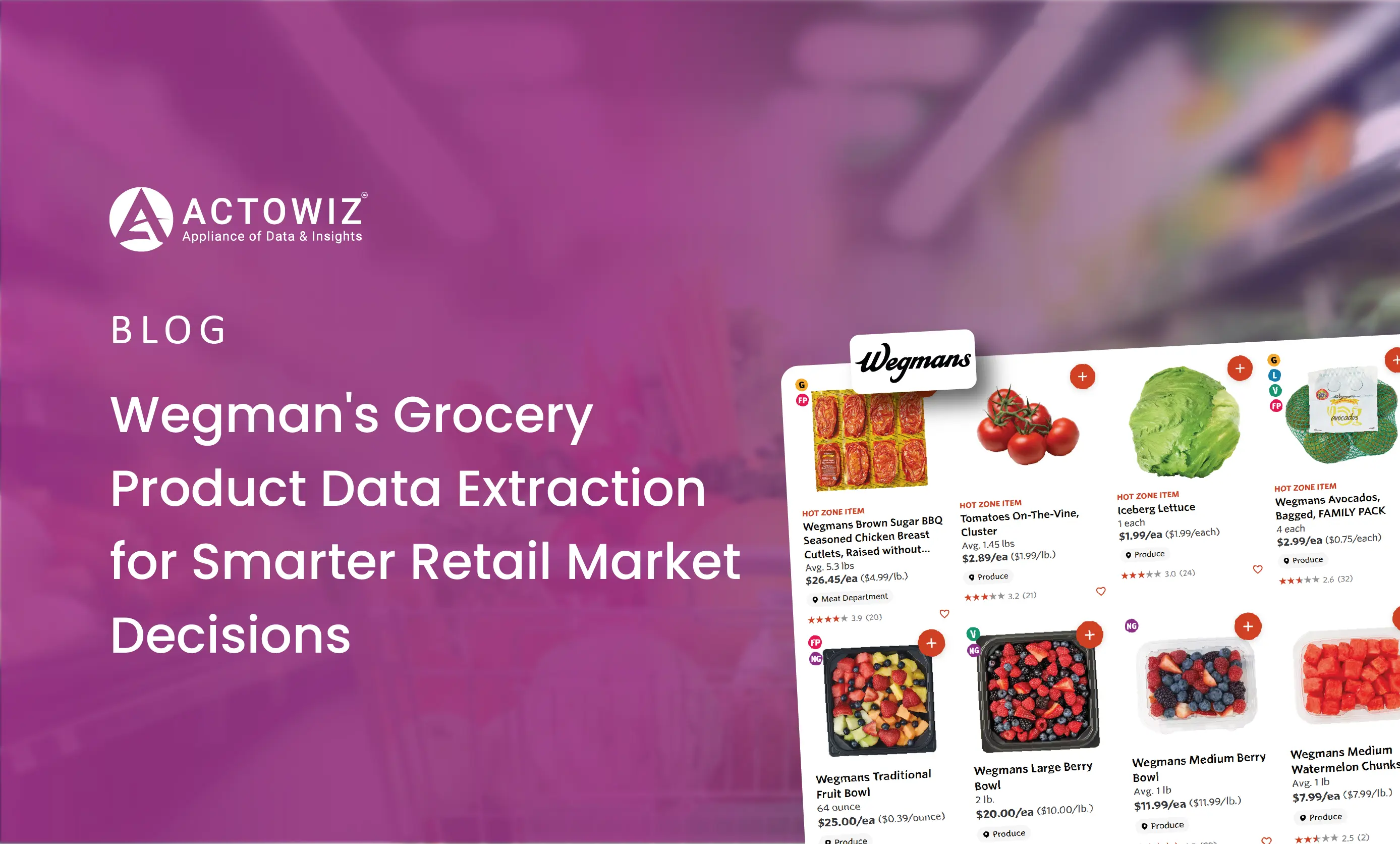
Wegmans Grocery Product Data Extraction helps retailers track prices, products, availability, and assortment changes to improve grocery market intelligence and decisions.
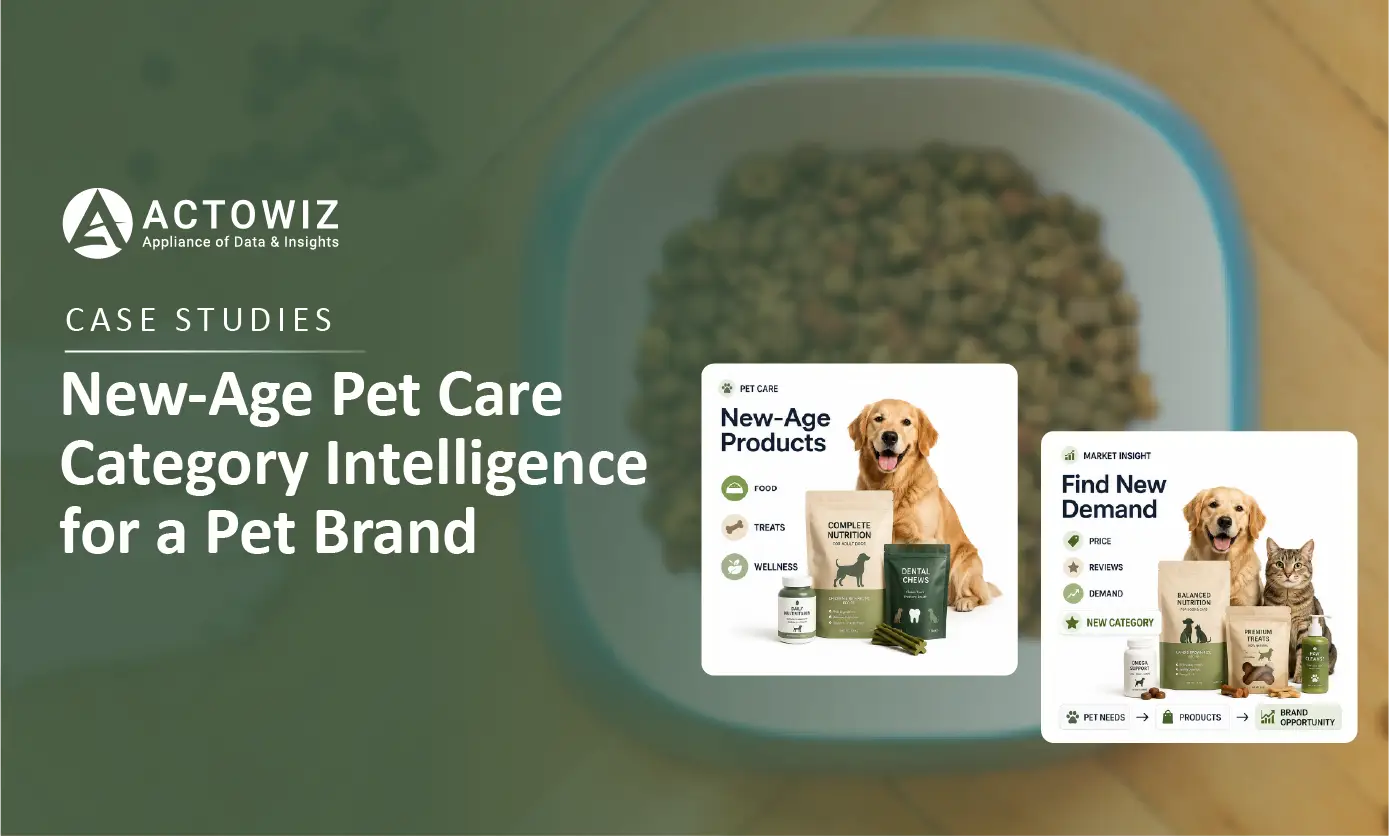
How Actowiz Solutions delivered pet-care category intelligence - food, health, retail & accessories mapped across brands and platforms for a new-age pet brand.

Brazil Car Rental Pricing Intelligence Report 2026 reveals rental price trends, market shifts, competitor rates, and opportunities for smarter pricing.
Whether you're a startup or a Fortune 500 — we have the right plan for your data needs.











































 377-7584 (USA).svg)

