Introduction
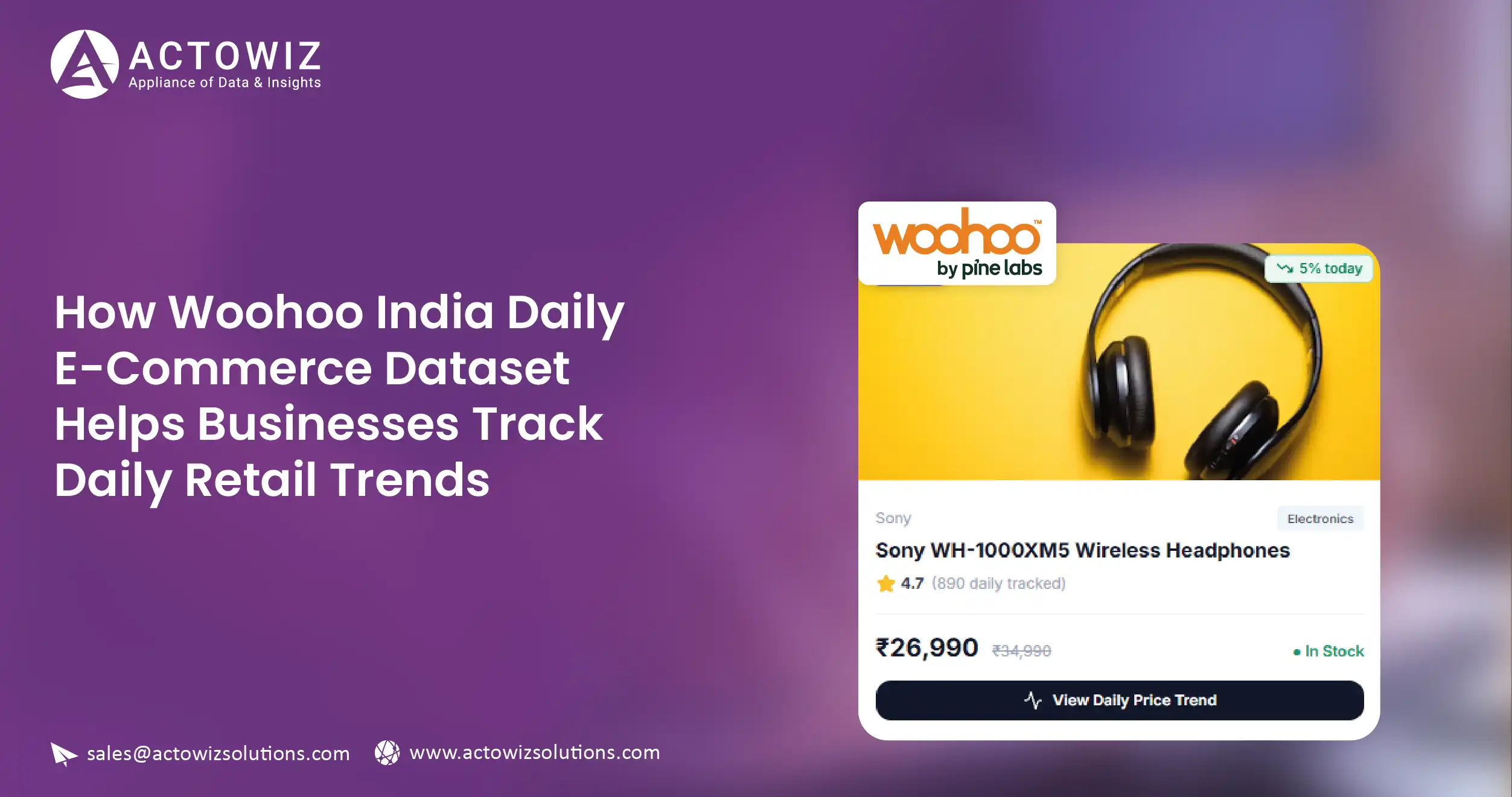
Businesses operating in India's digital retail and gifting ecosystem need reliable information to understand changing product prices, promotional offers, brand availability, and customer-facing deals. The Woohoo India Daily E-Commerce Dataset helps businesses organize publicly available gift-card and voucher information into structured records for daily market analysis, competitive research, and pricing intelligence. By using Data Intelligence Services, retailers, fintech companies, loyalty platforms, and market researchers can convert frequently changing online catalogue information into actionable business insights.
Woohoo, a digital gifting platform operated by Pine Labs, provides gift cards, e-gift cards, and vouchers across multiple retail categories. Its official website lists products across fashion, grocery, travel, electronics, entertainment, food, jewellery, and other categories. Woohoo also provides information about brand-specific denominations, discounts, and promotional offers. These details create opportunities for businesses to monitor digital gifting trends and compare publicly displayed offers over time.
India's e-commerce market has experienced considerable expansion. According to the India Brand Equity Foundation (IBEF), the Indian e-commerce market was valued at approximately US$125 billion in 2024 and is projected to reach US$163 billion in 2026. These projections highlight the growing importance of digital commerce intelligence.
Digital payment adoption further supports this transformation. Government of India figures show that annual digital payment transactions increased from 4,370.68 crore in FY2020–21 to 18,120.82 crore in FY2024–25 (data through January 2025 in the original report). This growing digital ecosystem makes structured market information increasingly valuable.
For businesses, the objective is straightforward: monitor relevant market changes, understand promotional activity, compare brand-level information, and make better-informed decisions using organized data.
How Has India's Digital Commerce Environment Evolved Between 2020 and 2026?
India's digital commerce expansion provides important context for businesses interested in daily retail and gift-card monitoring. The following figures combine published historical data and explicitly identified forecasts.
Indian E-Commerce Market Size
| Year |
Market value (US$ billion) |
Data status |
| 2020 |
Not stated in the cited IBEF series |
Not included |
| 2021 |
67 |
Published estimate |
| 2022 |
84 |
Published estimate |
| 2023 |
102 |
Published estimate |
| 2024 |
125 |
Published estimate |
| 2025 |
145 |
Forecast |
| 2026 |
163 |
Forecast |
Source: IBEF E-Commerce Industry Infographic, August 2025. Figures are market estimates and forecasts, not Woohoo sales or gift-card revenue.
What Do Digital Payment Figures Reveal?
The Government of India's Press Information Bureau published the following digital payment statistics:
| Financial year |
Transaction volume (crore) |
Transaction value (₹ lakh crore) |
| 2020–21 |
4,370.68 |
1,414.58 |
| 2021–22 |
7,197.68 |
1,744.01 |
| 2022–23 |
11,393.82 |
2,086.85 |
| 2023–24 |
16,443.02 |
2,428.24 |
| 2024–25 |
18,120.82 |
2,330.72 |
FY2024–25 figures are through January 2025, as specified in the original government release.
Source: Press Information Bureau – Digital Payment Transactions.
For FY2025–26, a subsequent government release reported 24,161.69 crore UPI transactions worth approximately ₹314 lakh crore. This is UPI-specific data, so it should not be directly combined with the broader digital-payment series above.
Source: Government of India – UPI Statistics.
These figures demonstrate why digital retail intelligence deserves attention. However, market growth alone does not reveal which gift-card brands are gaining popularity or which promotional offers are changing. Businesses need more granular catalogue-level information to answer those questions.
How Can Businesses Collect Structured Information From Digital Gift-Card Catalogues?
Woohoo India Gift Card Data Extraction helps businesses organize publicly displayed gift-card information into structured records that can be analyzed across brands, categories, denominations, and collection dates. When combined with the Woohoo India Daily E-Commerce Dataset, this approach provides a foundation for understanding daily changes in digital gifting catalogues.
Woohoo's official website displays gift-card products from brands across several categories. Its catalogue includes examples from fashion, travel, food, electronics, grocery, entertainment, and jewellery. The platform also displays product-specific discounts and denominations.
For market research teams, collecting these fields consistently is more useful than storing isolated screenshots or unstructured website content.
Important data fields include:
- Brand name and product title.
- Gift-card category.
- Available denominations.
- Displayed selling price.
- Face value, wherever published.
- Promotional discount.
- Product availability status.
- Source URL and collection timestamp.
- Applicable terms and conditions.
For example, Woohoo's official catalogue displays products such as Flipkart E-Gift Vouchers, Nykaa E-Gift Cards, Bigbasket E-Gift Cards, Croma E-Gift Cards, and MakeMyTrip Hotel E-Gift Cards. These are real catalogue examples, not an assumption about historical sales performance.
| Information collected |
Business application |
| Brand information |
Competitor and brand analysis |
| Category |
Market segmentation |
| Denomination |
Value comparison |
| Displayed discount |
Promotional analysis |
| Collection date |
Historical monitoring |
| Availability |
Catalogue tracking |
The collection process should preserve original source information and distinguish between missing records and confirmed unavailability. This helps analysts avoid interpreting technical collection failures as actual changes in the market.
Source: Woohoo Official Gift Card Catalogue.
Why Should Retailers Analyze Pricing Differences Across Individual Brands?
A Woohoo Brand-Wise Gift Card Price Dataset allows businesses to organize pricing information at the individual brand level. Instead of comparing broad category averages, analysts can examine the displayed denominations, selling prices, discounts, and offer conditions associated with each brand.
This is particularly useful for retailers, loyalty platforms, financial technology companies, and businesses that distribute digital rewards.
Different brands can display different promotional conditions. A fashion voucher may have a percentage discount, while a grocery voucher may have a different promotional structure. A travel gift card may also carry brand-specific redemption restrictions.
Therefore, a reliable pricing dataset should retain the original information instead of calculating comparisons using inconsistent values.
Businesses can organize brand-level information using the following structure:
| Pricing attribute |
Why it matters |
| Brand name |
Identifies the issuing or participating brand |
| Face value |
Establishes the stated voucher value |
| Selling price |
Records the displayed purchase price |
| Discount percentage |
Measures the advertised reduction |
| Promotion type |
Identifies discount or cashback |
| Validity period |
Supports offer-period analysis |
| Denomination |
Enables comparable value analysis |
| Collection timestamp |
Establishes when the price was observed |
A standardized pricing model also makes historical comparisons easier. Analysts can determine whether a displayed discount changed, whether a denomination disappeared, or whether a brand introduced a different promotional offer.
One important consideration is that advertised discounts and cashback should not be treated as identical. Cashback may involve additional conditions, while an instant discount may reduce the purchase price directly.
For accurate reporting, businesses should preserve the original promotional wording and calculate comparable metrics only when the underlying terms are sufficiently clear.
This approach helps commercial teams evaluate pricing patterns without confusing promotional claims with actual realized savings.
How Can Businesses Monitor Gift-Card Availability and Promotional Changes?
Woohoo Gift Card Availability and Offer Monitoring helps businesses identify changes in publicly displayed product availability, discounts, and promotional conditions. When supported by the Woohoo India Daily E-Commerce Dataset, this monitoring approach can create a historical record of catalogue movements.
Gift-card platforms regularly display promotional information that can change over time. Woohoo's official offers page provides examples of brand-specific promotions, including offers for Flipkart, Amazon, Nykaa, MakeMyTrip, Croma, Myntra, and other brands.
These offers demonstrate why monitoring should capture more than just the product name.
For example, an analyst should record the advertised discount, offer description, applicable dates, and collection timestamp. If a promotional page displays an expiry date, that information should also be preserved.
What Should Daily Monitoring Capture?
| Monitoring element |
Analytical purpose |
| New product listing |
Identifies catalogue additions |
| Missing product listing |
Flags possible catalogue changes |
| Discount movement |
Measures promotional changes |
| Offer expiry |
Tracks campaign timelines |
| Denomination change |
Identifies product-value updates |
| Category modification |
Supports classification analysis |
| Product-page changes |
Helps identify source updates |
Businesses can use these observations to understand whether a promotion is temporary, recurring, or discontinued.
However, a missing product should not automatically be classified as unavailable. A temporary website error, changed URL, page redesign, or incomplete collection can produce the same result.
A dependable monitoring system should therefore apply validation rules before reporting an availability change.
For example, it can compare product identifiers, confirm the source page's response, check whether the listing appears under another category, and record the final verification status.
This distinction is important for companies that use promotional intelligence to plan campaigns, evaluate competitors, or update internal pricing dashboards.
Source: Woohoo Official Offers Page.
What Can Fashion and Grocery Voucher Data Reveal About Retail Categories?
Fashion and Grocery Gift Voucher Data Collection helps businesses study category-specific promotional activity and catalogue changes across different retail segments.
Fashion and grocery are useful categories to examine because their commercial requirements differ. Fashion businesses may focus on brand positioning, seasonal promotions, and voucher denominations. Grocery businesses may pay greater attention to frequently updated offers, redemption conditions, and everyday shopping categories.
Woohoo's official website displays fashion-related gift cards from brands such as AJIO, Myntra, and other apparel retailers. Its grocery and daily-needs listings include examples such as Bigbasket, Blinkit, and Reliance-related retail offerings.
These listings provide real-world examples of the types of information that can be collected. They should not, however, be interpreted as evidence of actual redemption volumes or category sales.
Which Category-Level Attributes Should Businesses Track?
| Category |
Useful information |
Potential application |
| Fashion |
Brand, denomination, discount |
Promotional comparison |
| Grocery |
Selling price, validity, availability |
Offer monitoring |
| Electronics |
Voucher value, brand, conditions |
Price intelligence |
| Travel |
Discount, validity, restrictions |
Campaign comparison |
| Food and beverages |
Brand, denomination, offer |
Loyalty research |
| Entertainment |
Voucher value, redemption terms |
Catalogue analysis |
Category-level classification also makes it easier to compare similar products.
For example, a business can compare fashion vouchers with other fashion vouchers instead of combining them with travel or grocery products. This prevents unrelated products from distorting pricing analysis.
Retail analysts can also study whether a brand's promotional offer changes across different collection periods. If historical snapshots are retained, they can identify the duration of visible offers and the frequency of catalogue changes.
The most useful output is a clean dataset that preserves brand identity, category, pricing information, promotional conditions, and source references.
This supports better reporting for retail strategy teams, loyalty program operators, and businesses interested in digital gifting trends.
How Does Daily Data Collection Improve Digital Gifting Market Research?
A daily digital gifting market intelligence dataset helps businesses move beyond isolated catalogue observations and examine changes across multiple collection dates. By maintaining the Woohoo India Daily E-Commerce Dataset, analysts can build historical records of brand listings, voucher prices, discounts, and availability indicators.
Daily collection is particularly useful when promotional offers have limited validity periods or when businesses need to monitor changing catalogue information.
A one-time collection provides a snapshot. Repeated collection creates a time series that can be examined for patterns.
What Can Historical Data Help Businesses Understand?
- Promotional frequency: Businesses can identify how frequently particular brands display promotional offers. This requires retaining dated observations rather than overwriting older records.
- Price movements: Analysts can compare selling prices and denominations over time, provided the records refer to equivalent products and conditions.
- Catalogue expansion: Historical snapshots can identify newly listed brands and products.
- Catalogue changes: Businesses can track when previously listed products disappear or return.
- Category-level activity: Retail analysts can compare the number of visible listings across fashion, grocery, travel, electronics, and other categories.
- Campaign evaluation: Marketing teams can study the timing and duration of publicly displayed offers without assuming that a listing generated actual purchases.
Recommended Historical Data Structure
| Dataset component |
Information retained |
| Brand master |
Standardized brand names |
| Product catalogue |
Product and voucher details |
| Pricing history |
Dated selling prices |
| Offer history |
Promotional descriptions |
| Availability history |
Verified listing status |
| Category mapping |
Standardized retail segments |
| Source records |
Original URLs and timestamps |
India's expanding digital commerce environment makes this type of information relevant. IBEF estimates that the country's e-commerce market could reach US$163 billion in 2026, compared with US$125 billion in 2024.
These are overall market estimates, not gift-card market measurements. Their importance lies in demonstrating the scale of the wider digital retail environment.
For market researchers, the main advantage of historical data is the ability to distinguish actual changes from temporary observations. Consistent collection, standardized fields, and quality checks make those comparisons more meaningful.
How Can Businesses Compare Brand-Level Offers More Accurately?
Track brand-wise gift card pricing and promotional offers Data is an important requirement for companies that want to understand promotional positioning across digital gifting platforms.
Comparing offers requires more than collecting discount percentages. Businesses should consider the face value, selling price, offer type, validity period, redemption conditions, and any applicable restrictions.
For example, a displayed instant discount and a cashback promotion may produce different customer benefits. Treating them as equivalent could create inaccurate pricing comparisons.
A structured comparison should therefore retain both the original promotional description and normalized fields for analysis.
Recommended Comparison Framework
| Comparison factor |
What businesses should examine |
| Brand |
Whether the same brand is being compared |
| Product type |
Whether the voucher is equivalent |
| Face value |
Whether denominations match |
| Selling price |
Actual displayed purchase amount |
| Discount |
Advertised instant reduction |
| Cashback |
Additional reward conditions |
| Validity |
Promotion start and end dates |
| Redemption |
Applicable usage restrictions |
| Timestamp |
Date and time of observation |
A useful calculation for an eligible instant-discount offer is:
Discount percentage = [(Face value − Selling price) ÷ Face value] × 100
This calculation should only be applied when the displayed selling price and face value are directly comparable.
For cashback promotions, businesses should retain cashback separately rather than automatically including it in the instant-discount calculation.
How Can Businesses Use the Comparison Results?
- Retailers: Understand promotional positioning and identify changing competitor offers.
- Fintech companies: Research gift-card and rewards catalogue structures.
- Loyalty platforms: Examine available brand categories and promotional conditions.
- Marketing teams: Study offer duration and changes in promotional visibility.
- Market researchers: Build historical comparisons using standardized records.
For accurate market intelligence, every comparison should include source verification and collection dates.
This reduces the risk of comparing expired promotions, different denominations, or offers with incompatible redemption conditions.
The result is a more reliable view of the digital gifting marketplace and a stronger foundation for commercial decision-making.
How Can Actowiz Solutions Help Businesses Build Reliable Retail Intelligence?
Actowiz Solutions helps businesses develop structured data collection workflows designed around their research requirements, source availability, and reporting objectives.
For companies interested in gift-card and digital retail intelligence, the process begins by identifying the information that matters most. This may include brand names, voucher categories, denominations, selling prices, discounts, availability, and promotional validity.
The next step is building a standardized collection and processing workflow.
What Does the Data Collection Process Include?
- Requirement identification
Actowiz Solutions can help define the required brands, product categories, fields, collection frequency, and delivery format. This ensures that the dataset supports a specific business objective.
- Structured data extraction
The collection workflow can capture relevant information from authorized, publicly accessible web sources, subject to applicable website terms and technical restrictions.
- Data cleaning and normalization
Brand names, product titles, denominations, categories, and pricing fields can be standardized to improve consistency.
- Historical monitoring
Dated records can be retained to support comparisons of pricing, offers, and catalogue availability.
- Data validation
Validation rules can identify missing values, duplicate records, unexpected price changes, and incomplete collections.
- Flexible data delivery
Processed information can be supplied in formats such as CSV, JSON, Excel, or database-ready structures, depending on project requirements.
What Business Requirements Can Actowiz Support?
| Business requirement |
Potential solution |
| Gift-card catalogue research |
Structured product datasets |
| Competitor offer analysis |
Historical promotional records |
| Brand availability monitoring |
Recurring catalogue checks |
| Pricing research |
Standardized price records |
| Category analysis |
Product classification |
| Dashboard integration |
Structured data delivery |
| Custom reporting |
Business-specific datasets |
For organizations working with multiple digital commerce sources, the same approach can be adapted to different websites and mobile applications.
The Woohoo India Daily E-Commerce Dataset can serve as a defined project requirement for businesses that need organized gift-card catalogue and promotional information.
The priority is to deliver usable, traceable, and validated data rather than simply increasing the volume of collected records.
Conclusion
Building reliable digital retail intelligence requires more than collecting product information once. Businesses need consistent data collection, historical records, standardized pricing fields, and dependable validation processes.
The AI-Powered Scraping Services approach can help businesses transform publicly available online information into structured datasets that support competitor research, promotional analysis, catalogue monitoring, and market intelligence.
With the Woohoo India Daily E-Commerce Dataset, companies can organize relevant gift-card and voucher information into a historical resource for tracking brand-level pricing, promotional changes, and catalogue availability.
A flexible Web scraping API can make structured information easier to integrate into internal dashboards, databases, and analytics platforms. Meanwhile, Custom Datasets allow businesses to define the exact brands, categories, data fields, and collection schedules needed for their research.
An instant data scraper can also support rapid data collection requirements, with appropriate validation and source-compliance checks.
The opportunity is to turn frequently changing online information into dependable business intelligence that supports better decisions.
Ready to strengthen your retail research with structured and actionable data? Connect with Actowiz Solutions today to discuss your data collection and web scraping requirements!
You can also reach us for all your mobile app scraping, data collection, web scraping, and instant data scraper service requirements!

 By industry🏷 By platform🌐 By market
 Pricing & Promotions
MAP Violations Brand Protection Counterfeit Detection Price Intelligence AI HOT Data Intelligence
 Brand & Intelligence
Share of Search Content Audit & PDP Reviews & Ratings Retail Media Buy Box Monitoring Social Commerce HOT Live Commerce NEW Agentic Commerce NEW
 Digital Shelf & Search
Assortment Planning Competitive Benchmarking Product Availability Q-Commerce NEW
 AssortmentE-commerce Intelligence Hyperlocal Insights POI & Store Locator DTC Brand Analytics NEW
 For Retailers
 E-Commerce Dashboard
 Flipkart Insights (Live) #1
 Grocery Intelligence
.svg) Grocery Price (U.S.)
.svg) Quick Commerce (India) HOT
 Food & Restaurant
 Fashion Intelligence
 Automotive
 Travel & Hospitality
 Real Estate
 Food Delivery Intelligence NEW
 OTT & Streaming NEW
 Fuel & EV Charging Price Tracker NEW
 By Use Case
 Pricing Intelligence
 Digital Shelf Analytics
 MAP Monitoring HOT
 Cross-Border Price Parity NEW
 Share of Search
 Review Sentiment
 Kitchen Market Gaps NEW
 Dynamic Pricing / AI Repricing NEW
 Promotions & Deals Alerts NEW
 B2B / POI & Lead Data NEW
 AI Search Visibility Dashboard NEW
 Baby Products on Quick Commerce NEW
 Hotel & Flight Rate Parity NEW
 By Region🇮🇳 India 🇺🇸 USA 🇦🇪 Middle East 🇬🇧 UK 🇦🇺 Australia 🌏 SE Asia 🇪🇺 Europe 🌎 LATAMIndia
 Flipkart Real-Time Insights
 Quick Commerce — Zepto · Blinkit
 Pincode Price Tracker
Middle East
 GCC Q-Commerce — Talabat · Noon NEW
UK & Australia
 UK Grocery — Tesco, Sainsbury's, Asda
 AU Grocery — Coles & Woolworths NEW
 Marketplace Scrapers
Amazon API TikTok Shop API HOT Uber Eats API Airbnb API Zepto / Blinkit API Instacart API NEW Talabat API NEW
 Developer APIsWeb Extract API Reviews API SERP API Pricing Webhook NEW
 Universal APIsStreaming Crawl API Scheduler Realtime Alerts Webhook Delivery 🐍 Python SDK 💚 Node.js SDK
 Delivery & SDKs
 Knowledge Center
Digital Shelf Playbook MAP Compliance Guide Pricing Intel Guide Scraping Compliance TikTok Shop Guide NEW Cross-Border Guide NEW
 Guides & Playbooks
🎉 Seasonal & event tracking NEWBlack Friday pricing report Festive season, India Ramadan, GCC grocery All seasonal reportsSample Datasets HOT ROI Calculator NEW API Postman Collection Demo Dashboards Free API Playground NEW Press Kit
 Downloads & Tools
Trust Center About Us FAQs Careers
 Trust & CompanyRetail shelf research NEWRetail shelf research


 4.8/5 Average Rating
 50+ Video Testimonials
 92% Client Retention
 50+ Countries Served