Post content
The post itself, with text and media handled separately.
- Caption and body text
- Post type: image, video, reel, story, thread
- Media URLs and optional archiving
- Posting timestamp and edit detection

Scalable web, app and AI-powered collection across 40+ countries.
All services →Repricing driven by competitor moves rather than a weekly review.
Explore → Pricing & Promotions
 Brand & Intelligence
 Digital Shelf & Search
 Assortment
 For Retailers
Which solution fits?
Talk to ExpertTalabat, Careem Quik and Noon Minutes across 18 GCC cities.
Launch Demo →Tesco, Sainsbury's, Asda, Morrisons and Aldi, daily.
Get Early Access → E-Commerce Dashboard
 Flipkart Insights (Live) #1
 Grocery Intelligence
.svg) Grocery Price (U.S.)
Grocery Price (U.S.)
.svg) Quick Commerce (India) HOT
Quick Commerce (India) HOT
 Food & Restaurant
 Fashion Intelligence
 Automotive
 Travel & Hospitality
 Real Estate
 Food Delivery Intelligence NEW
 OTT & Streaming NEW
 By Use Case
 Pricing Intelligence
 Digital Shelf Analytics
 MAP Monitoring HOT
 Cross-Border Price Parity NEW
 Share of Search
 Review Sentiment
 Kitchen Market Gaps NEW
 Dynamic Pricing / AI Repricing NEW
 Promotions & Deals Alerts NEW
 B2B / POI & Lead Data NEW
 By Region
 Flipkart Real-Time Insights
 Quick Commerce — Zepto · Blinkit
 Pincode Price Tracker
 GCC Q-Commerce — Talabat · Noon NEW
 UK Grocery — Tesco, Sainsbury's, Asda
 AU Grocery — Coles & Woolworths NEW
Sources we already run pipelines against. Download a real sample from any of them.
Browse coverage → Marketplace Scrapers
 Developer APIs
 Universal APIs
 Delivery & SDKs
Fixed monthly retainer, named engineer, no per-request metering.
Managed Data API → Knowledge Center
 Guides & Playbooks
 Downloads & Tools
 Trust & Company
Scalable web, app and AI-powered collection across 40+ countries.
All 58 services →Repricing driven by competitor moves rather than a weekly review.
Explore → Pricing & Promotions
Brand & Intelligence
Digital Shelf & Search
Assortment For RetailersWhich solution fits?
Talk to ExpertSources we already run pipelines against. Download a real sample from any of them.
Browse coverage →Talabat, Careem Quik and Noon Minutes across 18 GCC cities.
Launch Demo →Tesco, Sainsbury's, Asda, Morrisons and Aldi, daily.
Get Early Access → E-Commerce Dashboard
Flipkart Insights (Live) #1
Grocery Intelligence
Grocery Price (U.S.)
Quick Commerce (India) HOT
Food & Restaurant
Fashion Intelligence
Automotive
Travel & Hospitality
Real Estate
Food Delivery Intelligence NEW
OTT & Streaming NEW
By Use Case
Pricing Intelligence
Digital Shelf Analytics
MAP Monitoring HOT
Cross-Border Price Parity NEW
Share of Search
Review Sentiment
Kitchen Market Gaps NEW
Dynamic Pricing / AI Repricing NEW
Promotions & Deals Alerts NEW
B2B / POI & Lead Data NEW
By Region Flipkart Real-Time Insights
Quick Commerce — Zepto · Blinkit
Pincode Price Tracker
GCC Q-Commerce — Talabat · Noon NEW
UK Grocery — Tesco, Sainsbury's, Asda
AU Grocery — Coles & Woolworths NEW
Marketplace Scrapers
Developer APIs Universal APIs Delivery & SDKsFixed monthly retainer, named engineer, no per-request metering.
Managed Data API → Knowledge Center
Guides & Playbooks
Downloads & Tools
Trust & CompanyFrom public sources, with the limits stated upfront.
Every vendor in this category promises full coverage. Almost none explains what platform terms actually permit. That explanation is on this page.
Free pilot on your own sources, returned in 48 hours. No card, no trial clock — and you keep the sample data either way.
Last verified 5 August 2026 by the Actowiz Solutions Data Engineering team.
Social media data covers the publicly visible layer of social platforms: post content and attached media, engagement counts, creator profile statistics, hashtag and mention graphs, and public comment threads. It powers brand monitoring, influencer selection and verification, trend detection and consumer language research.
It is also the category where vendor claims most often outrun what is actually permissible. Platform terms have tightened substantially, API access has been restricted or priced upward, and several platforms actively pursue unauthorised collection. Any vendor offering unlimited historical access to every major platform is either using credentialed scraping they will not disclose, or describing capability they do not have.
This means our coverage on some platforms is narrower than competitors advertise. It also means what we deliver can be documented as to source and method, which matters if your legal team ever asks — and it matters more if a platform ever does. The narrower dataset that you can actually use is worth more than the broader one you cannot defend.
Availability differs by platform. During scoping we give you a field-by-field matrix showing what is obtainable where, so expectations are set before contracting.
The post itself, with text and media handled separately.
Public counts, captured over time rather than once.
The account-level metrics used for influencer vetting.
The discovery and attribution layer.
Public conversation, which carries the actual consumer language.
The layer regulated advertisers need.
Public sources and official APIs only, with a null reason attached wherever a field is unavailable.
Every engagement delivers a documented schema. These are the core fields; the full dictionary is agreed during scoping.
| Field | Type | What it captures | Refresh |
|---|---|---|---|
post_id / platform |
string | Stable identifier and normalised platform name | Every run |
post_type |
enum | Image, carousel, video, reel, short, thread, live or text post | Every run |
creator_handle / creator_id |
string | Public handle and platform-native account identifier | Every run |
creator_followers |
int | Follower count at time of capture, so engagement rate is computed correctly | Daily |
posted_at |
timestamp | Publication time as shown by the platform, in UTC | Every run |
caption_text / hashtags |
string / array | Post text and extracted hashtag list | Every run |
engagement |
object | Likes, comments, shares, saves and views where publicly displayed | Hourly to daily |
brands_mentioned |
array | Detected brand mentions from text, tags and detectable on-media references | Every run |
disclosure_detected |
boolean | Whether a paid-partnership disclosure is present, with its form and placement | Every run |
comment_sentiment |
object | Sentiment distribution across public comments on the post | Daily |
null_reason |
enum | Where a field is empty: not_published, not_obtainable, or platform_restricted | Every run |
The null_reason field exists because 'no data' and 'we cannot lawfully obtain this' are different facts, and conflating them leads teams to draw conclusions from absent data.
Coverage depth varies substantially. We provide an exact per-platform field matrix during scoping rather than a general claim.
Platform access terms change frequently and we update our documented limits accordingly. If a platform restricts a field mid-contract, we tell you immediately rather than silently degrading the service. Request a source we don't list →
We deliver into 40+ countries. These are the markets where this particular service is requested most, and the reason demand concentrates there.
| Market | Why demand concentrates here |
|---|---|
| United States | The largest creator economy and the strictest platform enforcement to work within. |
| United Kingdom & Germany | Heavy influencer disclosure regulation, driving compliance monitoring demand. |
| India & Indonesia | Enormous creator volume with rapidly shifting platform mix. |
| Brazil | High engagement rates and a distinct platform preference profile. |
We run production collection across 40+ countries. Coverage depth varies by market and by source, so we confirm what is actually available for your specific markets during scoping rather than claiming uniform global coverage. Ask about a market we don't list →
Buyers who need documented sourcing — typically because a legal or compliance function reviews their vendors.
Creator media kits report inflated reach and engagement, and there is no independent way to verify a rate card before signing.
Independently measured engagement rates from actual public post performance, plus posting consistency and audience-geography signals where public.
Cost per real engagement
Native platform tools show your own accounts well and competitor activity badly, leaving competitive share of conversation unmeasurable.
Structured mention and engagement data across brands and competitors on the same schema, so share of conversation is comparable rather than anecdotal.
Share of conversation
Category trends surface on social months before they reach retail data, but manual monitoring catches them late and inconsistently.
Hourly hashtag and sound trend tracking with volume curves and creator adoption patterns, so emerging trends are detected while still early.
Trend lead time
Paid partnerships must carry proper disclosure, and non-compliant creator posts create regulatory exposure the brand carries.
Automated disclosure detection across your creator roster with timestamped evidence capture, plus alerting on missing or inadequate labels.
Disclosure compliance %
Public comment threads hold detailed product feedback at a scale no survey reaches, but it is trapped in unusable form.
Extracted public comment text with sentiment and theme clustering, delivered as clean text ready for topic modelling or LLM analysis.
Insight cycle time
Multimodal models need paired text and media with engagement labels, and web-scraped social data arrives without provenance or rights clarity.
Public post text and archived media with engagement metrics and full provenance metadata, plus documented collection method per platform.
Dataset defensibility
Four patterns, with measured outcomes.
Rather than accepting a media kit, engagement rate is computed from actual public post performance over a trailing window, alongside posting consistency, follower-growth pattern and comment authenticity signals. Anomalies — engagement spikes inconsistent with follower growth, or comment patterns suggesting purchased engagement — are surfaced before a contract is signed.
Outcome: Creator selection based on measured performance rather than self-reported reach.
Brand and competitor mentions are captured on one schema across platforms, with engagement weighting so a high-reach post is not counted equal to a low-reach one. This produces a comparable share-of-conversation series rather than raw mention counts.
Outcome: Social performance benchmarked against competitors on a consistent, defensible basis.
Hourly hashtag, sound and format tracking with volume curves reveals which trends are accelerating versus plateauing, and which creator tiers are adopting them. Category trends typically appear on social well before they register in retail sales data.
Outcome: Product and content decisions made while a trend is still ascending rather than after peak.
Every post from contracted creators is checked for a paid-partnership disclosure, its form and its prominence, with timestamped evidence archived. Missing or inadequate disclosures trigger alerts within hours rather than surfacing in a quarterly audit.
Outcome: Regulatory exposure reduced through same-day detection of non-compliant creator posts.
Clients rarely permit naming. These are real engagement shapes with identifying detail removed, so you can judge whether the work resembles your situation.
Campaign reporting used different tools with undisclosed engagement-rate formulas, so client-facing numbers could not be reconciled or defended.
Public engagement metrics with the calculation method documented explicitly, plus null reasons recorded wherever a platform did not expose a field.
One defensible methodology replaced three conflicting ones in client reporting.
The brand paid dozens of creators but had no systematic check that required advertising disclosures were actually present on published posts.
Public post monitoring with disclosure detection across the paid creator roster, reported weekly with links to the specific posts.
Non-disclosed paid posts were identified and corrected before becoming a regulatory issue.
Examples are anonymised at client request. Named references are available on request under NDA. See published case studies →
Before you commit to anything, we run this service against your own sources and send you the output. If the coverage isn't there, the sample will show you that too — which is the point. We would rather lose the deal at the pilot than at month three.
Same collection pipeline and same QA underneath. The difference is who holds the schedule and how the data reaches you.
We own the collection, the QA and the delivery. You receive clean data on a schedule and never touch a scraper.
Best fit: Teams who need the data, not the infrastructure.
The same collection pipeline exposed as an authenticated REST endpoint your systems query directly.
Best fit: Product and engineering teams building on live data.
A defined pull for a specific question — market sizing, diligence, a pitch, a one-off audit.
Best fit: Research, strategy and diligence work with a deadline.
Every engagement is quoted individually, because the honest answer depends on your scope: how many sources, how many records, how often, and how the data reaches you. We scope it with you, run a free pilot on your own sources, and then quote a fixed monthly figure — no per-request metering and no overage billing when volumes move. Request a quote and you will have a number after one call.
The risk here is not technical difficulty. It is platform terms, and most in-house builds breach them unknowingly.
| Consideration | In-house scraping team | Generic proxy / DIY tool | Actowiz managed feed |
|---|---|---|---|
| Time to first usable data | 6–12 weeks of engineering before anything is trustworthy | Days, but output needs manual cleanup before use | Free pilot in 48 hours, production in 5–10 business days |
| Who fixes it when a source changes | Your engineers, at the cost of their roadmap | You do — tools report failures, they don't resolve them | We do, same business day, inside the retainer |
| Data quality assurance | Whatever your team has time to build | None beyond HTTP success | Schema validation plus sampled human QA on every run |
| Compliance documentation | Rarely produced, then requested urgently by legal | Not provided; terms risk sits with you | Sources, method and lawful basis documented for review |
| Accountability | Distributed across a team with other priorities | A support ticket queue | A named engineer and an account owner |
| True annual cost | Engineer salaries, proxies, hosting, ongoing maintenance | Low licence fee plus significant hidden analyst time | One fixed monthly retainer, quoted after scoping |
Most social data proposals we compete against contain a coverage table with checkmarks across every platform and every field. Those tables are, in our experience, rarely accurate — and the inaccuracy has consequences that land on the buyer.
Our approach: a documented field matrix per platform before contracting, a null_reason code on every empty field so you can distinguish absent data from unobtainable data, and immediate notification when a platform changes access. If that produces a less impressive proposal than the alternative, it also produces a dataset your legal team will not have to unwind.
Social data pairs well with content and media data for retailer-side review and UGC content, and with news data for earned media alongside social.
Engagement rate is the primary currency of influencer marketing and one of the most inconsistently calculated metrics in the industry. Three vendors will report three different rates for the same creator, and all three may be defensible — because they are measuring different things.
We deliver the components, not just a computed rate: each interaction type separately, the follower count recorded at capture time, and multiple capture points across the post's first 48 hours. We also supply our own rate calculation with the method stated explicitly.
This lets your team apply whatever definition your benchmarks already use, rather than trying to reconcile a vendor's opaque number with the one your agency reports. Where we do compute a rate, the formula is documented in the schema — not left as a black box.
The per-platform field matrix is delivered during scoping, so you know exactly what is obtainable before contracting.
You send us target sites, regions, SKUs or keywords. We return a field-level schema proposal, coverage estimate and refresh recommendation — usually within two working days.
We extract a real sample from your actual targets so you can inspect field fill rates, edge cases and match quality before any commitment.
Our engineers build extractors, then wire validation rules: type checks, range checks, duplicate detection and golden-record comparison against a manually verified subset.
Feeds run at your chosen cadence and land in the warehouse or bucket you already use. Schema changes are versioned and announced before they ship.
We watch coverage drift, fill rates and source changes daily. A named engineer owns your account, and layout breaks are fixed by us — not queued for you.
JSON, JSONL, CSV, Parquet or XLSX, delivered to Amazon S3, Google Cloud Storage, Azure Blob, SFTP, Snowflake, BigQuery, Databricks or a REST/GraphQL endpoint. Webhooks fire on completion, and every batch ships with a manifest containing row counts, schema version and QA results so your pipeline can fail loudly instead of silently ingesting a bad file. Post media can be archived to your bucket with perceptual hashes for evidence use.
We collect only publicly visible content, use official platform APIs where they exist and where terms permit, and never create accounts, use credential pools or scrape authenticated views. Collection method is documented per platform. Where a platform restricts a field, we mark it as restricted rather than delivering a silent null, and we notify you when access terms change mid-contract.
These are contractual, not marketing copy. They appear in the engagement document.
| Commitment | What we hold ourselves to |
|---|---|
| Pilot turnaround | A real sample from your own sources within 48 hours of scoping, at no cost. |
| Go-live | Production collection running within 5–10 business days of sign-off. |
| Delivery punctuality | 99.5% on-schedule delivery, measured monthly and reported to you. |
| Breakage response | Source layout changes triaged same business day; critical sources inside 4 hours. |
| Data quality | Schema validation on every run plus sampled human QA before any delivery leaves us. |
| Escalation | A named engineer and an account owner, not a shared ticket queue. |
| Change requests | Field additions and source changes handled inside the retainer, not re-quoted. |
| Exit | Your historical data exported in full on request. No lock-in, no export fee. |
Plain definitions of the terms used on this page, so procurement and legal reviewers are working from the same vocabulary as your data team.
Including the ones other vendors avoid.
No. We collect only what is publicly visible without authentication. We do not create accounts, use credential pools, buy access to authenticated sessions, or scrape logged-in views.
Any vendor offering private-account data or authenticated-view depth is describing collection that breaches platform terms and, in some jurisdictions, more than that. The risk of using such data does not stay with the vendor — it attaches to the party processing it, which would be you.
Coverage is strongest where official APIs exist and are accessible: YouTube via the Data API, Reddit via its API, Twitch, and X within its API tiers. Public-page collection works reasonably for Instagram public profiles, TikTok public videos, Facebook Pages, Pinterest and public LinkedIn company posts.
Depth varies considerably even within a platform — public engagement counts may be available while audience demographics are not. We provide a field-by-field matrix during scoping so you see exactly what is obtainable per platform before you commit, rather than discovering the gaps in month two.
Not far, honestly, and this is where claims should be scrutinised hardest. Platforms restrict historical access aggressively. Where an official API permits historical queries we can retrieve within those limits. Where we already collect a platform for other clients, our own archive provides some depth.
Deep multi-year social history across major platforms is not something we can supply, and we would question how any vendor obtained it. For most social use cases the practical answer is that your series starts when collection starts — which is a strong argument for beginning earlier than you think you need to.
We surface signals rather than issue verdicts. Engagement spikes inconsistent with follower growth, follower-growth curves showing implausible step changes, comment patterns with low linguistic diversity, and engagement-rate outliers versus platform and tier norms are all reported as flags with supporting numbers.
We stop short of declaring an account fraudulent, because that determination requires data platforms don't expose publicly. What we provide is enough evidence for your team to ask better questions before signing a rate card — which is usually what's actually needed.
We check each post for disclosure in several forms: hashtags such as #ad, #sponsored or #gifted, platform-native paid-partnership labels, and in-caption disclosure language. We record whether a disclosure is present, which form it takes, and where it appears — prominence matters to regulators, since a disclosure buried after a 'more' truncation is often treated as inadequate.
Every check is archived with a timestamp and a screenshot, so you hold evidence of what was published when. Alerting can fire within hours of a non-compliant post rather than surfacing in a quarterly review.
We extract publicly visible comment text with engagement metrics, and we deliberately avoid building profiles of individual commenters. Comment data is delivered in aggregate and thematic form — sentiment distribution, recurring themes, extracted text — rather than as a database keyed to individuals.
Commenter handles can be excluded entirely on request, and for most research use cases we recommend that: the analytical value is in the language and sentiment, not in who said it. If your use case genuinely requires commenter-level data, that needs a specific discussion about basis and purpose before we agree to it.
We notify you immediately, explain which fields are affected, and mark them with a platform_restricted null reason so your pipeline can detect the change programmatically rather than silently ingesting empty columns.
Where an alternative public route exists within terms, we implement it and tell you how the methodology changed — because a methodology change mid-series affects comparability, and you need to know that. Where no compliant alternative exists, we say so and adjust your subscription rather than continuing to bill for a field we can no longer deliver.
Technically we can deliver clean paired text and media with engagement labels and full provenance. Whether you may train on it depends on platform terms, the rights of the original creators, and your jurisdiction — and the answer is often more restrictive than for other data types.
We document collection method and source per record so your legal team can assess it. We will not assert that you have training rights over user-generated content, because in most cases neither we nor the platform holds those rights to grant. If training is your purpose, raise it during scoping: the source selection and the conversation both change.
We quote every social media data engagement individually, because a real number depends on scope: source count, record volume, refresh frequency and delivery method. Anyone quoting you a price before understanding those four things is guessing.
Platform mix drives cost more than volume, because platforms differ enormously in what they permit and how expensive lawful access is.
The process is short: one scoping call, a free pilot on your own sources within 48 hours, then a fixed monthly quote. No per-request metering, no overage billing, and field or source additions are handled inside the retainer rather than re-quoted. Request a quote.
Tell us the platforms, creators or hashtags you track. We return public data with per-platform limits documented within 48 hours, at no cost.
Free pilot, no obligation, no card. You'll have a fixed monthly quote after one scoping call.Our web scraping expertise is relied on by 4,000+ global enterprises including Zomato, Tata Consumer, Subway, and Expedia — helping them turn web data into growth.
Watch how businesses like yours are using Actowiz data to drive growth.
 4.8/5 Average Rating
 50+ Video Testimonials
 92% Client Retention
 50+ Countries Served
From Zomato to Expedia — see why global leaders trust us with their data.
Backed by automation, data volume, and enterprise-grade scale — we help businesses from startups to Fortune 500s extract competitive insights across the USA, UK, UAE, and beyond.


 Product Matching
 Attribute Tagging
 Content Optimization
 Sentiment Analysis
 Prompt-Based Reporting
We partner with agencies, system integrators, and technology platforms to deliver end-to-end solutions across the retail and digital shelf ecosystem.


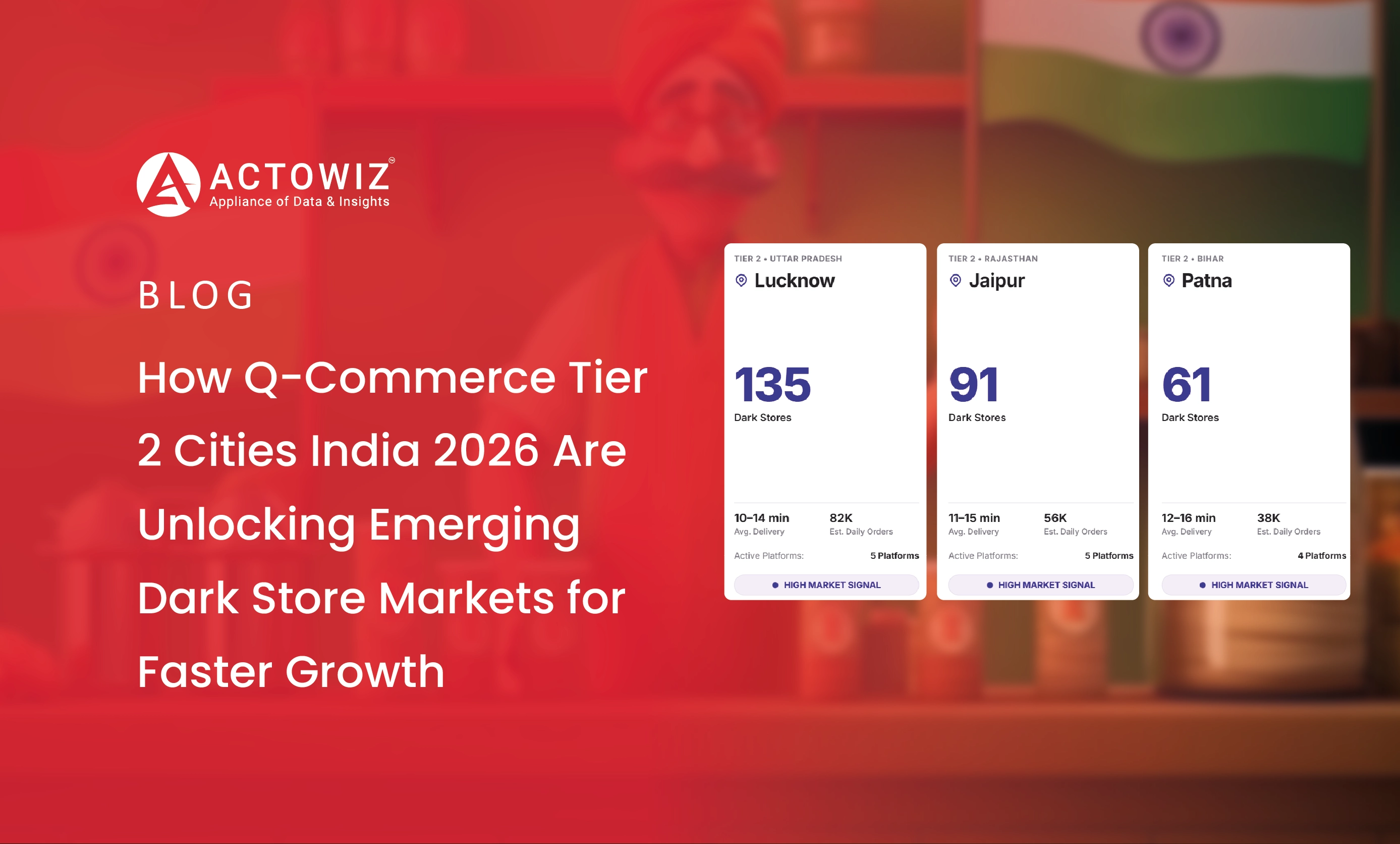
Explore Q-Commerce Tier 2 Cities India 2026, uncovering emerging dark store markets, consumer demand, delivery trends, and expansion opportunities.
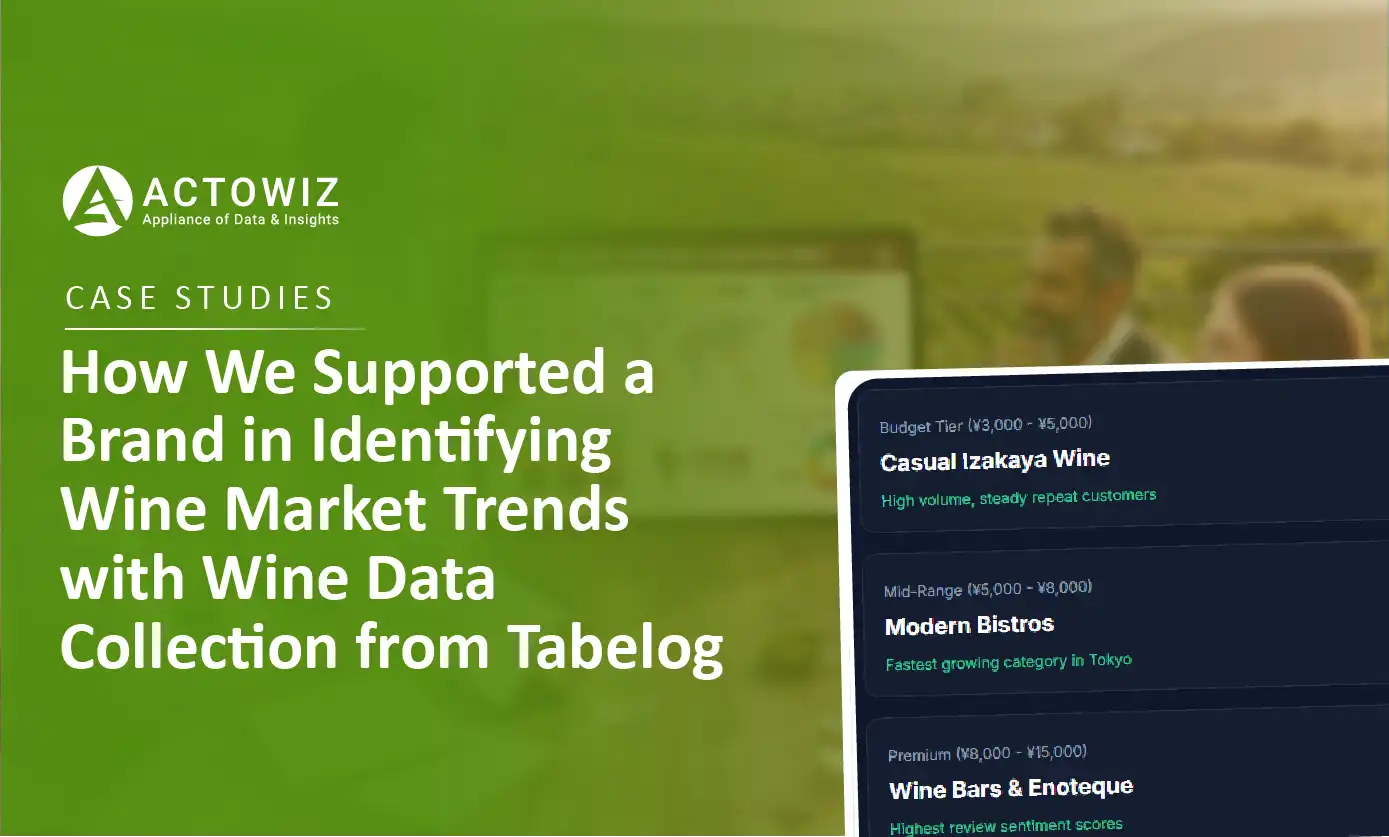
Discover Wine Data Collection from Tabelog to analyze wine listings, prices, ratings, restaurant trends, menus, and competitive market insights.

Discover how E-Com & Q-Com Review Intelligence Report 2026 helps brands analyze reviews, sentiment, product issues, and customer trends across major platforms.
Whether you're a startup or a Fortune 500 — we have the right plan for your data needs.