Article content
The article itself, cleanly separated from site furniture.
- Headline, subheadline, standfirst
- Full body text, boilerplate removed
- Author byline and section
- Word count and reading time

Scalable web, app and AI-powered collection across 40+ countries.
All services → By industry
Repricing driven by competitor moves rather than a weekly review.
Explore → Pricing & Promotions
 Brand & Intelligence
 Digital Shelf & Search
 Assortment
 For Retailers
Which solution fits?
Talk to ExpertTalabat, Careem Quik and Noon Minutes across 18 GCC cities.
Launch Demo →Tesco, Sainsbury's, Asda, Morrisons and Aldi, daily.
Get Early Access → By Industry
 E-Commerce Dashboard
 Flipkart Insights (Live) #1
 Grocery Intelligence
.svg) Grocery Price (U.S.)
Grocery Price (U.S.)
.svg) Quick Commerce (India) HOT
Quick Commerce (India) HOT
 Food & Restaurant
 Fashion Intelligence
 Automotive
 Travel & Hospitality
 Real Estate
 Food Delivery Intelligence NEW
 OTT & Streaming NEW
 Fuel & EV Charging Price Tracker NEW
 By Use Case
 Pricing Intelligence
 Digital Shelf Analytics
 MAP Monitoring HOT
 Cross-Border Price Parity NEW
 Share of Search
 Review Sentiment
 Kitchen Market Gaps NEW
 Dynamic Pricing / AI Repricing NEW
 Promotions & Deals Alerts NEW
 B2B / POI & Lead Data NEW
 AI Search Visibility Dashboard NEW
 Baby Products on Quick Commerce NEW
 Hotel & Flight Rate Parity NEW
 By Region
 Flipkart Real-Time Insights
 Quick Commerce — Zepto · Blinkit
 Pincode Price Tracker
 GCC Q-Commerce — Talabat · Noon NEW
 UK Grocery — Tesco, Sainsbury's, Asda
 AU Grocery — Coles & Woolworths NEW
Sources we already run pipelines against. Download a real sample from any of them.
Browse coverage → Marketplace Scrapers
 Developer APIs
 Universal APIs
 Delivery & SDKs
Fixed monthly retainer, named engineer, no per-request metering.
Managed Data API → Knowledge Center
 Guides & Playbooks
 Downloads & Tools
 Trust & Company
Scalable web, app and AI-powered collection across 40+ countries.
All 58 services → By industryRepricing driven by competitor moves rather than a weekly review.
Explore → Pricing & Promotions
Brand & Intelligence
Digital Shelf & Search
Assortment For RetailersWhich solution fits?
Talk to ExpertSources we already run pipelines against. Download a real sample from any of them.
Browse coverage →Talabat, Careem Quik and Noon Minutes across 18 GCC cities.
Launch Demo →Tesco, Sainsbury's, Asda, Morrisons and Aldi, daily.
Get Early Access → By Industry
E-Commerce Dashboard
Flipkart Insights (Live) #1
Grocery Intelligence
Grocery Price (U.S.)
Quick Commerce (India) HOT
Food & Restaurant
Fashion Intelligence
Automotive
Travel & Hospitality
Real Estate
Food Delivery Intelligence NEW
OTT & Streaming NEW
Fuel & EV Charging Price Tracker NEW
By Use Case
Pricing Intelligence
Digital Shelf Analytics
MAP Monitoring HOT
Cross-Border Price Parity NEW
Share of Search
Review Sentiment
Kitchen Market Gaps NEW
Dynamic Pricing / AI Repricing NEW
Promotions & Deals Alerts NEW
B2B / POI & Lead Data NEW
AI Search Visibility Dashboard NEW
Baby Products on Quick Commerce NEW
Hotel & Flight Rate Parity NEW
By Region Flipkart Real-Time Insights
Quick Commerce — Zepto · Blinkit
Pincode Price Tracker
GCC Q-Commerce — Talabat · Noon NEW
UK Grocery — Tesco, Sainsbury's, Asda
AU Grocery — Coles & Woolworths NEW
Marketplace Scrapers
Developer APIs Universal APIs Delivery & SDKsFixed monthly retainer, named engineer, no per-request metering.
Managed Data API → Knowledge Center
Guides & Playbooks
Downloads & Tools
Trust & CompanyWith entities resolved and duplicates already collapsed.
Raw news collection produces the same story forty times. The work worth paying for is everything that happens after collection.
Free pilot on your own sources, returned in 48 hours. No card, no trial clock — and you keep the sample data either way.
Last verified 5 August 2026 by the Actowiz Solutions Data Engineering team.
News data is journalism converted into records a machine can process: each article decomposed into a headline, body text, publication timestamp, author, outlet identity and geography, plus derived annotations such as the entities it mentions, the topics it covers and its tone. The value is not in the volume of articles — anyone can crawl a lot of news — but in what has been resolved before the data reaches you.
Three problems separate a usable feed from a firehose:
A single wire story is republished by dozens of outlets, often verbatim, sometimes with a changed headline. Uncollapsed, this produces phantom signal: a mention-volume spike that reflects one story, not forty. We compute content fingerprints across the corpus, designate a canonical record with the earliest reliable timestamp, and attach the duplicate count and republishing outlet list to it. Typical collapse ratio is around 3.4 to 1.
"Apple" is a company, a fruit and a record label. "Jaguar" is a car maker and an animal. String matching on a company name produces false positives that quietly corrupt any downstream signal. We resolve entities to identifiers — tickers, registry IDs, geographic codes — using surrounding context, and attach a salience score indicating whether the entity is central to the article or a passing reference.
Publishers backdate, update and silently republish. We record both the publisher's stated publication time and our own ingestion time, and flag material body changes on subsequent observation. For any latency-sensitive use case, knowing which timestamp you are trusting is not a detail — it is the whole basis of the analysis.
Take full text with annotations, or metadata-only if licensing or storage constraints apply.
The article itself, cleanly separated from site furniture.
Who published it, and how much weight that outlet should carry.
The organisations, people and places the article is actually about.
Consistent taxonomy so filtering doesn't rely on keyword guesswork.
Directional signal at both article and entity level.
The layer that turns volume into signal.
Collection is the easy part. Deduplication, entity resolution and classification are the service.
Every engagement delivers a documented schema. These are the core fields; the full dictionary is agreed during scoping.
| Field | Type | What it captures | Refresh |
|---|---|---|---|
article_id |
string | Stable identifier, persistent across updates to the same article | Real time |
canonical / duplicate_count |
boolean / int | Whether this is the canonical version and how many republications exist | Real time |
headline / body_text |
string | Headline and full article body with navigation and boilerplate stripped | Real time |
outlet / outlet_tier |
string / int | Publisher name and reach-based tier classification | Real time |
country / language |
enum | ISO country and language codes for the specific edition | Real time |
published_at / ingested_at |
timestamp | Publisher-stated publication time and our ingestion time, kept separate | Real time |
entities |
array | Resolved organisations, people and locations with type, identifier and salience | Real time |
topics |
array | Multi-label classification against our taxonomy or your custom mapping | Real time |
sentiment |
object | Article-level and per-entity sentiment scores with labels | Real time |
paywalled |
boolean | Whether full text sits behind a paywall, in which case we deliver metadata only | Real time |
revision_of / revised_at |
string / timestamp | Links a revised article to its earlier version with change timing | Real time |
Where an article is paywalled, we deliver headline and metadata only and never the protected body text. Publisher access restrictions are respected as a hard rule, not a configurable option.
Coverage is built by tier and region rather than by a fixed source list, so specialist trade press in your sector is usually addable.
If a specific trade publication matters to your sector and we don't already cover it, adding a source is routine work with a short lead time. Request a source we don't list →
We deliver into 40+ countries. These are the markets where this particular service is requested most, and the reason demand concentrates there.
| Market | Why demand concentrates here |
|---|---|
| United States & United Kingdom | Highest publisher density and the fastest syndication chains to deduplicate. |
| Germany, France & Spain | Multilingual monitoring with strong regional publisher ecosystems. |
| India | Very high publisher volume across multiple languages and heavy republishing. |
| Singapore & UAE | Regional financial and trade coverage hubs for Asia and the Middle East. |
We run production collection across 40+ countries. Coverage depth varies by market and by source, so we confirm what is actually available for your specific markets during scoping rather than claiming uniform global coverage. Ask about a market we don't list →
The same feed serves very different consumers — latency matters enormously to some and not at all to others.
News-based signals decay in minutes, and vendor feeds arrive with inconsistent timestamps and uncollapsed syndication that manufactures false volume spikes.
Streaming delivery with median sub-5-minute latency, separated publish and ingest timestamps, and deduplicated canonical records with entity salience.
Signal decay window
Covering hundreds of names means missing material developments in trade press that never reaches mainstream financial media.
Entity-filtered feeds across specialist trade press per name, with topic classification so operational news surfaces separately from market commentary.
Coverage completeness
Adverse-media screening against name lists produces overwhelming false positives because matching is string-based rather than entity-resolved.
Entity-resolved screening with salience thresholds and negative-topic classification, cutting false positives without losing genuine hits.
False positive rate
Coverage reports arrive next morning, after the news cycle has already formed, and count syndicated republication as separate coverage.
Real-time alerting on brand and executive mentions with deduplication, tier weighting and sentiment, routed to Slack or email within minutes.
Response time
Training or grounding a model on news requires clean, deduplicated, licence-clear text at volume — and web crawls deliver none of those properties.
Deduplicated full-text corpora in Parquet with provenance metadata, plus a documented archive suitable for training and RAG grounding.
Corpus quality
Supply disruptions surface first in regional and local press in the local language, days before international coverage.
Multilingual regional press monitoring with event-type classification for outages, strikes, weather and logistics disruption.
Signal lead time
Four patterns, with measured outcomes.
Streaming entity-resolved news drives systematic strategies that react to earnings language, guidance changes, management departures and regulatory actions. Deduplication ensures a single wire story doesn't register as a volume spike, and salience scores filter passing mentions from articles genuinely about the entity.
Outcome: Signal pipelines that fire on genuine first publication rather than on the fifth republication of the same story.
Name lists are screened against entity-resolved news rather than string matches, with salience thresholds and negative-topic classification applied. This removes the bulk of false positives that make manual review queues unmanageable.
Outcome: Screening review queues reduced substantially while genuine adverse coverage still surfaces.
Regional press in local languages is monitored for event types — port closures, plant outages, strikes, extreme weather, export restrictions — with geographic resolution, giving earlier warning than international coverage provides.
Outcome: Disruption awareness measured in hours rather than days on region-specific events.
Deduplicated full-text archives with provenance metadata are delivered as partitioned Parquet for model training, or as continuously updated indexed feeds for retrieval-augmented generation where currency and citation traceability matter.
Outcome: Model grounding on a corpus where every passage traces to a dated, attributable source.
Clients rarely permit naming. These are real engagement shapes with identifying detail removed, so you can judge whether the work resembles your situation.
A monitoring tool delivered high volume with no deduplication, so analysts spent significant time filtering republished versions of identical wire stories.
Deduplicated, entity-resolved delivery with syndication chains collapsed to a single canonical record, filtered to the firm's watchlist entities.
Article volume reaching analysts dropped substantially while genuine event coverage stayed intact.
Port closures, strikes and plant outages reached the team through supplier emails, often days after the event was publicly reported.
Sub-five-minute latency monitoring across logistics and industrial publishers, entity-resolved to the team's supplier and port watchlist.
Disruption awareness moved ahead of supplier notification in most monitored events.
Examples are anonymised at client request. Named references are available on request under NDA. See published case studies →
Before you commit to anything, we run this service against your own sources and send you the output. If the coverage isn't there, the sample will show you that too — which is the point. We would rather lose the deal at the pilot than at month three.
Same collection pipeline and same QA underneath. The difference is who holds the schedule and how the data reaches you.
We own the collection, the QA and the delivery. You receive clean data on a schedule and never touch a scraper.
Best fit: Teams who need the data, not the infrastructure.
The same collection pipeline exposed as an authenticated REST endpoint your systems query directly.
Best fit: Product and engineering teams building on live data.
A defined pull for a specific question — market sizing, diligence, a pitch, a one-off audit.
Best fit: Research, strategy and diligence work with a deadline.
Every engagement is quoted individually, because the honest answer depends on your scope: how many sources, how many records, how often, and how the data reaches you. We scope it with you, run a free pilot on your own sources, and then quote a fixed monthly figure — no per-request metering and no overage billing when volumes move. Request a quote and you will have a number after one call.
Deduplication at scale is a genuinely hard engineering problem and it never stops needing tuning.
| Consideration | In-house scraping team | Generic proxy / DIY tool | Actowiz managed feed |
|---|---|---|---|
| Time to first usable data | 6–12 weeks of engineering before anything is trustworthy | Days, but output needs manual cleanup before use | Free pilot in 48 hours, production in 5–10 business days |
| Who fixes it when a source changes | Your engineers, at the cost of their roadmap | You do — tools report failures, they don't resolve them | We do, same business day, inside the retainer |
| Data quality assurance | Whatever your team has time to build | None beyond HTTP success | Schema validation plus sampled human QA on every run |
| Compliance documentation | Rarely produced, then requested urgently by legal | Not provided; terms risk sits with you | Sources, method and lawful basis documented for review |
| Accountability | Distributed across a team with other priorities | A support ticket queue | A named engineer and an account owner |
| True annual cost | Engineer salaries, proxies, hosting, ongoing maintenance | Low licence fee plus significant hidden analyst time | One fixed monthly retainer, quoted after scoping |
If you evaluate one thing in a news data trial, evaluate deduplication. Everything downstream depends on it, and its absence is easy to miss until it has already corrupted months of analysis.
Consider mention volume as a signal. A company appears in 340 articles today versus a 40-article baseline. Without deduplication you might conclude a major event occurred. With deduplication you may find eleven genuine stories, republished across 329 outlets — a normal news day for a widely covered name. The uncollapsed version doesn't just add noise; it produces a confidently wrong conclusion.
We deliberately keep duplicates accessible instead of discarding them. Collapsing to canonical is right for signal generation; the full republication set matters for PR measurement and reach analysis. You choose per use case.
News has become one of the most sought-after training and grounding corpora, and also one of the most legally sensitive. Teams building retrieval-augmented systems need current, attributable, deduplicated text; teams training models need volume with clean provenance. Both need to know where the data came from.
On licensing: we can advise on the collection methodology and access status of every source, and we document it. We cannot grant you rights we do not hold, and any provider claiming blanket training rights over global news should be treated with suspicion. Our approach is to be precise about what each source permits so your legal team can make an informed decision.
Entity lists, topic filters and latency tier are configured during the pilot so the production stream matches your use case exactly.
You send us target sites, regions, SKUs or keywords. We return a field-level schema proposal, coverage estimate and refresh recommendation — usually within two working days.
We extract a real sample from your actual targets so you can inspect field fill rates, edge cases and match quality before any commitment.
Our engineers build extractors, then wire validation rules: type checks, range checks, duplicate detection and golden-record comparison against a manually verified subset.
Feeds run at your chosen cadence and land in the warehouse or bucket you already use. Schema changes are versioned and announced before they ship.
We watch coverage drift, fill rates and source changes daily. A named engineer owns your account, and layout breaks are fixed by us — not queued for you.
Streaming via webhook or WebSocket, REST/GraphQL API pull, or scheduled batch in JSON, JSONL or Parquet to S3, GCS, Azure Blob, SFTP, Snowflake, BigQuery or Databricks. Streaming and batch share one schema, so a batch pilot migrates to streaming without pipeline changes.
We extract only publicly accessible articles, never bypass paywalls or authentication, respect robots directives and publisher rate limits, and deliver metadata only where full text is protected. Each engagement includes a documented source list with access status per publisher so your legal team can assess licensing before signature.
These are contractual, not marketing copy. They appear in the engagement document.
| Commitment | What we hold ourselves to |
|---|---|
| Pilot turnaround | A real sample from your own sources within 48 hours of scoping, at no cost. |
| Go-live | Production collection running within 5–10 business days of sign-off. |
| Delivery punctuality | 99.5% on-schedule delivery, measured monthly and reported to you. |
| Breakage response | Source layout changes triaged same business day; critical sources inside 4 hours. |
| Data quality | Schema validation on every run plus sampled human QA before any delivery leaves us. |
| Escalation | A named engineer and an account owner, not a shared ticket queue. |
| Change requests | Field additions and source changes handled inside the retainer, not re-quoted. |
| Exit | Your historical data exported in full on request. No lock-in, no export fee. |
Plain definitions of the terms used on this page, so procurement and legal reviewers are working from the same vocabulary as your data team.
What buyers ask during evaluation.
We deliver headline, outlet, timestamp, author and any publicly visible summary, and we mark the record as paywalled. We do not extract protected body text, and we do not use subscription credentials, shared logins or paywall circumvention techniques of any kind.
This is a firm rule rather than a setting. A feed containing improperly obtained paywalled content creates liability for you as the recipient, not only for the provider, and that exposure typically surfaces long after ingestion when it is expensive to unwind.
Median under five minutes from publication to delivery on priority sources, which covers wires, major financial press and the outlets you designate as high-priority. Broader long-tail coverage runs on a longer polling cycle, typically 15 to 60 minutes, because polling 80,000 sources at wire frequency is neither economic nor welcome to publishers.
Every record carries both the publisher's stated publication time and our ingestion time, so you can measure our actual latency yourself rather than relying on our claim. We recommend doing exactly that during the pilot.
We resolve organisations to tickers and registry identifiers, and people and locations to typed entities with context. Accuracy is high on well-known entities and degrades on ambiguous names, small private companies and transliterated names in non-Latin scripts — which is true of every entity resolution system, ours included.
Each entity carries a salience score and a resolution confidence. For screening use cases we recommend filtering on both: it removes most false positives at a small cost in recall, and the tradeoff is tunable to your risk appetite.
Yes, on selected sources. Our archive extends multiple years for wires, major financial press and a substantial set of trade publications. Long-tail and regional sources have shallower history, and some have none before we began collecting them.
During scoping we give you exact date ranges per source rather than a headline claim, because a backtest built on a corpus with unacknowledged gaps produces results that look valid and are not. If your strategy needs uniform history across a specific source set, we will tell you plainly whether that exists.
It helps, provided you use both views. For measuring genuine story count, the canonical records are correct. For measuring reach and republication breadth, the duplicate set is what you want — a story picked up by 200 outlets has different value from one carried by three.
We deliver canonical records with the full republishing outlet list attached, so you can compute both story count and coverage breadth from the same feed. Suppressing duplicates entirely would destroy the reach measurement, which is why we attach rather than discard them.
Yes — 40+ languages, including full-text extraction and entity resolution in the major ones. Multilingual coverage is often the strongest argument for a managed feed, because regional developments surface in local-language press well before international outlets pick them up.
Optional machine translation of headline and body is available, delivered alongside the original text rather than replacing it. We keep the original because translation loses nuance that matters, particularly in regulatory and legal reporting.
Yes, and we recommend it strongly. Filters can be set on entities, entity salience thresholds, topics, outlet tier, country, language, sentiment range and keyword patterns, and combined with boolean logic.
Unfiltered global news is around 200,000 articles per four-hour window in our corpus. Almost no use case wants that. Most clients run a tightly filtered stream for alerting plus a broader scheduled batch for analysis, which keeps both cost and noise manageable.
We quote every news monitoring engagement individually, because a real number depends on scope: source count, record volume, refresh frequency and delivery method. Anyone quoting you a price before understanding those four things is guessing.
Publisher count, latency requirement and whether you need full-text or metadata-only delivery are the main drivers. Sub-five-minute latency costs meaningfully more than hourly.
The process is short: one scoping call, a free pilot on your own sources within 48 hours, then a fixed monthly quote. No per-request metering, no overage billing, and field or source additions are handled inside the retainer rather than re-quoted. Request a quote.
Technically, straightforwardly — we deliver deduplicated, clean, provenance-tagged text in Parquet built for exactly that. Legally, it depends on the sources, and you should treat any provider claiming otherwise with caution.
What we do is document the access status and collection methodology of every source in your feed, so your legal team can assess training rights source by source. What we cannot do is grant rights we do not hold. If training is your use case, raise it during scoping — source selection changes materially, and some sources are better excluded from a training corpus than included.
Give us the entities and topics you track. We return deduplicated, entity-resolved news records within 48 hours, at no cost.
Free pilot, no obligation, no card. You'll have a fixed monthly quote after one scoping call.Our web scraping expertise is relied on by 4,000+ global enterprises including Zomato, Tata Consumer, Subway, and Expedia — helping them turn web data into growth.
Watch how businesses like yours are using Actowiz data to drive growth.
 4.8/5 Average Rating
 50+ Video Testimonials
 92% Client Retention
 50+ Countries Served
From Zomato to Expedia — see why global leaders trust us with their data.
Backed by automation, data volume, and enterprise-grade scale — we help businesses from startups to Fortune 500s extract competitive insights across the USA, UK, UAE, and beyond.


 Product Matching
 Attribute Tagging
 Content Optimization
 Sentiment Analysis
 Prompt-Based Reporting
We partner with agencies, system integrators, and technology platforms to deliver end-to-end solutions across the retail and digital shelf ecosystem.


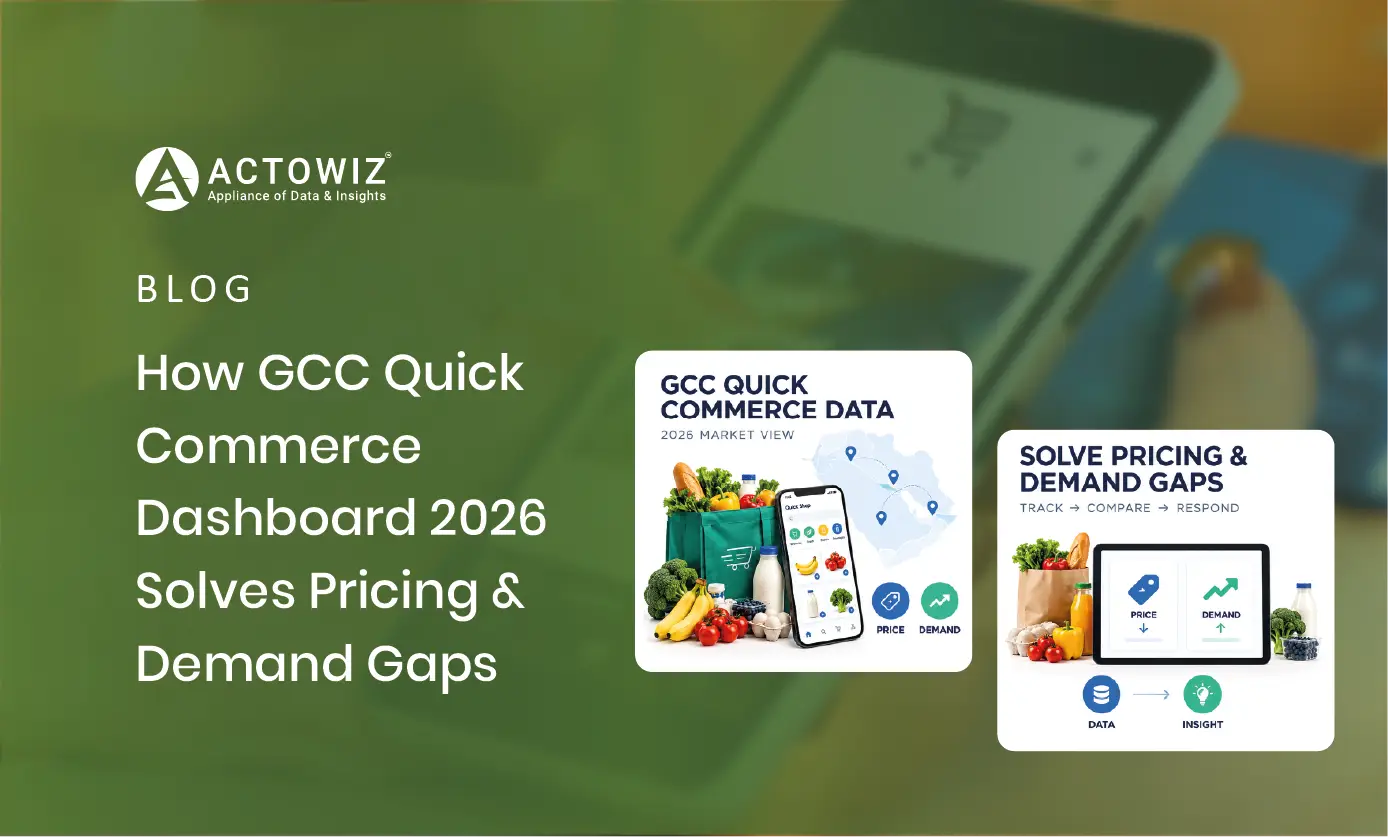
Quick Commerce GCC Dashboard 2026 delivers market, pricing, competitor, assortment, and demand insights for smarter quick-commerce decisions across GCC markets.
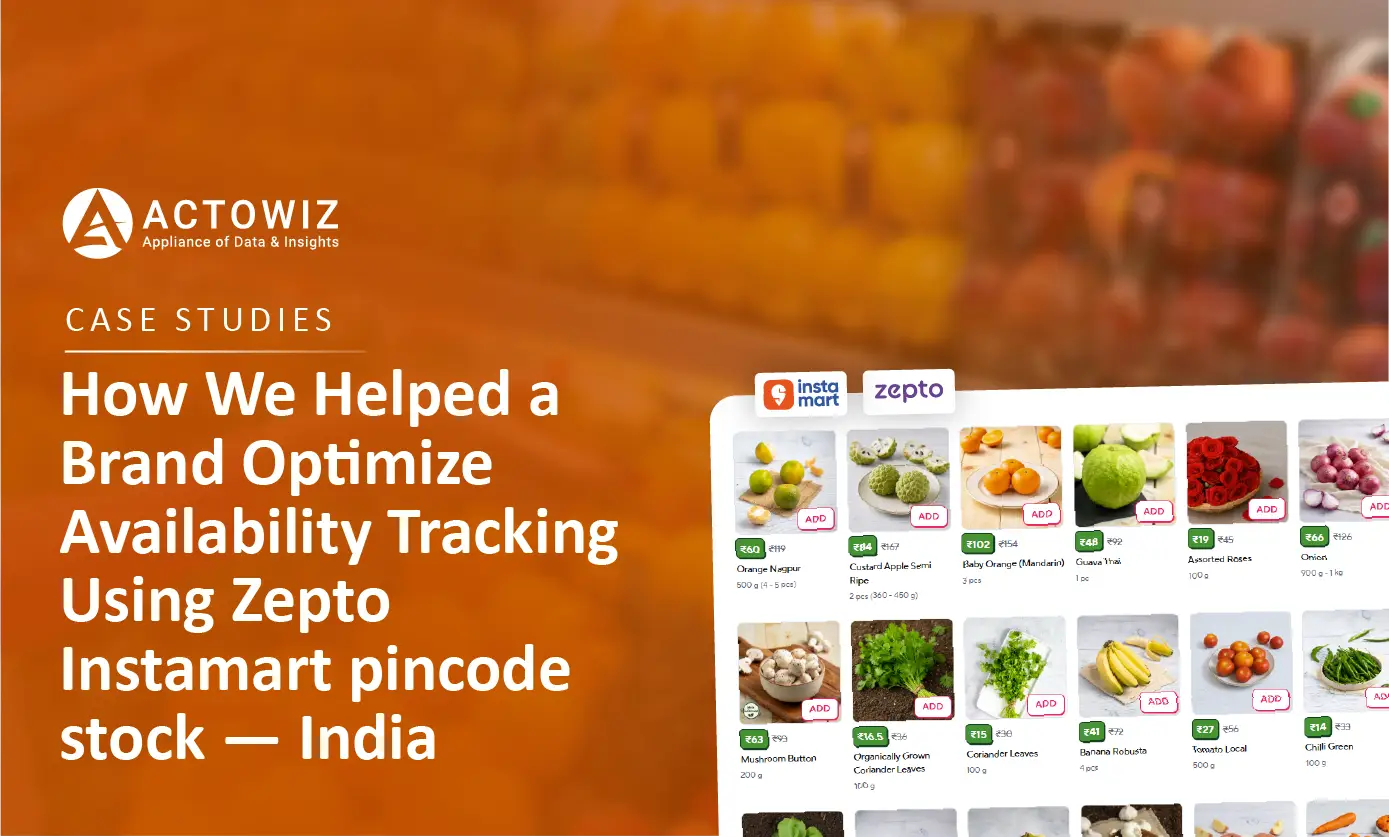
Track product availability across Indian pincodes with Zepto/Instamart pincode stock — India for better inventory, assortment, and regional insights.
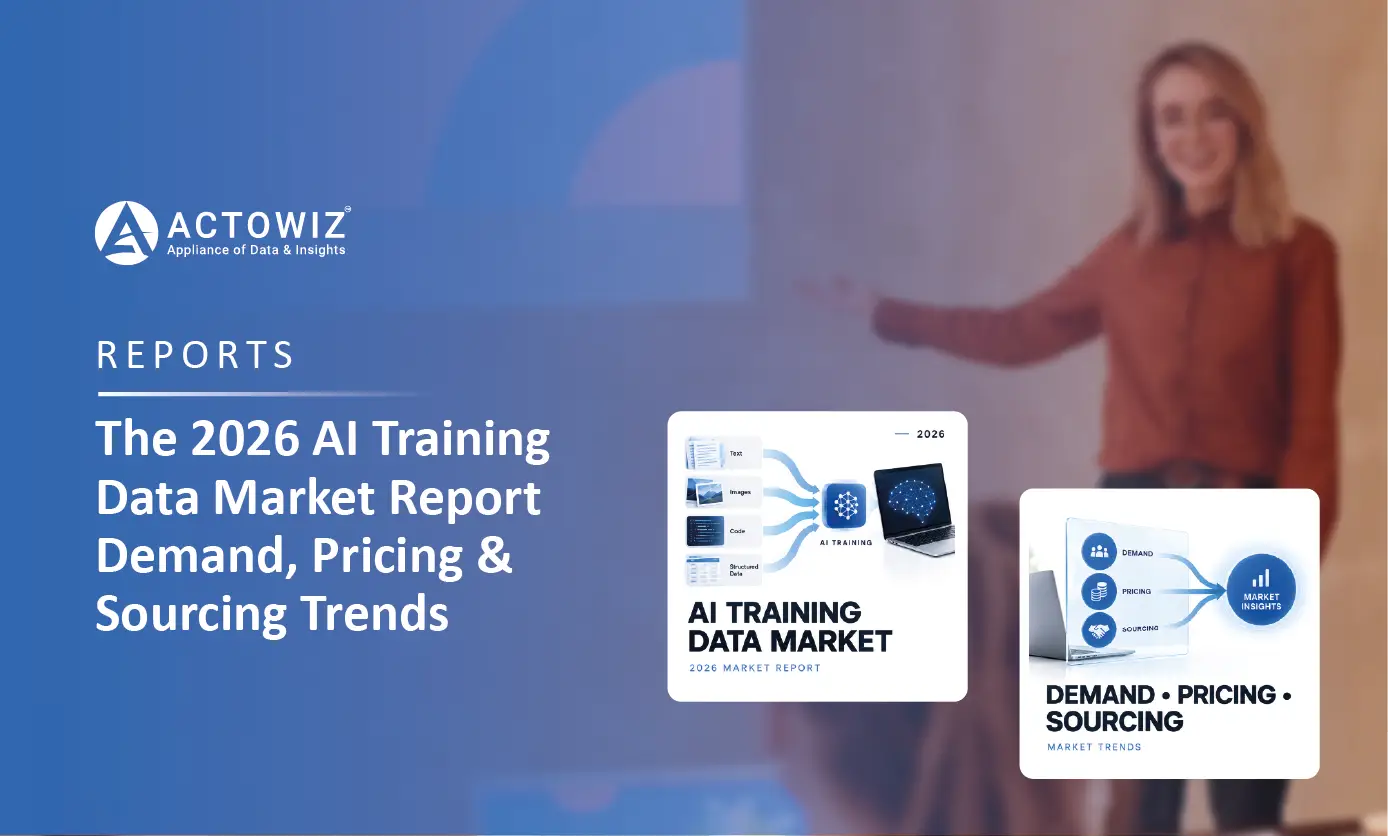
Actowiz Solutions' 2026 AI training data market report — demand drivers, pricing models, sourcing trends, compliance economics & what data buyers should know.
Whether you're a startup or a Fortune 500 — we have the right plan for your data needs.