Core services
Enterprise Data Extraction

Scalable web, app and AI-powered collection across 40+ countries.

All 58 services →
New 2026
AI Training Data

Corpus building with provenance and opt-out compliance.

Learn more →
Free pilot
24-hour sample

We run collection on your own sources before you commit.

Get a sample →
58Services
40+Countries
DEVELOPER

Ready-Made Scrapers

Pre-built for top platforms. Self-serve, no setup.

View All →
TRY FREE

API Playground

Test endpoints instantly. No credit card.

Start Free →
28Tools
2SDKs
icons Delivery & SDKs
Streaming Crawl API Scheduler Realtime Alerts Webhook Delivery 🐍 Python SDK 💚 Node.js SDK

Need it managed instead?

Fixed monthly retainer, named engineer, no per-request metering.

Managed Data API →
HOT

Case Studies

How brands use Actowiz, with named outcomes.

Read →
FREE

Sample Datasets

Real output, no signup.

Download →
NEW

ROI Calculator

Model the return on a data engagement.

Calculate →
Costco India Weekly E-Commerce Dataset

Introduction

Many web data RFPs fail before a vendor reads them. They ask for "competitor prices from all major retailers" and leave every vendor to guess the sources, countries, fields and refresh rate. The result is five quotes that cannot be compared.

A web data RFP checklist is the list of requirements a buyer defines before inviting vendors to quote: scope, sources, countries, data fields, refresh frequency, volume, delivery format, QA and acceptance criteria, SLA, change handling, compliance and usage rights, and pricing model. With these fixed, vendor quotes become comparable and can be scored.

This guide is written for procurement managers and data leads. It is vendor-neutral: use it to write your RFP, whoever you invite. It draws on the RFPs our team has received directly in 2026 from consulting firms, FMCG and beverage groups, retailers and travel companies, and on the gaps we see most often in them. If you are still deciding which kinds of provider to invite, start with our How to Choose a Web Scraping Partner in 2026: A Buyer's Guide. This article covers the next step: writing the document itself.

Why a web data RFP is different from a software RFP

A software RFP buys a tool. A web data RFP buys an ongoing stream of records from websites you do not control. Three facts change how you write it:

  • The sources change without notice. Retailers redesign pages, add bot protection and change URL structures. Your RFP must say what happens when a source breaks, not just what is delivered on day one.
  • "Data" is not a deliverable until it is defined. "Price" can mean list price, promo price, member price, per-unit price or price after a coupon. Undefined fields are the main reason why quotes can't be compared.
  • Cost depends on scope, not seats. The number of sources, countries, records and refreshes drives cost far more than the number of users. A precise scope gives you a precise quote.

In the RFPs we received in 2026, the authors were usually procurement teams working with a data owner in pricing, revenue management, strategy or data engineering. The best ones are co-written: procurement owns the process and terms, the data owner owns the requirement.

The 12-section web data RFP checklist

Costco India Weekly E-Commerce Dataset

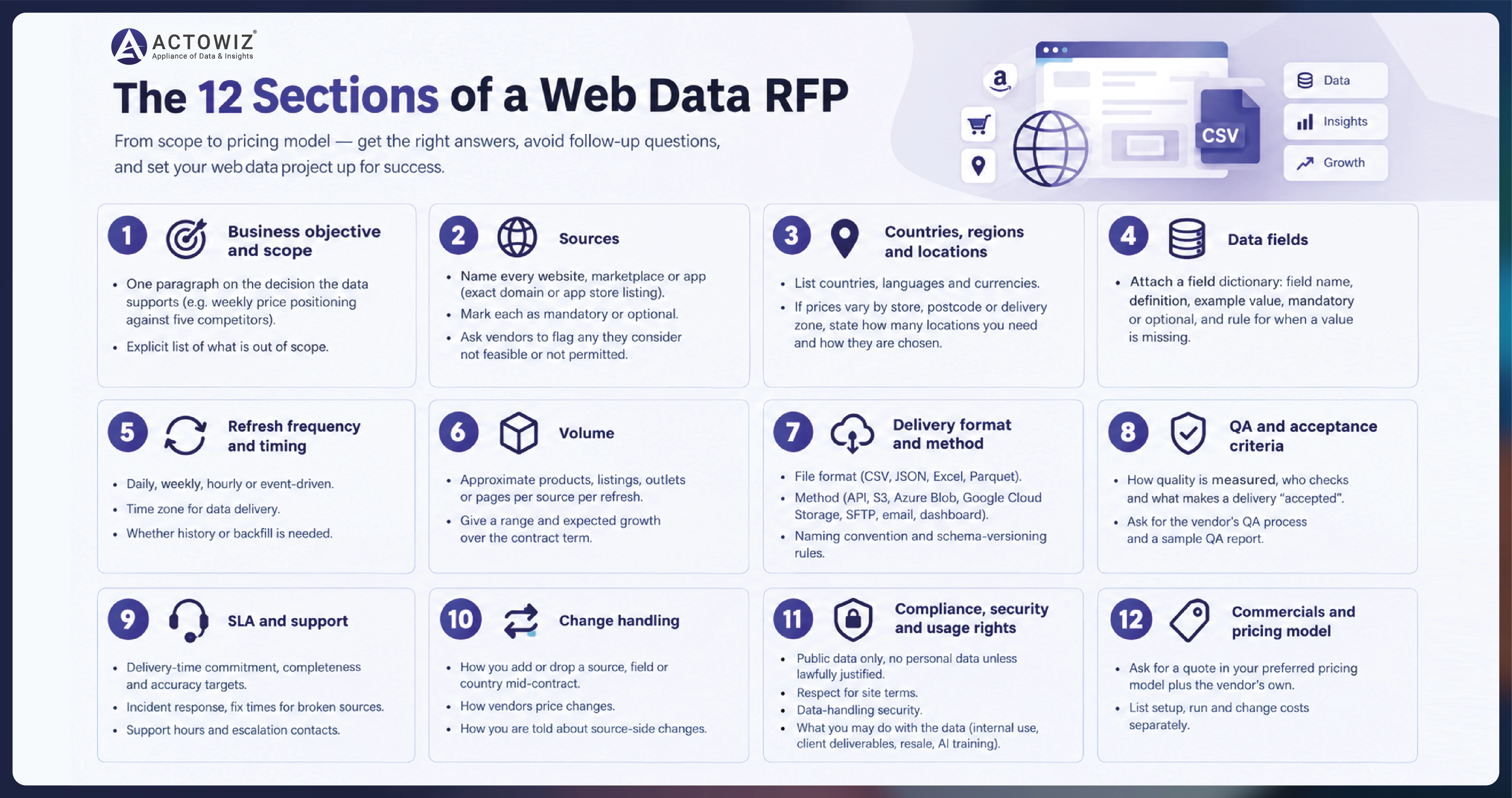
Use this web data RFP checklist as the backbone of your document. Each section answers a question every vendor would otherwise ask in a clarification round.

  • Business objective and scope. One paragraph on the decision the data supports (e.g. weekly price positioning against five competitors). Include an explicit list of what is out of scope.
  • Sources. Name every website, marketplace or app, with the exact domain or app store listing. Mark each as mandatory or optional, and ask vendors to flag any they consider not feasible or not permitted.
  • Countries, regions and locations. List countries, languages and currencies. If prices vary by store, postcode or delivery zone, state how many locations you need and how they are chosen.
  • Data fields. Attach a field dictionary: field name, definition, example value, mandatory or optional, and the rule for when a value is missing (see the table below).
  • Refresh frequency and timing. Daily, weekly, hourly, or event-driven. Say what time zone the data must arrive in, and whether history or backfill is needed.
  • Volume. Approximate products, listings, outlets or pages per source per refresh. Give a range and expected growth over the contract term.
  • Delivery format and method. File format (CSV, JSON, Excel, Parquet), method (API, S3, Azure Blob, Google Cloud Storage, SFTP, email, dashboard), naming convention and schema-versioning rules.
  • QA and acceptance criteria. How quality is measured, who checks it and what makes a delivery "accepted". Ask for the vendor's QA process and a sample QA report.
  • SLA and support. Delivery-time commitment, completeness and accuracy targets, incident response, fix times for broken sources, support hours and escalation contacts.
  • Change handling. How you add or drop a source, field or country mid-contract, how vendors price changes, and how you are told about source-side changes.
  • Compliance, security and usage rights. Public data only, no personal data unless lawfully justified, respect for site terms, data-handling security, and what you may do with the data (internal use, client deliverables, resale, AI training).
  • Commercials and pricing model. Ask for a quote in your preferred pricing model plus the vendor's own, with setup, run and change costs listed separately.

How to specify sources, countries and fields

This is the part most RFPs skip. A one-page field dictionary removes most clarification questions and makes quotes comparable. Here is an example for a retail price-monitoring RFP; adapt the fields to your use case.

Field Definition to write in the RFP Mandatory? Acceptance rule
source_name / country Website or app and ISO country code Yes Matches the agreed source list
product_id / url Retailer's own ID and canonical product URL Yes Unique per source per crawl date
product_title / brand Title and brand exactly as shown Yes Not blank; no HTML
list_price / sale_price Regular and current selling price, with currency Yes Numeric; sale_price no higher than list_price
pack_size / unit_price Pack size as shown, plus normalised per-unit price Optional Unit stated (g, ml, count)

availability In stock / out of stock, per location Yes One of the agreed values
promo_text Promotion or offer text shown on the page Optional Captured if visible
location_id Store, postcode or delivery zone used for the crawl If prices vary by location Matches the agreed location list
crawl_timestamp UTC date and time the record was collected Yes Within the agreed delivery window

Three tips from real RFPs we have answered in 2026:

  • Give vendors URLs, not brand names. One retailer brand can mean a dozen country sites and apps.
  • Separate the source list from the product list. Say whether vendors must collect the full catalogue or only a list of products you provide (your SKUs, EANs or URLs). The two scopes are priced very differently.
  • Ask for a sample against your own spec. It tells you more than any slide deck.

QA, acceptance criteria and the SLA

Quality claims such as "high accuracy" mean nothing in a contract. Put measurable definitions in the RFP and ask each vendor to state its own targets against them. You set the bar; the vendor tells you what it will commit to in writing.

Metric How to define it in the RFP How to check it
Coverage Share of agreed sources, locations and products delivered in each run Compare delivered record counts with the agreed list
Completeness Share of mandatory fields that are populated, per field Null-rate report per field, per source
Accuracy Share of sampled values that match the live page at crawl time Monthly manual spot-check of a random sample, with screenshots
Timeliness Delivery arrives by the agreed time in your time zone File or API timestamps against the schedule
Source-break fix time Time from a source breaking to data flowing again Incident log with open and close timestamps
Incident response Time to acknowledge and update on a reported issue Support-ticket timestamps
Schema stability Notice period before any field or format change Change log and version numbers

Define acceptance in three stages. Sample acceptance: the sample meets the field dictionary. Pilot acceptance: two to four weeks of production runs meet the metrics. Ongoing acceptance: monthly reporting against the SLA, with service credits or a remediation plan if targets are missed.

Web data pricing models compared

Vendors price web data in different ways, so a quote in one model is hard to compare with a quote in another. Describe the model you prefer in the RFP and ask each vendor to quote in it, plus its own model if different. The table below describes the common models only; it is not a price guide.

Pricing model How it is billed Works best when Watch out for
Per record A rate per row or item delivered Volumes are predictable and fields are fixed Duplicates and empty rows counted as records; how re-runs are billed
Per source / per site A setup fee plus a monthly fee per website or app Few sources, many records each Fees for adding countries, locations or fields to a source
Per request / credits Credits per page, request or API call Self-serve APIs and spiky demand Blocked or retried requests that use credits; overage rates
Subscription / managed service A fixed monthly or annual fee for a defined scope Ongoing feeds where budget certainty matters Volume caps, scope-creep clauses, notice periods
Project / one-off A fixed fee for one dataset or backfill Market studies and due diligence Cost to refresh later; who owns the scripts

Whatever the model, ask vendors to list setup, monthly run, change-request and extra-source costs separately, so you compare total cost over the term, not headline rates. For how Actowiz structures its own plans, see our pricing page.

The web data vendor evaluation scorecard

Agree the criteria and weights before you open any proposal, and publish them in the RFP. Public-sector guidance such as the UK government's Assessing Competitive Tenders makes the same point: tenders should be assessed against award criteria and weightings set out in advance. The weights below are a starting point; change them to match your priorities.

Criterion Suggested weight What a strong answer shows Score (1-5)
Data quality and QA 25% Measured QA process; sample matches your spec
Coverage and feasibility 20% Mandatory sources covered; honest feasibility flags
SLA and support 15% Written targets, named contact, escalation path
Delivery and integration 10% Your format and method; schema versioning
Compliance and security 10% Public-data policy; clear usage rights
Total cost over the term 15% Setup, run and change costs listed separately
Change handling and scalability 5% Clear process and price for changes

Score each criterion from 1 to 5, multiply by the weight and add up the results. Have at least two people from different teams score each proposal on their own, then agree the final scores together. Image: web-data-vendor-scorecard.png (alt: "Weighted scorecard for evaluating web data vendors").

A realistic RFP timeline

For a multi-country, multi-source requirement, eight weeks from draft to signature is realistic.

Week Step Output
1 Write the requirement with the data owner; build the field dictionary Draft RFP and source list
2 Issue the RFP to a shortlist of 3-6 vendors RFP sent, with NDA if needed
3 Clarification questions and answers shared with all vendors Q&A log
4 Proposals due; request samples against your spec Proposals and samples
5 Score proposals and samples on the scorecard Shortlist of 2
6-7 Paid or free pilot on 2-3 sources; check against acceptance criteria Pilot QA report
8 Negotiate SLA, usage rights and commercials; sign Contract and onboarding plan

Legal, compliance and usage-rights basics

Your legal team will decide what is acceptable for your organisation, but the RFP should require vendors to answer these points:

  • Public data only. Data visible without logging in, collected in a way that respects each site's terms of service, robots.txt directives and rate limits.
  • Personal data. State whether any personal data is in scope. Under the GDPR and similar laws, data about identifiable people needs a lawful basis. Most price and product projects need none; say so.
  • Usage rights. Spell out whether you may share data with clients, publish aggregates, combine it with other datasets or use it to train models.
  • Security. Ask how data is stored, transferred and deleted.
  • Feasibility honesty. A credible vendor will tell you when a source is not feasible or not permitted. Treat "we can scrape anything" as a red flag.

For a deeper look, read our web scraping compliance guide. This article is general guidance, not legal advice.

Frequently Asked Questions

What should a web data RFP checklist include?

At minimum: business objective, source list, countries and locations, a field dictionary, refresh frequency, volume, delivery format, QA and acceptance criteria, SLA, change handling, compliance and usage rights, and your preferred pricing model.

How is an RFP different from an RFI for web data?

An RFI collects general information about vendors' capabilities to build a shortlist. An RFP gives a defined scope and asks for a priced, comparable proposal. For complex requirements, an RFI first can save time.

How many vendors should we invite?

Three to six is usually enough. Fewer limits competition; more creates scoring work without better options. Use the RFI or a buyer's guide to shortlist.

Which pricing model is best for web data?

No model is best everywhere. Per-record suits stable volumes, per-source suits few sources with many records, and subscription suits ongoing feeds that need budget certainty. Ask for quotes in one common model so you can compare.

Should we ask for a free sample in the RFP?

Yes. Ask each shortlisted vendor for a sample from two or three of your sources in your field dictionary. It is the fastest way to test quality, coverage and how well the vendor understood your brief.

What SLA terms matter most for web data?

Timeliness of delivery, completeness of mandatory fields, accuracy on spot-checks, and fix time when a source breaks. Ask for written targets, monthly reporting and a remedy if targets are missed.

Download the Web Data RFP Checklist
company email, company name, use case (e.g. price monitoring, digital shelf, hotel rates, menu data, market research), countries and sources.
Talk to our data team

Conclusion

You can also reach us for all your mobile app scraping, data collection, web scraping, and instant data scraper service requirements!

Social Proof That Converts

Trusted by Global Leaders Across Q-Commerce, Travel, Retail, and FoodTech

Our web scraping expertise is relied on by 4,000+ global enterprises including Zomato, Tata Consumer, Subway, and Expedia — helping them turn web data into growth.

4,000+ Enterprises Worldwide
50+ Countries Served
20+ Industries
Join 4,000+ companies growing with Actowiz →
Real Results from Real Clients

Hear It Directly from Our Clients

Watch how businesses like yours are using Actowiz data to drive growth.

▶
1 min
★★★★★
"Actowiz Solutions offered exceptional support with transparency and guidance throughout. Anna and Saga made the process easy for a non-technical user like me. Great service, fair pricing!"
TG
Thomas Galido
Co-Founder / Head of Product at Upright Data Inc.
▶
2 min
★★★★★
"Actowiz delivered impeccable results for our company. Their team ensured data accuracy and on-time delivery. The competitive intelligence completely transformed our pricing strategy."
II
Iulen Ibanez
CEO / Datacy.es
▶
1:30
★★★★★
"What impressed me most was the speed — we went from requirement to production data in under 48 hours. The API integration was seamless and the support team is always responsive."
FC
Febbin Chacko
-Fin, Small Business Owner
icons 4.8/5 Average Rating
icons 50+ Video Testimonials
icons 92% Client Retention
icons 50+ Countries Served

Join 4,000+ Companies Growing with Actowiz

From Zomato to Expedia — see why global leaders trust us with their data.

Why Global Leaders Trust Actowiz

Backed by automation, data volume, and enterprise-grade scale — we help businesses from startups to Fortune 500s extract competitive insights across the USA, UK, UAE, and beyond.

icons
7+
Years of Experience
Proven track record delivering enterprise-grade web scraping and data intelligence solutions.
icons
4,000+
Projects Delivered
Serving startups to Fortune 500 companies across 50+ countries worldwide.
icons
200+
In-House Experts
Dedicated engineers across scrapers, AI/ML models, APIs, and data quality assurance.
icons
9.2M
Automated Workflows
Running weekly across eCommerce, Quick Commerce, Travel, Real Estate, and Food industries.
icons
270+ TB
Data Transferred
Real-time and batch data scraping at massive scale, across industries globally.
icons
380M+
Pages Crawled Weekly
Scaled infrastructure for comprehensive global data coverage with 99% accuracy.

AI Solutions Engineered
for Your Needs

→
LLM-Powered Attribute Extraction: High-precision product matching using large language models for accurate data classification.
→
Advanced Computer Vision: Fine-grained object detection for precise product classification using text and image embeddings.
→
GPT-Based Analytics Layer: Natural language query-based reporting and visualization for business intelligence.
→
Human-in-the-Loop AI: Continuous feedback loop to improve AI model accuracy over time.
icons Product Matching icons Attribute Tagging icons Content Optimization icons Sentiment Analysis icons Prompt-Based Reporting

Connect the Dots Across
Your Retail Ecosystem

We partner with agencies, system integrators, and technology platforms to deliver end-to-end solutions across the retail and digital shelf ecosystem.

icons
Analytics Services
icons
Ad Tech
icons
Price Optimization
icons
Business Consulting
icons
System Integration
icons
Market Research
Become a Partner →

Popular Datasets — Ready to Download

Browse All Datasets →
icons
Amazon
eCommerce
Free 100 rows
icons
Zillow
Real Estate
Free 100 rows
icons
DoorDash
Food Delivery
Free 100 rows
icons
Walmart
Retail
Free 100 rows
icons
Booking.com
Travel
Free 100 rows
icons
Indeed
Jobs
Free 100 rows

Latest Insights & Resources

View All Resources →
thumb
Blog

Web Data RFP Checklist: How to Write an RFP for Web Data Collection (2026)

Use this web data RFP checklist to define scope, sources, fields, SLA, QA and pricing models, then score vendors fairly.

thumb
Case Study

How Sensitive Skin Skincare Product Data API Helps Brands Track Cleansers, Serums, Moisturizers, and Sunscreens

Sensitive Skin Skincare Product Data API helps brands track cleansers, serums, moisturizers, and sunscreens with structured product data.

thumb
Report

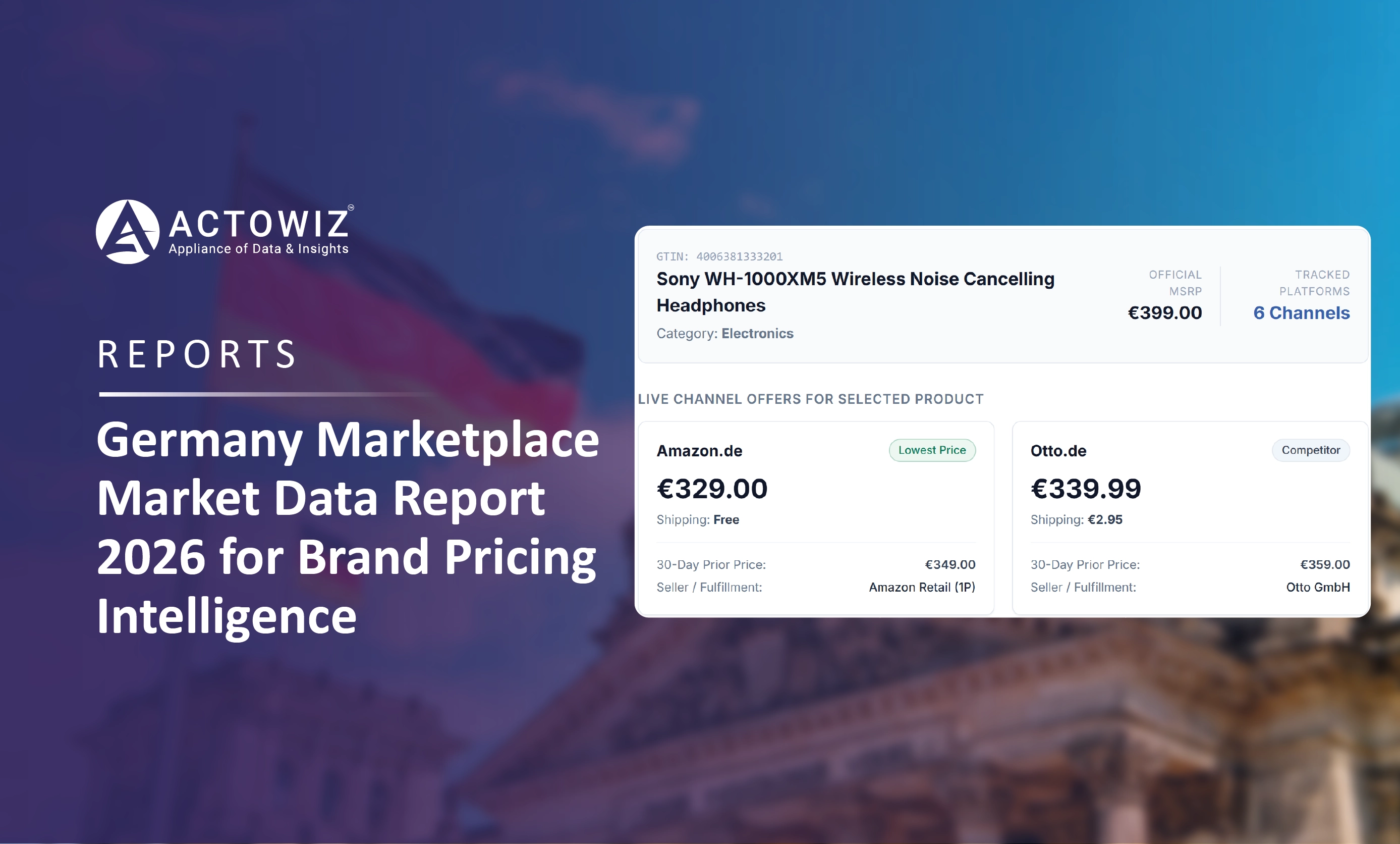
Germany Marketplace Market Data Report 2026 for Brand Pricing Intelligence

German marketplace data report 2026: online retail size, Amazon.de, Otto, Kaufland and Zalando price signals, PAngV rules and peak seasons.

Start Where It Makes Sense for You

Whether you're a startup or a Fortune 500 — we have the right plan for your data needs.

icons
Enterprise
Book a Strategy Call
Custom solutions, dedicated support, volume pricing for large-scale needs.
icons
Growing Brand
Get Free Sample Data
Try before you buy — 500 rows of real data, delivered in 2 hours. No strings.
icons
Just Exploring
View Plans & Pricing
Transparent plans from $500/mo. Find the right fit for your budget and scale.
Get in Touch
Let's Talk About
Your Data Needs
Tell us what data you need — we'll scope it for free and share a sample within hours.
  • icons
    Free Sample in 2 HoursShare your requirement, get 500 rows of real data — no commitment.
  • icons
    Plans from $500/monthFlexible pricing for startups, growing brands, and enterprises.
  • icons
    US-Based SupportOffices in New York & California. Aligned with your timezone.
  • icons
    ISO 9001 & 27001 CertifiedEnterprise-grade security and quality standards.
Request Free Sample Data
Fill the form below — our team will reach out within 2 hours.
+1 ▼
✓ Free 500-row sample · No credit card · Response within 2 hours

Request Free Sample Data

Our team will reach out within 2 hours with 500 rows of real data — no credit card required.

+1 ▼
✓ Free 500-row sample · No credit card · Response within 2 hours