Actowiz Metrics Real-time
logo
analytics dashboard for brands! Try Free Demo
Data-Transformation-and-Mapping-Techniques-for-Web-Scraping-with-Python-A-Complete-Guid

Introduction

Web Scraping with Python has become a widely used technique for extracting data from websites for competitive analysis, market research, and automation. Python’s powerful libraries—BeautifulSoup, Scrapy, and Selenium—allow businesses to extract structured and unstructured data efficiently. However, raw scraped data often contains errors, duplicates, and inconsistencies, making it difficult to analyze directly. This is where Scraped Data Transformation plays a critical role.

According to industry reports:

Statistic Details
85% of businesses Use web scraping for market intelligence.
60% of scraped data Requires transformation before use.
Data cleaning errors Can lead to a 40% drop in decision-making accuracy.

Without Data Cleaning in Python, businesses risk basing decisions on flawed data. By applying Data Mapping with Pandas, organizations can clean and structure the extracted information to ensure its usability. Implementing an ETL Process for Web Scraping enhances workflow efficiency, enabling companies to make data-driven decisions based on accurate, structured information.

Challenges of Handling Raw Scraped Data

Challenges-of-Handling-Raw-Scraped-Data

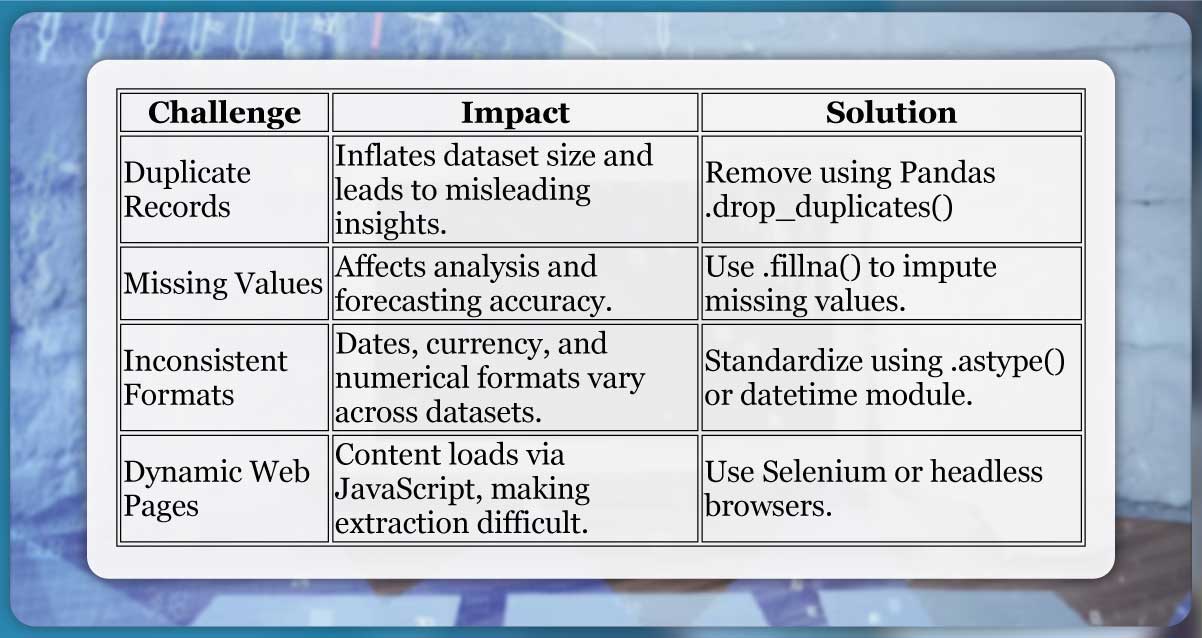
Extracting data is only the first step—processing and refining it is where most difficulties arise. Common challenges with raw scraped data include:

Challenge Impact Solution
Duplicate Records Inflates dataset size and leads to misleading insights. Remove using Pandas .drop_duplicates()

Missing Values Affects analysis and forecasting accuracy. Use .fillna() to impute missing values.
Inconsistent Formats Dates, currency, and numerical formats vary across datasets. Standardize using .astype() or datetime module.
Dynamic Web Pages Content loads via JavaScript, making extraction difficult. Use Selenium or headless browsers.

Without proper Data Cleaning in Python, these challenges can lead to incorrect analysis and flawed decision-making. Proper Scraped Data Transformation ensures that data is structured, standardized, and reliable.

Why Data Transformation and Mapping Are Crucial for Analysis?

Once data is scraped, it must be transformed and mapped into a structured format to be useful. Poorly mapped data can lead to inaccurate insights and inefficiencies in business processes. Data Mapping with Pandas ensures datasets are correctly structured and aligned with industry standards.

Aspect Impact of Poor Transformation Benefit of Proper Mapping
Price Monitoring Incorrect product-price mapping leads to wrong competitor analysis. Accurate pricing insights for competitive advantage.
Sentiment Analysis Scraped reviews with missing sentiment labels distort results. Reliable customer sentiment tracking.
Predictive Analytics Unstructured data affects model accuracy. Clean, structured data improves forecasting.

By following an ETL Process for Web Scraping, businesses ensure that raw data undergoes systematic cleaning, transformation, and storage, making it ready for advanced analysis and decision-making.

Understanding Scraped Data

What Raw Scraped Data Looks Like (Unstructured, Inconsistent Formats)

Raw data obtained from Web Scraping with Python is often unstructured and needs Python Data Processing before it becomes useful. Websites display information in various formats, including HTML, JSON, XML, and dynamically generated JavaScript content. This causes inconsistencies when extracting data, as the same type of information may appear in different structures across pages.

For example, a product’s price might appear in different ways:

Source Price Format
Website A ₹1,299
Website B Rs. 1,299/-
Website C 1299 INR

These inconsistencies make direct comparison difficult. Proper Data Structuring with Python ensures that all extracted values are converted into a uniform format for better analysis.

Common Issues: Missing Values, Duplicate Records, Incorrect Data Types

Raw data from scraping often contains missing values, duplicates, and incorrect data types, which can lead to errors in Big Data Analytics with Python.

Issue Impact Solution
Missing Values Incomplete datasets lead to inaccurate analysis. Use .fillna() or drop empty values.
Duplicate Records Inflates dataset size and affects machine learning models. Use .drop_duplicates() to remove redundancy.
Incorrect Data Types Numeric values stored as text can break calculations. Convert using .astype(int) or .astype(float).

To ensure Visualizing Scraped Data is effective, proper cleaning is crucial. Without preprocessing, graphs and models based on raw data may produce misleading results.

Examples of Raw Data from Web Scraping

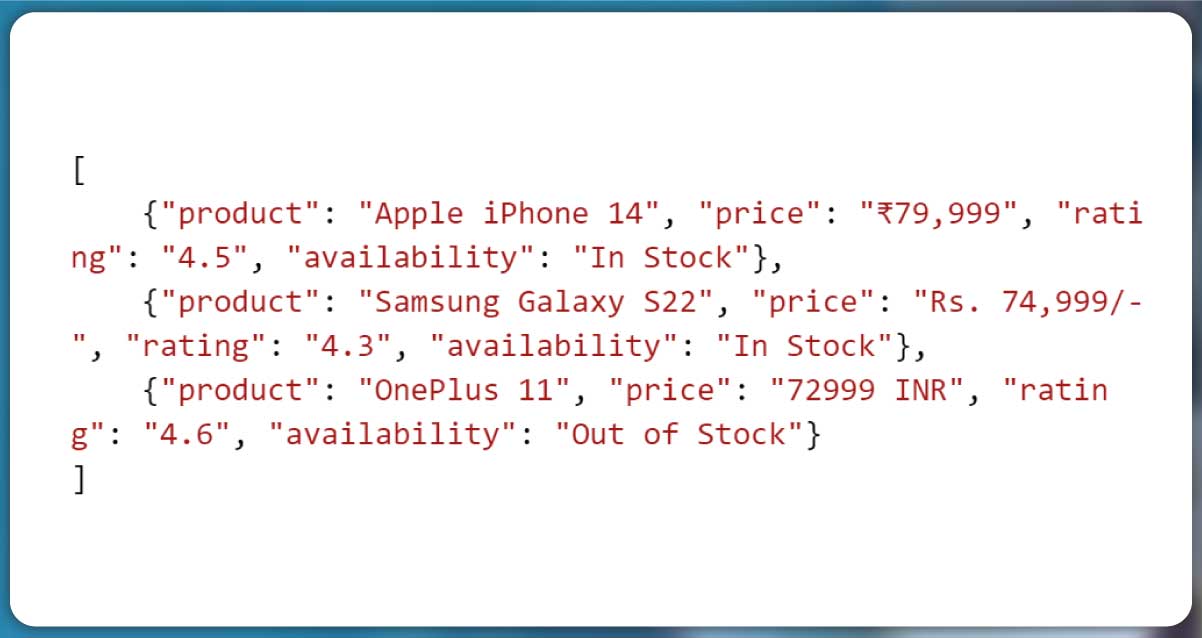
Here’s an example of unprocessed scraped data:

Examples-of-Raw-Data-from-Web-Scraping

Problems:

  • 1. Inconsistent price formats (₹, Rs., INR).
  • 2. Availability not standardized (some products are in stock, others not).
  • 3. Different rating scales (some sites may use 1-10 instead of 1-5).

Using Geospatial Data Mapping, businesses can structure this information based on location-based pricing and availability trends. Data Structuring with Python helps convert this messy data into clean, usable datasets, essential for Big Data Analytics with Python.

Essential Python Libraries for Data Transformation

Processing scraped data efficiently requires powerful Python Data Processing tools. Python offers several libraries that help clean, structure, and transform raw data into an analyzable format. Below are some essential libraries for Data Structuring with Python and their key use cases.

1. Pandas – Cleaning, Structuring, and Analyzing Scraped Data

Pandas is one of the most widely used libraries for cleaning, structuring, and analyzing scraped data. It provides DataFrame and Series objects to organize data efficiently.

Feature Use Case
.dropna() Removes missing values.
.fillna(value) Fills missing values with default values.
.drop_duplicates() Eliminates duplicate entries.
.astype(dtype) Converts data types (e.g., str → int).

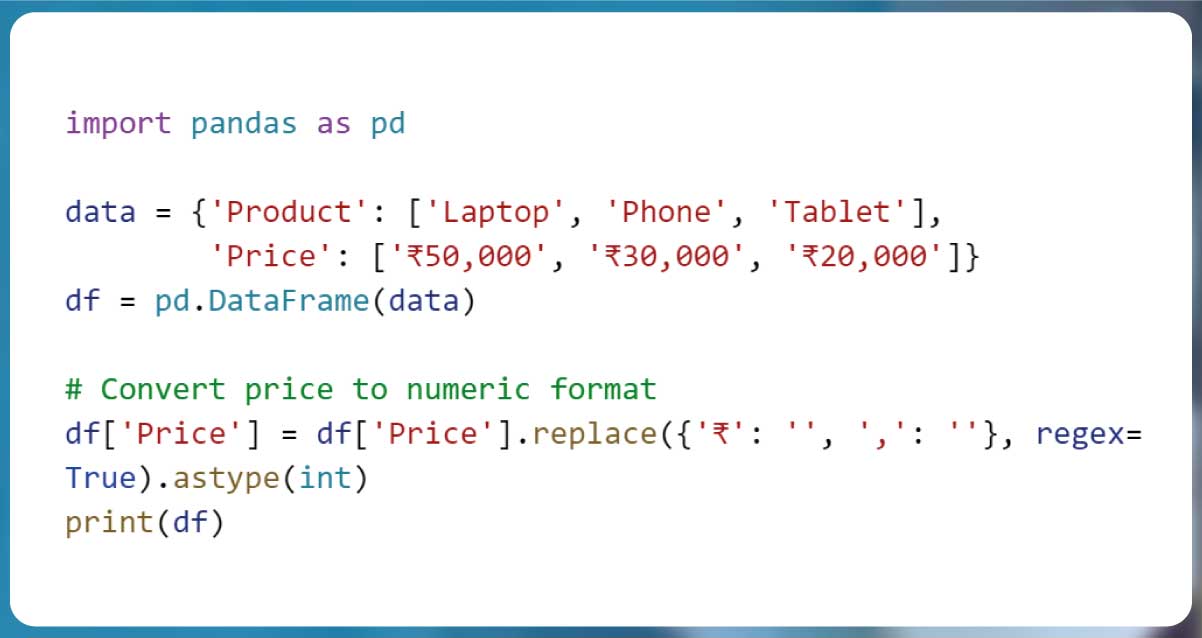
Example:

1.-Pandas-–-Cleaning,-Structuring,-and-Analyzing-Scraped-Data

This ensures the Visualizing Scraped Data process is accurate.

2. NumPy – Handling Numerical Data Efficiently

NumPy is used for efficient numerical computation in Big Data Analytics with Python. It supports multi-dimensional arrays and functions for statistical analysis.

Feature Use Case
np.array() Converts lists to numerical arrays.
np.mean() Calculates the average of numerical data.
np.median() Computes the median of a dataset.
np.std() Finds the standard deviation.

Example:

import numpy as np
prices = np.array([50000, 30000, 20000])
print("Average Price:", np.mean(prices))

3. BeautifulSoup & Scrapy – Extracting Structured Data

For web scraping, BeautifulSoup and Scrapy help extract structured data from HTML pages.

Library Purpose
BeautifulSoup Parses static HTML data.
Scrapy Extracts large-scale data efficiently.

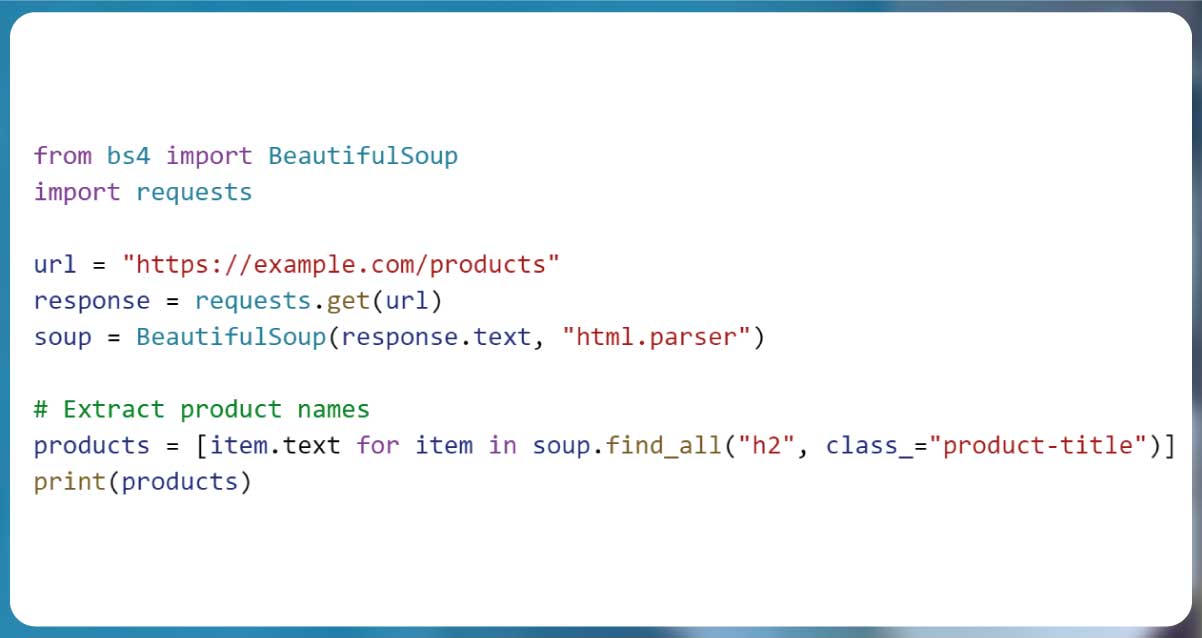
Example using BeautifulSoup:

3.-BeautifulSoup-&-Scrapy-–-Extracting-Structured-Data
4. JSON & CSV Modules – Storing and Exporting Cleaned Data

Data extracted and transformed should be stored in structured formats like JSON or CSV.

Format Use Case
CSV Best for tabular data (Excel, spreadsheets).
JSON Ideal for nested, hierarchical data.

Example:

import json

data = {'Product': 'Laptop', 'Price': 50000}
with open("output.json", "w") as file:
    json.dump(data, file)


This ensures efficient Geospatial Data Mapping and Big Data Analytics with Python.

Cleaning Scraped Data

Raw data extracted through Web Scraping with Python is often messy and requires thorough Data Cleaning in Python before analysis. This step is crucial in the ETL Process for Web Scraping, ensuring that data is structured and ready for further processing. Below are key methods for Scraped Data Transformation using Data Mapping with Pandas and other Python tools.

1. Removing HTML Tags, Special Characters, and Unnecessary Spaces

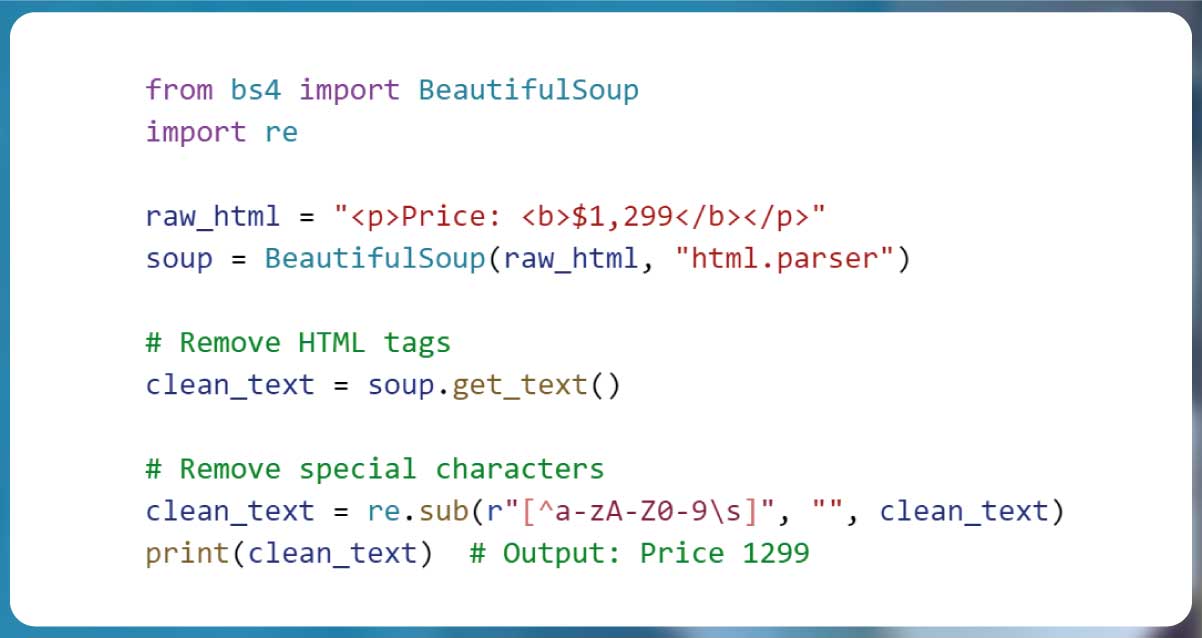
Web pages contain HTML tags, JavaScript code, and unnecessary symbols that must be removed for clean text extraction. BeautifulSoup helps eliminate HTML tags, while Pandas and Regex handle special characters and whitespace issues.

Example: Cleaning HTML and Special Characters
1.-Removing-HTML-Tags,-Special-Characters,-and-Unnecessary-Spaces
Issue Impact Solution
HTML Tags Clutters text fields. Use BeautifulSoup .get_text()
Special Characters Prevents clean data storage. Use regex re.sub()
Extra Spaces Affects search and sorting. Use .strip() or .replace()
2. Handling Missing Values (Filling, Removing, or Interpolating Data)

Incomplete data is a common issue in Scraped Data Transformation. Depending on the dataset, missing values can be:

  • Removed if they are not essential.
  • Filled using default or estimated values.
  • Interpolated using trends in the dataset.
Example: Handling Missing Values with Pandas
2.-Handling-Missing-Values-(Filling,-Removing,-or-Interpolating-Data)
Method Use Case
.dropna() Remove missing values.
.fillna(value) Replace missing values with a default.
.interpolate() Estimate missing values based on trends.
3. Standardizing Date, Time, and Numerical Formats

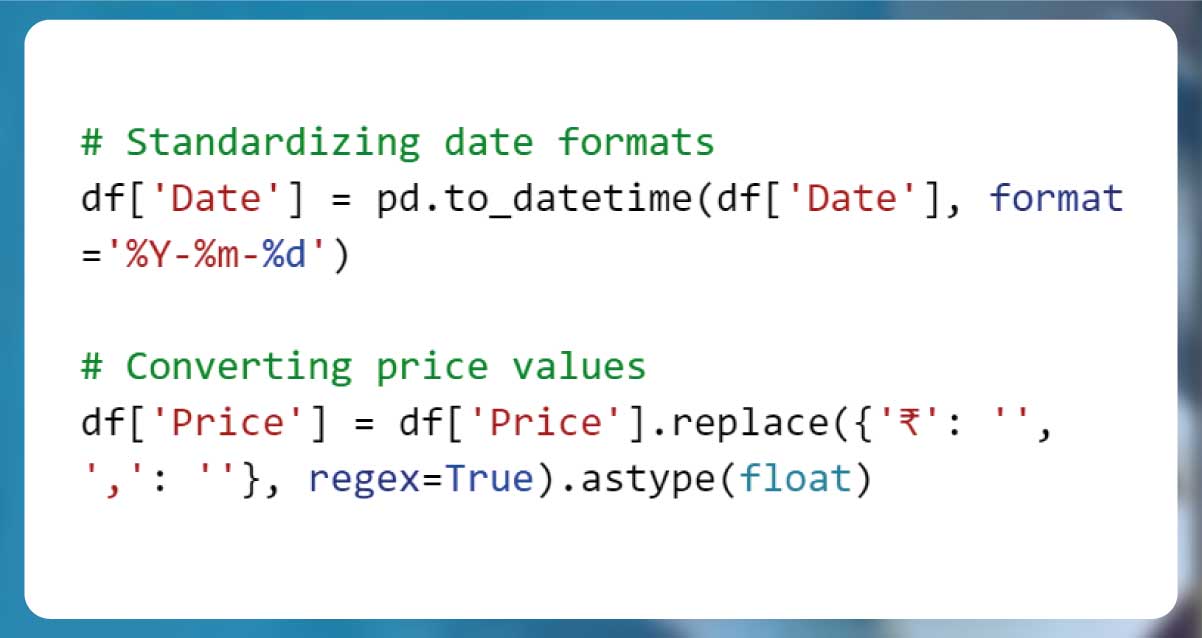
Inconsistent date formats and currency values can affect analysis and Data Mapping with Pandas. Converting them into a uniform structure ensures consistency.

Example: Converting Dates and Prices
3.-Standardizing-Date,-Time,-and-Numerical-Formats
Issue Solution
Different date formats (MM/DD/YYYY vs. DD-MM-YYYY) Use pd.to_datetime() for conversion.
Currency symbols and commas in numbers Use .replace() and .astype(float).

By applying these Data Cleaning in Python techniques, businesses can streamline the ETL Process for Web Scraping, ensuring that data is accurate, structured, and ready for insights.

Mapping and Structuring Data

Once data is cleaned, the next step in Scraped Data Transformation is mapping and structuring it into an organized format for analysis. Using dictionaries, Pandas DataFrames, and relational formats, businesses can ensure efficient Data Mapping with Pandas as part of the ETL Process for Web Scraping.

1. Using Dictionaries and DataFrames for Better Organization

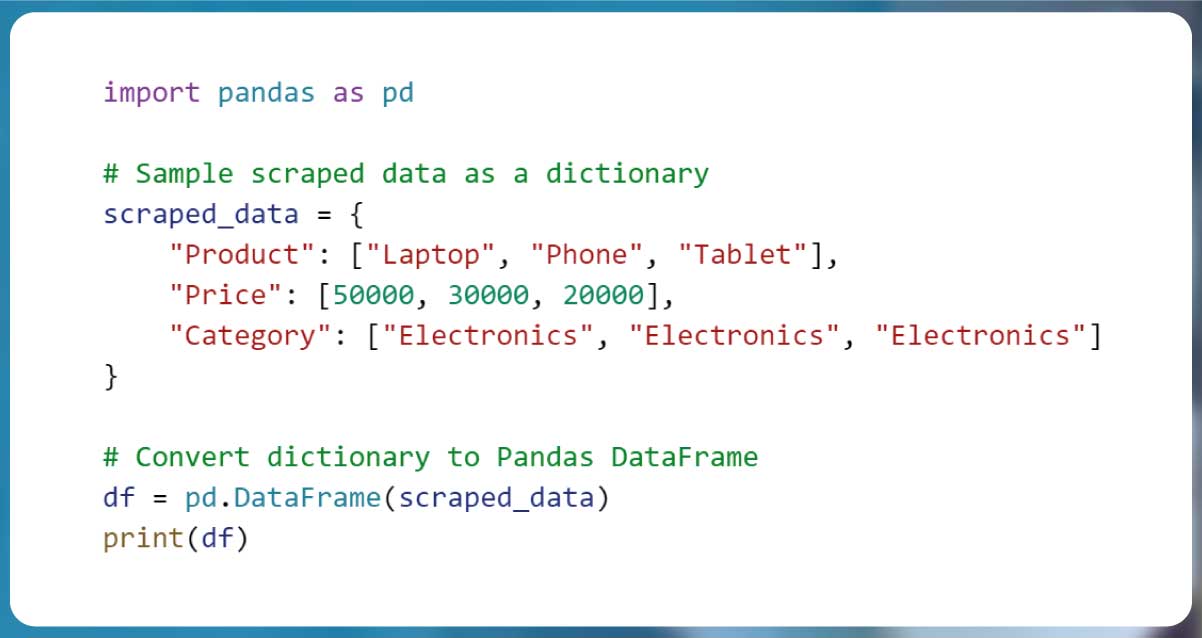
Dictionaries in Python are excellent for storing and organizing scraped data, while Pandas DataFrames offer tabular structures for efficient processing.

Example: Converting Raw Data into a Dictionary and DataFrame
1.-Using-Dictionaries-and-DataFrames-for-Better-Organization
Benefit Why It’s Useful
Dictionaries Store key-value pairs for easy mapping.
DataFrames Structure data into rows and columns for analysis.
2. Mapping Categories and Labels to Meaningful Names

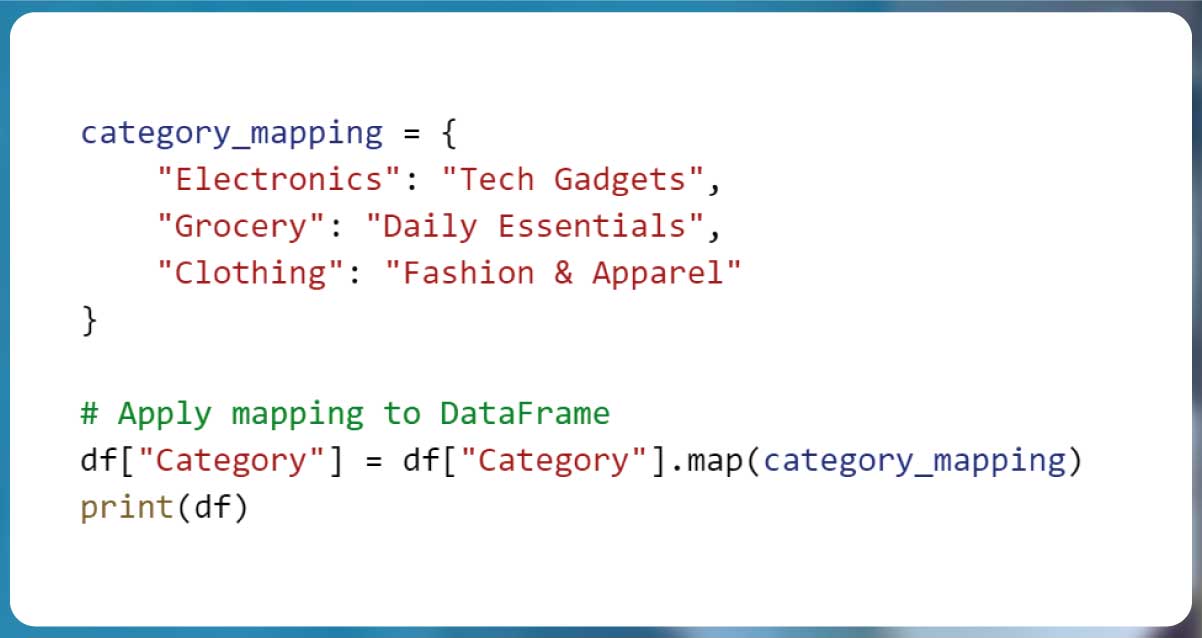
Often, scraped data contains vague or coded categories that need to be mapped to meaningful labels for clarity.

Example: Mapping Product Categories to User-Friendly Labels
2.-Mapping-Categories-and-Labels-to-Meaningful-Names
Issue Solution
Coded or vague labels (e.g., "Elec") Map to full names (e.g., "Electronics").
Different spellings across sources Use .replace() or .map() for consistency.
3. Converting Unstructured Data into a Relational Format

Relational databases require structured tables with relationships between entities. Scraped data often needs to be normalized before being stored.

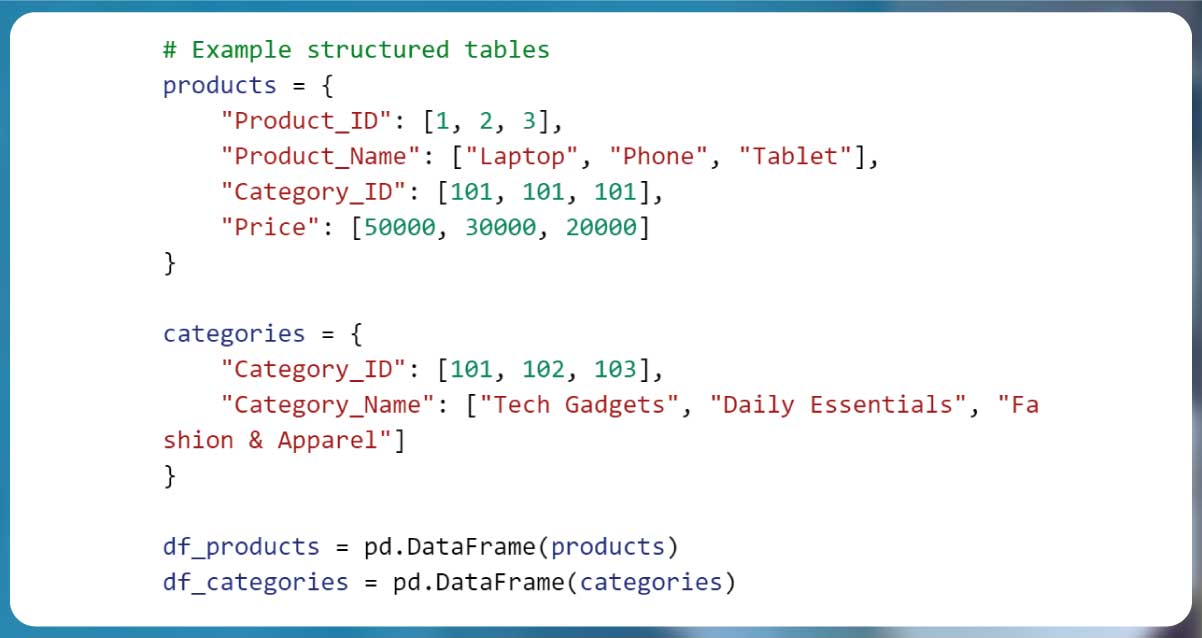
Example: Splitting Data into Multiple Tables for a Relational Format

Instead of storing all data in one table, separate it into related tables for efficient queries.

Table Fields
Products Product ID, Name, Category ID, Price
Categories Category ID, Category Name
3.-Converting-Unstructured-Data-into-a-Relational-Format

By mapping and structuring data properly, businesses can improve Big Data Analytics with Python, making it easier to visualize trends and extract insights.

Exporting and Storing Cleaned Data

Once Python Data Processing is complete, the next step is storing structured data efficiently for future use. This involves exporting cleaned data into formats like CSV, JSON, or databases and automating data storage with SQL and NoSQL systems. Proper data storage ensures smooth Big Data Analytics with Python, making insights easily accessible.

1. Saving Structured Data in CSV, JSON, or Databases

Depending on the use case, different formats are used for Data Structuring with Python:

Format Use Case Pros
CSV Best for tabular data & spreadsheets. Easy to read & lightweight.
JSON Works well for APIs & hierarchical data. Flexible & human-readable.
SQL Databases Suitable for structured, relational data. Optimized for queries & joins.
NoSQL (MongoDB, Firebase) Ideal for unstructured or dynamic data. Scalable & schema-free.
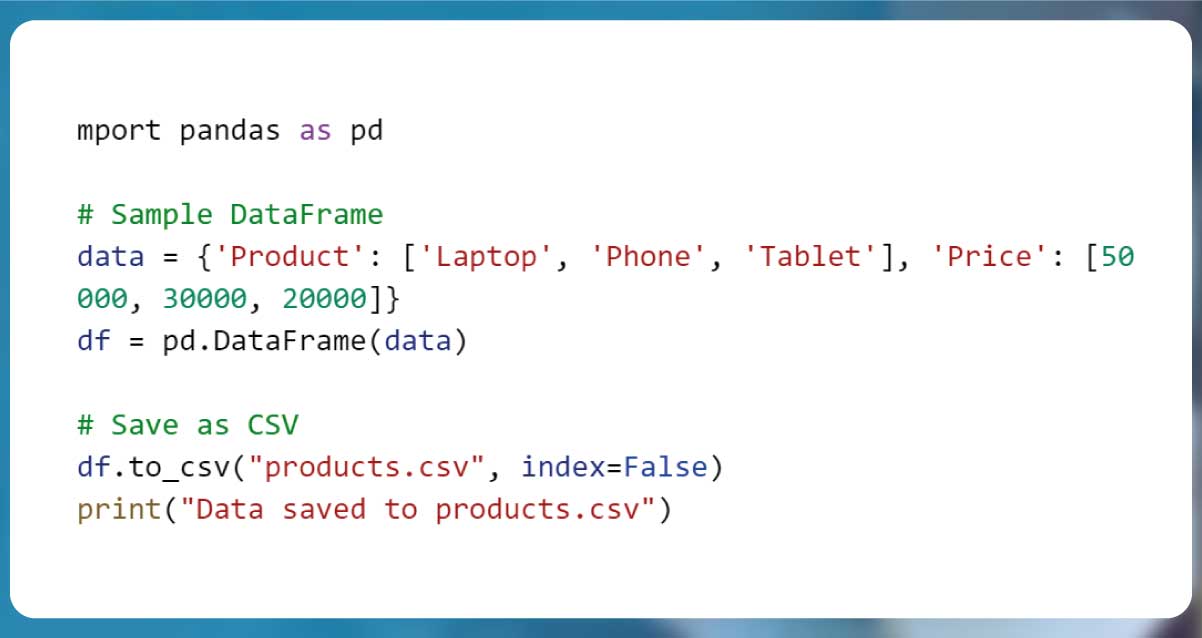
Example: Exporting Data to CSV
1.-Saving-Structured-Data-in-CSV,-JSON,-or-Databases
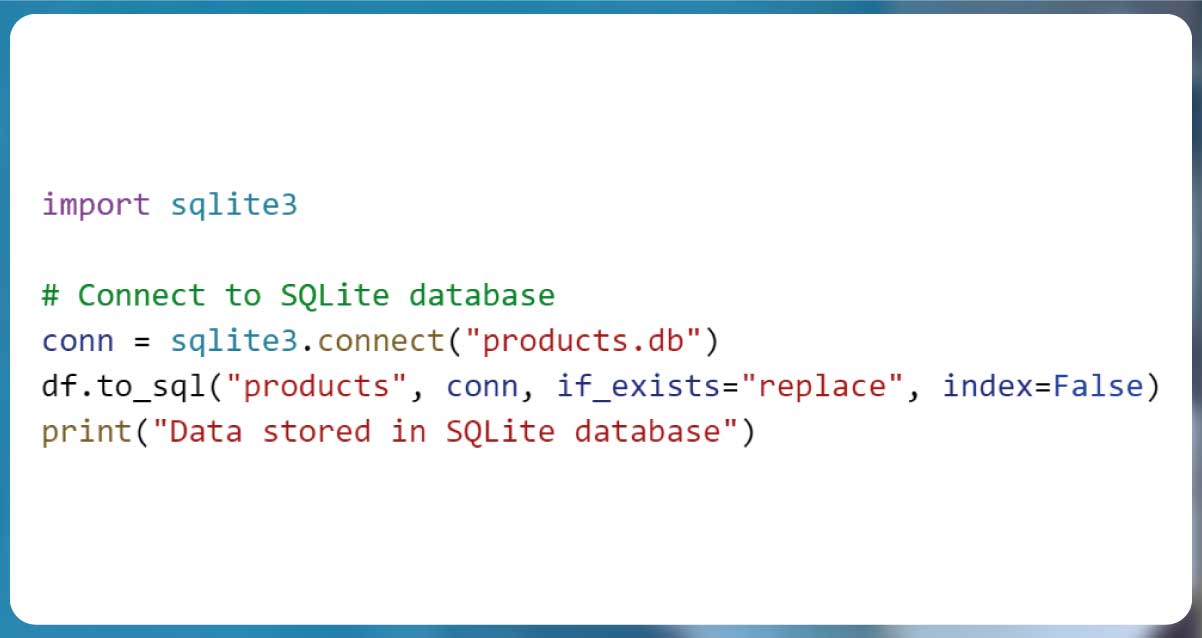
2. Automating Data Storage with SQL and NoSQL

For Visualizing Scraped Data and long-term storage, databases are more efficient than flat files.

Storing Data in SQL (MySQL / PostgreSQL)
2.-Automating-Data-Storage-with-SQL-and-NoSQL
Storing Data in NoSQL (MongoDB)
Storing-Data-in-NoSQL-(MongoDB)
3. Geospatial Data Mapping and Big Data Storage

For Geospatial Data Mapping, storing location-based data is crucial. PostGIS (PostgreSQL extension) and MongoDB’s geospatial indexing are useful for this.

Database Geospatial Feature
PostGIS Stores & queries latitude/longitude data.
MongoDB Supports 2D indexing for mapping.

By properly exporting and storing cleaned data, businesses can ensure scalability, efficiency, and easy data retrieval for analytics and reporting.

Automating the Transformation Process

Automation is essential in Scraped Data Transformation to handle large-scale datasets efficiently. By writing Python scripts, leveraging APIs for real-time updates, and integrating cloud storage solutions, businesses can streamline the ETL Process for Web Scraping and ensure continuous Data Mapping with Pandas.

1. Writing Python Scripts for Recurring Data Transformation Tasks

Manually cleaning and structuring scraped data is inefficient for recurring tasks. Python scripts automate these processes, ensuring consistent and accurate transformation.

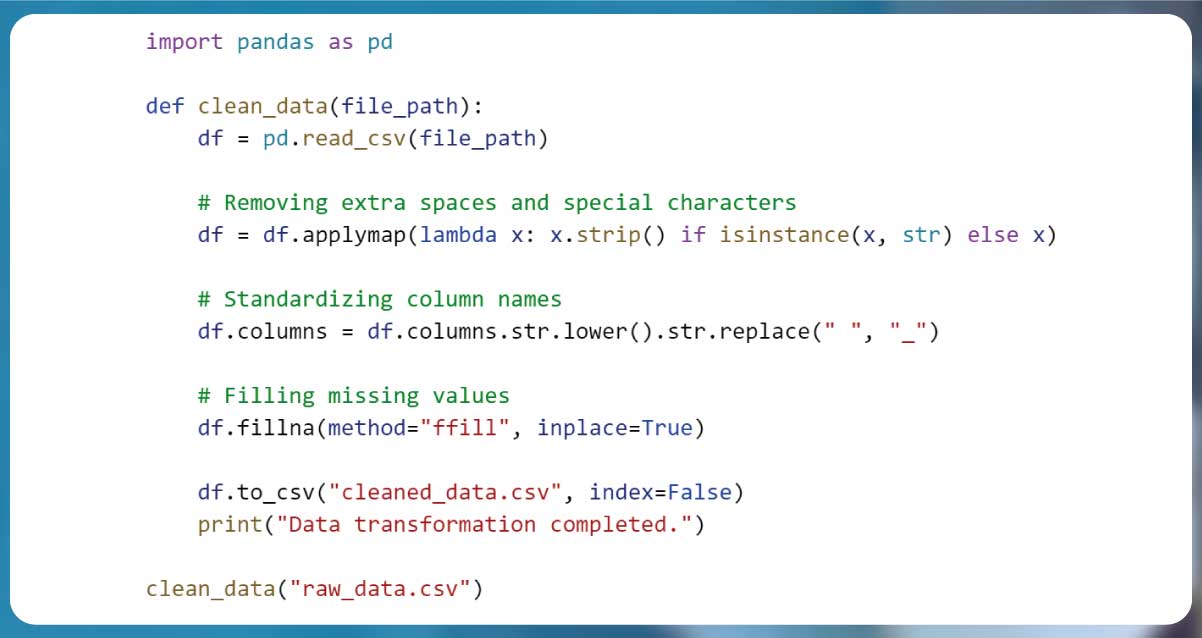
Example: Automating Data Cleaning with Pandas
1.-Writing-Python-Scripts-for-Recurring-Data-Transformation-Tasks
Task Automated Process
Removing spaces & symbols .applymap() function
Standardizing column names .str.lower() & .replace()
Handling missing values .fillna(method="ffill")
2. Using APIs for Real-Time Data Updates

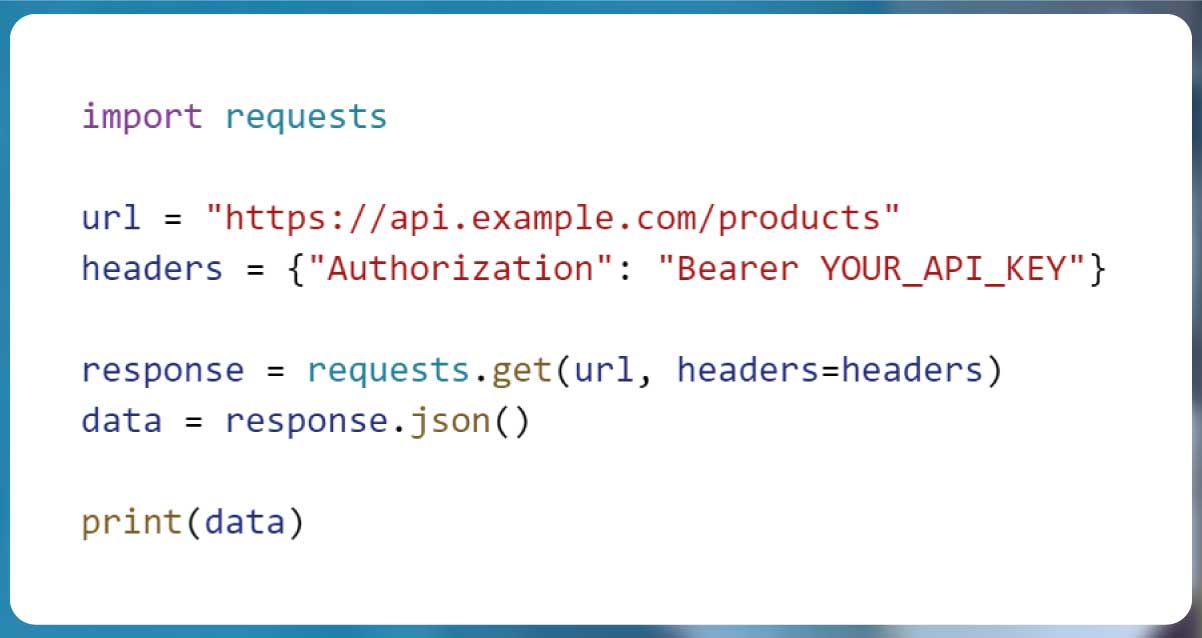
APIs help fetch real-time data instead of scraping static pages repeatedly. Web Scraping with Python can be combined with APIs for dynamic updates.

Example: Fetching Data from an API
2.-Using-APIs-for-Real-Time-Data-Updates
API Integration Benefits Why It’s Useful
Faster than scraping Direct data retrieval from sources.
Live data updates Always fetches the latest records.
No legal risks Avoids scraping restrictions.
3. Implementing Cloud Storage Solutions for Data Management

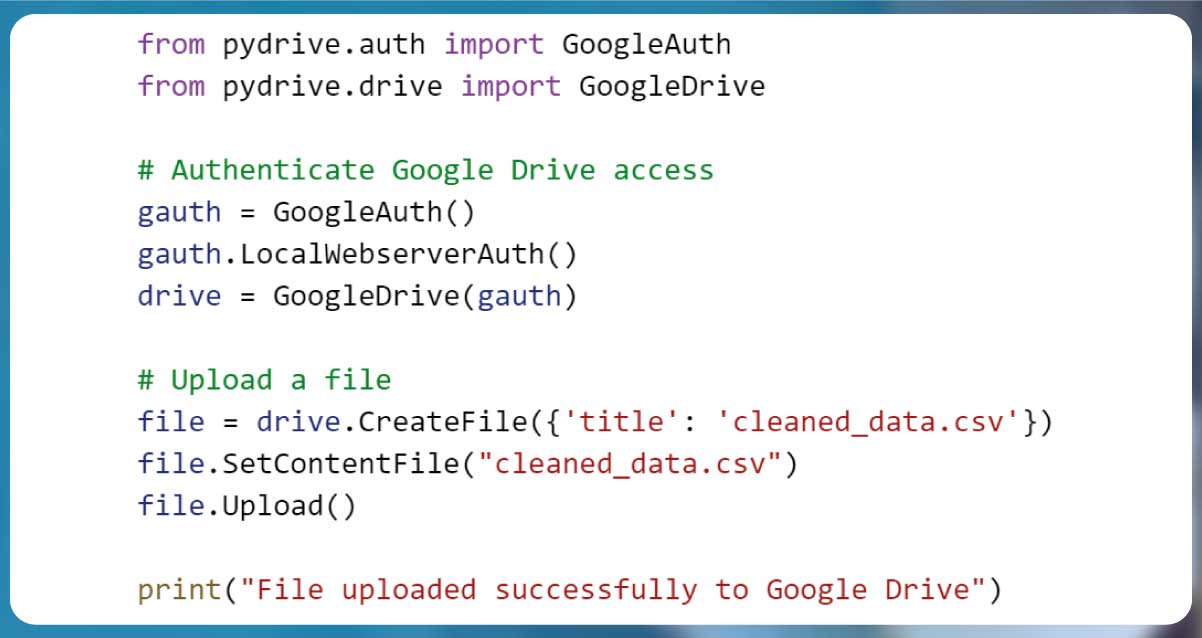
For scalability, storing transformed data in cloud platforms like AWS S3, Google Drive, or Azure ensures easy access and security.

Example: Uploading Data to Google Drive with Python
3.-Implementing-Cloud-Storage-Solutions-for-Data-Management
Cloud Storage Option Use Case
AWS S3 Large-scale enterprise storage
Google Drive Personal & small business storage
Azure Blob Storage Integrated with Microsoft ecosystem

By automating the transformation process, businesses can save time, reduce errors, and ensure data is always up to date.

Conclusion

Transforming and mapping scraped data is essential for making raw information structured, usable, and insightful. Throughout this guide, we explored key techniques, including Python Data Processing, Data Structuring with Python, and Geospatial Data Mapping. Leveraging libraries like Pandas, NumPy, and BeautifulSoup, we demonstrated how to clean, map, and store data efficiently for Big Data Analytics with Python.

Actowiz Solutions specializes in web scraping, data transformation, and automation services to help businesses extract and analyze data seamlessly. With expertise in ETL processes, Python-based data pipelines, and real-time data analytics, Actowiz ensures that organizations can make data-driven decisions with confidence. Contact Actowiz Solutions now! You can also reach us for all your mobile app scraping , data collection, web scrapings , and instant data scraper service requirements!

Social Proof That Converts

Trusted by Global Leaders Across Q-Commerce, Travel, Retail, and FoodTech

Our web scraping expertise is relied on by 4,000+ global enterprises including Zomato, Tata Consumer, Subway, and Expedia — helping them turn web data into growth.

4,000+ Enterprises Worldwide
50+ Countries Served
20+ Industries
Join 4,000+ companies growing with Actowiz →
Real Results from Real Clients

Hear It Directly from Our Clients

Watch how businesses like yours are using Actowiz data to drive growth.

1 min
★★★★★
"Actowiz Solutions offered exceptional support with transparency and guidance throughout. Anna and Saga made the process easy for a non-technical user like me. Great service, fair pricing!"
TG
Thomas Galido
Co-Founder / Head of Product at Upright Data Inc.
2 min
★★★★★
"Actowiz delivered impeccable results for our company. Their team ensured data accuracy and on-time delivery. The competitive intelligence completely transformed our pricing strategy."
II
Iulen Ibanez
CEO / Datacy.es
1:30
★★★★★
"What impressed me most was the speed — we went from requirement to production data in under 48 hours. The API integration was seamless and the support team is always responsive."
FC
Febbin Chacko
-Fin, Small Business Owner
4.8/5 Average Rating
📹 50+ Video Testimonials
🔄 92% Client Retention
🌍 50+ Countries Served

Join 4,000+ Companies Growing with Actowiz

From Zomato to Expedia — see why global leaders trust us with their data.

Why Global Leaders Trust Actowiz

Backed by automation, data volume, and enterprise-grade scale — we help businesses from startups to Fortune 500s extract competitive insights across the USA, UK, UAE, and beyond.

icons
7+
Years of Experience
Proven track record delivering enterprise-grade web scraping and data intelligence solutions.
icons
4,000+
Projects Delivered
Serving startups to Fortune 500 companies across 50+ countries worldwide.
icons
200+
In-House Experts
Dedicated engineers across scrapers, AI/ML models, APIs, and data quality assurance.
icons
9.2M
Automated Workflows
Running weekly across eCommerce, Quick Commerce, Travel, Real Estate, and Food industries.
icons
270+ TB
Data Transferred
Real-time and batch data scraping at massive scale, across industries globally.
icons
380M+
Pages Crawled Weekly
Scaled infrastructure for comprehensive global data coverage with 99% accuracy.

AI Solutions Engineered
for Your Needs

LLM-Powered Attribute Extraction: High-precision product matching using large language models for accurate data classification.
Advanced Computer Vision: Fine-grained object detection for precise product classification using text and image embeddings.
GPT-Based Analytics Layer: Natural language query-based reporting and visualization for business intelligence.
Human-in-the-Loop AI: Continuous feedback loop to improve AI model accuracy over time.
🎯 Product Matching 🏷️ Attribute Tagging 📝 Content Optimization 💬 Sentiment Analysis 📊 Prompt-Based Reporting

Connect the Dots Across
Your Retail Ecosystem

We partner with agencies, system integrators, and technology platforms to deliver end-to-end solutions across the retail and digital shelf ecosystem.

icons
Analytics Services
icons
Ad Tech
icons
Price Optimization
icons
Business Consulting
icons
System Integration
icons
Market Research
Become a Partner →

Popular Datasets — Ready to Download

Browse All Datasets →
icons
Amazon
eCommerce
Free 100 rows
icons
Zillow
Real Estate
Free 100 rows
icons
DoorDash
Food Delivery
Free 100 rows
icons
Walmart
Retail
Free 100 rows
icons
Booking.com
Travel
Free 100 rows
icons
Indeed
Jobs
Free 100 rows

Latest Insights & Resources

View All Resources →
thumb
Blog

AI-Powered Web Scraping: How Vision-LLMs Are Replacing CSS Selectors

How AI and Vision-LLMs are revolutionizing web scraping in 2026. Self-healing scrapers, visual parsing, and zero-maintenance data extraction explained.

thumb
Case Study

UK DTC Brand Detects 800+ MAP Violations in First Month

How a $50M+ consumer electronics brand used Actowiz MAP monitoring to detect 800+ violations in 30 days, achieving 92% resolution rate and improving retailer satisfaction by 40%.

thumb
Report

Track UK Grocery Products Daily Using Automated Data Scraping to Monitor 50,000+ UK Grocery Products from Morrisons, Asda, Tesco, Sainsbury’s, Iceland, Co-op, Waitrose, Ocado

Track UK Grocery Products Daily Using Automated Data Scraping across Morrisons, Asda, Tesco, Sainsbury’s, Iceland, Co-op, Waitrose, and Ocado for insights.

Start Where It Makes Sense for You

Whether you're a startup or a Fortune 500 — we have the right plan for your data needs.

icons
Enterprise
Book a Strategy Call
Custom solutions, dedicated support, volume pricing for large-scale needs.
icons
Growing Brand
Get Free Sample Data
Try before you buy — 500 rows of real data, delivered in 2 hours. No strings.
icons
Just Exploring
View Plans & Pricing
Transparent plans from $500/mo. Find the right fit for your budget and scale.
Get in Touch
Let's Talk About
Your Data Needs
Tell us what data you need — we'll scope it for free and share a sample within hours.
  • Free Sample in 2 HoursShare your requirement, get 500 rows of real data — no commitment.
  • 💰
    Plans from $500/monthFlexible pricing for startups, growing brands, and enterprises.
  • 🇺🇸
    US-Based SupportOffices in New York & California. Aligned with your timezone.
  • 🔒
    ISO 9001 & 27001 CertifiedEnterprise-grade security and quality standards.
Request Free Sample Data
Fill the form below — our team will reach out within 2 hours.
+1
Free 500-row sample · No credit card · Response within 2 hours

Request Free Sample Data

Our team will reach out within 2 hours with 500 rows of real data — no credit card required.

+1
Free 500-row sample · No credit card · Response within 2 hours
d