Hotel rates & availability
Rate shopping with the parameters that define the price.
- Rate by date, LOS and occupancy
- Room type and rate plan detail
- Refundable versus non-refundable
- Tax and fee treatment per channel
- Rooms-left and sold-out signals

Scalable web, app and AI-powered collection across 40+ countries.
All services → By industry
Repricing driven by competitor moves rather than a weekly review.
Explore → Pricing & Promotions
 Brand & Intelligence
 Digital Shelf & Search
 Assortment
 For Retailers
Which solution fits?
Talk to ExpertTalabat, Careem Quik and Noon Minutes across 18 GCC cities.
Launch Demo →Tesco, Sainsbury's, Asda, Morrisons and Aldi, daily.
Get Early Access → By Industry
 E-Commerce Dashboard
 Flipkart Insights (Live) #1
 Grocery Intelligence
.svg) Grocery Price (U.S.)
Grocery Price (U.S.)
.svg) Quick Commerce (India) HOT
Quick Commerce (India) HOT
 Food & Restaurant
 Fashion Intelligence
 Automotive
 Travel & Hospitality
 Real Estate
 Food Delivery Intelligence NEW
 OTT & Streaming NEW
 Fuel & EV Charging Price Tracker NEW
 By Use Case
 Pricing Intelligence
 Digital Shelf Analytics
 MAP Monitoring HOT
 Cross-Border Price Parity NEW
 Share of Search
 Review Sentiment
 Kitchen Market Gaps NEW
 Dynamic Pricing / AI Repricing NEW
 Promotions & Deals Alerts NEW
 B2B / POI & Lead Data NEW
 AI Search Visibility Dashboard NEW
 Baby Products on Quick Commerce NEW
 Hotel & Flight Rate Parity NEW
 By Region
 Flipkart Real-Time Insights
 Quick Commerce — Zepto · Blinkit
 Pincode Price Tracker
 GCC Q-Commerce — Talabat · Noon NEW
 UK Grocery — Tesco, Sainsbury's, Asda
 AU Grocery — Coles & Woolworths NEW
Sources we already run pipelines against. Download a real sample from any of them.
Browse coverage → Marketplace Scrapers
 Developer APIs
 Universal APIs
 Delivery & SDKs
Fixed monthly retainer, named engineer, no per-request metering.
Managed Data API → Knowledge Center
 Guides & Playbooks
 Downloads & Tools
 Trust & Company
Scalable web, app and AI-powered collection across 40+ countries.
All 58 services → By industryRepricing driven by competitor moves rather than a weekly review.
Explore → Pricing & Promotions
Brand & Intelligence
Digital Shelf & Search
Assortment For RetailersWhich solution fits?
Talk to ExpertSources we already run pipelines against. Download a real sample from any of them.
Browse coverage →Talabat, Careem Quik and Noon Minutes across 18 GCC cities.
Launch Demo →Tesco, Sainsbury's, Asda, Morrisons and Aldi, daily.
Get Early Access → By Industry
E-Commerce Dashboard
Flipkart Insights (Live) #1
Grocery Intelligence
Grocery Price (U.S.)
Quick Commerce (India) HOT
Food & Restaurant
Fashion Intelligence
Automotive
Travel & Hospitality
Real Estate
Food Delivery Intelligence NEW
OTT & Streaming NEW
Fuel & EV Charging Price Tracker NEW
By Use Case
Pricing Intelligence
Digital Shelf Analytics
MAP Monitoring HOT
Cross-Border Price Parity NEW
Share of Search
Review Sentiment
Kitchen Market Gaps NEW
Dynamic Pricing / AI Repricing NEW
Promotions & Deals Alerts NEW
B2B / POI & Lead Data NEW
AI Search Visibility Dashboard NEW
Baby Products on Quick Commerce NEW
Hotel & Flight Rate Parity NEW
By Region Flipkart Real-Time Insights
Quick Commerce — Zepto · Blinkit
Pincode Price Tracker
GCC Q-Commerce — Talabat · Noon NEW
UK Grocery — Tesco, Sainsbury's, Asda
AU Grocery — Coles & Woolworths NEW
Marketplace Scrapers
Developer APIs Universal APIs Delivery & SDKsFixed monthly retainer, named engineer, no per-request metering.
Managed Data API → Knowledge Center
Guides & Playbooks
Downloads & Tools
Trust & CompanyPriced by date, occupancy and length of stay, the way travel actually sells.
A hotel does not have a price. It has a price for two adults, checking in on 14 October, staying two nights, on a refundable rate, booked through a specific channel. Strip any of those away and the number means nothing.
Free pilot on your own sources, returned in 48 hours. No card, no trial clock — and you keep the sample data either way.
Last verified 5 August 2026 by the Actowiz Solutions Data Engineering team.
Travel data scraping is the automated collection of pricing and availability from travel booking sources. It differs from every other scraping category in one structural way: travel prices do not exist on pages, they exist as responses to searches.
A retail product page has a price. A hotel page has no price until you specify dates, occupancy and length of stay. The same room on the same night can carry six different prices depending on how the search was constructed, and every one of them is correct.
A dataset that reports "average nightly rate for this hotel" has silently collapsed all six dimensions. It cannot answer whether you are undercut on a specific compression date, whether your two-night weekend pricing is competitive, or whether an OTA is breaking parity on a refundable rate.
Every record we deliver carries the complete search context that produced it. That makes the volume larger — a property across 180 dates, three lengths of stay and two occupancies is over a thousand shops — and it is the only way the data supports a revenue decision. We scope the grid with you so cost tracks the decisions you actually make.
Hotel rate shopping is the largest use case. All categories share the same principle: full search context on every record.
Rate shopping with the parameters that define the price.
The same stay compared across every channel you sell on.
Route-level fares with the fine print captured.
Short-term rental pricing, which behaves unlike hotels.
Rates by pickup window and vehicle class.
The reputation and presentation layer.
A managed engagement, not a tool licence. We own the pipeline and everything that breaks in it.
Every engagement delivers a documented schema. These are the core hotel fields; flight, rental and car hire schemas follow the same context-complete principle.
| Field | Type | What it captures | Refresh |
|---|---|---|---|
property_id |
string | Stable property identity across channels, so parity comparison is like-for-like | Every run |
channel / point_of_sale |
string | Booking channel and the point of sale the shop was run from | Every run |
shop_date |
date | When the search ran, which anchors days-to-arrival analysis | Every run |
checkin / los |
date / int | Arrival date and length of stay, both of which change the price | Every run |
occupancy |
object | Adults, children and child ages where the channel requires them | Every run |
room_type / rate_plan |
string | Room product and rate plan including inclusions such as breakfast | Every run |
refundable / cancel_deadline |
boolean / date | Cancellation terms, which make otherwise identical rates different products | Every run |
price_total / price_per_night |
decimal | Total for the stay and derived nightly rate, in the shopped currency | Per cadence |
taxes_included / tax_est |
boolean / decimal | Tax treatment flag and estimated tax, since channels differ | Per cadence |
rooms_left_hint / sold_out |
int / boolean | Scarcity signals and closed-out dates where the channel displays them | Per cadence |
parity_vs_brand_site |
decimal | Computed gap against the brand's own-site rate for the identical stay | Per cadence |
Parity is computed, not just collected: we run the identical stay across channels within the same shop window, because a parity comparison built from shops hours apart is not a comparison at all.
Coverage is built to your competitive set and channel mix. Shop grids are scoped deliberately, since the grid drives volume.
Some channels vary pricing by the searcher's apparent country and currency. Where that happens we collect per point of sale rather than reporting one price and calling it global. Request a source we don't list →
We deliver into 40+ countries. These are the markets where this particular service is requested most, and the reason demand concentrates there.
| Market | Why demand concentrates here |
|---|---|
| United Kingdom & Western Europe | Dense OTA competition and strong direct-booking programmes make parity monitoring the dominant use case. |
| United States | Large branded hotel estates with sophisticated revenue management, so shop grids tend to be deep and high-frequency. |
| United Arab Emirates & Saudi Arabia | Rapid supply growth and event-driven compression create heavy demand for forward-window rate data. |
| India & Southeast Asia | High OTA dependence and volatile pricing, with strong demand for competitor rate visibility at city level. |
We run production collection across 40+ countries. Coverage depth varies by market and by source, so we confirm what is actually available for your specific markets during scoping rather than claiming uniform global coverage. Ask about a market we don't list →
Hotel revenue management is the largest segment, with OTAs, rental operators and investors following.
Rate shopping tools return averages without full search context, so you cannot see whether you are undercut on the specific dates and stay patterns that matter.
Context-complete competitor rates across your shop grid, refreshed daily and more often on compression dates, with parity gaps computed per channel.
RevPAR
OTA and wholesale channels undercut your own site, and detecting it requires identical stays shopped simultaneously across channels.
Parity monitoring on identical stays within the same shop window, with undercut evidence captured per channel, date and rate plan.
Direct booking share
You need to know how your displayed rates and inventory compare with competing channels on the same properties and dates.
Cross-channel rate and availability benchmarking on a shared property key, revealing where you are uncompetitive or missing inventory.
Look-to-book ratio
Short-term rental pricing depends on stay length and calendar, and competitor pricing is invisible without systematic collection.
Competitor nightly rates by stay length with fees separated, minimum-stay restrictions and calendar availability across your markets.
Occupancy × ADR
Route-level competitor fares change constantly and fare fine print determines whether a comparison is valid.
Route and date-level fares by cabin with baggage and change conditions captured, so like-for-like comparison is possible.
Yield per seat
Hospitality theses need observable rate, occupancy proxy and supply data rather than quarterly operator commentary.
Longitudinal rate and availability panels by market, star tier and property type, with supply counts tracked over time.
Signal lead time
Four patterns, with the outcome each is judged on.
Competitor rates are shopped across your defined grid of dates, lengths of stay and occupancies, with room type, rate plan and cancellation terms captured so comparisons are like-for-like. Compression dates are shopped more frequently than shoulder dates, because that is where pricing decisions concentrate.
Outcome: Rate decisions made against comparable products on the specific dates that matter, not against a market average.
The identical stay is shopped across your own site, each OTA and metasearch within the same window, and parity gaps are computed per channel, date and rate plan with evidence retained.
Outcome: Parity breaches identified with channel-specific evidence, which is what a distribution conversation requires.
Rooms-left hints, closed-out dates and rate movement across the forward window are tracked over successive shop dates, revealing where the market is compressing before it shows in your own booking pace.
Outcome: Pricing and inventory decisions taken earlier in the booking curve.
Property and listing counts by market, star tier and type are tracked over time, with new entrants and delistings detected, including vacation rental supply that competes with hotel inventory.
Outcome: Supply-side shifts visible before they affect your rate position.
Clients rarely permit naming. These are real engagement shapes with identifying detail removed, so you can judge whether the work resembles your situation.
An existing rate shopping tool flagged breaches without normalising rate plans or tax treatment, producing dozens of weekly alerts that were mostly noise.
Simultaneous cross-channel shopping on identical stays with rate plan, cancellation terms and tax treatment captured, and breaches classified by cause.
Alert volume fell sharply while genuine same-product breaches became visible and actionable.
Revenue decisions on event and holiday dates relied on historical patterns rather than observed competitor movement in the current booking window.
Sub-daily shopping on identified compression dates across the competitive set, with rooms-left signals and rate movement tracked across the forward window.
Rate decisions on peak dates moved earlier in the booking curve.
Examples are anonymised at client request. Named references are available on request under NDA. See published case studies →
Before you commit to anything, we run this service against your own sources and send you the output. If the coverage isn't there, the sample will show you that too — which is the point. We would rather lose the deal at the pilot than at month three.
Same collection pipeline and same QA underneath. The difference is who holds the schedule and how the data reaches you.
We own the collection, the QA and the delivery. You receive clean data on a schedule and never touch a scraper.
Best fit: Teams who need the data, not the infrastructure.
The same collection pipeline exposed as an authenticated REST endpoint your systems query directly.
Best fit: Product and engineering teams building on live data.
A defined pull for a specific question — market sizing, diligence, a pitch, a one-off audit.
Best fit: Research, strategy and diligence work with a deadline.
Every engagement is quoted individually, because the honest answer depends on your scope: how many sources, how many records, how often, and how the data reaches you. We scope it with you, run a free pilot on your own sources, and then quote a fixed monthly figure — no per-request metering and no overage billing when volumes move. Request a quote and you will have a number after one call.
Shop-grid design and simultaneous cross-channel collection are what make this hard, not the extraction itself.
| Consideration | In-house scraping team | Generic proxy / DIY tool | Actowiz managed feed |
|---|---|---|---|
| Time to first usable data | 6–12 weeks of engineering before anything is trustworthy | Days, but output needs manual cleanup before use | Free pilot in 48 hours, production in 5–10 business days |
| Who fixes it when a source changes | Your engineers, at the cost of their roadmap | You do — tools report failures, they don't resolve them | We do, same business day, inside the retainer |
| Data quality assurance | Whatever your team has time to build | None beyond HTTP success | Schema validation plus sampled human QA on every run |
| Compliance documentation | Rarely produced, then requested urgently by legal | Not provided; terms risk sits with you | Sources, method and lawful basis documented for review |
| Accountability | Distributed across a team with other priorities | A support ticket queue | A named engineer and an account owner |
| True annual cost | Engineer salaries, proxies, hosting, ongoing maintenance | Low licence fee plus significant hidden analyst time | One fixed monthly retainer, quoted after scoping |
In travel, the design decision that matters most is not how you collect — it is what you choose to shop. The grid of dates, stay lengths and occupancies defines both the cost and the usefulness of everything downstream.
We design the grid with your revenue team rather than applying a default, because grid design is where cost and value are decided. A dense grid on the 30 dates that drive your revenue usually beats a thin grid across 365 days for the same money.
We also shop asymmetrically: high frequency on compression and event dates, lower frequency on shoulder periods, and identical timing across channels when parity is in scope. That last point matters more than it sounds — a parity comparison assembled from shops taken hours apart is not evidence of anything, because rates move within the day.
Parity monitoring is the most common reason hotel groups buy travel data, and it is also where methodology quietly decides whether the output is usable.
Identical stays shopped across all in-scope channels within the same window, with rate plan, cancellation terms and tax treatment captured per record, and the parity gap computed as a delivered field rather than left for you to derive.
Because false positives are the main failure mode in parity work, breaches are classified: genuine same-product undercut, different rate plan, different tax treatment, or different point of sale. A distribution team that receives fifty alerts a week and finds forty are noise stops reading the alerts — which is worse than having no monitoring at all.
The shop grid is designed with your revenue team before build, since grid design determines both cost and analytical value.
You send us target sites, regions, SKUs or keywords. We return a field-level schema proposal, coverage estimate and refresh recommendation — usually within two working days.
We extract a real sample from your actual targets so you can inspect field fill rates, edge cases and match quality before any commitment.
Our engineers build extractors, then wire validation rules: type checks, range checks, duplicate detection and golden-record comparison against a manually verified subset.
Feeds run at your chosen cadence and land in the warehouse or bucket you already use. Schema changes are versioned and announced before they ship.
We watch coverage drift, fill rates and source changes daily. A named engineer owns your account, and layout breaks are fixed by us — not queued for you.
JSON, JSONL, CSV, Parquet or XLSX, delivered to Amazon S3, Google Cloud Storage, Azure Blob, SFTP, Snowflake, BigQuery, Databricks or a REST/GraphQL endpoint. Webhooks fire on completion, and every batch ships with a manifest containing row counts, schema version and QA results so your pipeline can fail loudly instead of silently ingesting a bad file. Rate-shop data is commonly delivered into RMS and BI tools alongside your own booking data.
We collect publicly displayed rates and availability from public search interfaces. We do not create accounts, use loyalty or corporate credentials, access negotiated or wholesale rates requiring authentication, or place bookings. Guest and traveller personal data is never part of the deliverable. Collection rates are set low enough to avoid burdening booking infrastructure.
These are contractual, not marketing copy. They appear in the engagement document.
| Commitment | What we hold ourselves to |
|---|---|
| Pilot turnaround | A real sample from your own sources within 48 hours of scoping, at no cost. |
| Go-live | Production collection running within 5–10 business days of sign-off. |
| Delivery punctuality | 99.5% on-schedule delivery, measured monthly and reported to you. |
| Breakage response | Source layout changes triaged same business day; critical sources inside 4 hours. |
| Data quality | Schema validation on every run plus sampled human QA before any delivery leaves us. |
| Escalation | A named engineer and an account owner, not a shared ticket queue. |
| Change requests | Field additions and source changes handled inside the retainer, not re-quoted. |
| Exit | Your historical data exported in full on request. No lock-in, no export fee. |
Plain definitions of the terms used on this page, so procurement and legal reviewers are working from the same vocabulary as your data team.
What revenue and distribution teams ask during evaluation.
Because one price requires one search, and a useful dataset requires thousands of searches per property. A retail page yields a price with a single request. A hotel needs a separate shop for every combination of date, length of stay and occupancy — a single property across 180 dates, three stay lengths and two occupancies is over a thousand shops, repeated daily.
This is why grid design matters more than anything else in scoping. A dense grid on the dates that drive your revenue usually delivers more value than a thin grid stretched across a full year for the same cost.
Yes, and the method is what makes it usable. We shop the identical stay across your own site and every in-scope channel within the same window, capture rate plan, cancellation terms and tax treatment per record, and deliver the parity gap as a computed field.
Breaches are then classified rather than dumped: genuine same-product undercut, different rate plan, different tax treatment, or different point of sale. This matters because false positives are the failure mode in parity work — a team that finds most alerts are noise stops reading them, which is worse than no monitoring.
No, and this is a firm boundary rather than a capability gap. Those rates sit behind authentication — corporate codes, loyalty logins, wholesale portals — and we do not create accounts or use credentials to reach them.
What we do capture is every publicly displayed rate, including member rates that a channel shows without login, and promotional rates on public search. If leakage of wholesale rates into public channels is your concern, that leakage is publicly visible by definition and we will find it.
Up to 365 days where channels allow it, though most channels open inventory progressively so far-out dates may return partial results. Common configurations are every date for the first 60–90 days, then weekly intervals to a year.
We shop asymmetrically by default: high frequency on compression and event dates, lower on shoulder periods. Uniform frequency across a full year spends most of its budget on dates where nothing is changing.
Yes, with fine print captured, because fare comparison without it is misleading. We collect fare by route, date, cabin and stop count, plus baggage inclusion, fare class and change conditions.
A fare that excludes checked baggage is not comparable to one that includes it, and low-cost carrier pricing depends heavily on ancillaries. We capture the components rather than one headline fare so like-for-like comparison is actually possible.
By collecting per point of sale rather than reporting one price as global. Several channels price by the searcher's apparent country and currency, so a single figure would be an artefact of whichever market we happened to shop from.
Records carry the point of sale and the currency shopped. Where you need cross-market comparison we supply rates in the shopped currency plus a conversion using a documented daily rate, so the conversion is auditable rather than hidden.
We collect publicly displayed rates from public search interfaces, without accounts, credentials or bookings. Public price display is the general position most jurisdictions treat as accessible, but channel terms often restrict automated access, and we say so plainly rather than implying the question does not exist.
Every engagement includes a written methodology document describing exactly what we access and how, and a DPA is available before signature. That lets your counsel form a view on your specific use case, which is the only responsible answer — we are not your lawyers.
Yes, and increasingly clients want both because short-term rental supply competes directly with hotel inventory in many markets. Rental pricing behaves differently: nightly rate varies by total stay length, cleaning and service fees are separate, and minimum-stay restrictions are common.
We capture fees separately from nightly rate rather than blending them, since a low nightly rate with a high cleaning fee is expensive for short stays and competitive for long ones. Calendar availability is captured where displayed.
We quote individually, and in this category the quote is driven almost entirely by grid size multiplied by shop frequency — properties, dates, stay lengths, occupancies and channels multiplied together, then by how often you shop.
A defined competitive set with a focused grid on high-value dates sits at the lighter end. Multi-market portfolios with full-year grids, several occupancies and sub-daily parity shopping sit considerably higher. We design the grid with you first so the number reflects decisions you actually make. One scoping call, a free pilot on your own comp set within 48 hours, then a fixed monthly quote. Request a quote.
Send us your property and its competitive set. We shop real rates across your channels and dates within 48 hours, with parity gaps computed.
Free pilot, no card, no obligation. We'll design a shop grid with you before quoting anything.Our web scraping expertise is relied on by 4,000+ global enterprises including Zomato, Tata Consumer, Subway, and Expedia — helping them turn web data into growth.
Watch how businesses like yours are using Actowiz data to drive growth.
 4.8/5 Average Rating
 50+ Video Testimonials
 92% Client Retention
 50+ Countries Served
From Zomato to Expedia — see why global leaders trust us with their data.
Backed by automation, data volume, and enterprise-grade scale — we help businesses from startups to Fortune 500s extract competitive insights across the USA, UK, UAE, and beyond.


 Product Matching
 Attribute Tagging
 Content Optimization
 Sentiment Analysis
 Prompt-Based Reporting
We partner with agencies, system integrators, and technology platforms to deliver end-to-end solutions across the retail and digital shelf ecosystem.


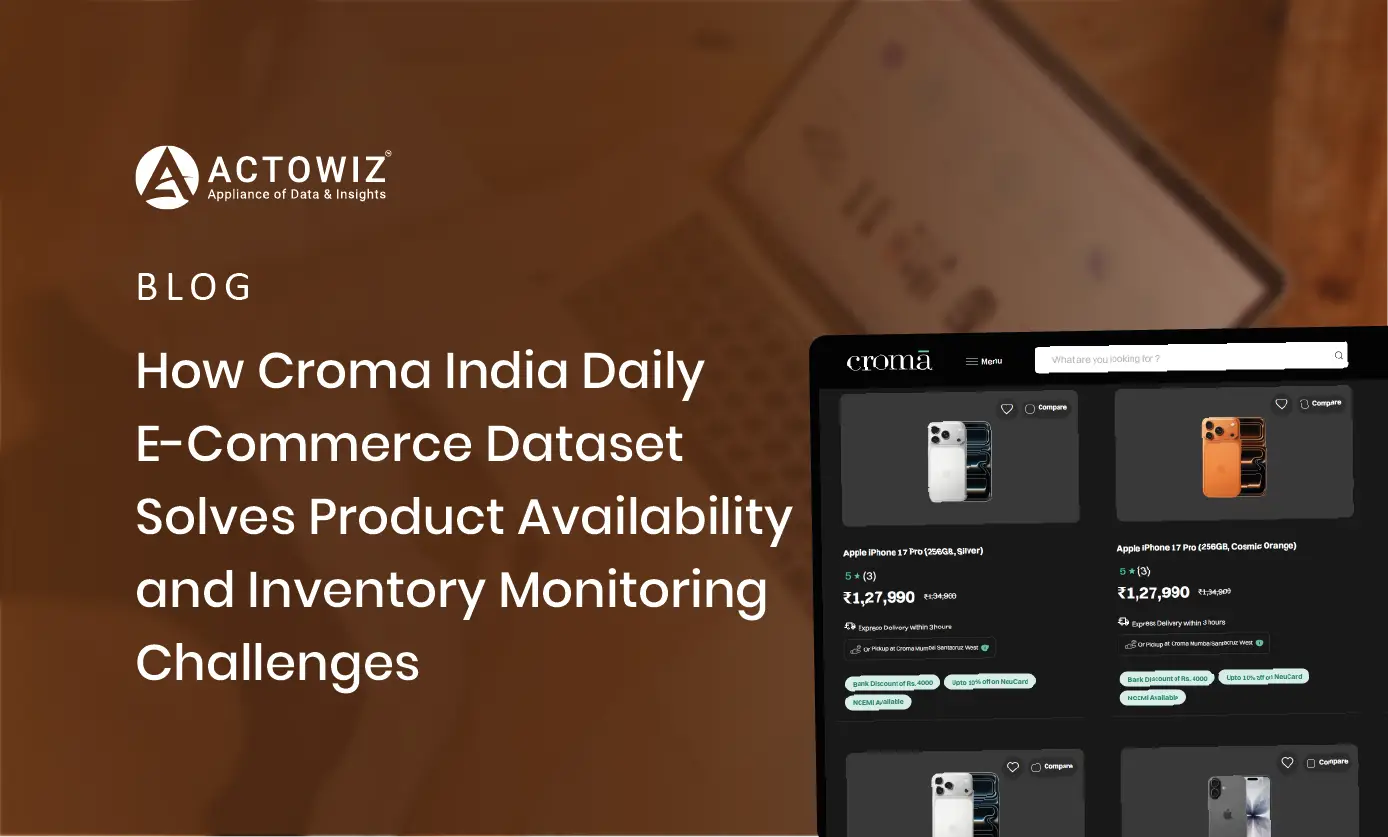
Croma India Daily E-Commerce Dataset helps track product prices, availability, discounts, ratings, and market trends for smarter retail decisions.

CarDekho Data API 2026 helps businesses track vehicle images, pricing, specs, and reviews for smarter automotive market and competitor analysis.

The AutoZone Parts Pricing & Promotion Report tracks automotive parts prices, discounts, promotions, and competitor pricing trends.
Whether you're a startup or a Fortune 500 — we have the right plan for your data needs.