NEW 2026

GCC Quick Commerce

Talabat · Careem Quik · Noon Minutes — live pricing across Dubai, Riyadh, Abu Dhabi & Jeddah. 18 GCC cities.

Launch Demo →
HOT

KitchenIntel

Cloud kitchen market gaps, ghost-kitchen tracking & strategy simulator. Plans from ₹9,999/mo.

See Pricing →
11+Dashboards
99.9%Accuracy
Want THIS view for your brand · your city · your category? Custom dashboard in 7 days. Free Consultation →
Crex Data Scraping - Solving Accuracy and Data Consistency Issues in Cricket Analytics

Key Takeaways

  • Indian quick commerce now spans 7 major platforms with daily intra-day price changes — weekly dashboards are obsolete.
  • Effective Q-commerce price tracking demands 4 capabilities: hyperlocal capture, canonical SKU matching, sub-hour refresh, and structured delivery.
  • Building in-house costs ₹2-4 Cr per year; partnership-led pipelines cost a fraction — at higher quality.
  • Real-time AI agents on top of pricing data unlock OOS detection, dynamic pricing, and ad-spend optimisation — three high-ROI use cases.
  • FMCG brands without 7-platform real-time intelligence are operating blind against competitors who have it.

Indian quick commerce has transformed urban grocery shopping

Blinkit, Zepto, and Swiggy Instamart pioneered 10-minute delivery. BigBasket scaled the model nationally. JioMart leveraged Reliance Retail's footprint. Amazon Now and Flipkart Minutes entered with deep funding and platform infrastructure. The result: Indian consumers now have 7 major quick commerce platforms competing for their daily groceries, snacks, and household needs — and the category drives 25-40% of urban FMCG revenue depending on segment.

For FMCG brands, Q-commerce sellers, and retail analytics teams, this creates a new operational reality: pricing intelligence must span all 7 platforms in real time. A weekly Excel report is a museum exhibit by Tuesday morning. A daily dashboard misses 70% of intra-day price changes. The brands winning Q-commerce in 2026 have built — or partnered for — true 7-platform real-time price trackers. This guide explains how to build one.

Why a 7-Platform Tracker Matters in 2026

Indian quick commerce is the fastest-moving retail format in the country. Prices change multiple times per day. Stock turns over rapidly. Promotional pricing windows open and close within hours. Competitive responses happen at speeds traditional retail has never seen. In this environment, the brands with real-time visibility are pricing, stocking, and promoting with information their competitors do not have.

Why 7 Platforms, Not Just 3

The Big Three (Blinkit, Zepto, Instamart) get the headlines, but the other 4 platforms cumulatively control 35-45% of Indian Q-commerce share by city and category. JioMart leads in Tier-2 cities. Amazon Now and Flipkart Minutes are growing 200%+ year-on-year. BigBasket retains dominance in scheduled-delivery use cases. Tracking only 3 platforms misses nearly half the market.

The 7 Platforms That Matter — and What Makes Each Different

Before building a tracker, understand what makes each platform distinct. The technical and strategic approach differs across the 7.

Platform Owner Strength Tracking Priority
Blinkit Eternal (Zomato) Highest urban density; aggressive pricing Critical
Zepto Independent Fastest delivery; premium positioning Critical
Swiggy Instamart Swiggy Largest catalogue; strong dark store network Critical
BigBasket Tata Digital Scheduled + express; corporate accounts High
Amazon Now Amazon India Prime integration; expanding rapidly High
Flipkart Minutes Flipkart (Walmart) Marketplace-style; growing fast High
JioMart Reliance Retail Tier-2 reach; offline+online Medium

What Exactly to Track on Each Platform

A real Q-commerce price tracker captures far more than just price. Capture the wrong fields and the data cannot drive business decisions. Here is the full field list every 7-platform tracker should include:

Field Category What to Capture Refresh Need
Identity SKU ID, name, brand, pack size, category Daily
Pricing MRP, selling price, discount %, offer text Sub-hour
Stock In stock / out of stock / low stock Sub-hour
Delivery ETA, delivery fee, free-delivery threshold Hourly
Offers Multi-buy, bundle, coupon, cashback Hourly
Location Pin code served, dark store ID/name Daily
Ranking Position in search/category results Daily
Visual Product image URL, ratings, review count Weekly

Hyperlocal Is Not Optional

Q-commerce pricing changes by pin code. Blinkit Bandra West may price a SKU at ₹289 while Blinkit Andheri East prices the same SKU at ₹295 — because they serve different dark stores. A national-average tracker is meaningless. Real pricing intelligence requires pin-code or dark-store-level capture.

The Technical Architecture: A 5-Stage Pipeline

Every credible Q-commerce price tracker follows the same 5-stage architecture. Skip any stage and the data becomes unreliable, stale, or unusable.

  • CAPTURE — 7 chain crawlers × pin codes
  • NORMALISE — Cross-platform SKU taxonomy
  • DETECT — Price + stock change events
  • ENRICH — Offers, ETAs, rankings
  • DELIVER — API + dashboard + webhooks
Stage 1 — Capture: 7 Chain-Specific Crawlers

Each of the 7 platforms operates a different e-commerce frontend, mobile app, anti-bot stack, and refresh cadence. There is no shortcut: 7 separate crawlers are required, each tuned to its target. The best approach uses Indian residential proxies across major metros and Tier-2 cities, browser automation for JavaScript-heavy frontends, mobile API capture where app endpoints are more accessible, and respectful rate limits that avoid triggering platform defences.

Stage 2 — Normalise: Canonical SKU Taxonomy

This is the stage most in-house attempts fail at. 'Continental Espresso Coffee Powder 200g' on Blinkit, 'Continental Espresso 200gm' on Zepto, and 'Continental Coffee Espresso (200g)' on Instamart must all resolve to one canonical SKU — otherwise you cannot compare prices across platforms. Building this taxonomy requires fuzzy matching, brand+pack-size logic, and ML-assisted product matching where automated rules fail.

Stage 3 — Detect: Event-Based Change Tracking

Raw price snapshots are not enough — you need event detection. Compare each refresh against the prior snapshot and emit structured events: price-changed, went-out-of-stock, offer-launched, offer-ended, new-SKU-listed, SKU-delisted. These events drive downstream alerts and automated actions, not just dashboards.

Stage 4 — Enrich: Beyond Just Price

Enrichment captures the layers that make pricing actionable: delivery ETAs (when does the buyer actually get it?), offer structures (₹50 off ₹299, or 20% off, or BOGO?), search rankings (where does your SKU appear in 'instant coffee' results?), and dark store mapping (which physical store serves a given pin code?).

Stage 5 — Deliver: API-First, Dashboard-Second

Top-tier Q-commerce trackers deliver data through APIs and webhook events that integrate directly into pricing engines, ad platforms, and ERP systems. Dashboards are for humans — but humans cannot react fast enough at Q-commerce speed. The real value is automation downstream of the API.

The 3 Killer Use Cases Once You Have the Data

Crex Data Scraping - Solving Accuracy and Data Consistency Issues in Cricket Analytics

Once a 7-platform real-time price tracker is in place, three high-ROI use cases unlock. Each on its own justifies the investment — combined, they transform Q-commerce performance.

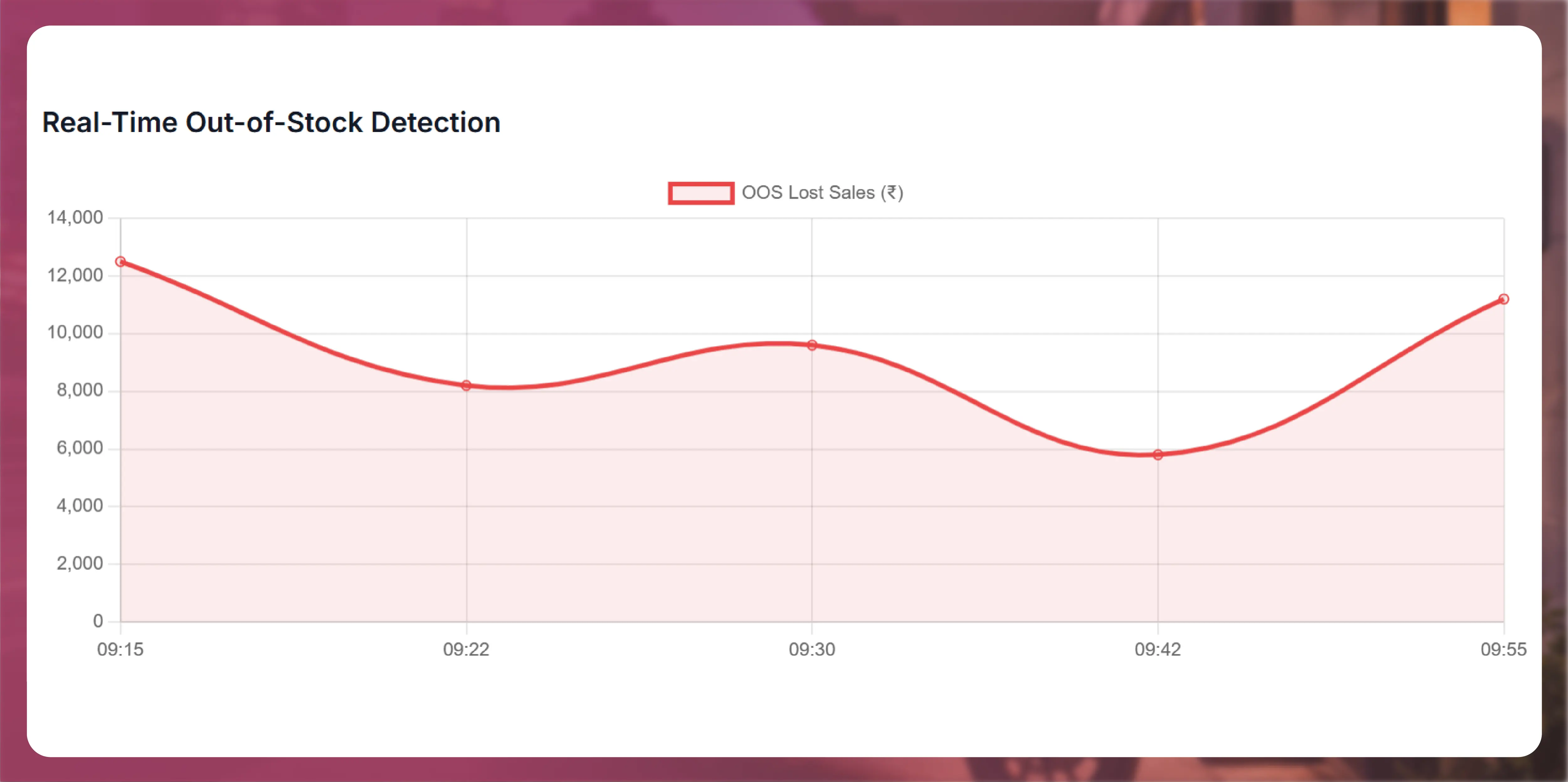
Use Case #1 — Real-Time Out-of-Stock Detection

Across 7 platforms × 15,000+ dark stores in India, stockouts happen constantly. Detected within minutes, OOS events drive emergency replenishment, competitor-stockout opportunity capture, and pricing adjustments (hold price when competitors are OOS). Manual monitoring misses 80%+ of OOS events. AI-agent monitoring catches them all.

Use Case #2 — Dynamic Pricing & Competitive Response

Competitor pricing changes trigger automated repricing recommendations within minutes — not days. The pricing engine considers position vs competitors, historical price elasticity, current stock levels, and promotional calendar. The result: pricing decisions that protect margin without sacrificing share.

Use Case #3 — Ad Spend Optimisation Across Platforms

Q-commerce platforms now host significant brand advertising budgets. ROAS varies dramatically by platform, city, and time of day. Real-time tracking surfaces underperforming ad sets within hours — letting brands pause them, redirect budget to high-ROAS channels, and optimise creative continuously.

Use Case Average Revenue Uplift Per Use Case (₹ Crore Annualised — Illustrative)
OOS Detection & Recovery ₹4.8 Cr
Dynamic Pricing Engine ₹6.2 Cr
Ad ROAS Optimisation ₹2.4 Cr
Combined (compounding) ₹14 Cr

Combined impact compounds — a mid-sized FMCG brand can realistically expect ₹10-15 crore annualised uplift from a well-deployed 7-platform tracker with AI agent layer.

Build vs Buy: The Honest Economics

Many brands instinctively want to build Q-commerce data infrastructure in-house. The economics rarely justify it. Here is the honest comparison:


Annual Cost: In-House Build vs Managed Partnership (₹ Lakh)
Engineering Team (4 FTEs) — ₹2.2 Cr/yr
Proxy Infrastructure — ₹36 L/yr
Anti-Bot Maintenance — ₹28 L/yr
Data QA + Tooling — ₹22 L/yr
Total In-House Cost — ~₹3 Cr/yr
Managed Partnership — ~₹48 L/yr

A managed partnership delivers comparable or better data quality at 15-20% of the in-house cost. The 5x cost differential is the difference between a Q-commerce strategy and a Q-commerce data engineering project.

When to Build In-House Anyway

Build in-house if (a) data is your core product (you're a data company, not an FMCG brand using data), (b) you have unique competitive data needs that no vendor will customise for, or (c) regulatory constraints prevent third-party data handling. For nearly every other case, the buy path is mathematically obvious.

5 Common Pitfalls to Avoid

Even well-funded Q-commerce tracking initiatives fail when they hit one or more of these pitfalls. Avoiding them upfront saves quarters of wasted effort.

Pitfall #1 — National Pricing Averages

Q-commerce pricing varies by pin code. Aggregating into 'India average price' destroys the signal. Always track at pin-code or dark-store level — even if you report at city level.

Pitfall #2 — Daily Refresh on Volatile Data

Pricing changes multiple times per day. Daily refresh captures roughly 30% of real price movements. Sub-hour refresh is the threshold where data reflects reality. Anything slower is misleading.

Pitfall #3 — No Canonical SKU Matching

Without canonical SKU mapping, cross-platform comparison is impossible. Many teams build trackers that produce per-platform reports but cannot answer 'where is this SKU cheapest right now?' Build canonical matching from day one.

Pitfall #4 — Dashboards Without Actions

A dashboard nobody monitors at 11 PM Sunday is useless. The data must trigger automated alerts, recommendations, or actions — Slack pings, email digests, webhook events to pricing engines. Dashboards alone do not move the needle.

Pitfall #5 — Tracking 3 Platforms Instead of 7

'We track Blinkit, Zepto, and Instamart — that's enough.' This is the most common pitfall. The other 4 platforms cumulatively control 35-45% of share. Brands operating on 3-platform data routinely make decisions that look right on their tracker but lose share on the platforms they ignore.

Frequently Asked Questions

How often should Q-commerce prices be refreshed?

Sub-hour refresh on price and stock is the practical minimum. Hourly is acceptable for slower-moving categories; 10-15 minute refresh is recommended for high-velocity categories like beverages, snacks, and personal care. Daily refresh is insufficient for any actionable use case.

Do I need to track all 7 platforms, or can I start with 3?

Starting with the Big Three (Blinkit, Zepto, Instamart) is reasonable for pilot programmes, but production decisions require 7-platform coverage. The other 4 platforms collectively control 35-45% of share — invisible to a 3-platform tracker.

Is Q-commerce price scraping legal in India?

Public product and pricing data scraping is generally legally defensible in India under current case law, provided it respects platform Terms of Service in good faith and complies with the DPDP Act 2023 (which mainly affects personal-data scraping, not product-pricing data). Always work with a partner that maintains compliance discipline.

How much does a managed Q-commerce data partnership cost?

Pricing varies by scope, but a typical 7-platform real-time partnership covering 1,000-5,000 SKUs runs in the ₹40-60 lakh per year range — roughly 15-20% of the in-house equivalent cost. Pilots typically start smaller (3 platforms, fewer SKUs) at ₹8-15 lakh per year.

What is canonical SKU matching, and why does it matter?

Canonical SKU matching maps each platform's native SKU to a single master product ID. Without it, you cannot answer 'which platform has the lowest price for this product right now?' — you can only see seven unrelated product listings. It is the single most important data engineering choice in a Q-commerce tracker.

Can the same tracker work for FMCG brands and Q-commerce sellers?

Largely yes — the underlying data is the same. FMCG brands typically focus on category dynamics, competitor pricing, and ad ROAS. Q-commerce sellers focus on their own catalogue, stock levels, and platform ranking. Both use cases run on the same 5-stage pipeline.

How do AI agents fit on top of the tracker?

Once structured real-time data is flowing, an LLM-based agent layer consumes detected events and generates specific recommendations: 'Pause ad set 12 on Zepto — ROAS down 38% in 4 hours'; 'Reduce price on SKU-X by ₹4 in Bangalore Blinkit to match competitor'. The data is the foundation; the agent is the intelligence on top.

How long does it take to deploy a 7-platform tracker?

A managed-partnership deployment typically reaches first-data in 2-4 weeks (pilot scope) and full 7-platform production in 8-12 weeks. An in-house build typically takes 9-15 months to reach equivalent production quality — and requires ongoing maintenance investment thereafter.

Conclusion

Indian quick commerce in 2026 is no longer a 3-platform race. With Blinkit, Zepto, Swiggy Instamart, BigBasket, Amazon Now, Flipkart Minutes, and JioMart all competing across thousands of dark stores nationwide, real-time 7-platform intelligence has become foundational FMCG infrastructure. The brands operating on weekly reports or 3-platform trackers are not just less efficient — they are systematically losing share to brands that have built proper data infrastructure.

The architecture is well-understood: 5 stages, hyperlocal capture, canonical SKU matching, sub-hour refresh, event-based detection, and API-first delivery. The economics favour managed partnerships at roughly 15-20% of in-house build cost. The high-ROI use cases — OOS detection, dynamic pricing, ad ROAS optimisation — compound into ₹10-15 crore annualised uplift for mid-sized brands. And the gap between brands with this infrastructure and brands without it is widening every quarter.

If your brand competes in Indian quick commerce, real-time 7-platform price tracking is no longer optional. The question is only how fast you build or partner for it — and how much share you are willing to lose to competitors who already have.

You can also reach us for all your mobile app scraping, data collection, web scraping , and instant data scraper service requirements!

Ready to Build Your 7-Platform Q-Commerce Tracker?
Talk to Actowiz Solutions
Social Proof That Converts

Trusted by Global Leaders Across Q-Commerce, Travel, Retail, and FoodTech

Our web scraping expertise is relied on by 4,000+ global enterprises including Zomato, Tata Consumer, Subway, and Expedia — helping them turn web data into growth.

4,000+ Enterprises Worldwide
50+ Countries Served
20+ Industries
Join 4,000+ companies growing with Actowiz →
Real Results from Real Clients

Hear It Directly from Our Clients

Watch how businesses like yours are using Actowiz data to drive growth.

1 min
★★★★★
"Actowiz Solutions offered exceptional support with transparency and guidance throughout. Anna and Saga made the process easy for a non-technical user like me. Great service, fair pricing!"
TG
Thomas Galido
Co-Founder / Head of Product at Upright Data Inc.
2 min
★★★★★
"Actowiz delivered impeccable results for our company. Their team ensured data accuracy and on-time delivery. The competitive intelligence completely transformed our pricing strategy."
II
Iulen Ibanez
CEO / Datacy.es
1:30
★★★★★
"What impressed me most was the speed — we went from requirement to production data in under 48 hours. The API integration was seamless and the support team is always responsive."
FC
Febbin Chacko
-Fin, Small Business Owner
icons 4.8/5 Average Rating
icons 50+ Video Testimonials
icons 92% Client Retention
icons 50+ Countries Served

Join 4,000+ Companies Growing with Actowiz

From Zomato to Expedia — see why global leaders trust us with their data.

Why Global Leaders Trust Actowiz

Backed by automation, data volume, and enterprise-grade scale — we help businesses from startups to Fortune 500s extract competitive insights across the USA, UK, UAE, and beyond.

icons
7+
Years of Experience
Proven track record delivering enterprise-grade web scraping and data intelligence solutions.
icons
4,000+
Projects Delivered
Serving startups to Fortune 500 companies across 50+ countries worldwide.
icons
200+
In-House Experts
Dedicated engineers across scrapers, AI/ML models, APIs, and data quality assurance.
icons
9.2M
Automated Workflows
Running weekly across eCommerce, Quick Commerce, Travel, Real Estate, and Food industries.
icons
270+ TB
Data Transferred
Real-time and batch data scraping at massive scale, across industries globally.
icons
380M+
Pages Crawled Weekly
Scaled infrastructure for comprehensive global data coverage with 99% accuracy.

AI Solutions Engineered
for Your Needs

LLM-Powered Attribute Extraction: High-precision product matching using large language models for accurate data classification.
Advanced Computer Vision: Fine-grained object detection for precise product classification using text and image embeddings.
GPT-Based Analytics Layer: Natural language query-based reporting and visualization for business intelligence.
Human-in-the-Loop AI: Continuous feedback loop to improve AI model accuracy over time.
icons Product Matching icons Attribute Tagging icons Content Optimization icons Sentiment Analysis icons Prompt-Based Reporting

Connect the Dots Across
Your Retail Ecosystem

We partner with agencies, system integrators, and technology platforms to deliver end-to-end solutions across the retail and digital shelf ecosystem.

icons
Analytics Services
icons
Ad Tech
icons
Price Optimization
icons
Business Consulting
icons
System Integration
icons
Market Research
Become a Partner →

Popular Datasets — Ready to Download

Browse All Datasets →
icons
Amazon
eCommerce
Free 100 rows
icons
Zillow
Real Estate
Free 100 rows
icons
DoorDash
Food Delivery
Free 100 rows
icons
Walmart
Retail
Free 100 rows
icons
Booking.com
Travel
Free 100 rows
icons
Indeed
Jobs
Free 100 rows

Latest Insights & Resources

View All Resources →
thumb
Blog

Privacy Act 1988 & Web Scraping: A Compliance Guide for Australian Businesses

Complete Privacy Act 1988 web scraping compliance guide for Australian businesses personal information, APPs, OAIC & practical safeguards by Actowiz Solutions.

thumb
Case Study

How We Assisted a Digital Matrimony Brand in Enhancing User Intelligence with Shaadi.com Data Scraping

Extract real-time matrimony profiles, preferences, and matchmaking insights efficiently with advanced Shaadi.com data scraping solutions.

thumb
Report

Scraping Key Food Grocery Data to Improve Product Availability Tracking and Grocery Analytics Insights

Scraping Key Food Grocery Data helps brands track pricing, inventory, promotions, and grocery trends for smarter retail analytics.

Start Where It Makes Sense for You

Whether you're a startup or a Fortune 500 — we have the right plan for your data needs.

icons
Enterprise
Book a Strategy Call
Custom solutions, dedicated support, volume pricing for large-scale needs.
icons
Growing Brand
Get Free Sample Data
Try before you buy — 500 rows of real data, delivered in 2 hours. No strings.
icons
Just Exploring
View Plans & Pricing
Transparent plans from $500/mo. Find the right fit for your budget and scale.
Get in Touch
Let's Talk About
Your Data Needs
Tell us what data you need — we'll scope it for free and share a sample within hours.
  • icons
    Free Sample in 2 HoursShare your requirement, get 500 rows of real data — no commitment.
  • icons
    Plans from $500/monthFlexible pricing for startups, growing brands, and enterprises.
  • icons
    US-Based SupportOffices in New York & California. Aligned with your timezone.
  • icons
    ISO 9001 & 27001 CertifiedEnterprise-grade security and quality standards.
Request Free Sample Data
Fill the form below — our team will reach out within 2 hours.
+1
Free 500-row sample · No credit card · Response within 2 hours

Request Free Sample Data

Our team will reach out within 2 hours with 500 rows of real data — no credit card required.

+1
Free 500-row sample · No credit card · Response within 2 hours