Introduction
Two corporate families control the majority of the American rental car counter. Hertz Global Holdings operates Hertz, Dollar, Thrifty and Firefly. Avis Budget Group operates Avis, Budget, Payless and Zipcar. Between them, they price hundreds of thousands of vehicle-days across roughly 300 US airports and thousands of neighborhood locations — and they reprice constantly.
For anyone competing with them, buying from them, or brokering their inventory, that creates a hard problem. A single quote from Hertz at LAX for a midsize sedan next Tuesday tells you almost nothing. The same car, at the same airport, for a five-day rental instead of three, booked twelve days out instead of two, might carry a rate 60% different. And Dollar — Hertz's own value brand, on the same lot, sometimes with the same cars — might be quoting 22% below its parent for a nearly identical product.
US Rental Car Price Intelligence is the discipline of turning that chaos into a legible market. It means systematically tracking rate, availability, fleet class, fee structure and customer sentiment across every brand in both portfolios, over time, at the location level — and then reading the resulting signal well enough to act on it.
This guide covers what to collect, how to structure it, what the data actually reveals about how these two groups compete, and how to build the system without tripping over the mistakes that sink most first attempts. It draws on how Actowiz Solutions (www.actowizsolutions.com) runs rental car pricing programs for travel marketplaces, corporate travel teams and mobility platforms across the US.
Why Rental Car Pricing Is Harder Than Retail Pricing
E-commerce price tracking is comparatively simple: a SKU has a price. Rental car pricing has no such thing as "the price." A single rate is a function of at least eight variables simultaneously:
- Brand — Hertz, Dollar, Thrifty, Avis, Budget, Payless each occupy a deliberate price tier
- Location — airport counters carry concession fees that neighborhood branches don't
- Pickup date/time and drop-off date/time
- Length of rental (LOR) — the per-day rate curve is famously non-linear; a 7-day rental often costs less in total than a 5-day one
- Booking lead time — the advance-purchase decay curve
- Vehicle class — Economy through Premium SUV, plus specialty fleets
- Rate type — pay-now vs. pay-later, member vs. public, corporate discount code (CDP/BCD)
- Fleet availability — the same class sells out and the price steps up
Change any one of these and the number changes. This means a pricing intelligence system that samples "the Hertz price at LAX" once a day is not collecting data. It is collecting noise.
Real Hertz & Avis Car Rental Price Data Intelligence requires a deliberately designed sampling grid — a matrix across all eight dimensions, refreshed at a cadence that matches how fast each cell actually moves.
The Brand Architecture You Need to Map First
Before collecting anything, understand what you're comparing. The two groups run near-mirror-image portfolios, and comparing Hertz to Budget is a category error — you're comparing a premium brand to a value brand and concluding something meaningless.
| Parent Group |
Brand |
Typical Positioning |
Primary Customer |
| Hertz Global |
Hertz |
Premium / loyalty-led |
Corporate, frequent traveler |
| Hertz Global |
Dollar |
Mid-value |
Leisure, price-aware |
| Hertz Global |
Thrifty |
Value |
Budget leisure |
| Hertz Global |
Firefly |
Deep value / limited footprint |
Price-first leisure |
| Avis Budget |
Avis |
Premium / corporate |
Corporate, business travel |
| Avis Budget |
Budget |
Mid-value |
Leisure, family |
| Avis Budget |
Payless |
Deep value |
Price-first leisure |
| Avis Budget |
Zipcar |
Car-sharing / hourly |
Urban, short-duration |
The correct comparison pairs are Hertz ↔ Avis (premium tier), Dollar ↔ Budget (mid tier), and Thrifty/Firefly ↔ Payless (value tier). A Hertz vs Avis Car Rental Price Comparison that respects tier alignment produces insight; one that doesn't produces a chart nobody trusts.
The second thing the data reveals is intra-portfolio spread — how far a parent lets its own value brand undercut its flagship at the same location. That spread is a strategic tell. When it narrows, the group is protecting flagship margin. When it widens, it is defending volume against the other group's value brands. Watching that spread across 40 airports over 90 days tells you more about competitive posture than any press release.
For the collection layer behind this, Actowiz Solutions runs dedicated pipelines for Hertz Automobile data extraction and Avis Automobile data extraction, plus broader Car Rental Data Scraping Services across the wider competitive set.
What to Collect: The Field Set
| Data Group |
Fields |
Why It Matters |
| Query context |
Brand, pickup location code, pickup datetime, dropoff datetime, LOR, lead time, capture timestamp |
The sampling grid; without it nothing is comparable |
| Vehicle |
ACRISS/SIPP code, class name, example model, transmission, seats, bags, A/C, EV flag |
Class normalization across brands |
| Rate |
Base rate per day, total base, currency, rate type (pay-now/pay-later), member vs. public |
Core benchmarking input |
| Fees & taxes |
Airport concession fee, facility charge, vehicle license fee, state/local tax, total all-in |
The all-in price is the only honest comparison |
| Inclusions |
Mileage policy, additional driver, young driver surcharge, fuel policy |
True-cost normalization |
| Add-ons |
Insurance (LDW/CDW/SLI), GPS, child seat, prepaid fuel, toll pass |
Ancillary margin analysis |
| Availability |
Class sold out flag, "only X left" signals, no-availability responses |
Fleet pressure detection |
| Loyalty & promo |
Member rate delta, coupon/promo code applied, pay-now discount |
Promotional intensity tracking |
| Reviews |
Rating, review count, review text, sentiment tags, location-level scores |
Service quality vs. price positioning |
Two of these carry disproportionate weight.
All-in price, not base rate. Airport concession recovery fees, customer facility charges and vehicle license recovery fees can add 25–35% on top of a base rate, and they vary by airport and by brand's contract at that airport. A benchmark built on base rates is systematically wrong, and it is wrong by different amounts at different locations — which is the worst kind of wrong.
Availability signals. A sold-out class is not a missing data point. It is the single most valuable data point in the set. When Hertz's Standard SUV class goes unavailable at DEN for a Friday pickup while Avis still shows inventory, you are watching a fleet imbalance in real time — and Avis is about to raise its rate.
Sample Data: What a Clean Record Looks Like
Here is a single normalized observation from a US Rental Car Price Intelligence feed:
{
  "capture_ts": "2026-07-13T09:14:22Z",
  "parent_group": "Hertz Global",
  "brand": "Dollar",
  "location_code": "LAX",
  "location_type": "airport",
  "pickup_ts": "2026-07-24T10:00:00",
  "dropoff_ts": "2026-07-27T10:00:00",
  "length_of_rental_days": 3,
  "lead_time_days": 11,
  "acriss_code": "ICAR",
  "vehicle_class": "Intermediate",
  "example_model": "Nissan Sentra or similar",
  "transmission": "Automatic",
  "rate_type": "pay_later",
  "base_rate_per_day_usd": 41.99,
  "base_total_usd": 125.97,
  "fees": {
    "airport_concession_fee_usd": 14.19,
    "customer_facility_charge_usd": 27.00,
    "vehicle_license_fee_usd": 6.15,
    "tax_usd": 12.83
  },
  "all_in_total_usd": 186.14,
  "all_in_per_day_usd": 62.05,
  "mileage_policy": "unlimited",
  "availability_status": "available",
  "seats_signal": null,
  "member_rate_delta_pct": -6.4
}
And the same query run across the tier-aligned competitive set on the same timestamp:
| Brand |
Group |
Tier |
Base/Day |
All-In Total |
All-In/Day |
Availability |
| Hertz |
Hertz Global |
Premium |
$58.99 |
$253.44 |
$84.48 |
Available |
| Avis |
Avis Budget |
Premium |
$56.49 |
$244.91 |
$81.64 |
Available |
| Dollar |
Hertz Global |
Mid |
$41.99 |
$186.14 |
$62.05 |
Available |
| Budget |
Avis Budget |
Mid |
$43.99 |
$193.02 |
$64.34 |
Available |
| Thrifty |
Hertz Global |
Value |
$38.49 |
$174.98 |
$58.33 |
Available |
| Payless |
Avis Budget |
Value |
$36.99 |
$170.15 |
$56.72 |
Sold out (ICAR) |
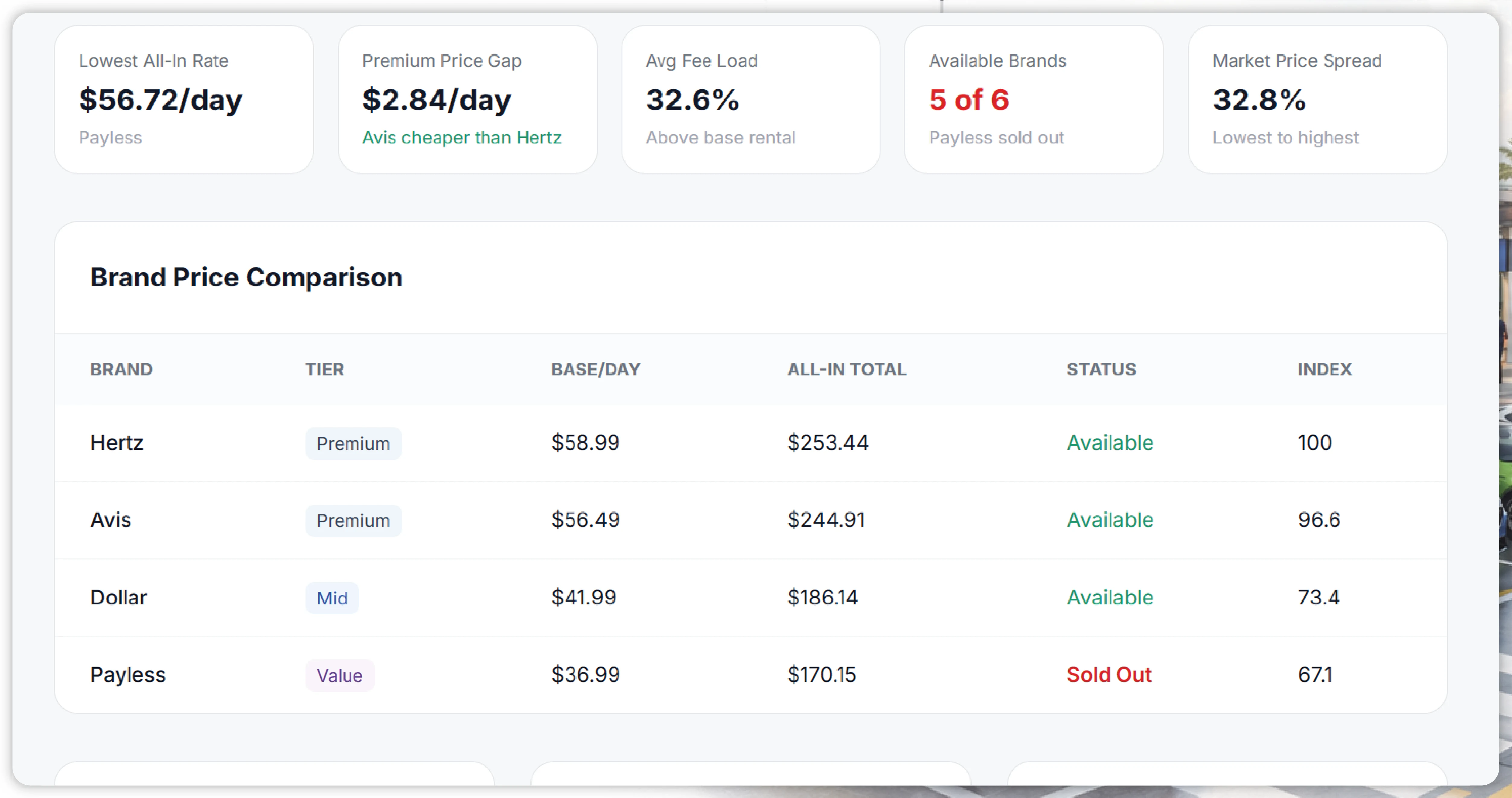
Read that table carefully and three things jump out that no single-brand check would reveal. Avis is undercutting Hertz by $2.84/day all-in at the premium tier. Hertz's own Dollar brand is 27% below its flagship — a wide intra-portfolio spread indicating volume defense. And Payless is sold out in this class, which means Budget's rate is likely to firm up within hours. That last observation is a buying signal.
This is what Hertz & Avis Rental Price Benchmarking looks like when it's done properly: not a price, but a market.
Building the Collection System
1. Design the sampling grid before writing code
Pick your dimensions deliberately:
- Locations: the 40–60 airports that carry the bulk of US demand, plus a neighborhood sample. Not all 300.
- Vehicle classes: 6–8 ACRISS codes covering Economy through Full-Size SUV.
- Lead times: a fixed ladder — 1, 3, 7, 14, 30, 60 days out. Fixed ladders make the time series comparable.
- LOR: 1, 3, 5, 7 days. The LOR curve is where the most exploitable pricing quirks live.
- Brands: all eight, always. Collecting Hertz without Dollar is collecting half a strategy.
That grid — say 50 locations × 7 classes × 6 lead times × 4 LORs × 8 brands — defines your query volume. Tier it: refresh the high-volume airport/class cells every few hours, the long tail weekly.
2. Handle the collection mechanics
Scraping Avis rental car pricing data and its Hertz-side equivalent means dealing with session-based search flows, dynamically rendered rate tables, brand-specific class taxonomies, and fee disclosures that only appear at the final quote step. Practical requirements:
- Full rendering — rate grids are client-side
- Session and cookie handling through a multi-step search flow
- Geo-appropriate request origination
- Respectful pacing and back-off; aggressive collection degrades data quality through blocks and partial pages
- Schema validation at the edge — a fee field that silently disappeared is a corrupted benchmark
- Capture of the final quote page, where the all-in total lives, not just the search results grid
3. Normalize ruthlessly
Brands name classes differently. Hertz's "Standard" and Avis's "Standard Elite" are not the same box. Map everything to ACRISS/SIPP codes — the four-letter industry standard (category, type, transmission/drive, fuel/AC). Without a common class code, every cross-brand comparison you publish will be quietly wrong.
Then normalize fees, currency, mileage policy and inclusion sets so that "all-in per day, unlimited mileage, automatic, no add-ons" means exactly the same thing for all eight brands.
4. Track availability as a first-class signal
Hertz & Avis Car Rental Availability Data Tracking deserves its own pipeline. Log every sold-out class, every "only 2 left" indicator, every location that returns no inventory. Availability collapse leads price movement by hours — often by a full day at leisure-heavy airports before a holiday weekend. A system that only records prices sees the spike after it happens. A system that records availability sees it coming.
5. Add review and rating data
Scrape Hertz Review & Rating Data — and Avis's, and every sub-brand's — at the location level, not just the corporate level. Rental car sentiment is intensely local: the same brand can be excellent at one airport and disastrous at the one 200 miles away. Location-level ratings, review volume, and recurring complaint themes (wait times, vehicle condition, surprise fees, shuttle delays) let you construct a price-vs-quality quadrant:
- High price, high rating — premium justified
- High price, low rating — vulnerable; a competitor's opportunity
- Low price, high rating — the market's best value; watch for it to reprice upward
- Low price, low rating — commodity floor
That quadrant, mapped across 50 airports, is a genuine US Rental Car Market Data insights asset — the kind of finding that gets quoted, cited and shared, because nobody else has it.
What the Data Reveals: Patterns Worth Watching
The LOR cliff. Total price frequently drops when you extend a rental — a 7-day booking undercutting a 5-day one is common. Systematic LOR curve tracking finds these cliffs across brands and locations, and they represent real, immediate savings for any high-volume buyer.
The lead-time inversion. Rental pricing does not always reward booking early. On some airport/class combinations, rates decline into the final week as fleet is dumped. On others they spike hard. Which is which is knowable only from the time series, and it differs by location and season.
Intra-portfolio spread as strategy. Track the Hertz→Dollar and Avis→Budget gaps as a percentage, over time, per airport. Widening spreads signal volume defense; narrowing spreads signal margin protection. This is the single most under-exploited metric in the category.
Fee-load asymmetry. All-in vs. base divergence varies materially by airport and brand. Some locations carry all-in loads well above others. A benchmark that ignores this systematically favors whichever brand happens to have the lighter fee contract at the airports you sampled.
Ancillary attach economics. Insurance, toll passes and prepaid fuel carry disproportionate margin. Brands that price the base car aggressively often recover on add-ons. Tracking add-on pricing alongside base rates reveals the real economics of a booking.
Pair all of this with continuous Real-Time Price Monitoring from Actowiz Solutions and the analysis stops being a quarterly deck and becomes an operational alerting system.
Who Uses This, and How
- Rental operators and regional fleets benchmark their own rates against the Big Two at the airports where they compete, tier by tier, and reprice with evidence rather than instinct.
- OTAs, metasearch and travel aggregators validate the rates their suppliers hand them, spot when a supplier's feed has gone stale, and detect where they're being fed uncompetitive inventory.
- Corporate travel managers and TMCs audit whether their negotiated CDP/BCD rates are actually beating public rates. They frequently aren't — and that finding, backed by 90 days of data, is the strongest possible position to renegotiate from.
- Investors and market researchers track pricing power, fleet tightness and promotional intensity across both groups as a leading indicator of quarterly performance.
- Insurance and mobility platforms use vehicle class availability and rate curves to price their own adjacent products.
Compliance and Method
- Collect publicly displayed rate and availability information only — the same quotes any shopper can pull.
- No personal data. Rates are not people; nothing collected identifies a renter.
- Respectful, rate-limited collection that does not degrade the source's service.
- Attribute your benchmarks. If a client sees a market comparison, they should see the capture timestamp and methodology alongside it. Methodology transparency is a trust asset — and, increasingly, a citation asset.
- Benchmark, don't misrepresent. Market data informs your pricing; it never gets presented as bookable inventory you hold.
KPIs for the Program
| Metric |
Target |
| Grid coverage (cells filled per refresh cycle) |
95%+ |
| Extraction success rate |
97%+ |
| All-in fee capture rate |
99% — a missing fee is a broken benchmark |
| Class normalization accuracy (ACRISS mapping) |
99%+ |
| Freshness at analysis (Tier 1 cells) |
Under 4 hours |
| Availability-event lead time before price move |
Measured in hours; the higher, the more actionable |
| Rate gap vs. tier-matched competitor |
Within your strategic band |
How Actowiz Solutions Delivers This
Actowiz Solutions operates US Rental Car Price Intelligence as a managed data program rather than a script you have to maintain. The delivery model:
- Sampling grid design — Actowiz Solutions starts from your booking history and builds a bounded, tiered grid across brands, airports, ACRISS classes, lead times and lengths of rental.
- Eight-brand coverage — Hertz, Dollar, Thrifty, Firefly, Avis, Budget, Payless and Zipcar, collected together so tier-aligned comparison is possible from day one.
- All-in pricing capture — base rate plus concession fees, facility charges, licence recovery fees and tax, taken from the final quote page.
- Availability event stream — sold-out classes and low-inventory signals logged as first-class events, not discarded errors.
- Location-level review and rating data — joined to price so you get a positioning map, not just a price list.
- Delivery — API, webhook, or scheduled warehouse drop, in a single normalized schema, with a free sample dataset before you commit.
Because Actowiz Solutions maintains the collection layer — layout changes, class taxonomy shifts, new market coverage — your engineers spend their time on the pricing and alerting logic that actually differentiates your business.
Frequently Asked Questions
Why track sub-brands instead of just Hertz and Avis?
Because that's where the competition actually happens. The premium brands move relatively slowly and predictably. Dollar, Thrifty, Budget and Payless fight on price daily, and the gap between a parent and its own value brand is one of the clearest strategic signals in the market. Tracking only the flagships means missing most of the story.
Is base rate or all-in price the right benchmark?
All-in, always. Airport fees and taxes can add a third to the base rate, they vary by location and brand contract, and a base-rate benchmark is therefore wrong by an amount that changes with your sample. Collect both, benchmark on all-in.
How often does rental pricing actually change?
Materially, several times a day on high-demand airport/class cells — and faster when fleet tightens. Long-tail cells can be stable for days. A single refresh cadence for the whole grid either wastes budget or misses movement. Tier it.
What's the value of review data if the goal is pricing?
Price without quality context is half a picture. A brand charging a premium with a collapsing location-level rating is vulnerable; one charging a discount with strong ratings is about to reprice upward. Reviews are a leading indicator for pricing power.
Is scraping public rental car rates permissible?
Collecting publicly displayed pricing and availability for benchmarking and competitive analysis is a long-established practice across travel and retail. The requirements are: public data only, no personal data, non-disruptive collection, and use for benchmarking rather than misrepresentation. Build inside those lines.
How long before the data is useful?
Meaningful cross-sectional comparison is available on day one. Meaningful time-series insight — LOR curves, lead-time decay, spread dynamics — needs 60 to 90 days of consistent collection on a fixed grid. Start collecting before you need the answer.
Conclusion
The American rental car market looks like two companies. It behaves like eight brands running eight different pricing strategies against each other, in real time, at every airport in the country. Anyone pricing, buying or brokering against them without that resolution is negotiating in the dark.
US Rental Car Price Intelligence — done with a proper sampling grid, ACRISS-normalized classes, all-in pricing, availability tracking and location-level review data — turns that opacity into a market you can actually read. The patterns are there: the LOR cliffs, the lead-time inversions, the intra-portfolio spreads, the availability collapses that precede every price spike. They're just invisible to anyone checking one price at a time.
Start with 40 airports, eight brands and a fixed lead-time ladder. Ninety days later, you'll know things about this market that the people running it discuss only in closed rooms.
Actowiz Solutions builds and runs exactly this system — from a single-airport pilot to nationwide, eight-brand coverage refreshed hourly. Visit www.actowizsolutions.com to request a free sample of the rental car dataset before you commit to anything.
You can also reach us for all your mobile app scraping, data collection, web scraping , and instant data scraper service requirements!

 By industry🏷 By platform🌐 By market
 Pricing & Promotions
MAP Violations Brand Protection Counterfeit Detection Price Intelligence AI HOT Data Intelligence
Pricing & Promotions
MAP Violations Brand Protection Counterfeit Detection Price Intelligence AI HOT Data Intelligence Brand & Intelligence
Share of Search Content Audit & PDP Reviews & Ratings Retail Media Buy Box Monitoring Social Commerce HOT Live Commerce NEW Agentic Commerce NEW
Brand & Intelligence
Share of Search Content Audit & PDP Reviews & Ratings Retail Media Buy Box Monitoring Social Commerce HOT Live Commerce NEW Agentic Commerce NEW Digital Shelf & Search
Assortment Planning Competitive Benchmarking Product Availability Q-Commerce NEW
Digital Shelf & Search
Assortment Planning Competitive Benchmarking Product Availability Q-Commerce NEW AssortmentE-commerce Intelligence Hyperlocal Insights POI & Store Locator DTC Brand Analytics NEW
 For Retailers
 E-Commerce Dashboard
 Flipkart Insights (Live) #1
 Grocery Intelligence
.svg) Grocery Price (U.S.)
Grocery Price (U.S.)
.svg) Quick Commerce (India) HOT
Quick Commerce (India) HOT
 Food & Restaurant
 Fashion Intelligence
 Automotive
 Travel & Hospitality
 Real Estate
 Food Delivery Intelligence NEW
 OTT & Streaming NEW
 Fuel & EV Charging Price Tracker NEW
 By Use Case
 Pricing Intelligence
 Digital Shelf Analytics
 MAP Monitoring HOT
 Cross-Border Price Parity NEW
 Share of Search
 Review Sentiment
 Kitchen Market Gaps NEW
 Dynamic Pricing / AI Repricing NEW
 Promotions & Deals Alerts NEW
 B2B / POI & Lead Data NEW
 AI Search Visibility Dashboard NEW
 Baby Products on Quick Commerce NEW
 Hotel & Flight Rate Parity NEW
 By Region🇮🇳 India 🇺🇸 USA 🇦🇪 Middle East 🇬🇧 UK 🇦🇺 Australia 🌏 SE Asia 🇪🇺 Europe 🌎 LATAMIndia
 Flipkart Real-Time Insights
 Quick Commerce — Zepto · Blinkit
 Pincode Price Tracker
Middle East
Pincode Price Tracker
Middle East GCC Q-Commerce — Talabat · Noon NEW
UK & Australia
GCC Q-Commerce — Talabat · Noon NEW
UK & Australia UK Grocery — Tesco, Sainsbury's, Asda
 AU Grocery — Coles & Woolworths NEW
 Marketplace Scrapers
Amazon API TikTok Shop API HOT Uber Eats API Airbnb API Zepto / Blinkit API Instacart API NEW Talabat API NEW
Marketplace Scrapers
Amazon API TikTok Shop API HOT Uber Eats API Airbnb API Zepto / Blinkit API Instacart API NEW Talabat API NEW Developer APIsWeb Extract API Reviews API SERP API Pricing Webhook NEW
 Universal APIsStreaming Crawl API Scheduler Realtime Alerts Webhook Delivery 🐍 Python SDK 💚 Node.js SDK
 Delivery & SDKs
 Knowledge Center
Digital Shelf Playbook MAP Compliance Guide Pricing Intel Guide Scraping Compliance TikTok Shop Guide NEW Cross-Border Guide NEW
Knowledge Center
Digital Shelf Playbook MAP Compliance Guide Pricing Intel Guide Scraping Compliance TikTok Shop Guide NEW Cross-Border Guide NEW Guides & Playbooks
🎉 Seasonal & event tracking NEWBlack Friday pricing report Festive season, India Ramadan, GCC grocery All seasonal reportsSample Datasets HOT ROI Calculator NEW API Postman Collection Demo Dashboards Free API Playground NEW Press Kit
Guides & Playbooks
🎉 Seasonal & event tracking NEWBlack Friday pricing report Festive season, India Ramadan, GCC grocery All seasonal reportsSample Datasets HOT ROI Calculator NEW API Postman Collection Demo Dashboards Free API Playground NEW Press Kit Downloads & Tools
Trust Center About Us FAQs Careers
Downloads & Tools
Trust Center About Us FAQs Careers Trust & CompanyRetail shelf research NEWRetail shelf research






































 4.8/5 Average Rating
 50+ Video Testimonials
 92% Client Retention
 50+ Countries Served


.webp)