Introduction
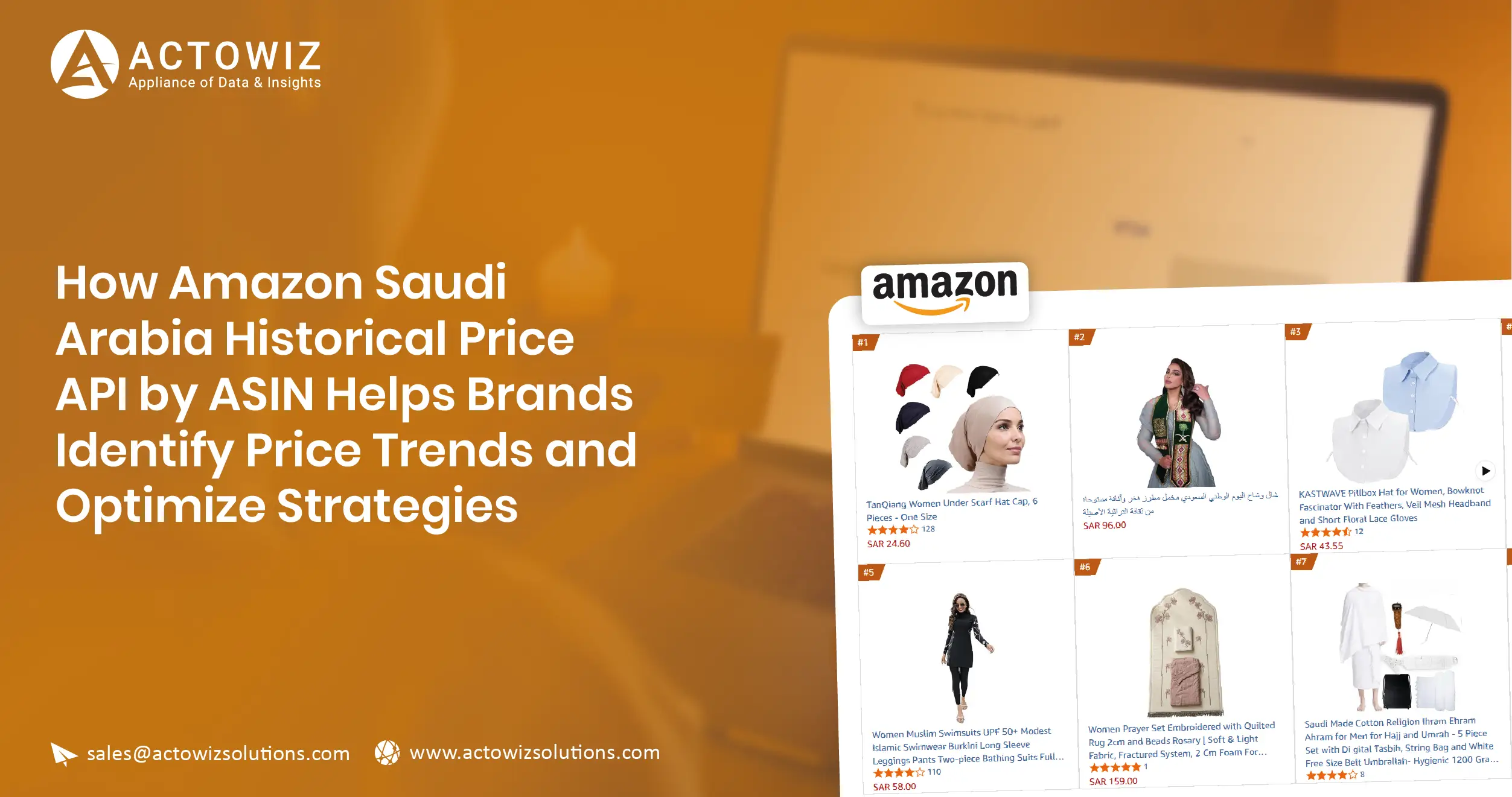
Brands can optimize Amazon pricing strategies by analyzing historical ASIN-level price movements instead of relying only on today's selling price. Historical data reveals discount patterns, price volatility, promotional cycles, and competitive positioning, helping pricing and e-commerce teams make more informed decisions.
Amazon Saudi Arabia Historical Price API by ASIN provides a structured approach to tracking product-level pricing changes on Amazon Saudi Arabia. Instead of manually recording prices for individual products, businesses can collect historical observations linked to specific ASINs and use them to understand how prices change over time.
This capability is increasingly relevant as Saudi Arabia's digital commerce ecosystem continues to expand. Saudi Central Bank (SAMA) reported that electronic payments represented 85% of total retail payments in 2025, up from 79% in 2024. The number of electronic transactions reached 14.6 billion in 2025 compared with 12.6 billion in 2024.
The growth of digital commerce creates a larger need for reliable pricing intelligence. Amazon.sa Product Data Scraping can help businesses collect structured information such as ASIN, product title, brand, category, current price, previous price where available, discount information, seller, availability, ratings, review counts, and product URL.
For brands, retailers, pricing analysts, marketplace managers, and e-commerce strategy teams, the objective is not simply to collect prices. The objective is to understand how prices behave and turn historical observations into actionable commercial insights.
What Does a Historical Pricing System Need to Track?
An Amazon Saudi Arabia price history API can provide a structured mechanism for organizing product-level price observations over time. The value of historical pricing comes from the ability to compare multiple observations rather than treating each price as an isolated number.
For example, a brand may want to determine whether a competitor consistently sells a product below its recommended price or only reduces the price during major promotional periods. Without historical records, this distinction is difficult to establish.
Key Fields for Historical Price Monitoring
| Data Field |
Business Purpose |
| ASIN |
Unique product-level identifier |
| Product name |
Product identification |
| Brand |
Brand-level comparison |
| Category |
Category analysis |
| Current price |
Current market position |
| Previous observed price |
Historical comparison |
| Discount |
Promotion measurement |
| Seller |
Seller-level monitoring |
| Availability |
Pricing context |
| Rating |
Customer-facing signal |
| Review count |
Engagement indicator |
| Timestamp |
Historical tracking |
| Product URL |
Source verification |
The ASIN is particularly useful because product names can change, while the ASIN provides a consistent reference point for tracking a specific Amazon listing.
Why Historical Price Data Is More Useful Than a Snapshot
Consider a product currently priced at SAR 299. A snapshot tells a pricing team that SAR 299 is the current observed price. Historical records can reveal whether the product was priced at SAR 349 last month, SAR 279 during a promotion, and SAR 319 during the preceding period.
That additional context changes the business interpretation.
A pricing manager can determine whether SAR 299 represents a normal market price, a temporary discount, or a recovery from an earlier promotion.
2020–2026 Market Development
Saudi Arabia's digital payment ecosystem has expanded considerably during the 2020–2026 period, increasing the importance of online retail data. SAMA reported that non-cash payments accounted for 70% of retail payments in 2023, rising to 79% in 2024 and 85% in 2025. Electronic payment transactions increased from 10.8 billion in 2023 to 12.6 billion in 2024 and 14.6 billion in 2025. In July 2025, SAMA also launched a new e-commerce payments interface to strengthen national payment infrastructure and support the continued growth of online businesses. As digital commerce matures into 2026, brands have greater reason to supplement current-price checks with historical product-level datasets that reveal how market prices evolve.
How Can Brands Detect Competitor Price Movements Earlier?
Brands can use Scrape Amazon.sa historical price data to create a time-series view of selected products and categories. When historical observations are stored consistently, pricing teams can identify recurring patterns that would otherwise remain hidden.
Amazon Saudi Arabia Historical Price API by ASIN can support this workflow by associating pricing observations with individual ASINs and predefined collection timestamps.
The practical benefit is straightforward: instead of asking only "What is the price today?", businesses can ask:
- How has the price changed during the last 30, 60, or 90 days?
- How frequently does a competitor change the price?
- What is the average observed price?
- What is the lowest and highest observed price?
- How often does a product receive a discount?
- Are price changes associated with availability changes?
- Which ASINs experience the highest price volatility?
Example Historical Pricing Analysis
| ASIN |
Current Price |
30-Day Low |
30-Day High |
Price Movement |
| B0XXXX001 |
SAR 299 |
SAR 279 |
SAR 349 |
Moderate |
| B0XXXX002 |
SAR 449 |
SAR 399 |
SAR 499 |
High |
| B0XXXX003 |
SAR 189 |
SAR 179 |
SAR 199 |
Low |
| B0XXXX004 |
SAR 699 |
SAR 649 |
SAR 749 |
Moderate |
Illustrative example; values are not presented as live Amazon prices.
This type of table gives pricing teams a more useful view than a single current-price column.
What Should Trigger a Pricing Alert?
| Alert |
Example Rule |
| Major price decrease |
Price falls more than 10% |
| Competitor undercut |
Competitor price below internal threshold |
| Promotional event |
Repeated discount detected |
| Price recovery |
Price returns above recent average |
| High volatility |
Large repeated price movements |
| Availability-price interaction |
Price changes following stock movement |
These rules can be customized by category. A consumer electronics brand may require tighter thresholds than a furniture retailer because electronics prices can change frequently.
2020–2026 Market Development
The move toward continuous price monitoring reflects the broader development of Saudi digital commerce. In 2023, SAMA's payment usage study found that 63% of surveyed respondents had bought goods online, with debit cards the most preferred payment method for the last e-commerce purchase at 50%, followed by cash at 25%. By 2024 and 2025, the broader payment ecosystem had expanded substantially, with electronic payments reaching 79% and then 85% of retail payments. SAMA also reported that e-commerce transactions using mada cards increased 65.9% year over year in Q2 2025. For 2026, this increasingly digital purchasing environment makes historical pricing a valuable input for competitive monitoring and pricing strategy.
How Does Historical Data Reveal Pricing Patterns?
Amazon historical pricing data scraping helps brands transform individual price observations into a time-series dataset. This makes it possible to analyze price direction, frequency, volatility, and promotional behavior.
Historical analysis can be especially valuable for products that experience frequent changes. Rather than reacting to every movement, businesses can calculate meaningful indicators such as average price, median price, minimum price, maximum price, percentage change, and price-change frequency.
Useful Historical Pricing Metrics
| Metric |
What It Helps Explain |
| Average price |
Typical observed market level |
| Median price |
Central price without extreme values dominating |
| Minimum price |
Lowest observed position |
| Maximum price |
Highest observed position |
| Price range |
Degree of movement |
| Price volatility |
Stability of pricing |
| Discount frequency |
Promotional behavior |
| Price-change frequency |
Competitive activity |
| Week-over-week change |
Short-term movement |
| Month-over-month change |
Medium-term trend |
For example, suppose a product has a three-month average price of SAR 320 but is currently selling for SAR 279. That does not automatically mean the product is permanently cheaper. It may indicate a promotional event.
A historical dataset lets analysts determine whether similar price reductions occurred repeatedly.
Identifying Promotional Cycles
Brands can divide historical price observations into periods and compare them.
For example:
| Period |
Observed Price |
Interpretation |
| Week 1 |
SAR 349 |
Regular pricing |
| Week 2 |
SAR 349 |
Stable |
| Week 3 |
SAR 299 |
Promotion |
| Week 4 |
SAR 299 |
Promotion |
| Week 5 |
SAR 349 |
Price recovery |
| Week 6 |
SAR 329 |
Competitive adjustment |
This pattern may suggest that SAR 299 is promotional rather than the product's long-term market price.
Such insights can influence promotional planning, inventory decisions, and competitive response.
2020–2026 Market Development
Saudi Arabia's retail payment data demonstrates how quickly digital transaction behavior has developed during this period. SAMA's 2024 data showed 12.6 billion electronic transactions, compared with 10.8 billion in 2023. In 2025, that figure increased to 14.6 billion. SAMA's Q3 2025 economic report also showed e-commerce transactions using mada cards increasing 71% year over year in that quarter. This expansion means online pricing increasingly operates within a high-frequency digital purchasing environment. From 2020 through 2026, the commercial value of price data has therefore shifted from occasional benchmarking toward continuous historical monitoring, especially for brands competing across large online catalogs.
How Can ASIN-Level Tracking Improve Product Monitoring?
Amazon.sa ASIN price history extraction gives brands a product-specific framework for tracking price behavior. ASIN-level monitoring is useful because broad category averages can hide important differences between individual products.
Two products within the same category may have completely different pricing patterns. One may remain stable throughout the year, while another may change prices every few days.
Why ASIN-Level Monitoring Matters
| Challenge |
ASIN-Level Solution |
| Product names change |
Stable product identifier |
| Similar products are confused |
Product-specific tracking |
| Prices vary frequently |
Timestamped observations |
| Multiple sellers compete |
Seller-level comparison |
| Promotions are temporary |
Historical comparison |
| Product availability changes |
Price and availability correlation |
| Catalogs are large |
Automated product tracking |
For marketplace teams, ASIN-level monitoring can also help establish a product universe. The business can define a list of priority ASINs and monitor them at a chosen frequency.
For example, a brand may divide products into three monitoring groups:
- Tier 1: High-revenue products monitored multiple times per day.
- Tier 2: Strategic competitor products monitored daily.
- Tier 3: Long-tail products monitored weekly.
This approach can control data volume while keeping high-priority products under closer observation.
Combining Price With Other Product Signals
Price should not be interpreted independently.
A price reduction accompanied by declining availability may mean something different from a price reduction while inventory remains stable.
Likewise, a price increase accompanied by a stronger rating or increased review activity may represent a different market situation than a price increase with falling customer engagement.
Therefore, brands should ideally combine:
- Price
- Discount
- Availability
- Seller
- Rating
- Review count
- Product category
- Brand
- ASIN
- Timestamp
2020–2026 Market Development
The evolution of digital commerce in Saudi Arabia has increased the usefulness of product-level monitoring. SAMA reported that electronic payments represented 70% of retail payments in 2023, rising to 79% in 2024. By 2025, the share reached 85%, while electronic transactions reached 14.6 billion. SAMA also introduced new e-commerce payment infrastructure in 2025, including integration between mada and global payment networks and centralized registration capabilities for financial institutions. As the digital commerce ecosystem becomes more sophisticated through 2026, ASIN-level historical tracking can give brands a more granular understanding of product-level competitive movements.
How Can Brands Turn Historical Prices Into Actionable Strategy?
ASIN-Level Price History Tracking from Amazon Saudi Arabia can help brands move from basic price observation to structured decision-making.
The most useful historical dataset is not necessarily the largest one. It is the dataset that is aligned with a specific business question.
A pricing team may want to identify competitors consistently priced below its products. A marketplace team may want to monitor the effectiveness of promotions. A category manager may want to understand price ranges across a particular product segment.
Business Questions and Data Applications
| Business Question |
Recommended Analysis |
| Are competitors undercutting us? |
Competitor price-gap analysis |
| Which products are volatile? |
Price volatility analysis |
| When do discounts occur? |
Promotional-cycle analysis |
| What is the normal market price? |
Historical average/median |
| Which ASINs need monitoring? |
Priority-product scoring |
| Are prices recovering after promotions? |
Post-promotion tracking |
| Are competitors changing prices together? |
Cross-product comparison |
One actionable approach is to calculate a price position index.
For example:
Price Position Index = Brand Price ÷ Competitor Benchmark Price × 100
If a brand's product is priced at SAR 300 and the benchmark competitor price is SAR 285:
300 ÷ 285 × 100 = 105.3
The brand is therefore approximately 5.3% above the benchmark.
This metric can be calculated repeatedly to determine whether the gap is temporary or persistent.
Building Pricing Alerts
Historical data can also power automated alerts.
For example:
| Alert Type |
Suggested Trigger |
| Price drop |
More than 8% |
| Competitor gap |
More than 5% |
| High volatility |
Multiple changes within a week |
| Promotion detected |
Discount appears after stable pricing |
| Price recovery |
Increase after promotional low |
| New competitor |
New seller/product detected |
The exact thresholds should be determined by category economics and business objectives rather than applied universally.
2020–2026 Market Development
Saudi Arabia's digital retail environment has increasingly supported data-led commercial strategies. In 2024, electronic payments reached 79% of retail payment activity, with 12.6 billion electronic transactions. In 2025, electronic payments increased to 85% and transaction volume reached 14.6 billion. Q2 2025 e-commerce transactions using mada cards increased 65.9% year over year, while Q3 growth reached 71%. These figures do not directly measure Amazon-specific demand or pricing, but they demonstrate the scale and increasing digitalization of the Saudi retail environment. From 2020 to 2026, brands have consequently gained a stronger business case for combining marketplace-level observations with historical pricing analytics.
What Should a Scalable Product Pricing Dataset Contain?
An Amazon Saudi Product & Pricing Dataset can combine product identity, commercial attributes, pricing information, availability, and historical observations in a consistent structure. Amazon Saudi Arabia Historical Price API by ASIN can support a repeatable approach to organizing these records around individual products.
A useful dataset should be designed according to the needs of the end user. Pricing analysts require price history, while category managers may need assortment and availability. Marketplace teams may need seller information and product status.
Recommended Dataset Structure
| Dataset Layer |
Example Fields |
| Product identity |
ASIN, product name, SKU where available |
| Brand |
Brand name |
| Category |
Product category/subcategory |
| Pricing |
Current price, previous observed price |
| Promotions |
Discount, promotion indicator |
| Seller |
Seller name/type where available |
| Availability |
Stock status |
| Customer signals |
Rating, review count |
| Source |
Product URL |
| Time |
Collection date and timestamp |
| Historical layer |
Previous observations |
The timestamp is especially important. Without a timestamp, a price record cannot reliably become part of a historical series.
Data Quality Requirements
A scalable dataset should also address:
- Product matching: Ensure observations refer to the same ASIN.
- Deduplication: Avoid storing duplicate records as separate products.
- Normalization: Standardize currency, numerical fields, categories, and text.
- Validation: Detect missing or inconsistent values.
- Historical storage: Preserve previous observations rather than overwriting them.
- Monitoring: Track collection failures and changes in source structures.
- Compliance: Collect only appropriate publicly available information and operate according to applicable laws, platform requirements, and website terms.
2020–2026 Market Development
The Saudi digital commerce environment has moved rapidly toward infrastructure that supports continuous online activity. SAMA's payment data shows electronic payments increasing from 70% of retail payments in 2023 to 79% in 2024 and 85% in 2025. The central bank also reported 14.6 billion electronic transactions in 2025, up from 12.6 billion in 2024. In addition, Saudi Arabia's e-commerce payment infrastructure was strengthened through a new interface launched in July 2025. These developments create a stronger environment for data-driven retail operations in 2026. For brands, a structured product and pricing dataset can provide the historical foundation needed to understand price movements rather than reacting only to current marketplace conditions.
How Can Actowiz Solutions Help?
Actowiz Solutions helps brands, retailers, marketplace teams, and e-commerce businesses build structured datasets from online retail sources. Ecommerce Data Scraping can be customized around selected products, ASINs, categories, sellers, pricing attributes, and collection schedules.
A typical workflow starts by defining the business objective. If the objective is competitive pricing, the dataset can prioritize current prices, historical prices, discounts, sellers, and availability. If the objective is category intelligence, additional product and assortment attributes can be included.
The workflow can include source discovery, automated collection, data extraction, product identification, normalization, validation, historical storage, and delivery.
For ASIN-level monitoring, each observation can be associated with a product identifier and timestamp. This creates a longitudinal dataset that can support price trend analysis, competitive benchmarking, promotional monitoring, and pricing alerts.
Amazon Saudi Arabia Historical Price API by ASIN can be integrated into a broader data workflow where businesses require recurring product-level observations rather than one-time data collection.
Actowiz Solutions can also customize the output according to the buyer's analytical environment. Structured CSV, Excel, JSON, database-ready records, APIs, and other formats can be considered based on project requirements.
The goal is to reduce manual monitoring while giving commercial teams reliable, structured information that can be analyzed repeatedly.
Conclusion
Current pricing tells brands where the market is today. Historical pricing tells them how the market got there and whether the current position is temporary, promotional, or part of a broader trend.
Saudi Arabia's rapidly expanding digital payment environment strengthens the case for systematic e-commerce intelligence. SAMA reported that electronic payments reached 85% of retail payments in 2025, while electronic transactions reached 14.6 billion. E-commerce transactions using mada cards also recorded strong year-over-year growth during 2025.
A Web scraping API can help businesses automate recurring data collection and integrate structured marketplace information into their analytics workflows.
Custom Datasets can be designed around specific ASINs, categories, competitors, pricing fields, sellers, and historical periods, helping businesses avoid collecting irrelevant information.
An instant data scraper can also be useful when teams need rapid product or pricing intelligence for market research, competitor checks, or short-term analysis.
For brands selling in Saudi Arabia, the strategic advantage comes from moving beyond isolated price checks. A well-designed historical dataset can reveal price trends, promotional cycles, competitor movements, and product-level changes that support more disciplined pricing decisions.
You can also reach us for all your mobile app scraping, data collection, web scraping , and instant data scraper service requirements!

 Pricing & Promotions
MAP Violations Brand Protection Counterfeit Detection Price Intelligence AI HOT Data Intelligence
Pricing & Promotions
MAP Violations Brand Protection Counterfeit Detection Price Intelligence AI HOT Data Intelligence Brand & Intelligence
Share of Search Content Audit & PDP Reviews & Ratings Retail Media Buy Box Monitoring Social Commerce HOT Live Commerce NEW Agentic Commerce NEW
Brand & Intelligence
Share of Search Content Audit & PDP Reviews & Ratings Retail Media Buy Box Monitoring Social Commerce HOT Live Commerce NEW Agentic Commerce NEW Digital Shelf & Search
Assortment Planning Competitive Benchmarking Product Availability Q-Commerce NEW
Digital Shelf & Search
Assortment Planning Competitive Benchmarking Product Availability Q-Commerce NEW AssortmentE-commerce Intelligence Hyperlocal Insights POI & Store Locator DTC Brand Analytics NEW
 For Retailers
 E-Commerce Dashboard
 Flipkart Insights (Live) #1
 Grocery Intelligence
.svg) Grocery Price (U.S.)
Grocery Price (U.S.)
.svg) Quick Commerce (India) HOT
Quick Commerce (India) HOT
 Food & Restaurant
 Fashion Intelligence
 Automotive
 Travel & Hospitality
 Real Estate
 Food Delivery Intelligence NEW
 OTT & Streaming NEW
 By Use Case
 Pricing Intelligence
 Digital Shelf Analytics
 MAP Monitoring HOT
 Cross-Border Price Parity NEW
 Share of Search
 Review Sentiment
 Kitchen Market Gaps NEW
 Dynamic Pricing / AI Repricing NEW
 Promotions & Deals Alerts NEW
 B2B / POI & Lead Data NEW
 By Region🇮🇳 India 🇺🇸 USA 🇦🇪 Middle East 🇬🇧 UK 🇦🇺 Australia 🌏 SE Asia 🇪🇺 Europe 🌎 LATAMIndia
 Flipkart Real-Time Insights
 Quick Commerce — Zepto · Blinkit
 Pincode Price Tracker
Middle East
Pincode Price Tracker
Middle East GCC Q-Commerce — Talabat · Noon NEW
UK & Australia
GCC Q-Commerce — Talabat · Noon NEW
UK & Australia UK Grocery — Tesco, Sainsbury's, Asda
 AU Grocery — Coles & Woolworths NEW
 Marketplace Scrapers
Amazon API TikTok Shop API HOT Uber Eats API Airbnb API Zepto / Blinkit API Instacart API NEW Talabat API NEW
Marketplace Scrapers
Amazon API TikTok Shop API HOT Uber Eats API Airbnb API Zepto / Blinkit API Instacart API NEW Talabat API NEW Developer APIsWeb Extract API Reviews API SERP API Pricing Webhook NEW
 Universal APIsStreaming Crawl API Scheduler Realtime Alerts Webhook Delivery 🐍 Python SDK 💚 Node.js SDK
 Delivery & SDKs
 Knowledge Center
Digital Shelf Playbook MAP Compliance Guide Pricing Intel Guide Scraping Compliance TikTok Shop Guide NEW Cross-Border Guide NEW
Knowledge Center
Digital Shelf Playbook MAP Compliance Guide Pricing Intel Guide Scraping Compliance TikTok Shop Guide NEW Cross-Border Guide NEW Guides & Playbooks
🎉 Seasonal & event tracking NEWBlack Friday pricing report Festive season, India Ramadan, GCC grocery All seasonal reportsSample Datasets HOT ROI Calculator NEW API Postman Collection Demo Dashboards Free API Playground NEW Press Kit
Guides & Playbooks
🎉 Seasonal & event tracking NEWBlack Friday pricing report Festive season, India Ramadan, GCC grocery All seasonal reportsSample Datasets HOT ROI Calculator NEW API Postman Collection Demo Dashboards Free API Playground NEW Press Kit Downloads & Tools
Trust Center About Us FAQs Careers
Downloads & Tools
Trust Center About Us FAQs Careers Trust & CompanyRetail shelf research NEWRetail shelf research






































 4.8/5 Average Rating
 50+ Video Testimonials
 92% Client Retention
 50+ Countries Served