Introduction
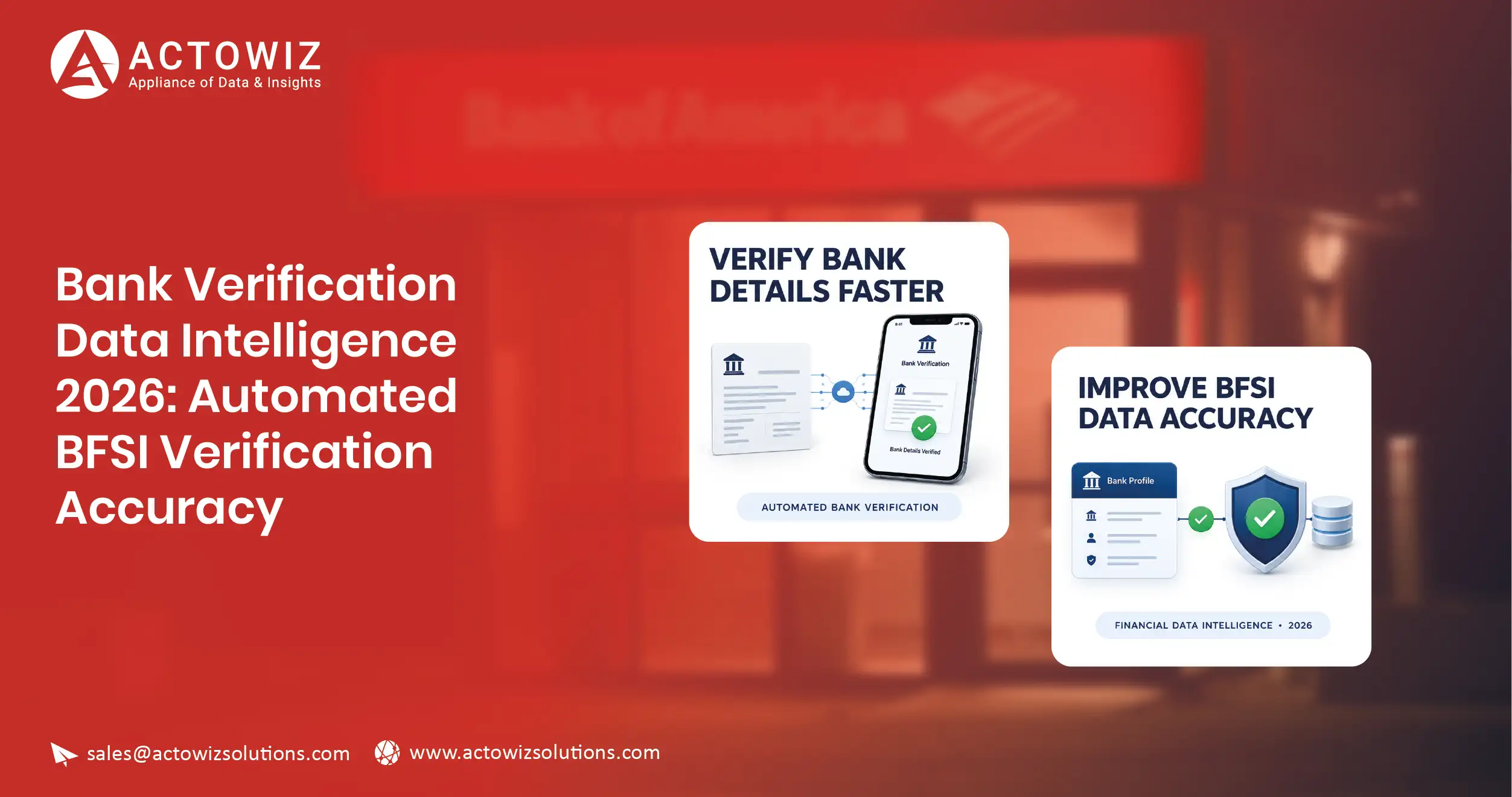
Bank Verification Data Intelligence 2026 helps banking, financial services, and insurance (BFSI) firms organize verification-related information, identify discrepancies, and support more consistent customer due diligence. By combining Financial Data Scraping Services with authorized data sources, validation rules, and human review, organizations can improve the quality and traceability of verification workflows without treating scraped information as proof of account ownership.
Bank verification matters across customer onboarding, beneficiary checks, lending operations, vendor due diligence, and fraud-risk assessment. Yet names, account details, business records, and publicly available information may be incomplete, outdated, or inconsistent. Manual checking alone can make it difficult to review large volumes of records consistently.
The solution is a controlled data workflow: collect only permitted information, standardize relevant fields, validate records against authoritative sources, flag mismatches, and retain evidence for review. Automation can support this process, but it cannot replace bank-authorized verification, regulatory controls, or secure handling of personal and financial data.
The scale of digital finance makes these controls increasingly important. The Reserve Bank of India (RBI) reported that retail digital payment transactions in India reached 22,167.90 crore transactions in FY 2024–25, with a total value of ₹849.12 lakh crore. UPI accounted for 81% of retail digital payment transactions that year, according to a Government of India release published in March 2026. Source: Press Information Bureau
How can financial institutions improve record accuracy before making decisions?
Bank verification data extraction & validation involves collecting relevant information from permitted sources, standardizing its format, and checking it against authoritative records. It can support operational workflows, but extracting a bank name or account-related field from a public webpage does not establish that an account exists, belongs to a particular person, or is active.
For BFSI operations teams, the first priority is to define which fields are necessary for each verification task. Business onboarding may require a legal entity name and registration details, while beneficiary validation may require a bank-supported confirmation of account details. These are different checks and should not be treated as interchangeable.
A practical validation pipeline should include field-level checks, duplicate detection, normalization, source timestamps, and exception handling. If a business name differs slightly between records, the system can flag the discrepancy for review rather than automatically rejecting the application. Similarly, missing information should be marked as unavailable—not interpreted as evidence of fraud.
The scale of account access reinforces the importance of reliable verification. The World Bank’s Global Findex 2021 found that 76% of adults worldwide had an account at a bank, another financial institution, or a mobile money provider, compared with 68% in 2017 and 51% in 2011. Source: World Bank.
For Bank Verification Data Intelligence 2026, the operational lesson is to separate data extraction from identity proof and final approval. Every result should identify its source, collection time, validation method, and confidence limitations.
| Validation check |
What it establishes |
What it does not establish |
| Format and completeness |
Whether required fields are present and correctly structured |
Whether the information is genuine |
| Name matching |
Whether two names match under defined rules |
Legal ownership without authoritative evidence |
| Source comparison |
Whether records agree with a designated source |
That every source is current |
| Bank-authorized confirmation |
Whether the relevant bank verification service confirms specified details |
Other facts outside that service’s scope |
Why does current banking information matter in digital workflows?
Real-time banking data intelligence & verification can help teams respond to changes sooner, provided the source supports timely access and the organization has permission to use it. The phrase “real-time” should describe a defined service level, such as event-driven updates or a specified polling interval, rather than imply instant access to every banking record.
This distinction matters because bank information is not uniformly public. Some information is published in official registries, while sensitive account data is generally available only through authorized banking systems, approved verification providers, or consent-based workflows. Public-data collection can support research and record enrichment; it cannot replace secure account verification.
India’s digital payments expansion illustrates the scale of the surrounding ecosystem. Government figures show retail digital payment volume rising from 7,176.90 crore transactions in FY 2021–22 to 22,167.90 crore in FY 2024–25. The reported transaction value increased from ₹457.44 lakh crore to ₹849.12 lakh crore over the same period. Source: Press Information Bureau, 16 March 2026.
As digital activity grows, financial institutions need data workflows that can identify incomplete records, distinguish current observations from stale ones, and route unresolved cases to the correct team. An update timestamp is therefore as important as the value itself. A record without a clear date may be unsuitable for a time-sensitive decision.
A useful implementation should specify:
- Which sources are authoritative for each field.
- How frequently each source can be checked.
- What happens when a source is unavailable.
- Which discrepancies require manual investigation.
- How long verification evidence may be retained under applicable rules.
For BFSI buyers, timely data is valuable only when its provenance, permitted use, and limitations are clear.
What should BFSI firms prioritize in their 2026 verification strategy?
Bank verification data intelligence for BFSI firms in 2026 should be designed around risk, evidence quality, and the consequences of an incorrect match. Banks, fintech companies, lenders, payment providers, and insurance businesses may all need verification workflows, but their exact obligations and acceptable evidence can differ by product, jurisdiction, and regulatory status.
A useful strategy begins by mapping each decision to its required evidence. Customer identification, legal-entity checks, beneficiary validation, and ongoing due diligence should have separate control definitions. This prevents an automated data match from being treated as a universal approval signal.
The Financial Action Task Force (FATF) provides guidance on using digital identity systems for customer due diligence, including onboarding and ongoing due diligence. Its guidance emphasizes the reliability and independence of digital identity systems and the application of a risk-based approach. Source: FATF, Guidance on Digital Identity.
In India, the RBI’s Know Your Customer (KYC) Direction establishes requirements for regulated entities’ customer due diligence processes. The direction has been amended over time, including amendments issued in November 2024 and June 2025. BFSI teams should consult the current official version and any applicable subsequent directions rather than relying on an old checklist. RBI KYC Master Direction and RBI KYC Amendment Directions, June 2025.
The following table gives an actionable framework for implementation.
| Priority |
Recommended control |
Example performance measure |
| Source reliability |
Maintain approved-source lists and field-level provenance |
Percentage of records with traceable sources |
| Matching quality |
Define exact and fuzzy matching rules with review thresholds |
Confirmed match rate after review |
| Exception management |
Route unresolved discrepancies to authorized staff |
Median time to resolve exceptions |
| Freshness |
Track collection and source-update timestamps |
Share of records within the freshness target |
| Governance |
Document access permissions, retention, and audit trails |
Completion of scheduled control reviews |
For Bank Verification Data Intelligence 2026, success should be measured by the quality and traceability of verification decisions—not simply the number of records collected.
How can an API connect verification checks with existing systems?
A Bank verification API for BFSI can connect an application or internal workflow to an authorized verification provider or banking service. Depending on the provider, the service may confirm specific account details, validate a supported identifier, or return a defined verification status. The exact response must be interpreted according to the provider’s documentation and permitted use.
An API-based workflow can reduce repeated manual entry and make validation rules more consistent. For example, an onboarding platform can submit the fields required by an approved service, receive the response, record the verification timestamp, and route exceptions for review. This describes a general integration pattern, not a claim that every bank exposes a public verification API.
A reliable integration should define authentication, authorization, encryption, error handling, rate limits, audit logging, and data retention. It should also distinguish a technical failure from a negative verification result. A timeout or unavailable service is not evidence that the submitted account information is invalid.
FATF’s digital identity guidance explains how digital identity systems can support customer identification and verification under its customer due diligence standards. Source: FATF Guidance on Digital Identity. For India-specific deployments, API integration and personal-data processing should also be assessed against applicable RBI requirements and the Digital Personal Data Protection framework.
The Government of India notified the Digital Personal Data Protection Rules, 2025, on 14 November 2025. The framework addresses principles including purpose limitation, data minimisation, accuracy, security safeguards, and accountability. Organizations should review the Act, rules, and applicable commencement provisions to determine which obligations apply to a particular processing activity. Source: Press Information Bureau.
Before implementation, BFSI teams should ask vendors:
- What exact verification result does the API provide?
- Which institution or source supports that result?
- What consent or authorization is required?
- How are unavailable and inconclusive results represented?
- Can every response be linked to a timestamp and audit record?
How can automation improve consistency without bypassing controls?
An Automated bank verification solution can coordinate data collection, field normalization, validation, exception routing, and evidence logging. It can reduce repetitive work, but it should not automatically approve a customer or beneficiary solely because two records appear similar. Verification outcomes need to follow the institution’s approved control framework.
The importance of strong controls is reinforced by fraud reporting. In its 2024–25 Annual Report, the RBI reported 13,516 card and internet fraud cases involving ₹520 crore in the category table for that financial year. The same report recorded 7,950 fraud cases involving ₹33,148 crore in the advances category. These figures cover reported bank frauds classified by area of operation; they are not a measure of bank-verification failures, and the amount involved should not be interpreted as the final loss. Source: RBI Annual Report 2024–25.
A controlled automation workflow should treat records as evidence inputs rather than conclusive judgments. It can check whether fields are present, compare names against approved reference records, detect duplicate submissions, and flag differences between submitted information and authoritative responses. Human review remains necessary for ambiguous cases, high-risk decisions, and exceptions defined by policy.
A historical view of digital finance and verification-related controls helps place this work in context. The figures below are published indicators, not a directly comparable annual measure of verification accuracy.
| Year |
Verified published indicator |
Relevance to verification workflows |
| 2020 |
FATF published guidance on digital identity and customer due diligence. Source |
Established a risk-based framework for assessing digital identity systems. |
| 2021 |
The World Bank reported global account ownership at 76%, up from 68% in 2017. Source |
Demonstrated the growing reach of formal and mobile financial accounts. |
| 2022 |
India recorded 7,176.90 crore retail digital payment transactions in FY 2021–22. Source |
Shows the scale of digital payment activity in the Indian ecosystem. |
| 2023 |
India’s Digital Personal Data Protection Act was enacted on 11 August 2023. Source |
Put a dedicated digital personal-data protection framework on the statute book. |
| 2024 |
The RBI amended its KYC Direction on 6 November 2024. Source |
Reinforced the need to keep verification procedures aligned with current rules. |
| 2025 |
India notified the Digital Personal Data Protection Rules on 14 November 2025. Source |
Made implementation planning and applicability assessment more important for data workflows. |
| 2026 |
Government figures published on 16 March 2026 reported 22,167.90 crore retail digital payment transactions in FY 2024–25. Source |
Provides a recent scale indicator for the digital-payment environment in which verification controls operate. |
These indicators should not be read as proof that automation alone improves accuracy. To evaluate an implementation, BFSI firms should measure their own confirmed-match rate, false-positive rate, exception volume, review time, and audit completeness against a documented baseline.
Where can AI-assisted data collection add value?
AI-Powered Scraping Services can support the extraction and organization of permitted information from public websites, official registries, financial institution disclosures, and other approved sources. In a BFSI workflow, potential uses include identifying relevant fields in documents, standardizing company names, detecting missing values, and classifying records for further review.
AI-generated extraction results should not be treated as authoritative financial evidence. An incorrectly read digit, an outdated company address, or a similar-looking business name can create a false match. Every critical field should therefore be checked against its source, and material verification decisions should rely on an appropriate authoritative service.
A practical architecture separates collection from validation:
- Source layer: Approved websites, public registries, authorized APIs, and institution-provided records.
- Extraction layer: Structured capture of relevant fields and source references.
- Normalization layer: Consistent formatting for dates, names, addresses, and supported identifiers.
- Validation layer: Checks against authoritative records and documented business rules.
- Review layer: Human assessment of conflicting, incomplete, or high-risk records.
- Audit layer: Timestamps, validation outcomes, source provenance, and access records.
The World Bank’s Global Findex Database 2025 offers useful context for digital financial services. It is based on nationally representative surveys of approximately 148,000 adults across 141 economies, conducted during 2024. The report includes data on account ownership, financial-service use, mobile-phone ownership, internet use, and digital safety. These indicators describe the financial and digital environment; they do not measure the accuracy of scraping or bank-verification systems. Source: World Bank Global Findex Database 2025.
For BFSI teams, AI is most useful when it makes data easier to organize and review without hiding uncertainty. Systems should preserve the original source, flag low-confidence extraction, and avoid inventing missing information. Collection must also respect access restrictions, contractual terms, privacy requirements, and the sensitivity of financial data.
How can Actowiz Solutions help BFSI firms build a reliable workflow?
Actowiz Solutions can help businesses plan structured data collection workflows based on their source coverage, verification objectives, and technical requirements. The appropriate approach depends on whether a project involves public corporate information, financial institution disclosures, authorized API responses, or sensitive account data that requires explicit authorization.
Custom Data Extraction Services can be scoped around defined fields, approved sources, data formats, collection schedules, and quality checks. For BFSI firms, the objective should be to provide traceable information that supports authorized verification processes—not to substitute scraped data for confirmation from a bank or regulated verification provider.
Potential areas of support include:
- Source assessment: Identify suitable public and authorized sources for the required information.
- Structured extraction: Organize available records into consistent fields for downstream analysis.
- Data normalization: Standardize names, dates, addresses, and other relevant fields to support comparison.
- Quality checks: Flag missing information, duplicate records, inconsistent values, and potential extraction errors.
- Historical tracking: Retain dated observations where permitted, so teams can review changes over time.
- Workflow integration: Prepare outputs in agreed formats for internal analytics, reporting, or authorized verification systems.
- Governance support: Document source provenance, collection limitations, and quality-control requirements.
For Bank Verification Data Intelligence 2026, the right design starts with the intended decision. A business-information enrichment project may use public sources, while bank-account validation may require a bank-authorized service. Keeping these use cases separate helps prevent overreliance on information that cannot independently establish account ownership or status.
Before starting a project, define the required fields, authoritative reference sources, acceptable error thresholds, update frequency, retention policy, and escalation process. These criteria create a measurable basis for assessing whether the resulting dataset is suitable for its intended purpose.
Conclusion
Accurate bank verification depends on more than collecting information quickly. BFSI firms need authoritative sources, consistent validation rules, appropriate permissions, traceable evidence, and a clear process for resolving exceptions. Automation can help organize this work, but sensitive account verification and final risk decisions must remain within authorized systems and established controls.
Combining carefully governed Web Scraping, permitted Mobile App Scraping, and a quality-checked Real-time dataset can help organize relevant public information and monitor changes where sources support timely access. These methods should complement—not replace—bank-authorized confirmation, customer due diligence, and regulatory obligations.
Ready to improve your financial data workflows? Contact Actowiz Solutions to discuss your requirements for structured data extraction, financial information monitoring, and verification-support datasets tailored to your business needs.
You can also reach us for all your mobile app scraping, data collection, web scraping, and instant data scraper service requirements!
 Actowiz Solutions

 By industry
 Pricing & Promotions
 Brand & Intelligence
 Digital Shelf & Search
 Assortment
 For Retailers
 E-Commerce Dashboard
 Flipkart Insights (Live)
 Grocery Intelligence
.svg) Grocery Price (U.S.)
.svg) Quick Commerce (India)
 Food & Restaurant
 Fashion Intelligence
 Automotive
 Travel & Hospitality
 Real Estate
 Food Delivery Intelligence
 OTT & Streaming
 Fuel & EV Charging Price Tracker
 By Use Case
 Pricing Intelligence
 Digital Shelf Analytics
 MAP Monitoring
 Cross-Border Price Parity
 Share of Search
 Review Sentiment
 Kitchen Market Gaps
 Dynamic Pricing / AI Repricing
 Promotions & Deals Alerts
 B2B / POI & Lead Data
 AI Search Visibility Dashboard
 Baby Products on Quick Commerce
 Hotel & Flight Rate Parity
 By Region
 Flipkart Real-Time Insights
 Quick Commerce — Zepto · Blinkit
 Pincode Price Tracker
 GCC Q-Commerce — Talabat · Noon
 UK Grocery — Tesco, Sainsbury's, Asda
 AU Grocery — Coles & Woolworths
 Marketplace Scrapers
 Developer APIs
 Universal APIs
 Delivery & SDKs
 Knowledge Center
 Guides & Playbooks
 Downloads & Tools
 Trust & Company


 4.8/5 Average Rating
 50+ Video Testimonials
 92% Client Retention
 50+ Countries Served