Core services
Enterprise Data Extraction

Scalable web, app and AI-powered collection across 40+ countries.

All 58 services →
New 2026
AI Training Data

Corpus building with provenance and opt-out compliance.

Learn more →
Free pilot
24-hour sample

We run collection on your own sources before you commit.

Get a sample →
58Services
40+Countries
DEVELOPER

Ready-Made Scrapers

Pre-built for top platforms. Self-serve, no setup.

View All →
TRY FREE

API Playground

Test endpoints instantly. No credit card.

Start Free →
28Tools
2SDKs
icons Delivery & SDKs
Streaming Crawl API Scheduler Realtime Alerts Webhook Delivery 🐍 Python SDK 💚 Node.js SDK

Need it managed instead?

Fixed monthly retainer, named engineer, no per-request metering.

Managed Data API →
HOT

Case Studies

How brands use Actowiz, with named outcomes.

Read →
FREE

Sample Datasets

Real output, no signup.

Download →
NEW

ROI Calculator

Model the return on a data engagement.

Calculate →

Introduction

Saudi Arabia online grocery market data is now a core input for FMCG pricing, category and retail strategy teams. Grocery shoppers in Riyadh, Jeddah and Dammam can compare a dark-store basket delivered in minutes, a scheduled hypermarket order and a marketplace delivery on one phone. Each channel sets its own price, promotion and range for the same product.

Direct answer: The Saudi online grocery market was valued at about USD 1.54 billion in 2024 and is forecast by IMARC Group to reach about USD 5.93 billion by 2033 (15.87% CAGR). For brands and retailers, the useful signal is not market size alone but daily, SKU-level prices, promotions and stock status across apps such as Nana, Ninja, Carrefour, Panda, Tamimi, Danube, Lulu, Othaim, Amazon.sa and noon Minutes.

This report sets out the landscape, the platform models, the seasonal calendar, the data challenges (Arabic/English matching, pack sizes, VAT-inclusive prices) and a practical method for measuring competitive position. Where our own measured values belong, we show a clear placeholder rather than a guessed figure.

How big is the Saudi online grocery market, and how fast is it growing?

Published estimates differ by definition – some include restaurant food delivery, others count only grocery baskets. We use IMARC Group's public press release as the anchor because it states a base year, a forecast year and a growth rate. IMARC puts the market at USD 1,543.7 million in 2024 and USD 5,925.7 million by 2033, a compound annual growth rate of 15.87% for 2025–2033. These are third-party estimates, not official statistics.

The wider e-commerce base is also growing. Ministry of Commerce data reported in early 2026 showed 43,854 e-commerce registrations at the end of Q4 2025, up 9% from 40,041 a year earlier. Riyadh Province led with 19,062 registrations, followed by Makkah Province (11,062) and the Eastern Province (6,659). That geography closely matches where online grocery coverage is deepest.

Capital is still flowing into the channel. In July 2025, quick-commerce player Ninja raised about USD 250 million in a round led by Riyad Capital, at a valuation of roughly USD 1.5 billion, according to Wamda. For FMCG teams, more funded competitors usually means more promotional intensity and faster range changes – exactly the movements that need tracking.

Metric Value Source / status
Online grocery market size, 2024 USD 1,543.7 million IMARC Group (estimate)
Online grocery market forecast, 2033 USD 5,925.7 million IMARC Group (estimate)
CAGR 2025–2033 15.87% IMARC Group (estimate)
E-commerce registrations, Q4 2025 43,854 (+9% YoY) Ministry of Commerce
SKUs tracked across KSA grocery apps, 2026 Pending Actowiz dataset
Share of tracked SKUs on promotion, 2026 average Pending Actowiz dataset

Which platform models compete for the Saudi grocery basket?

Three models now sit side by side, and each behaves differently on price and availability. Quick commerce (Ninja, noon Minutes and HungerStation's Quick Market) runs dark stores with a curated range and delivery promises measured in minutes. Scheduled delivery from grocers such as Tamimi Markets, Danube and Othaim, and from grocery apps such as Nana, offers a wider range with delivery slots or same-day windows. Hypermarket and marketplace online – Carrefour KSA (Majid Al Futtaim), Panda through the Panda app, Lulu KSA and Amazon.sa – mixes deep ranges with hypermarket-style promotions.

Partnerships are blurring the lines. In October 2025, Amazon announced same-day grocery delivery in Riyadh and Jeddah with Al-Othaim Markets, with Othaim products shown under the "Fresh" section of the Amazon app. That same month, Jahez and noon announced that a noon Minutes tile would appear inside the Jahez app from November 2025, with Jahez food delivery in the noon app from December 2025. HungerStation has run its Quick Market dark-store grocery service since 2020, according to a company-sponsored Arab News feature.

For data teams, the model matters because it changes what "the price" means. A dark-store app may price a product differently by zone, show a smaller range and flip to out-of-stock within hours. A hypermarket app may hold one national price but rotate weekly leaflet deals. Reliable monitoring needs a store or delivery-zone context for every observation.

Model Example platforms in KSA Typical delivery promise Range depth What to track most closely
Quick commerce (dark stores) Ninja, noon Minutes (also via Jahez), HungerStation Quick Market Minutes to about an hour (platform-stated) Curated Zone-level price, stock-outs, delivery fee thresholds
Scheduled grocer delivery Tamimi Markets, Danube, Othaim, Nana Same-day or slotted Wide Weekly promotions, multi-buy deals, fresh-category pricing
Hypermarket / marketplace online Carrefour KSA (MAF), Panda app, Lulu KSA, Amazon.sa (Fresh via Othaim) Same-day or next-day Very wide Leaflet deals, private label gaps, seller vs retailer price
Coverage in Actowiz KSA dataset All of the above (public pages only) – Pending SKUs Refresh: Pending

What do pricing and promotion signals look like by category?

Saudi online grocery prices are shown in Saudi riyals (SAR) and are generally VAT-inclusive at the standard 15% rate. That sounds simple, but comparisons break easily. Some apps show a struck-through "was" price, others a percentage badge, and others a multi-buy ("2 for SAR X") that only applies at checkout. A clean dataset records the shelf price, the promoted price, the promotion mechanic and the effective unit price separately.

Category behaviour differs. Staples such as rice, cooking oil, sugar and flour are highly price-visible and often used as traffic drivers, especially in the large pack sizes common in Saudi households. Dairy, laban and bakery items move quickly and are sensitive to stock-outs on quick-commerce apps. Beverages, snacks and confectionery see frequent percentage-off and bundle deals. Fresh produce and meat are priced per kilogram with frequent changes, which makes per-unit normalisation essential.

Delivery economics also shape the shopper price. Minimum basket values, delivery fees and subscription benefits (for example Prime or noon One) change the true cost of a basket. Brand teams should record these alongside product prices so that a "cheaper" shelf price is not misread.

Category Typical promotion mechanic seen online Key price signal to monitor Actowiz 2026 measured value
Rice, oil, sugar, flour (staples) Large-pack discounts, leaflet hero deals Price per kg / litre across 5 kg–10 kg packs Pending
Dairy and laban Multi-buy, app-exclusive offers Stock status and price per litre by zone Pending
Beverages and water Case discounts, bundle pricing Price per litre; case vs single price gap Pending
Snacks and confectionery Percentage off, buy-one-get-one Promotion depth and frequency Pending
Fresh produce and meat Frequent price changes, weekend offers Price per kg; origin labels Pending
Household and personal care Bundles, private label alternatives Brand vs private label price index Pending

When do Saudi grocery prices and promotions peak?

The Saudi grocery calendar is shaped by religious and national moments more than by a single sales weekend. Ramadan is the largest event: shoppers stock up on dates, rice, oils, juices, dairy and baking items before and during the month, and retailers run long promotional campaigns. Because Ramadan follows the Hijri calendar, it moves about 11 days earlier each Gregorian year, so year-on-year comparisons must align on the Hijri date rather than the calendar month. Eid al-Fitr and Eid al-Adha follow with their own demand peaks.

National occasions add further spikes. Founding Day (22 February) and Saudi National Day (23 September) bring themed packs and national-day offers across hypermarket and quick-commerce apps. White Friday, the regional name for the November sales period, now reaches grocery and household categories through marketplaces such as Amazon.sa and noon, although its impact on fresh grocery is usually smaller than Ramadan's.

For pricing teams, the practical issue is baseline drift. A promotion that starts two weeks before Ramadan can look like a permanent price cut if monitoring is weekly. Daily collection in the four to six weeks around each event gives a clean pre-event baseline, an in-event depth and a post-event return price.

Event Typical timing Categories most affected Recommended collection frequency Actowiz measured promo depth
Ramadan Hijri month 9 (moves about 11 days earlier each year) Dates, rice, oil, juices, dairy, baking Daily, from 3 weeks before Pending
Eid al-Fitr / Eid al-Adha Hijri calendar Sweets, meat, beverages, gifting Daily during event week Pending
Founding Day 22 February Snacks, beverages, themed packs Daily for event week Pending
Saudi National Day 23 September Beverages, snacks, household, themed packs Daily for 2 weeks Pending
White Friday November Household, personal care, packaged grocery on marketplaces Daily for the sale period Pending

How do you match Arabic and English products and normalise pack sizes?

Most Saudi grocery apps publish product names in both Arabic and English, but the two are not always direct translations. The same product may appear as an English brand name on one app and a transliterated Arabic name on another. Titles may also mix units (g / غ, ml / مل, kg / كجم), use Arabic-Indic numerals, or describe multipacks inconsistently ("6 x 200 ml" versus "200 ml, pack of 6").

Reliable matching combines several signals. Barcodes (GTIN/EAN) are the strongest anchor when a retailer exposes them publicly. Where they are not shown, matching relies on normalised brand, variant, size and pack count, plus image similarity and human review for low-confidence pairs. Arabic text needs its own normalisation: removing diacritics, unifying letter forms (for example different forms of alif and taa marbuta), and converting Arabic-Indic digits to Western digits before parsing sizes.

Pack-size normalisation then converts every price to a comparable unit – price per 100 g, per litre or per unit – so that a 1.8 litre oil bottle on one app can be compared with a 1.5 litre bottle on another. Without this step, competitive price indices across Saudi retailers are misleading.

Matching step Example issue in KSA grocery data How it is handled
Text normalisation Arabic diacritics, letter variants, Arabic-Indic numerals Normalise script, convert digits, standardise units
Size and pack parsing "6 × 200 مل" vs "200ml Pack of 6" Parse to pack count × unit size → total volume
Brand and variant match English brand on one app, Arabic transliteration on another Brand dictionary in both scripts plus variant rules
Identifier match Barcode visible on some apps only Use GTIN where public; fall back to attribute + image match
Human QA Low-confidence pairs Analyst review; match confidence stored per pair
Match rate achieved in Actowiz KSA dataset – Pending

How does online grocery coverage differ across Riyadh, Jeddah and Dammam/Khobar?

Riyadh is the deepest market for online grocery, with the widest choice of quick-commerce dark stores, hypermarket apps and marketplace delivery. Jeddah follows and has its own retailer mix alongside national players. The Eastern Province cluster of Dammam, Khobar and Dhahran is served by regional and national grocers, with quick-commerce footprints that can be narrower than in the two largest cities.

This matters because prices and ranges are often location-specific. A quick-commerce app serves a product from a nearby dark store, so the same SKU can be available in north Riyadh and out of stock in Jeddah at the same moment. Amazon's grocery partnership with Othaim, for example, launched initially in Riyadh and Jeddah. Monitoring that uses one default address can therefore miss regional promotions and stock gaps.

A sound regional design picks a fixed set of delivery locations per city, keeps them stable over time and records the store or zone that served each observation. This produces regional price indices and availability rates that are comparable week to week.

City / region E-commerce registrations, Q4 2025 (province, MoC) Platforms typically present Tracked locations in Actowiz design Availability rate (Actowiz)
Riyadh 19,062 (Riyadh Province) Quick commerce, hypermarket, scheduled grocers, Amazon Fresh Pending Pending
Jeddah 11,062 (Makkah Province) Quick commerce, hypermarket, scheduled grocers, Amazon Fresh Pending Pending
Dammam / Khobar 6,659 (Eastern Province) Hypermarket, scheduled grocers, selected quick commerce Pending Pending

How should brands and retailers measure competitive position?

Competitive position in Saudi online grocery is best measured as a small set of repeatable indices rather than one-off price checks. The price index compares each retailer's effective unit price for a matched basket against a reference (for example the category median). The promotion index tracks how often and how deeply each retailer discounts. Availability measures the share of tracked SKUs in stock by city and zone. Share of shelf measures how visible a brand is in search results and category pages.

Policy context supports this kind of measurement. The Ministry of Commerce lists "expansion of e-commerce for goods and services" as an initiative under the National Transformation Program, a Vision 2030 programme, with the objective of "developing the retail sector". As more trade shifts online, public prices become a larger share of what shoppers see.

On compliance, Saudi Arabia's Personal Data Protection Law (PDPL) is overseen by the Saudi Data and AI Authority (SDAIA). In plain words, it governs how organisations collect and use personal data about individuals. Grocery market monitoring of the kind described here collects public business data – product names, prices, promotions, stock status and ratings counts – and does not collect personal data. Collection should still respect each site's terms and avoid anything behind a login. This is general information, not legal advice.

KPI Definition Who uses it Actowiz 2026 baseline
Price index Effective unit price for a matched basket vs category median (=100) Pricing / RGM, retailer strategy Pending
Promotion index Share of SKU-days on promotion × average depth Category managers, trade marketing Pending
Availability rate In-stock SKUs ÷ tracked SKUs, by city and zone Supply chain, key account teams Pending
Share of shelf Brand share of top search and category positions E-commerce, brand teams Pending
Delivery cost index Delivery fee and minimum basket by platform and city Channel strategy Pending

How Actowiz Solutions Helps

  • Coverage across the Saudi grocery landscape. Public product, price, promotion and stock data from quick-commerce, scheduled and hypermarket apps and websites, with a fixed set of delivery locations in Riyadh, Jeddah and Dammam/Khobar. See our Saudi Arabia web scraping services
  • Arabic/English matching and normalisation. Script normalisation, pack-size parsing, unit pricing in SAR (VAT-inclusive) and a stored match confidence for every product pair. Related work
  • Freshness that fits the event. Daily or intraday refresh around Ramadan, Founding Day, National Day and White Friday; weekly refresh for steady-state categories. Refresh frequency and coverage are agreed in a written SLA.
  • QA and auditability. Automated checks on price outliers, missing fields and duplicate listings, plus analyst review for low-confidence matches. Every record keeps its source URL, timestamp and location context.
  • Delivery where your teams work. API, CSV/JSON, or direct delivery to Amazon S3, Snowflake, Google BigQuery or Azure, with dashboards through Actowiz Metrics and digital shelf analytics
  • Security and usage rights. Public business data only, no personal data, no login-only content; access controls and usage terms set out in the contract. An enterprise sample can be delivered within 48 hours of scoping.

Conclusion

Saudi online grocery is growing quickly, and its structure is changing even faster. Quick-commerce dark stores, scheduled grocers and hypermarket apps now compete for the same basket, and partnerships such as Amazon with Othaim and noon with Jahez are widening reach. For FMCG and retail teams, published market-size forecasts give direction, but decisions on price, promotion and range need SKU-level evidence by platform, city and week.

The teams that get the most from this data keep it consistent. They use fixed locations, Hijri-aligned seasonal baselines, Arabic/English matching with unit pricing, and a small set of indices tracked over time. That turns noisy app data into a reliable view of competitive position.

Request the full report or an enterprise sample (48-hour turnaround) – use your company email and tell us your categories, retailers, cities and refresh frequency.

Frequently Asked Questions

Which online grocery platforms in Saudi Arabia can be monitored?

Public product and price pages from apps and sites such as Nana, Ninja, Carrefour KSA, Panda, Tamimi Markets, Danube, Lulu KSA, Othaim, Amazon.sa (including Fresh) and noon Minutes can be scoped. Final coverage depends on public availability and each site's terms; login-only content is excluded.

How often should Saudi grocery prices be collected?

Weekly is usually enough for steady-state tracking. Daily or intraday collection is recommended for quick-commerce apps and for the weeks around Ramadan, Founding Day, Saudi National Day and White Friday.

Are prices recorded with or without VAT?

Saudi consumer prices are shown in SAR and are generally VAT-inclusive at 15%. We record the displayed price and can add a VAT-exclusive field for internal analysis.

How do you compare products listed in Arabic on one app and English on another?

We normalise Arabic text and numerals, parse pack sizes, use barcodes where public, and apply brand dictionaries in both scripts. Low-confidence matches go to analyst review, and each match carries a confidence score.

Does this data collection fall under Saudi PDPL?

The PDPL, overseen by SDAIA, governs personal data. Grocery market monitoring collects public business data such as prices and stock status, not personal data. This is general information, not legal advice; your legal team should review your specific use.

How is the data delivered?

Via API, CSV/JSON files, or directly into Amazon S3, Snowflake, Google BigQuery or Azure, with optional dashboards. A scoped enterprise sample is available within 48 hours.

Get the full Saudi Arabia Online Grocery Market Data Report 2026. Request the full report or an enterprise sample (24-hour turnaround) – use your company email and tell us your categories, retailers, cities (Riyadh, Jeddah, Dammam/Khobar) and refresh frequency.

Contact Us Today!
Social Proof That Converts

Trusted by Global Leaders Across Q-Commerce, Travel, Retail, and FoodTech

Our web scraping expertise is relied on by 4,000+ global enterprises including Zomato, Tata Consumer, Subway, and Expedia — helping them turn web data into growth.

4,000+ Enterprises Worldwide
50+ Countries Served
20+ Industries
Join 4,000+ companies growing with Actowiz →
Real Results from Real Clients

Hear It Directly from Our Clients

Watch how businesses like yours are using Actowiz data to drive growth.

▶
1 min
★★★★★
"Actowiz Solutions offered exceptional support with transparency and guidance throughout. Anna and Saga made the process easy for a non-technical user like me. Great service, fair pricing!"
TG
Thomas Galido
Co-Founder / Head of Product at Upright Data Inc.
▶
2 min
★★★★★
"Actowiz delivered impeccable results for our company. Their team ensured data accuracy and on-time delivery. The competitive intelligence completely transformed our pricing strategy."
II
Iulen Ibanez
CEO / Datacy.es
▶
1:30
★★★★★
"What impressed me most was the speed — we went from requirement to production data in under 48 hours. The API integration was seamless and the support team is always responsive."
FC
Febbin Chacko
-Fin, Small Business Owner
icons 4.8/5 Average Rating
icons 50+ Video Testimonials
icons 92% Client Retention
icons 50+ Countries Served

Join 4,000+ Companies Growing with Actowiz

From Zomato to Expedia — see why global leaders trust us with their data.

Why Global Leaders Trust Actowiz

Backed by automation, data volume, and enterprise-grade scale — we help businesses from startups to Fortune 500s extract competitive insights across the USA, UK, UAE, and beyond.

icons
7+
Years of Experience
Proven track record delivering enterprise-grade web scraping and data intelligence solutions.
icons
4,000+
Projects Delivered
Serving startups to Fortune 500 companies across 50+ countries worldwide.
icons
200+
In-House Experts
Dedicated engineers across scrapers, AI/ML models, APIs, and data quality assurance.
icons
9.2M
Automated Workflows
Running weekly across eCommerce, Quick Commerce, Travel, Real Estate, and Food industries.
icons
270+ TB
Data Transferred
Real-time and batch data scraping at massive scale, across industries globally.
icons
380M+
Pages Crawled Weekly
Scaled infrastructure for comprehensive global data coverage with 99% accuracy.

AI Solutions Engineered
for Your Needs

→
LLM-Powered Attribute Extraction: High-precision product matching using large language models for accurate data classification.
→
Advanced Computer Vision: Fine-grained object detection for precise product classification using text and image embeddings.
→
GPT-Based Analytics Layer: Natural language query-based reporting and visualization for business intelligence.
→
Human-in-the-Loop AI: Continuous feedback loop to improve AI model accuracy over time.
icons Product Matching icons Attribute Tagging icons Content Optimization icons Sentiment Analysis icons Prompt-Based Reporting

Connect the Dots Across
Your Retail Ecosystem

We partner with agencies, system integrators, and technology platforms to deliver end-to-end solutions across the retail and digital shelf ecosystem.

icons
Analytics Services
icons
Ad Tech
icons
Price Optimization
icons
Business Consulting
icons
System Integration
icons
Market Research
Become a Partner →

Popular Datasets — Ready to Download

Browse All Datasets →
icons
Amazon
eCommerce
Free 100 rows
icons
Zillow
Real Estate
Free 100 rows
icons
DoorDash
Food Delivery
Free 100 rows
icons
Walmart
Retail
Free 100 rows
icons
Booking.com
Travel
Free 100 rows
icons
Indeed
Jobs
Free 100 rows

Latest Insights & Resources

View All Resources →
thumb
Blog

Retail Data Intelligence for UAE Retail Groups: The Complete Guide (2026)

UAE retail data intelligence for retail groups: prices, assortment, stock, reviews and share of search across Noon, Amazon.ae and more. 

thumb
Case Study

How Sensitive Skin Skincare Product Data API Helps Brands Track Cleansers, Serums, Moisturizers, and Sunscreens

Sensitive Skin Skincare Product Data API helps brands track cleansers, serums, moisturizers, and sunscreens with structured product data.

thumb
Report

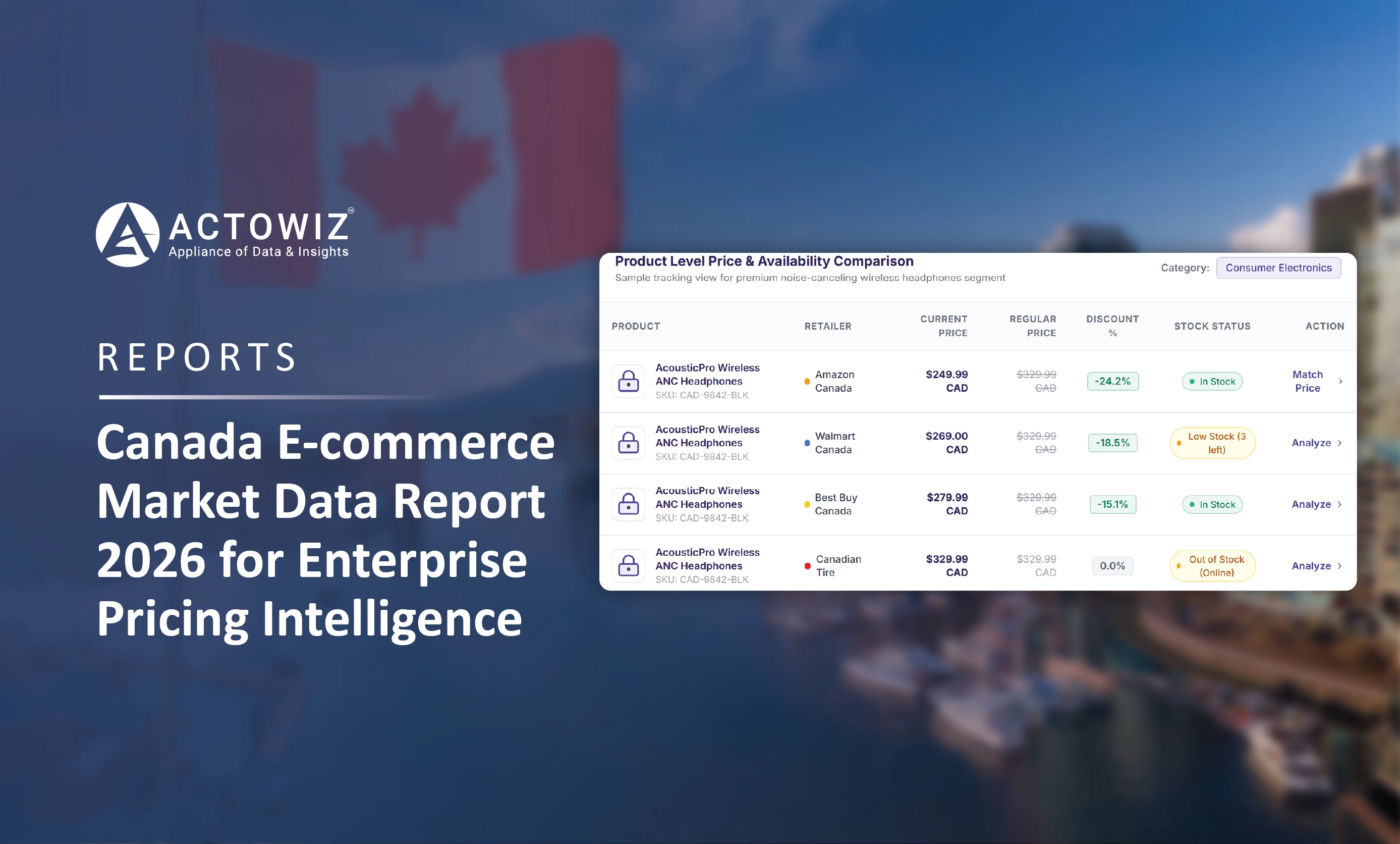
Canada E-commerce Market Data Report 2026 for Enterprise Pricing Intelligence

Canada ecommerce market data for 2026: StatCan online sales, key retailers, tax, French-language and pricing rules.

Start Where It Makes Sense for You

Whether you're a startup or a Fortune 500 — we have the right plan for your data needs.

icons
Enterprise
Book a Strategy Call
Custom solutions, dedicated support, volume pricing for large-scale needs.
icons
Growing Brand
Get Free Sample Data
Try before you buy — 500 rows of real data, delivered in 2 hours. No strings.
icons
Just Exploring
View Plans & Pricing
Transparent plans from $500/mo. Find the right fit for your budget and scale.

Request Free Sample Data

Our team will reach out within 2 hours with 500 rows of real data — no credit card required.

+1 ▼
✓ Free 500-row sample · No credit card · Response within 2 hours