Introduction
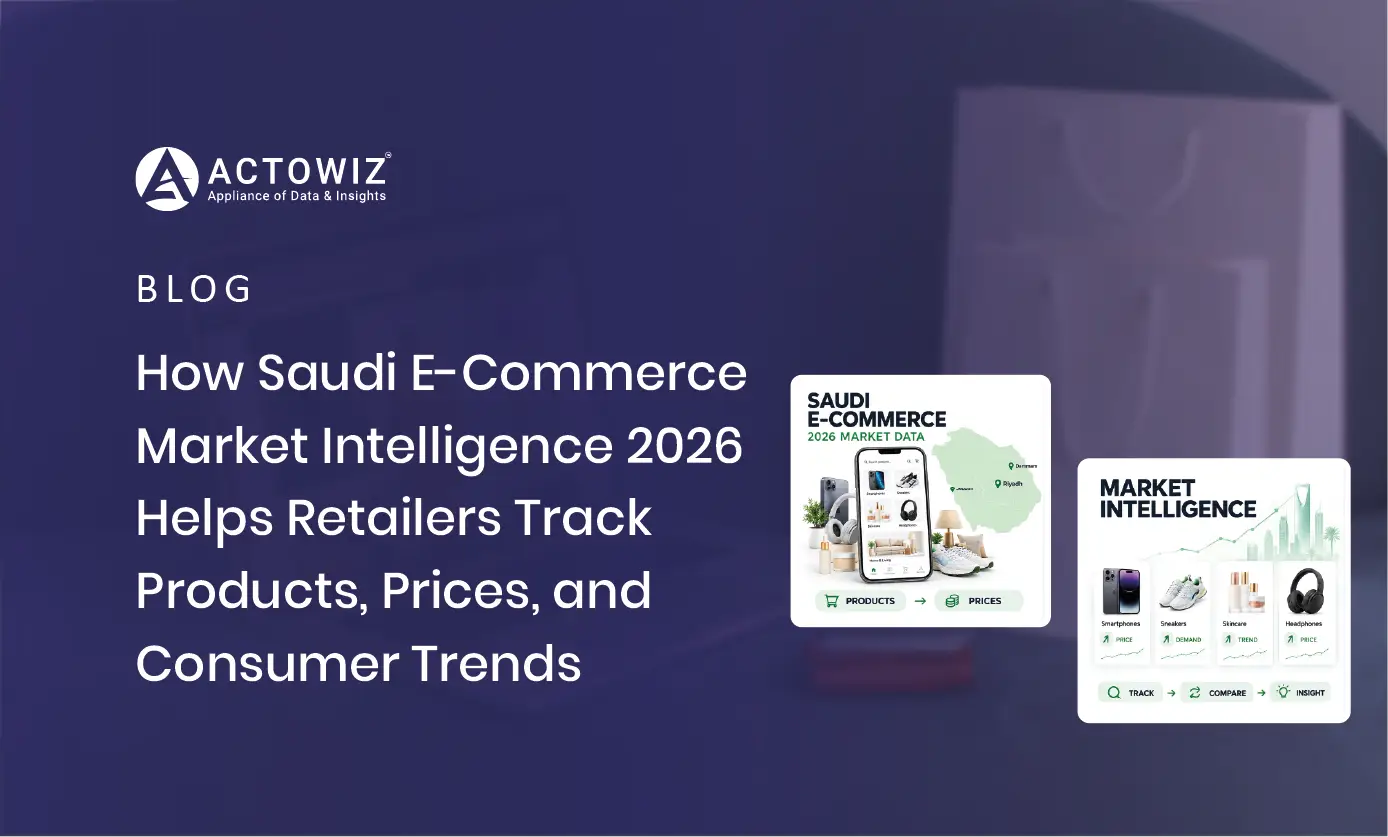
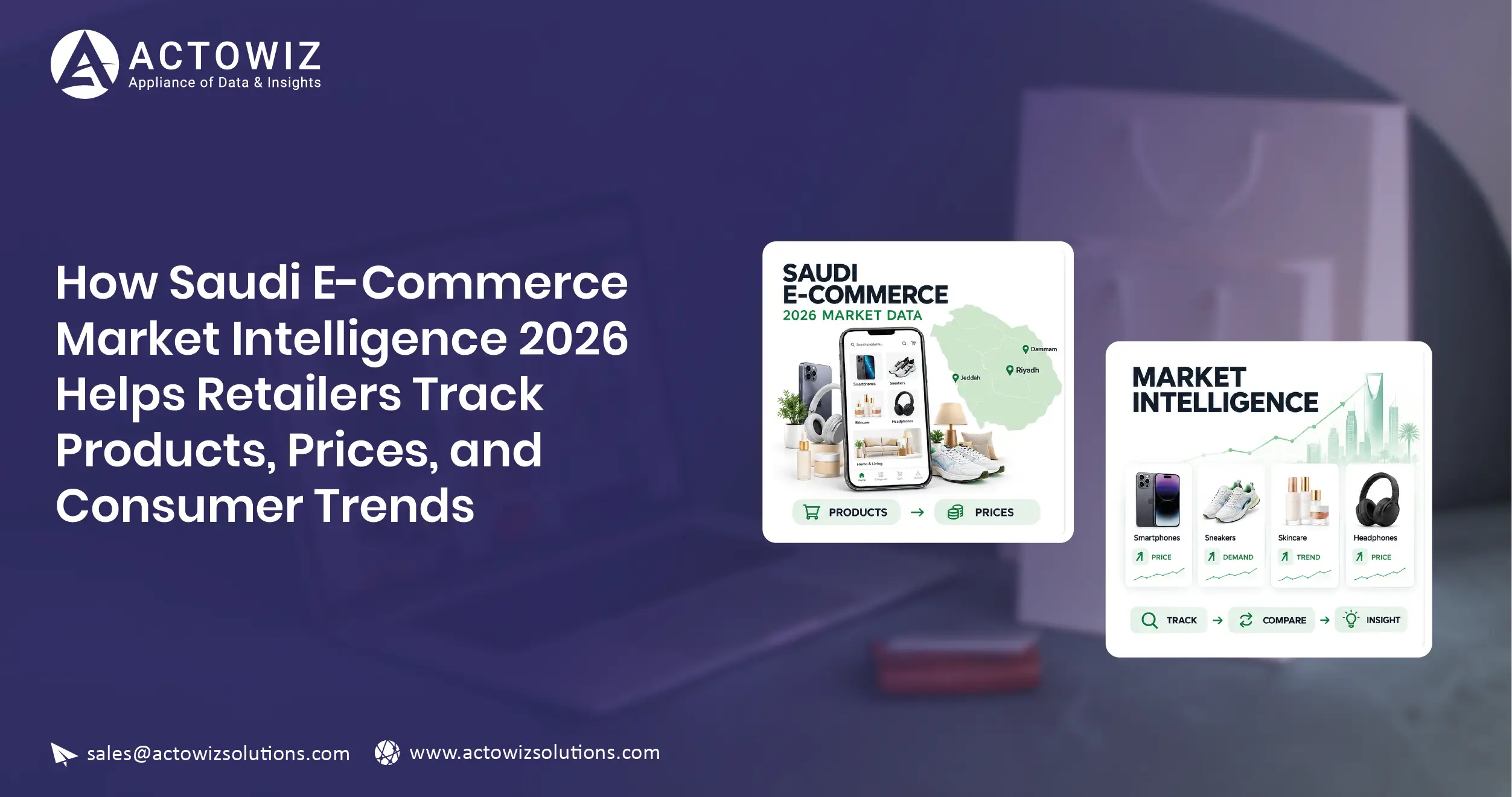
Saudi E-Commerce Market Intelligence 2026 helps retailers track product assortments, pricing changes, availability, competitor activity, and consumer-facing market signals so they can make faster and more informed commercial decisions. For retailers operating in Saudi Arabia, the challenge is no longer simply finding online product information. The bigger challenge is continuously organizing changing marketplace data into actionable intelligence.
Saudi Arabia's digital commerce environment has expanded rapidly. The Saudi Central Bank reported that e-commerce sales through mada cards exceeded SAR 69.3 billion in Q1 2025, representing 56% annual growth compared with Q1 2024. More than 370 million transactions were recorded during the quarter.
The country's broader digital infrastructure also supports this growth. The Communications, Space and Technology Commission reported 99% internet penetration in Saudi Arabia in 2024, while 93.1% of online shopping occurred on local websites. Mobile phones accounted for 99.4% of internet browsing usage.
For retailers, this creates a valuable but complex data environment. Saudi E-commerce Data Extraction can help transform publicly available product and marketplace information into structured datasets covering product names, categories, brands, SKUs, prices, discounts, availability, ratings, seller information, and other relevant attributes.
The resulting datasets can support pricing teams, category managers, e-commerce heads, marketplace teams, consumer research teams, and business intelligence professionals. Instead of manually checking hundreds or thousands of product pages, businesses can establish recurring data collection processes and compare changes over time.
How Can Retailers Build a Reliable View of the Market?
Saudi e-commerce market data scraping enables retailers to collect structured information from online stores and marketplaces at scale. The purpose is not simply to gather more data. It is to create a consistent information layer that makes product and competitor changes measurable.
A retailer may monitor a defined category across selected websites and capture product title, brand, SKU, category, pack size, current price, original price, discount, stock status, seller, rating, review count, product URL, and collection timestamp.
What Data Can Retailers Monitor?
| Data Point |
Business Use |
| Product name |
Product identification and catalog comparison |
| Brand |
Brand-level competitive analysis |
| SKU/product ID |
Product matching and historical tracking |
| Category |
Category-level market analysis |
| Current price |
Competitive price monitoring |
| Original price |
Discount and promotion analysis |
| Availability |
Stock and assortment visibility |
| Ratings |
Customer perception signals |
| Review count |
Demand and engagement proxy |
| Seller information |
Marketplace seller analysis |
| Product URL |
Source verification and monitoring |
| Timestamp |
Historical price and availability tracking |
The importance of systematic collection becomes clearer as online transaction activity increases. SAMA reported that electronic payments represented 79% of total retail payments in Saudi Arabia in 2024, rising from 70% in 2023. Electronic transactions reached 12.6 billion in 2024 compared with 10.8 billion in 2023.
2020–2026 Market Development
From 2020 onward, Saudi retail increasingly shifted toward digitally accessible product discovery, online ordering, and electronic payments. During the early part of the decade, retailers focused heavily on establishing online storefronts and digital fulfillment capabilities. As adoption increased, the competitive requirement moved toward product visibility, pricing consistency, promotions, and marketplace performance. By 2024, 99% internet penetration demonstrated the maturity of the country's digital environment. In 2025, e-commerce sales through mada cards reached record levels, including SAR 69.3 billion in Q1 and more than SAR 30.7 billion in October alone. SAMA also reported that electronic payments accounted for 85% of total retail payments in 2025, up from 79% in 2024. By 2026, retailers therefore have a stronger need for continuous competitive monitoring rather than occasional market research.
How Can Businesses Convert Online Signals Into Competitive Intelligence?
Saudi online retail intelligence gives retailers a structured way to understand how products, prices, promotions, availability, and competitors are changing across digital channels. Saudi E-Commerce Market Intelligence 2026 becomes particularly useful when businesses need to compare current marketplace conditions with historical observations.
For example, a retailer selling consumer electronics may discover that a competing seller has reduced the price of a high-demand SKU by 8%. Another retailer may notice that a popular model has become unavailable across several online stores. A category manager can use these signals to investigate pricing strategy, inventory availability, and potential demand shifts.
Which Metrics Should Retailers Track?
| Intelligence Area |
Key Metrics |
| Pricing |
Current price, average price, price gap |
| Promotions |
Discount %, promotional frequency |
| Assortment |
Product count, new listings, discontinued products |
| Availability |
In-stock/out-of-stock status |
| Competition |
Seller count, competing brands |
| Customer response |
Ratings, reviews, review growth |
| Category movement |
New products, price changes, assortment shifts |
Saudi Arabia's payment infrastructure is also evolving. In July 2025, SAMA launched a new e-commerce payments interface designed to improve national payment infrastructure and integrate mada with global payment networks. The initiative also introduced centralized registration and supported innovative financing solutions for e-commerce businesses.
This type of infrastructure development increases the importance of reliable digital commerce intelligence because retailers increasingly operate within connected online ecosystems.
2020–2026 Market Development
The 2020–2026 period shows a progression from digital adoption to data-led competition. In 2020, many businesses were primarily concerned with maintaining digital selling capabilities and meeting changing customer purchasing habits. During 2021 and 2022, online assortments, digital promotions, and marketplace participation became more important. By 2023 and 2024, retailers had more mature digital channels and increasingly needed competitive visibility. The 2024 internet penetration rate of 99% and 93.1% local-site share of online shopping highlight the scale of the addressable digital environment. In 2025, record e-commerce sales and improvements in payment infrastructure further strengthened digital retail. In 2026, the competitive advantage increasingly comes from turning these digital signals into structured intelligence that category, pricing, and strategy teams can act upon.
How Does Analytics Help Retailers Understand Product and Consumer Trends?
Saudi Arabia e-commerce data analytics helps retailers move from raw product records to measurable commercial insights. Data collection provides the foundation, but analytics reveals what is changing and why it matters.
A retailer can compare products across weeks or months to identify pricing movements, assortment expansion, product discontinuation, availability changes, and customer engagement patterns. When historical data is retained, teams can analyze trends instead of relying only on the current state of a website.
Examples of Analytical Questions
| Business Question |
Analytical Output |
| Which products are becoming more expensive? |
Price-change analysis |
| Which brands have the largest assortment? |
Brand assortment ranking |
| Which products are frequently unavailable? |
Availability trend |
| Where are competitors discounting? |
Promotion analysis |
| Which products receive more reviews? |
Engagement analysis |
| Which categories are expanding? |
Category growth tracking |
| Where is our price higher? |
Price-gap analysis |
Analytics can also support product matching. Similar products listed by different retailers can be normalized using brand, model, SKU, pack size, specifications, and other attributes. This makes competitor comparison more accurate.
For consumer trends, retailers can monitor changes in product popularity indicators such as review volumes, ratings, product introductions, and category expansion. These indicators should be treated as market signals rather than direct measurements of total consumer demand unless validated with additional business data.
2020–2026 Market Development
Between 2020 and 2026, retail analytics has evolved from periodic reporting toward continuous monitoring. In the earlier part of the period, businesses often relied on internal sales records and manual competitor checks. As online catalogs expanded, external digital signals became increasingly valuable. The growth of electronic transactions provides a strong indication of this shift. SAMA reported 10.8 billion electronic transactions in 2023, increasing to 12.6 billion in 2024 and 14.6 billion in 2025. At the same time, Saudi Arabia's high internet penetration and strong local online-shopping activity create a broad digital environment for market observation. By 2026, analytics programs can combine historical product datasets, pricing records, availability observations, and customer-facing signals to identify patterns earlier and support more proactive decisions.
How Can Retailers Monitor Marketplace Competition at Scale?
Scrape Saudi online marketplace data to create a recurring view of competitor products, sellers, prices, discounts, availability, ratings, and other publicly visible attributes. The key advantage of a structured process is consistency.
Manual research may provide a snapshot of a marketplace on one day. Automated collection can provide comparable observations across multiple dates, categories, retailers, and product groups.
A Practical Marketplace Monitoring Framework
| Monitoring Layer |
Example Information |
| Product discovery |
New products and new SKUs |
| Price tracking |
Current and previous prices |
| Promotion tracking |
Discounts and promotional events |
| Availability |
In-stock and out-of-stock changes |
| Seller monitoring |
Seller names and listing activity |
| Customer signals |
Ratings and review counts |
| Category monitoring |
Assortment changes |
| Historical tracking |
Date-stamped observations |
For a pricing team, historical observations can reveal whether a competitor consistently undercuts a particular category or only changes prices during promotional periods. For category managers, assortment monitoring can identify brands or products entering or leaving the market.
The process should also include data validation. Duplicate products, changing URLs, inconsistent product names, missing prices, and dynamic page structures can affect analysis if not addressed. Normalization and product matching should therefore be treated as core parts of the workflow.
2020–2026 Market Development
Saudi Arabia's marketplace environment has developed alongside broader digital adoption. From 2020 onward, retailers increasingly needed online visibility as customer journeys moved toward digital discovery and purchasing. By 2023–2024, the scale of internet and electronic payment adoption made online marketplaces strategically significant. In 2024, Saudi Arabia recorded 99% internet penetration, while 93.1% of online shopping occurred on local websites. In 2025, e-commerce sales through mada cards reached SAR 69.3 billion in Q1, 56% higher year over year, while October monthly sales exceeded SAR 30.7 billion. These developments indicate why marketplace monitoring in 2026 needs to operate continuously and at scale rather than through occasional manual checks.
How Can Retailers Improve Pricing Decisions With Product-Level Data?
Extract product pricing data from Saudi retailers to establish a detailed view of how products are positioned across the market. Pricing intelligence becomes more useful when current prices are compared with historical prices, competitor prices, discounts, and product availability.
A retailer does not necessarily need to change its price every time a competitor changes theirs. Instead, pricing teams can use structured observations to determine where a meaningful price gap exists and whether that gap is temporary or persistent.
Pricing Metrics That Matter
| Metric |
What It Shows |
| Current selling price |
Present market position |
| Previous selling price |
Price movement |
| Average competitor price |
Market benchmark |
| Minimum competitor price |
Lowest observed market position |
| Maximum competitor price |
Highest observed position |
| Discount percentage |
Promotional intensity |
| Price gap |
Difference between retailer and market |
| Availability |
Context for price comparison |
| Price frequency |
How often prices change |
For example, if a product is priced at SAR 250 by one retailer and SAR 225 by several competitors, the 10% difference may warrant investigation. But if those competitors are temporarily out of stock, the pricing interpretation may change. This is why price data should be analyzed together with availability and product matching.
SAMA's 2025 data demonstrates the scale of the digital transaction environment. Q1 e-commerce sales through mada cards exceeded SAR 69.3 billion, while more than 370 million transactions were recorded.
2020–2026 Market Development
Pricing intelligence became increasingly important as Saudi consumers gained access to more online purchasing options. During 2020–2022, businesses focused strongly on digital channel availability and operational continuity. From 2023 onward, the growth of electronic transactions created more opportunities for consumers to compare products and offers digitally. SAMA's figures show electronic retail payments rising from 70% of total retail payments in 2023 to 79% in 2024 and 85% in 2025. E-commerce sales via mada also reached a record SAR 30.7 billion in October 2025. By 2026, retailers can use historical price datasets to distinguish routine competitive movements from major market shifts and build more disciplined pricing strategies.
How Can Businesses Create a Long-Term Data Foundation?
Saudi Arabia ecommerce data extraction enables businesses to build repeatable datasets covering products, prices, sellers, availability, ratings, reviews, and other publicly accessible marketplace information. Saudi E-Commerce Market Intelligence 2026 can then turn these datasets into a structured decision-support system for retail and e-commerce teams.
The strongest approach is to establish a standardized data pipeline. Product pages are collected according to defined sources and categories. Relevant attributes are extracted, normalized, validated, and stored with timestamps. Historical records can then be compared to identify changes.
What Should a Scalable Data Pipeline Include?
| Pipeline Stage |
Purpose |
| Source selection |
Define retailers and marketplaces |
| Data collection |
Capture required online information |
| Extraction |
Identify product and commercial fields |
| Normalization |
Standardize names, prices, units |
| Validation |
Detect missing or inconsistent records |
| Product matching |
Match equivalent products |
| Historical storage |
Maintain previous observations |
| Analytics |
Generate market insights |
| Delivery |
Provide datasets, dashboards, or APIs |
This approach is particularly valuable for organizations monitoring hundreds or thousands of products. Instead of creating disconnected spreadsheets, businesses can develop a reusable data asset that supports pricing, assortment, category management, competitive intelligence, and strategic planning.
Data governance is also important. Retailers should define collection frequency, required attributes, data quality rules, retention policies, and access controls. Personal data should not be collected unnecessarily, and data collection should respect applicable laws, website terms, and platform requirements.
2020–2026 Market Development
The digital retail journey from 2020 to 2026 has increasingly emphasized infrastructure, automation, and intelligence. The early years accelerated online shopping adoption and digital storefront development. By 2024, 99% internet penetration and 93.1% local-site share of online shopping demonstrated a highly connected consumer environment. In 2025, SAMA introduced a new e-commerce payments interface and later launched Google Pay through mada, further strengthening the digital payment ecosystem. Electronic payments reached 85% of total retail payments in 2025. These developments make structured external market data increasingly valuable in 2026, particularly for retailers seeking a consistent historical view of products, pricing, availability, and competitive movements.
How Can Actowiz Solutions Help?
Actowiz Solutions helps retailers convert complex online marketplace information into structured, analysis-ready datasets. Ecommerce Data Scraping can be designed around specific categories, retailers, marketplaces, products, SKUs, locations, or business requirements.
The process can begin with defining the business questions. A pricing team may need competitor price comparisons, while a category team may need assortment and availability tracking. A market research team may require product, seller, rating, and review information.
The resulting workflow can include source identification, automated collection, data extraction, normalization, validation, product matching, historical storage, and scheduled delivery.
For retailers operating across multiple categories, this approach can support recurring market monitoring instead of one-time research. Data can be structured around fields such as product name, brand, SKU, category, price, discount, availability, seller, rating, reviews, product URL, and timestamp.
Saudi E-Commerce Market Intelligence 2026 can therefore become a practical operational capability rather than simply a research report. Retailers can use recurring datasets to compare market prices, identify assortment gaps, detect product availability changes, monitor promotions, and evaluate competitor positioning.
Actowiz Solutions can also customize collection frequency and delivery formats according to business requirements, including structured datasets, APIs, dashboards, or other analytics-ready outputs.
Conclusion
Saudi Arabia's digital retail environment is becoming increasingly measurable. Record e-commerce transaction values, high internet penetration, expanding electronic payments, and strong local online-shopping activity give retailers access to a growing number of market signals.
Pricing & Product Data Scraping helps transform those signals into structured information that pricing, category, marketplace, and strategy teams can use. When historical product, price, availability, and competitor information is collected consistently, retailers can identify changes earlier and make decisions using evidence rather than isolated observations.
A scalable Web scraping API can support automated access to structured information, while Custom Datasets can be designed around specific categories, retailers, products, or market requirements. An instant data scraper can also support faster access to selected online information when businesses need rapid market checks or research inputs.
The key is to treat e-commerce data as an ongoing business intelligence asset. Retailers that combine reliable collection, normalization, historical tracking, and actionable analytics can build a clearer understanding of market movements and respond more effectively to pricing, assortment, availability, and competitive changes.
You can also reach us for all your mobile app scraping, data collection, web scraping , and instant data scraper service requirements!

 Pricing & Promotions
MAP Violations Brand Protection Counterfeit Detection Price Intelligence AI HOT Data Intelligence
Pricing & Promotions
MAP Violations Brand Protection Counterfeit Detection Price Intelligence AI HOT Data Intelligence Brand & Intelligence
Share of Search Content Audit & PDP Reviews & Ratings Retail Media Buy Box Monitoring Social Commerce HOT Live Commerce NEW Agentic Commerce NEW
Brand & Intelligence
Share of Search Content Audit & PDP Reviews & Ratings Retail Media Buy Box Monitoring Social Commerce HOT Live Commerce NEW Agentic Commerce NEW Digital Shelf & Search
Assortment Planning Competitive Benchmarking Product Availability Q-Commerce NEW
Digital Shelf & Search
Assortment Planning Competitive Benchmarking Product Availability Q-Commerce NEW AssortmentE-commerce Intelligence Hyperlocal Insights POI & Store Locator DTC Brand Analytics NEW
 For Retailers
 E-Commerce Dashboard
 Flipkart Insights (Live) #1
 Grocery Intelligence
.svg) Grocery Price (U.S.)
Grocery Price (U.S.)
.svg) Quick Commerce (India) HOT
Quick Commerce (India) HOT
 Food & Restaurant
 Fashion Intelligence
 Automotive
 Travel & Hospitality
 Real Estate
 Food Delivery Intelligence NEW
 OTT & Streaming NEW
 By Use Case
 Pricing Intelligence
 Digital Shelf Analytics
 MAP Monitoring HOT
 Cross-Border Price Parity NEW
 Share of Search
 Review Sentiment
 Kitchen Market Gaps NEW
 Dynamic Pricing / AI Repricing NEW
 Promotions & Deals Alerts NEW
 B2B / POI & Lead Data NEW
 By Region🇮🇳 India 🇺🇸 USA 🇦🇪 Middle East 🇬🇧 UK 🇦🇺 Australia 🌏 SE Asia 🇪🇺 Europe 🌎 LATAMIndia
 Flipkart Real-Time Insights
 Quick Commerce — Zepto · Blinkit
 Pincode Price Tracker
Middle East
Pincode Price Tracker
Middle East GCC Q-Commerce — Talabat · Noon NEW
UK & Australia
GCC Q-Commerce — Talabat · Noon NEW
UK & Australia UK Grocery — Tesco, Sainsbury's, Asda
 AU Grocery — Coles & Woolworths NEW
 Marketplace Scrapers
Amazon API TikTok Shop API HOT Uber Eats API Airbnb API Zepto / Blinkit API Instacart API NEW Talabat API NEW
Marketplace Scrapers
Amazon API TikTok Shop API HOT Uber Eats API Airbnb API Zepto / Blinkit API Instacart API NEW Talabat API NEW Developer APIsWeb Extract API Reviews API SERP API Pricing Webhook NEW
 Universal APIsStreaming Crawl API Scheduler Realtime Alerts Webhook Delivery 🐍 Python SDK 💚 Node.js SDK
 Delivery & SDKs
 Knowledge Center
Digital Shelf Playbook MAP Compliance Guide Pricing Intel Guide Scraping Compliance TikTok Shop Guide NEW Cross-Border Guide NEW
Knowledge Center
Digital Shelf Playbook MAP Compliance Guide Pricing Intel Guide Scraping Compliance TikTok Shop Guide NEW Cross-Border Guide NEW Guides & Playbooks
🎉 Seasonal & event tracking NEWBlack Friday pricing report Festive season, India Ramadan, GCC grocery All seasonal reportsSample Datasets HOT ROI Calculator NEW API Postman Collection Demo Dashboards Free API Playground NEW Press Kit
Guides & Playbooks
🎉 Seasonal & event tracking NEWBlack Friday pricing report Festive season, India Ramadan, GCC grocery All seasonal reportsSample Datasets HOT ROI Calculator NEW API Postman Collection Demo Dashboards Free API Playground NEW Press Kit Downloads & Tools
Trust Center About Us FAQs Careers
Downloads & Tools
Trust Center About Us FAQs Careers Trust & CompanyRetail shelf research NEWRetail shelf research






































 4.8/5 Average Rating
 50+ Video Testimonials
 92% Client Retention
 50+ Countries Served