Core services
Enterprise Data Extraction

Scalable web, app and AI-powered collection across 40+ countries.

All 58 services →
New 2026
AI Training Data

Corpus building with provenance and opt-out compliance.

Learn more →
Free pilot
24-hour sample

We run collection on your own sources before you commit.

Get a sample →
58Services
40+Countries
DEVELOPER

Ready-Made Scrapers

Pre-built for top platforms. Self-serve, no setup.

View All →
TRY FREE

API Playground

Test endpoints instantly. No credit card.

Start Free →
28Tools
2SDKs
icons Delivery & SDKs
Streaming Crawl API Scheduler Realtime Alerts Webhook Delivery 🐍 Python SDK 💚 Node.js SDK
Need it managed instead?

Fixed monthly retainer, named engineer, no per-request metering.

Managed Data API →
HOT

Case Studies

How brands use Actowiz, with named outcomes.

Read →
FREE

Sample Datasets

Real output, no signup.

Download →
NEW

ROI Calculator

Model the return on a data engagement.

Calculate →

An AI-powered commerce platform building AI-driven product discovery and conversational shopping experiences.

Industry
Retail technology / AI commerce
Region
United Kingdom (source)
Data type
Full product catalogue — categories, products, variants, attributes, images, descriptions
Delivery
One-time full load plus refresh schedule

The client

An AI-powered commerce platform builds AI-driven product discovery and conversational shopping experiences. Its models sit between a shopper and a retailer's inventory, answering open-ended questions — about fit, material, occasion, designer, colour family — and returning specific products.

For the VP of Product there, that kind of system is only as good as the catalogue behind it. A model that can only see a product title, a price and a thumbnail cannot answer "a lightweight wool blazer in navy, cut for a tall frame, under a price threshold". It needs the structured attributes and the prose description that a retailer's own merchandising team wrote.

The brief was unambiguous: a complete, attribute-rich catalogue for a flagship UK luxury department store — not a sample, not the bestsellers, and not a price-only feed. Every category, every product, every variant, with the descriptive depth intact.

The challenge

The hard part was not frequency. Prices on a luxury catalogue move slowly compared with an electronics marketplace. The hard part was completeness and attribute depth.

  • Category diversity. A flagship luxury department store carries a wide assortment across categories that behave nothing like each other. Womenswear has size, colour, fit and designer. Beauty has shade, volume, skin concern and ingredient lists. Home has dimensions, material and care instructions. Fine jewellery has carat, metal, stone and certification. A single flat schema turns all of this into unusable free text — and a per-category schema needs the category tree mapped properly before a single product is collected.
  • Variant modelling. On a luxury site one "product" is frequently a family: the same garment in six colours and eight sizes, sometimes with different prices and availability per combination. Collapsing that family into one row loses what the AI needs. Exploding it carelessly produces duplicates that look like distinct items to a recommendation model.
  • Descriptive content. Rich descriptions, editorial copy, composition and care blocks, sizing notes and designer biographies render in different components in different categories. Capturing them with structure preserved, rather than as a single collapsed string, required per-category handling.

What we collected

Field Type Notes
product_id string Retailer's own identifier, used as the stable join key
product_url string Canonical URL
product_name string As displayed
brand / designer string Normalised against a controlled brand list
category_path array Full breadcrumb, root to leaf
category_leaf_id string Node ID in the mapped taxonomy
price_current decimal With currency code
price_original decimal Where a was-price is shown
currency string ISO 4217
availability enum In stock / out of stock / pre-order, per variant
variant_id string One row per purchasable combination
variant_axes object Size, colour, shade, volume, length — per category
colour_name string Retailer's label
colour_family string Normalised to a controlled colour vocabulary
size_label / size_normalised string Raw label plus normalised value and size system
description_short text Summary copy
description_long text Editorial copy, structure preserved
composition array Materials with percentages where given
care_instructions text Where present
dimensions object Value plus unit, for home and accessories
attributes_extra object Category-specific key/value pairs
image_urls array Ordered, primary flagged
image_role enum Primary, alternate, detail, model shot, swatch
sku_code string Where exposed
captured_at timestamp UTC

How we built it

Source analysis before any collection

We began with a structural survey of the site rather than a scrape. The goal was to answer four questions: how is the taxonomy expressed, how are products addressed, how are variants represented, and where does each attribute actually live. That survey produced a written source map — a category-by-category inventory of which fields are present, which are optional, where the same concept appears under different labels, and which categories carry attributes no other category has. Every later decision in the pipeline traces back to that map.

Taxonomy-first crawl design

Because completeness was the stated requirement, we did not discover products by following links opportunistically. We first enumerated the full category tree to leaf level, then treated each leaf as a bounded collection unit with its own expected product count. This matters for a simple reason: you cannot prove a catalogue is complete without a denominator. With leaf-level enumeration, each unit has a target count from the site's own listing metadata, and any unit that comes back short is flagged rather than silently accepted.

Variant expansion

We modelled the catalogue at two levels: a product entity and a variant entity, joined by product_id. Shared attributes — brand, description, category, composition — live on the product. Everything that can differ by combination — price, availability, size label, colour, SKU — lives on the variant. Variant axes were read per category from the source map, not guessed. Where a combination was not purchasable, we recorded it as unavailable rather than omitting it, so the client can tell "does not exist" apart from "temporarily out of stock".

Attribute extraction and per-category schemas

Each category got an extraction profile: a set of rules mapping source components to target fields, with a fallback path for optional blocks. Free-text attribute blocks were parsed into key/value pairs where the source used a consistent label pattern, and retained verbatim in attributes_extra where it did not. Nothing was inferred. If a value was not stated on the page, the field is null — never filled with a plausible guess.

Reliability and responsible collection

A full-catalogue pass against a large site is a sustained workload, not a burst. We ran it as a paced, distributed job designed to behave like ordinary traffic: conservative per-source concurrency, randomised request ordering, session and header hygiene consistent with real clients, and a rendering path only for components that genuinely require it. Rate limiting was applied on our side as a hard ceiling rather than a target. Reliability came from checkpointing. Every leaf unit and every page within it was tracked in a job ledger, so a failed unit retried in isolation with exponential backoff rather than restarting the pass.

Normalisation and matching

Brands were resolved against a controlled list, with alias handling for punctuation and legal-entity variants. Colour names were mapped to a colour family vocabulary while retaining the retailer's own label. Size labels were parsed into a normalised value plus a declared size system. Prices were stored as decimals with explicit currency, never as formatted strings. Product identity was anchored on the retailer's own identifier where exposed, with a fallback composite key, so a re-run reconciles against the previous load instead of creating duplicates.

Quality assurance
  • Coverage reconciliation. Per-leaf captured count versus the site's declared count, with a tolerance threshold that triggers investigation rather than a pass.
  • Taxonomy integrity. Every product resolves to a leaf; no orphan nodes; no product attached to an interior node only.
  • Variant completeness. Every product has at least one variant; variant axes match the category's expected axis set.
  • Attribute fill-rate monitoring. Per field, per category, against the previous load; a sudden drop is treated as an extraction fault, not a catalogue change.
  • Image validation. Every URL resolves, primary image present, no duplicate primaries within a variant.
  • Price sanity. Currency present, non-negative, price_current ≤ price_original where both exist, outliers flagged by category.
  • Text integrity. Encoding checks for accented characters and designer names, no truncated descriptions, no HTML leakage.
  • Duplicate detection. Exact and near-duplicate checks on product_id, URL and name-plus-brand.
  • Manual spot review. Sampled rows checked against the live page each load, across every category.

Results

These figures must be taken from the project records before publication. Do not estimate.

  • Products delivered in the complete catalogue: as per project records.
  • Variants delivered: as per project records.
  • Category leaf nodes covered: as per project records.
  • Attribute fill rate on core fields: as per project records.
  • Coverage against the source's own declared counts: as per project records.
  • Turnaround from kickoff to first validated load: as per project records.
  • Ongoing refresh reliability: as per project records.

Why this approach worked

The decision that carried this project was mapping the taxonomy before collecting anything. It cost time up front and it made every downstream guarantee possible: a per-leaf denominator to measure completeness against, a per-category schema that respects how different merchandise actually behaves, and a variant model that a recommendation engine can use without deduplicating first.

The second decision was refusing to infer. An AI commerce platform is trained on what you give it, so a plausible-looking guessed attribute is worse than a null — it is wrong in a way nobody can detect downstream. Leaving fields empty when the source is silent produced a smaller dataset than a maximalist approach would have, and a far more trustworthy one.

Client Feedback

“Our models can only be as good as the catalogue behind them. Actowiz delivered a complete, attribute-rich catalogue — every category, every variant, with the descriptive depth our AI needs to answer real shopper questions.”

— VP of Product, AI Commerce Platform

Need a complete, attribute-rich catalogue?

Request a free sample dataset for your category. Visit actowizsolutions.com to discuss your data requirement.

Social Proof That Converts

Trusted by Global Leaders Across Q-Commerce, Travel, Retail, and FoodTech

Our web scraping expertise is relied on by 4,000+ global enterprises including Zomato, Tata Consumer, Subway, and Expedia — helping them turn web data into growth.

4,000+ Enterprises Worldwide
50+ Countries Served
20+ Industries
Join 4,000+ companies growing with Actowiz →
Real Results from Real Clients

Hear It Directly from Our Clients

Watch how businesses like yours are using Actowiz data to drive growth.

▶
1 min
★★★★★
"Actowiz Solutions offered exceptional support with transparency and guidance throughout. Anna and Saga made the process easy for a non-technical user like me. Great service, fair pricing!"
TG
Thomas Galido
Co-Founder / Head of Product at Upright Data Inc.
▶
2 min
★★★★★
"Actowiz delivered impeccable results for our company. Their team ensured data accuracy and on-time delivery. The competitive intelligence completely transformed our pricing strategy."
II
Iulen Ibanez
CEO / Datacy.es
▶
1:30
★★★★★
"What impressed me most was the speed — we went from requirement to production data in under 48 hours. The API integration was seamless and the support team is always responsive."
FC
Febbin Chacko
-Fin, Small Business Owner
icons 4.8/5 Average Rating
icons 50+ Video Testimonials
icons 92% Client Retention
icons 50+ Countries Served

Join 4,000+ Companies Growing with Actowiz

From Zomato to Expedia — see why global leaders trust us with their data.

Why Global Leaders Trust Actowiz

Backed by automation, data volume, and enterprise-grade scale — we help businesses from startups to Fortune 500s extract competitive insights across the USA, UK, UAE, and beyond.

icons
7+
Years of Experience
Proven track record delivering enterprise-grade web scraping and data intelligence solutions.
icons
4,000+
Projects Delivered
Serving startups to Fortune 500 companies across 50+ countries worldwide.
icons
200+
In-House Experts
Dedicated engineers across scrapers, AI/ML models, APIs, and data quality assurance.
icons
9.2M
Automated Workflows
Running weekly across eCommerce, Quick Commerce, Travel, Real Estate, and Food industries.
icons
270+ TB
Data Transferred
Real-time and batch data scraping at massive scale, across industries globally.
icons
380M+
Pages Crawled Weekly
Scaled infrastructure for comprehensive global data coverage with 99% accuracy.

AI Solutions Engineered
for Your Needs

→
LLM-Powered Attribute Extraction: High-precision product matching using large language models for accurate data classification.
→
Advanced Computer Vision: Fine-grained object detection for precise product classification using text and image embeddings.
→
GPT-Based Analytics Layer: Natural language query-based reporting and visualization for business intelligence.
→
Human-in-the-Loop AI: Continuous feedback loop to improve AI model accuracy over time.
icons Product Matching icons Attribute Tagging icons Content Optimization icons Sentiment Analysis icons Prompt-Based Reporting

Connect the Dots Across
Your Retail Ecosystem

We partner with agencies, system integrators, and technology platforms to deliver end-to-end solutions across the retail and digital shelf ecosystem.

icons
Analytics Services
icons
Ad Tech
icons
Price Optimization
icons
Business Consulting
icons
System Integration
icons
Market Research
Become a Partner →

Popular Datasets — Ready to Download

Browse All Datasets →
icons
Amazon
eCommerce
Free 100 rows
icons
Zillow
Real Estate
Free 100 rows
icons
DoorDash
Food Delivery
Free 100 rows
icons
Walmart
Retail
Free 100 rows
icons
Booking.com
Travel
Free 100 rows
icons
Indeed
Jobs
Free 100 rows

Latest Insights & Resources

View All Resources →
thumb
Blog

Request a Sample Web Scraping Dataset: Fields, Freshness and Coverage Before You Buy (2026)

Request a sample web scraping dataset for retail, quick commerce, food delivery or travel. Check fields, freshness and coverage first.

thumb
Case Study

How Sensitive Skin Skincare Product Data API Helps Brands Track Cleansers, Serums, Moisturizers, and Sunscreens

Sensitive Skin Skincare Product Data API helps brands track cleansers, serums, moisturizers, and sunscreens with structured product data.

thumb
Report

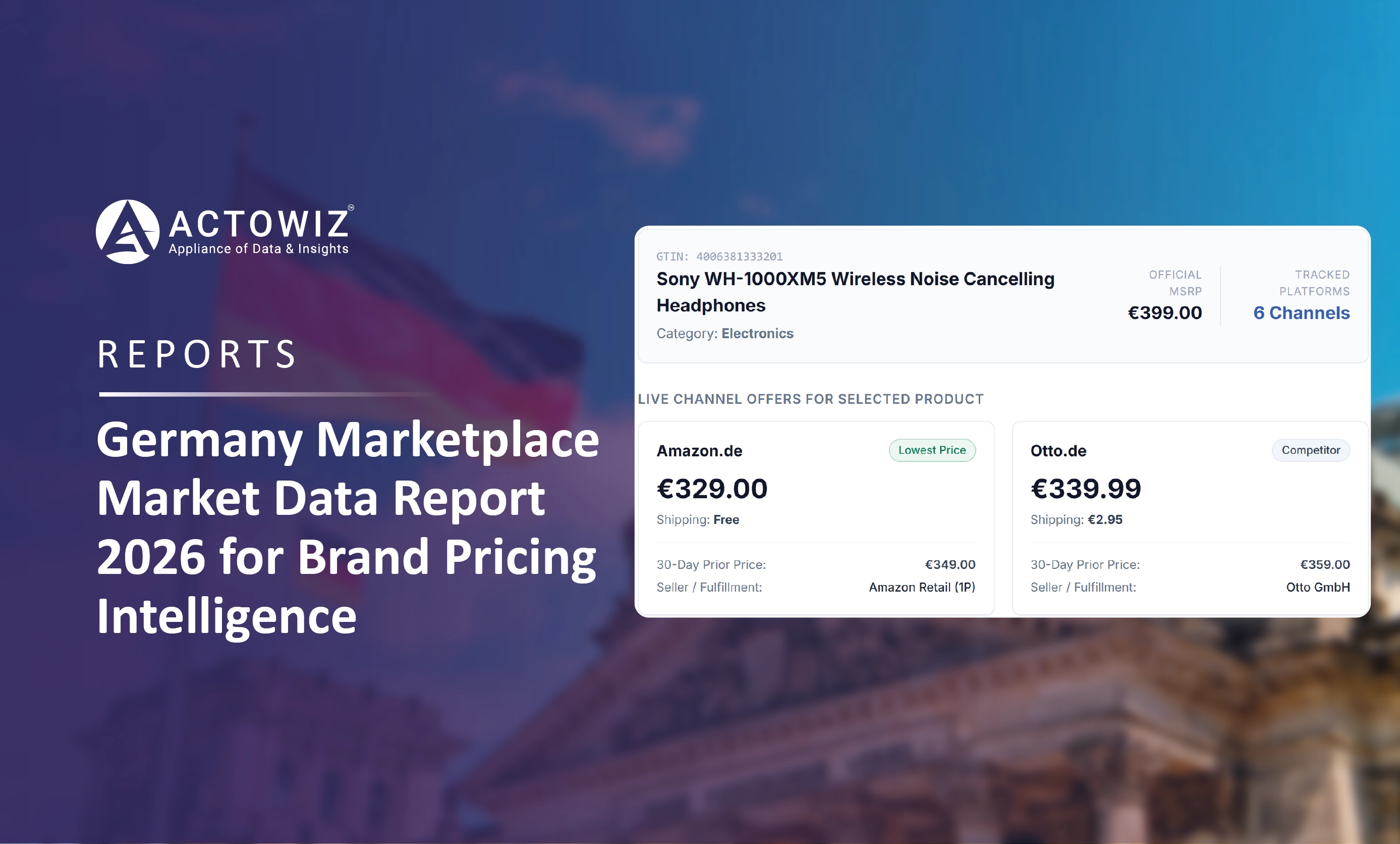
Germany Marketplace Market Data Report 2026 for Brand Pricing Intelligence

German marketplace data report 2026: online retail size, Amazon.de, Otto, Kaufland and Zalando price signals, PAngV rules and peak seasons.

Start Where It Makes Sense for You

Whether you're a startup or a Fortune 500 — we have the right plan for your data needs.

icons
Enterprise
Book a Strategy Call
Custom solutions, dedicated support, volume pricing for large-scale needs.
icons
Growing Brand
Get Free Sample Data
Try before you buy — 500 rows of real data, delivered in 2 hours. No strings.
icons
Just Exploring
View Plans & Pricing
Transparent plans from $500/mo. Find the right fit for your budget and scale.

Request Free Sample Data

Our team will reach out within 2 hours with 500 rows of real data — no credit card required.

+1 ▼
✓ Free 500-row sample · No credit card · Response within 2 hours