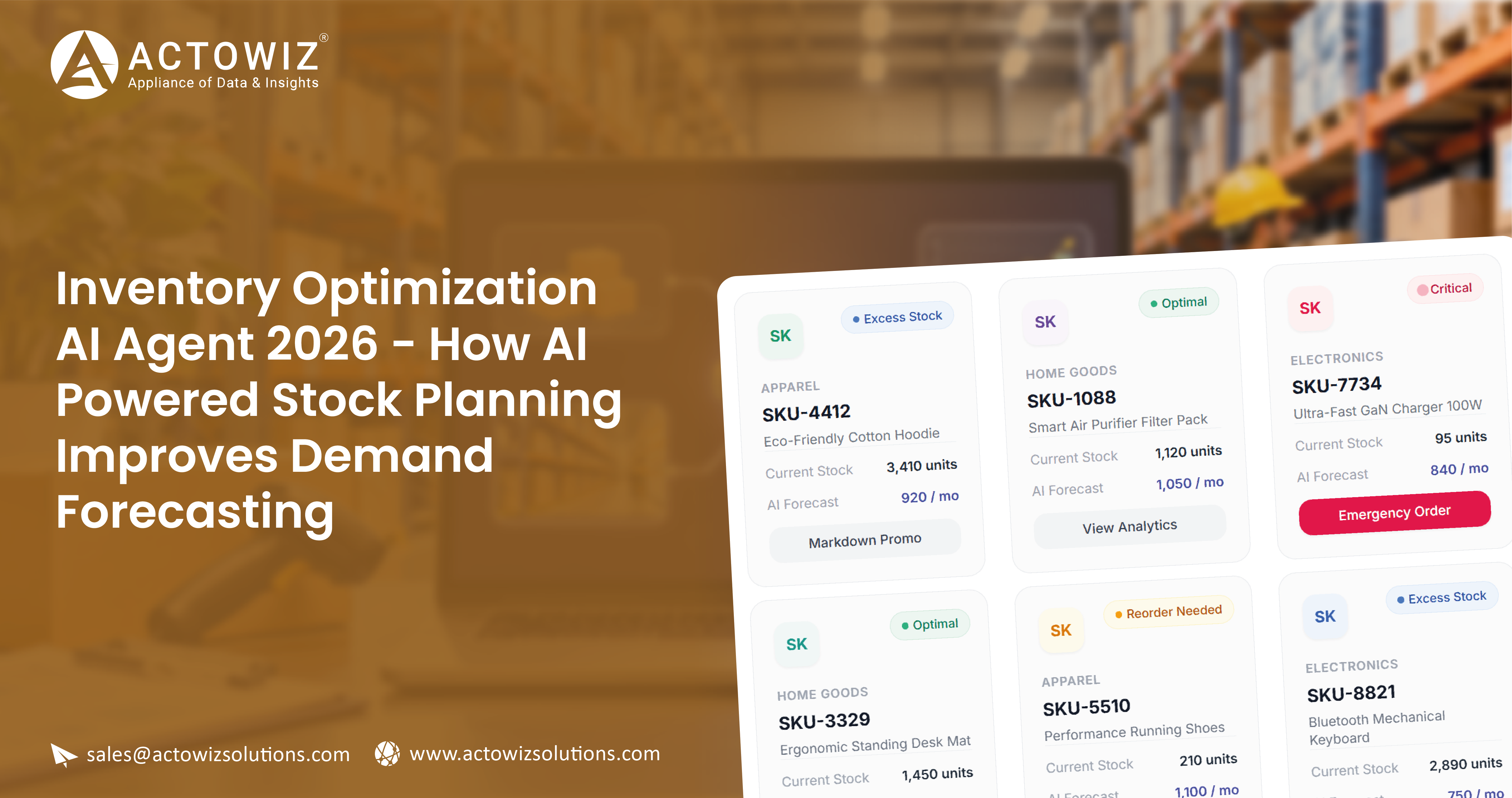
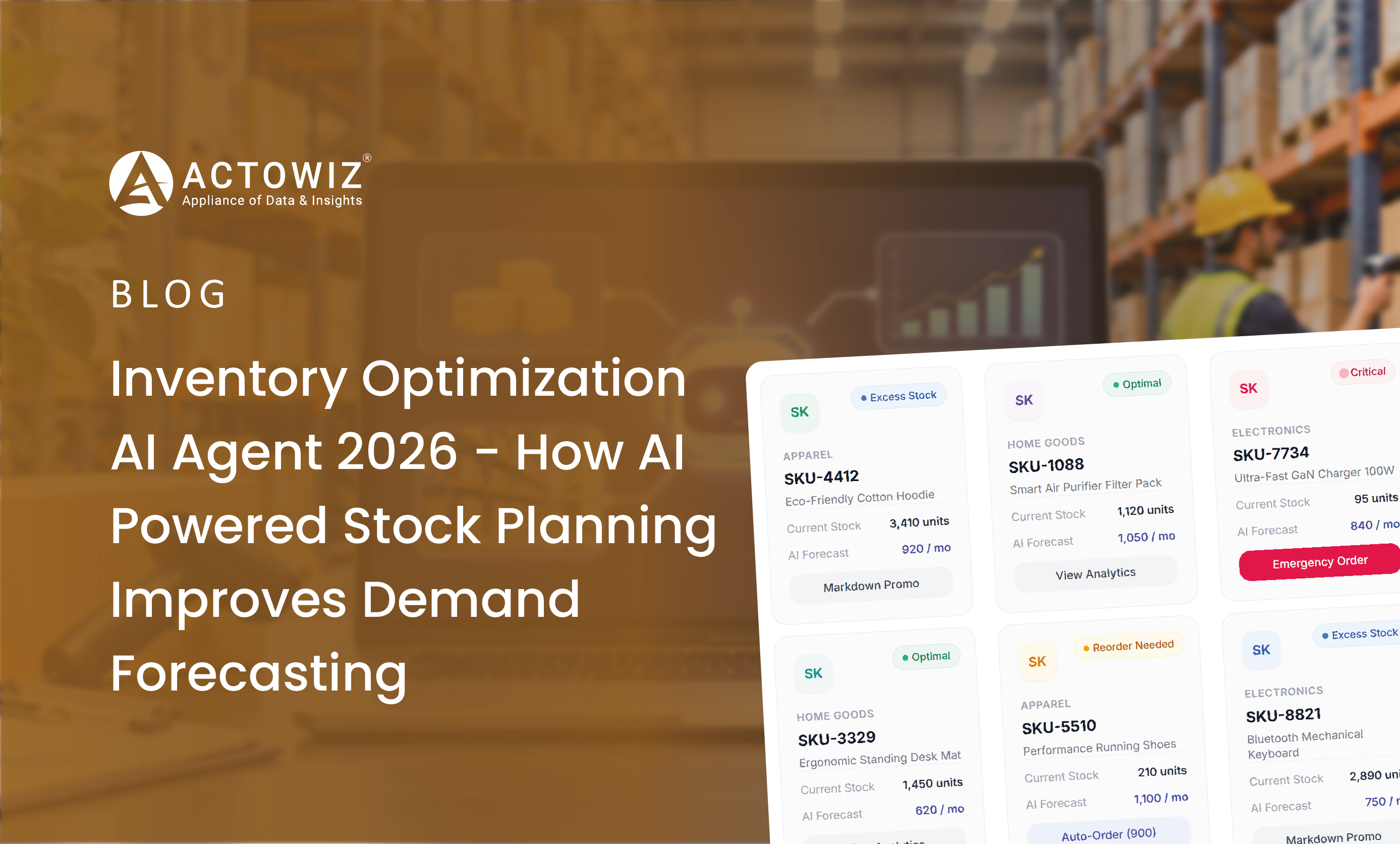
An Inventory Optimization AI Agent 2026 helps businesses make smarter stock-planning decisions by combining demand signals, inventory records, sales history, supplier lead times, and replenishment rules. When connected to reliable Real-Time Product Inventory data, AI-powered workflows can help retailers identify potential stockouts, recognize slow-moving products, and prioritize replenishment before inventory problems disrupt sales.
For e-commerce companies, distributors, manufacturers, and multi-channel retailers, the challenge is not simply maintaining sufficient stock. It is balancing product availability against carrying costs, changing customer demand, supplier delays, and working-capital constraints. Historical reports alone may not capture these changes quickly enough.
AI agents can help address this challenge by analyzing updated data, generating recommendations, and triggering approved workflows under defined business rules. Their effectiveness depends on data quality, forecast accuracy, integration reliability, and human oversight.
For Actowiz Solutions, the opportunity lies in helping businesses build dependable data pipelines that bring together product availability, pricing, sales indicators, and inventory signals from authorized sources. These structured inputs can support forecasting systems and inventory decision tools without treating AI predictions as guaranteed outcomes.
An Inventory optimization AI agent using real-time product data combines current inventory signals with historical sales, demand forecasts, supplier lead times, and replenishment policies to identify products that may require attention. The aim of Inventory Optimization AI Agent 2026 is to help planning teams move from periodic stock reviews toward more responsive, data-informed decisions.
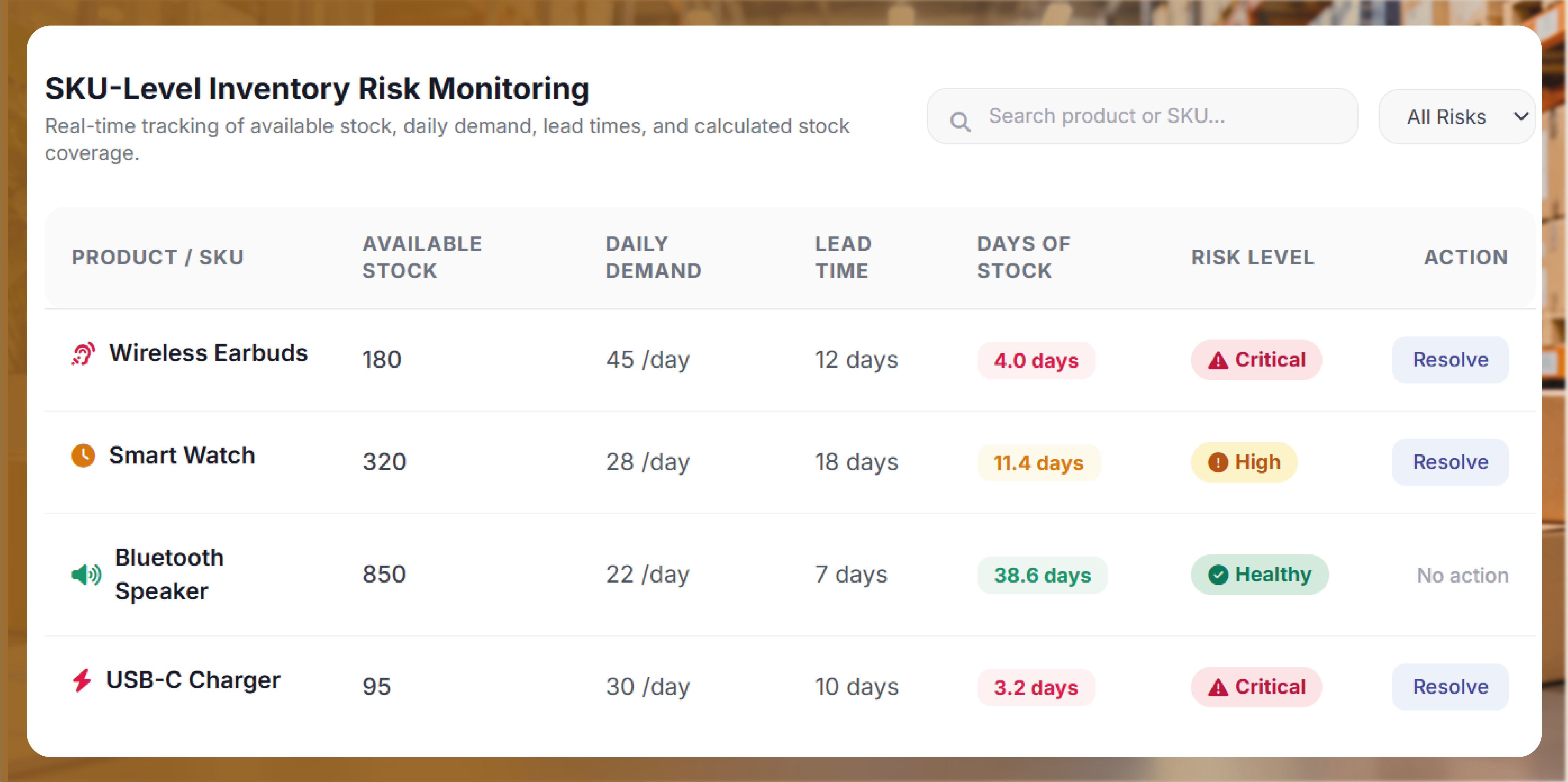
An agent can compare available inventory with expected demand during the replenishment lead time. It can flag products that are likely to fall below their reorder thresholds, identify excess stock, and prioritize SKUs based on business impact. For example, a product with high demand and a long supplier lead time may need earlier attention than a slow-moving item with readily available supply.
McKinsey's research on AI in supply chains discusses potential improvements in forecasting accuracy, inventory levels, and lost sales caused by product unavailability. Its estimates include forecasting-error reductions of 30–50% and inventory reductions of 20–50% in applicable settings. These are potential outcomes, not guaranteed results for every retailer. Source: McKinsey, Smartening up with artificial intelligence.
A useful implementation should prioritize three actions: detect risk, explain the underlying signal, and recommend a response. Purchase orders or stock transfers should require approval unless the business has explicitly authorized automated execution.
The U.S. Census Bureau's retail inventories-to-sales ratio provides a useful public indicator of how retailers balance inventory with sales. The following figures are December observations from the seasonally adjusted general-merchandise series, except for 2026, which uses August data.
| Period | Inventory-to-sales ratio |
|---|---|
| December 2020 | 1.26 |
| December 2021 | 1.32 |
| December 2022 | 1.36 |
| December 2023 | 1.37 |
| December 2024 | 1.41 |
| December 2025 | 1.40 |
| August 2026 | 1.39 |
Source: FRED — U.S. Census Bureau general-merchandise inventories-to-sales ratio.
These figures are a broad retail indicator, not a direct measurement of AI adoption or inventory-agent performance. They demonstrate why businesses need to interpret inventory relative to sales instead of relying on stock quantities alone.
AI-driven inventory planning using real-time stock data helps businesses combine demand estimates with current stock positions and incoming supply. This matters because historical sales alone may not reveal whether a product is temporarily unavailable, experiencing a seasonal spike, or facing a supplier delay.
A planning system should first establish a reliable inventory position. That position generally includes usable stock, confirmed incoming supply, reserved quantities, and outstanding demand, with adjustments for the business's own inventory definitions. The forecast can then be compared with available supply over the expected replenishment period.
For instance, if a retailer sells a product across several channels, the planning process should avoid treating stock allocated to online orders as freely available for store sales. It should also account for supplier lead-time variability and minimum order quantities. Otherwise, an apparently accurate forecast can still produce poor purchasing decisions.
McKinsey's supply-chain research highlights the potential of AI to improve demand forecasting and inventory planning, while emphasizing that realized outcomes depend on the operating context. Source: McKinsey's AI research.
| Input | Planning purpose |
|---|---|
| Historical sales | Establish baseline demand |
| Current usable stock | Measure available supply |
| Open purchase orders | Account for expected receipts |
| Supplier lead times | Estimate when new stock can arrive |
| Promotions and price changes | Identify potential demand shifts |
| Seasonal patterns | Adjust forecasts for recurring changes |
| Returns and cancellations | Improve demand and stock reconciliation |
| Minimum order quantities | Keep recommendations operationally feasible |
An AI agent can rank replenishment tasks by urgency, expected sales impact, supplier constraints, and inventory value. Planners should also monitor forecast error and recommendation acceptance rates to identify where the system needs refinement.
The best approach is not to automate every purchasing decision immediately. Businesses can begin with recommendations, measure their accuracy, and gradually enable controlled automation for repeatable, low-risk scenarios.
Real-time product data integration for AI inventory agents connects information from inventory systems, sales channels, warehouse platforms, supplier feeds, and relevant external product sources. For Inventory Optimization AI Agent 2026, this integration is critical because a sophisticated model cannot compensate for missing, delayed, or contradictory records.
Consider a retailer selling the same SKU through its website, a mobile app, and a marketplace. Each channel may report inventory at a different time. If the agent combines those records without reconciling timestamps, reservations, and fulfillment locations, it may overestimate available stock. Duplicate product identifiers can create a similar problem by splitting demand across multiple records.
Amazon's official Fulfillment by Amazon Inventory API documentation explains that authorized sellers can retrieve inventory summaries, including fulfillable, inbound, reserved, unfulfillable, and researching quantities. These categories show why inventory status needs more detail than a single stock number. Source: Amazon SP-API — FBA Inventory API.
| Pipeline stage | Required control |
|---|---|
| Source connection | Confirm permissions and available fields |
| Product matching | Map SKUs and identifiers consistently |
| Data ingestion | Record collection time and source |
| Reconciliation | Resolve duplicates and stock discrepancies |
| Validation | Check missing, stale, or implausible values |
| Feature preparation | Calculate demand and inventory indicators |
| Forecasting | Generate demand estimates with uncertainty |
| Decision support | Recommend replenishment or investigation |
| Monitoring | Track data freshness and forecast performance |
The integration frequency should match the operational need. A high-volume retailer may need frequent updates for fast-moving products, while a business with stable demand may operate effectively on a slower schedule. Refreshing data more often is not automatically better if the source itself updates infrequently.
Companies should define a freshness threshold for each critical field. If inventory data is stale, the agent should flag the uncertainty rather than confidently recommend an order based on outdated information.
AI inventory management for multi-channel retail businesses helps coordinate stock decisions across online marketplaces, branded websites, physical stores, mobile applications, and distribution centers. The main challenge is ensuring that every channel works from a consistent understanding of available inventory and expected demand.
Without effective coordination, one channel may advertise an item that another channel has already reserved. A product may also appear unavailable online while usable stock remains in another warehouse. An inventory agent can highlight these discrepancies and recommend a transfer, allocation adjustment, or replenishment action when supported by business rules.
The U.S. Census Bureau publishes monthly retail inventory and sales indicators, providing a useful external reference for analyzing inventory trends. However, those national indicators cannot determine the optimal stock level for an individual retailer. SKU-level decisions require company-specific sales, availability, and supply information. Source: U.S. Census Bureau economic indicators.
| Period | U.S. general-merchandise inventory-to-sales ratio |
|---|---|
| December 2020 | 1.26 |
| December 2021 | 1.32 |
| December 2022 | 1.36 |
| December 2023 | 1.37 |
| December 2024 | 1.41 |
| December 2025 | 1.40 |
| August 2026 | 1.39 |
Source: FRED, based on U.S. Census Bureau data.
The ratio represents inventory relative to sales; it is not a stockout rate, an AI performance score, or a direct measure of inventory efficiency. It can help businesses understand broader conditions, but local decisions need more granular evidence.
A practical multi-channel implementation should establish a shared inventory ledger, define ownership of each stock location, synchronize reservations, and distinguish available-to-promise inventory from physical stock. The agent can then recommend where to allocate inventory, subject to shipping costs, service commitments, channel priorities, and transfer constraints.
An Inventory replenishment data API for supply chain planning provides a structured way to exchange inventory, product, order, and supply information between operational systems and planning applications. Within Inventory Optimization AI Agent 2026, API-based integration can help make recommendations more timely and traceable.
The exact data available depends on the source and the permissions granted. Amazon's FBA Inventory API, for example, provides inventory information for authorized sellers across supported marketplaces. It distinguishes inventory states such as fulfillable, inbound, reserved, unfulfillable, and researching. Source: Amazon SP-API documentation.
An inventory planning service can combine these observations with internal demand history, supplier lead times, purchase orders, and replenishment policies. It can then calculate inventory position, estimate days of cover, identify reorder candidates, and return recommendations to a dashboard or approved workflow.
| Metric | How it supports decisions |
|---|---|
| Forecast demand | Estimates expected sales over a future period |
| Days of cover | Estimates how long current usable stock may last |
| Reorder point | Signals when replenishment should be considered |
| Safety stock | Provides a buffer against demand and supply uncertainty |
| Lead-time demand | Estimates consumption before replenishment arrives |
| Forecast error | Measures the difference between predictions and actual demand |
| Fill rate | Tracks the proportion of demand fulfilled |
| Inventory turnover | Measures how frequently inventory is sold and replaced |
A simple reorder-point calculation is:
Reorder point = expected demand during lead time + safety stock
This formula assumes the business has a defensible demand estimate and an appropriate safety-stock policy. More advanced models can account for variable lead times, demand uncertainty, service-level targets, and ordering constraints.
API integrations also need operational safeguards. These include authentication, rate-limit handling, retry logic, schema validation, duplicate-event protection, and logging. Before the agent sends a purchase order or changes inventory allocation, the system should verify that the underlying data is current and that the action complies with approval rules.
The result is a more auditable planning process, where users can trace a recommendation to its inputs, calculation, and approval status.
AI-Powered Scraping Services can help businesses collect relevant product information from authorized web sources when that information is not already available through internal systems or suitable APIs. External signals can complement operational records, particularly when businesses need to understand competitor pricing, product assortment, visible availability, or changes in product presentation.
However, external marketplace observations are not equivalent to a retailer's actual inventory. A product marked as available on a public product page does not necessarily reveal the quantity held in a warehouse. Businesses should therefore keep external product observations separate from verified internal stock records.
| Data signal | Potential application | Important limitation |
|---|---|---|
| Product availability | Identify changes in visible market availability | Does not confirm physical inventory quantity |
| Competitor pricing | Support price and promotion analysis | Does not independently predict demand |
| Product assortment | Monitor new, removed, or changed listings | Requires reliable product matching |
| Product specifications | Improve categorization and SKU matching | Source descriptions may be incomplete |
| Public demand indicators | Supplement demand research | May not represent actual sales |
| Delivery estimates | Provide contextual service information | Can vary by location and time |
For forecasting, external information should be evaluated against historical prediction performance before it receives significant weight. A competitor's price reduction may influence demand, but its effect depends on brand preference, product substitutability, promotion timing, and customer behavior.
A robust implementation should also document the collection method, source, timestamp, permitted use, and validation rules. Public websites and APIs may have different access conditions, so data collection must follow applicable platform terms and legal requirements.
The most useful outcome is a unified analytical environment that distinguishes verified stock, forecast demand, external market signals, and model-generated recommendations. This separation improves traceability and makes it easier for inventory planners to challenge an unexpected result.
Actowiz Solutions can help businesses plan data collection and integration workflows that support inventory analysis, demand forecasting, and replenishment decisions. The appropriate approach depends on the client's systems, required fields, source permissions, refresh frequency, and reporting objectives.
A Web Scraping API can be part of this architecture when permitted external product information needs to be collected and delivered in a structured format. It should complement—not replace—inventory systems that hold authoritative stock quantities.
A practical engagement can cover:
The implementation should begin with a measurable business problem, such as recurring stockouts in a product category or excessive inventory for slow-moving SKUs. Teams can establish a baseline, run the workflow in recommendation mode, and evaluate forecast error, stockout frequency, service levels, and inventory carrying costs before expanding automation.
Actowiz Solutions can help businesses explore the data infrastructure needed for these workflows. Specific capabilities, integrations, and performance outcomes should be confirmed during project scoping rather than assumed in advance.
An AI-powered inventory workflow is most effective when reliable data, demand forecasting, replenishment rules, and operational controls work together. Businesses need more than an automated prediction: they need to understand why a product is at risk, which action is recommended, and whether the supporting data is sufficiently current.
For Inventory Optimization AI Agent 2026, the priority should be building a dependable foundation for stock decisions. Begin with clean SKU records, reconcile inventory across channels, establish realistic lead times, and measure forecasting performance against actual outcomes. Then introduce automation gradually, with clear approval and exception-handling rules.
Actowiz Solutions can help organizations evaluate data collection and integration requirements for these initiatives. A well-designed Web Scraping workflow can supplement permitted external product intelligence, while Mobile App Scraping may be relevant where an authorized app-based source is appropriate. Together with internal inventory feeds, these sources can contribute to a structured Real-time dataset for analysis, subject to actual source refresh rates and access limitations.
Ready to improve inventory visibility and build smarter replenishment workflows? Contact Actowiz Solutions to discuss your data requirements, integration options, and inventory intelligence goals.
You can also reach us for all your mobile app scraping, data collection, web scraping, and instant data scraper service requirements!
Our web scraping expertise is relied on by 4,000+ global enterprises including Zomato, Tata Consumer, Subway, and Expedia — helping them turn web data into growth.
Watch how businesses like yours are using Actowiz data to drive growth.
From Zomato to Expedia — see why global leaders trust us with their data.
Backed by automation, data volume, and enterprise-grade scale — we help businesses from startups to Fortune 500s extract competitive insights across the USA, UK, UAE, and beyond.
We partner with agencies, system integrators, and technology platforms to deliver end-to-end solutions across the retail and digital shelf ecosystem.
Inventory Optimization AI Agent 2026 helps businesses improve stock planning, forecast demand, reduce inventory waste, and make smarter replenishment decisions.
Explore how Travel Price Comparison Data Scraping helps travel brands monitor fares, compare rates, and gain real-time competitive pricing insights.
Explore the US Home Improvement Price Index 2026, comparing Home Depot, Lowe's, Menards, and Walmart on pricing and product trends.
Whether you're a startup or a Fortune 500 — we have the right plan for your data needs.