Introduction
More shoppers now ask an AI assistant to find the best deal instead of opening ten tabs. The assistant reads prices, stock, ratings and delivery promises from many sites, then returns a short list. If your data is wrong or inconsistent, your offer may be compared unfairly or left out entirely.
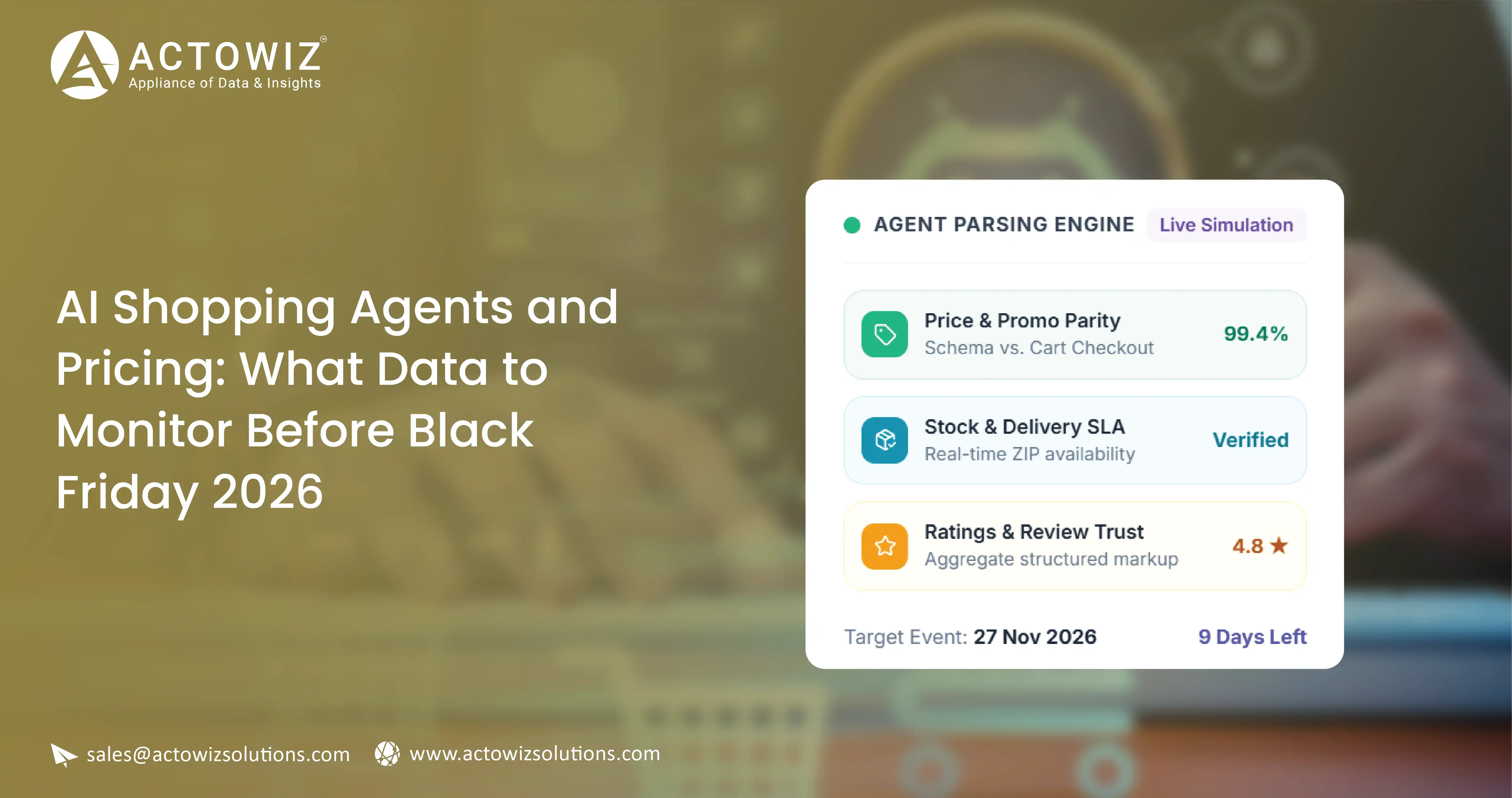
AI shopping agents pricing is the way AI assistants and shopping agents find, read and compare product prices, promotions, stock and ratings across retailers before recommending or buying an item. For brands and retailers, it means price and product data must be accurate and consistent wherever an agent might look.
This guide explains how AI shopping agents compare offers, what data they rely on, where inconsistencies come from, and an agent-ready pricing checklist to run before Black Friday on 27 November 2026.
Why do AI shopping agents matter for Black Friday 2026?
AI shopping agents matter because a fast-growing share of holiday shoppers already use AI tools to research and compare deals. When an agent shortlists offers, it relies on the data it can read. Price, stock or promotion errors during Black Friday can push your product off that shortlist.
The holiday data from 2025 points the same way:
- Adobe reported that traffic from generative AI tools to US retail sites rose 693.4% year on year in the 2025 holiday season, and 670% on Cyber Monday. US online spend reached $257.8 billion from 1 November to 31 December 2025, up 6.8% (Adobe, 7 January 2026: Adobe Holiday Shopping Season).
- Salesforce reported that AI and agents influenced about 20% of global orders during Cyber Week 2025 (25 November to 1 December), linked to $67 billion in sales (Salesforce, 5 December 2025: Salesforce Cyber Week Report).
- Black Friday itself stays huge: Adobe recorded $11.8 billion in US online sales on Black Friday 2025 (Nasdaq, 30 November 2025: Black Friday 2025 Sales Report).
Growth from a small base can look dramatic, so treat the percentages as a direction of travel rather than a share of sales. Still, the direction is clear: agentic commerce is becoming part of how deals are found.
How do AI shopping agents compare prices, stock and ratings?
AI shopping agents gather offer data from retailer pages, product feeds, marketplaces and comparison sources, match listings that look like the same product, and rank them on price, availability, delivery, ratings and trust signals. They reward offers that are clear, consistent and easy to match.
The steps differ by assistant, but most follow a similar pattern:
- Understand the request. The shopper asks for, say, "a 65-inch TV under $600 delivered before Friday".
- Gather candidate offers. The agent reads product pages, merchant feeds and marketplace listings.
- Match the same product. It groups offers by brand, model number, GTIN and title.
- Read the offer details. Price, sale price, shipping cost, delivery date, stock, returns and seller.
- Weigh quality signals. Ratings, review counts and retailer reputation.
- Shortlist and explain. It presents a few options, often with a short reason such as "lowest price in stock".
Exact ranking logic is not public and changes often, so brands cannot optimise for one formula. What they can control is the quality of the data the agent reads.
What price and product data do AI shopping agents read?
AI shopping agents read the same data a careful shopper would, but faster and across more sites: current price, discount, total cost with shipping, stock, delivery date, ratings, product identifiers and specifications. Missing or conflicting fields make an offer harder to match and easier to skip.
| Data field |
What the agent uses it for |
Common Black Friday problem |
| Current price and sale price |
Price comparison and "best deal" ranking |
Page, feed and cart show different prices |
| Promotion terms |
Checking whether a discount applies to the shopper |
Coupon or member-only price not clear in text |
| Shipping cost and delivery date |
Total cost and "arrives by" filters |
Delivery promise not updated during peak demand |
| Stock status |
Excluding out-of-stock offers |
Product sold out but page still shows "in stock" |
| GTIN, brand, model number |
Matching the same product across retailers |
Missing or wrong identifiers on marketplace listings |
| Title, variant, pack size |
Matching and checking the request |
Bundles and variants confused with single units |
| Ratings and review count |
Quality ranking |
Reviews split across duplicate listings |
| Seller and returns policy |
Trust and risk checks |
Unauthorized seller holding the main offer |
Our product matching guide explains how to link the same item across retailers reliably.
Where do price inconsistencies come from?
Price inconsistencies usually come from timing and scope: feeds updated less often than pages, promotions that apply only in the cart or to members, marketplace sellers pricing differently, and regional or app-only deals. During Black Friday, frequent price changes multiply these gaps.
Common sources to check:
- Feed lag. The product feed still shows yesterday's price after a flash deal starts or ends.
- Cart-only pricing. The discounted price appears only after adding to cart, so agents may read the higher price.
- Member and app-only deals. Prices visible only to logged-in members or in an app may not be readable at all.
- Third-party sellers. Marketplace sellers undercut or overprice your offer, and an agent may compare against them.
- Bundles and variants. A gift bundle priced like a single unit confuses matching.
- Stale stock data. Sold-out items still shown as available, or available items shown as sold out.
What is an agent-ready pricing checklist for Black Friday 2026?
An agent-ready pricing checklist is a set of checks that confirm your prices, promotions, stock and identifiers are accurate and consistent across your site, feeds and marketplaces before and during Black Friday. Run it in early November, then monitor key SKUs throughout the sale.
- Price parity check. Compare the price on your product page, your merchant feed and each marketplace listing for every priority SKU.
- Promotion clarity check. Make sure deal prices, start and end times and coupon terms appear in plain text on the page.
- Total cost check. Confirm shipping costs and delivery dates are correct for peak-season capacity.
- Stock accuracy check. Verify stock status matches real availability, and update quickly when items sell out.
- Identifier check. Ensure GTIN, brand and model number are present and correct on every listing.
- Variant and bundle check. Separate bundles from single units with clear titles and their own identifiers.
- Seller check. Find unauthorized or non-compliant sellers that may hold the main offer on marketplaces.
- Competitor context check. Know where your price sits against key competitors, since agents compare them side by side.
- Post-sale reset check. Confirm deal prices end on time and feeds return to standard pricing.
Our Black Friday pricing tracking service supports these checks across major US retailers.
How should brands and retailers monitor this data?
Monitor the same public pages and listings an agent can see, at a higher cadence during the sale, and compare them against your intended prices. That means tracking your own listings, competitor offers and marketplace sellers together, with alerts for gaps between page, feed and marketplace prices.
Monitoring approach by team:
| Team |
What to monitor |
Cadence during Black Friday week |
| Brand pricing |
Own SKUs on retailer and marketplace pages versus intended price |
Several times a day; hourly on hero SKUs |
| Retail ecommerce |
Own site versus feed, stock and delivery promise |
Hourly on deal SKUs |
| Channel / brand protection |
Seller offers below policy, unauthorized sellers |
Several times a day |
| Category / competitive intelligence |
Competitor prices, promotions and stock |
Several times a day |
Useful supporting data includes promotions and offers data and competitor price monitoring. For market context, see our holiday 2026 US retail price war report.
Actowiz tracked findings: Pending Actowiz tracked data (post-event): page vs feed vs marketplace price gaps after Black Friday 2026.
What are the compliance basics?
Monitoring for agent-ready pricing uses publicly visible product data only: prices, promotions, stock, ratings and seller business names. Respect each site's terms, avoid logins and access controls, and do not collect personal data. Pricing claims in your own feeds should also follow local advertising rules.
- Public data only. No logged-in, member-only or account data.
- Respect site terms. Reasonable collection rates and schedules.
- No personal data. Review text can be analysed in aggregate; reviewer identities are not collected.
- Accurate pricing claims. Check that reference and "was" prices in your feeds meet local pricing rules.
Frequently Asked Questions
What are AI shopping agents?
AI shopping agents are AI assistants or tools that search for products, compare offers across retailers and, in some cases, complete purchases for a shopper. They read prices, stock, delivery and ratings from many sources to recommend options.
Do AI shopping agents always pick the lowest price?
Not always. Agents usually weigh price with stock, delivery date, ratings and seller trust. A cheap offer that is out of stock or slow to deliver may rank below a slightly higher one.
How is this different from AI search brand visibility?
Brand visibility monitoring tracks whether AI answers mention your brand. Agent-ready pricing is about the accuracy and consistency of the price, stock and product data that agents read when comparing offers.
What should I fix first before Black Friday 2026?
Start with price parity between your product pages, feeds and marketplace listings for your top SKUs, then check stock accuracy and product identifiers. These gaps cause the most mismatches.
Can Actowiz monitor prices the way AI agents see them?
Actowiz collects public prices, promotions, stock, ratings and seller data from retailer and marketplace pages, and flags gaps against your intended prices, so you can see the same offers agents read.
Conclusion
You can also reach us for all your mobile app scraping, data collection, web scraping , and instant data scraper service requirements!
 Actowiz Solutions

 By industry
 Pricing & Promotions
 Brand & Intelligence
 Digital Shelf & Search
 Assortment
 For Retailers
 E-Commerce Dashboard
 Flipkart Insights (Live)
 Grocery Intelligence
.svg) Grocery Price (U.S.)
.svg) Quick Commerce (India)
 Food & Restaurant
 Fashion Intelligence
 Automotive
 Travel & Hospitality
 Real Estate
 Food Delivery Intelligence
 OTT & Streaming
 Fuel & EV Charging Price Tracker
 By Use Case
 Pricing Intelligence
 Digital Shelf Analytics
 MAP Monitoring
 Cross-Border Price Parity
 Share of Search
 Review Sentiment
 Kitchen Market Gaps
 Dynamic Pricing / AI Repricing
 Promotions & Deals Alerts
 B2B / POI & Lead Data
 AI Search Visibility Dashboard
 Baby Products on Quick Commerce
 Hotel & Flight Rate Parity
 By Region
 Flipkart Real-Time Insights
 Quick Commerce — Zepto · Blinkit
 Pincode Price Tracker
 GCC Q-Commerce — Talabat · Noon
 UK Grocery — Tesco, Sainsbury's, Asda
 AU Grocery — Coles & Woolworths
 Marketplace Scrapers
 Developer APIs
 Universal APIs
 Delivery & SDKs
 Knowledge Center
 Guides & Playbooks
 Downloads & Tools
 Trust & Company


 4.8/5 Average Rating
 50+ Video Testimonials
 92% Client Retention
 50+ Countries Served