.webp)
Introduction
Airline ancillary fee monitoring is the regular collection of the extra charges airlines publish on top of the base fare – checked and cabin bags, seat selection, priority boarding, change and cancellation rules – by route, date and fare family. It lets pricing and travel teams compare the real total trip cost, not just the headline fare.
Ancillaries are now a core revenue line. IdeaWorksCompany estimated global airline ancillary revenue at about $157 billion for 2025, or 15.7% of total airline revenue. Its 2026 Yearbook, summarised by PhocusWire, found that ancillary revenue at the airlines it covers grew roughly twice as fast as total revenue in 2025, helped by branded fares and seat-assignment fees.
At the same time, rules on how fees are shown keep moving. In July 2026 the US Department of Transportation published a final rule removing the 2024 requirement to show key bag and change fees at the first point of search, after a court vacated that rule. For anyone comparing fares, that makes structured fee data more – not less – important.
Who needs ancillary fee data?
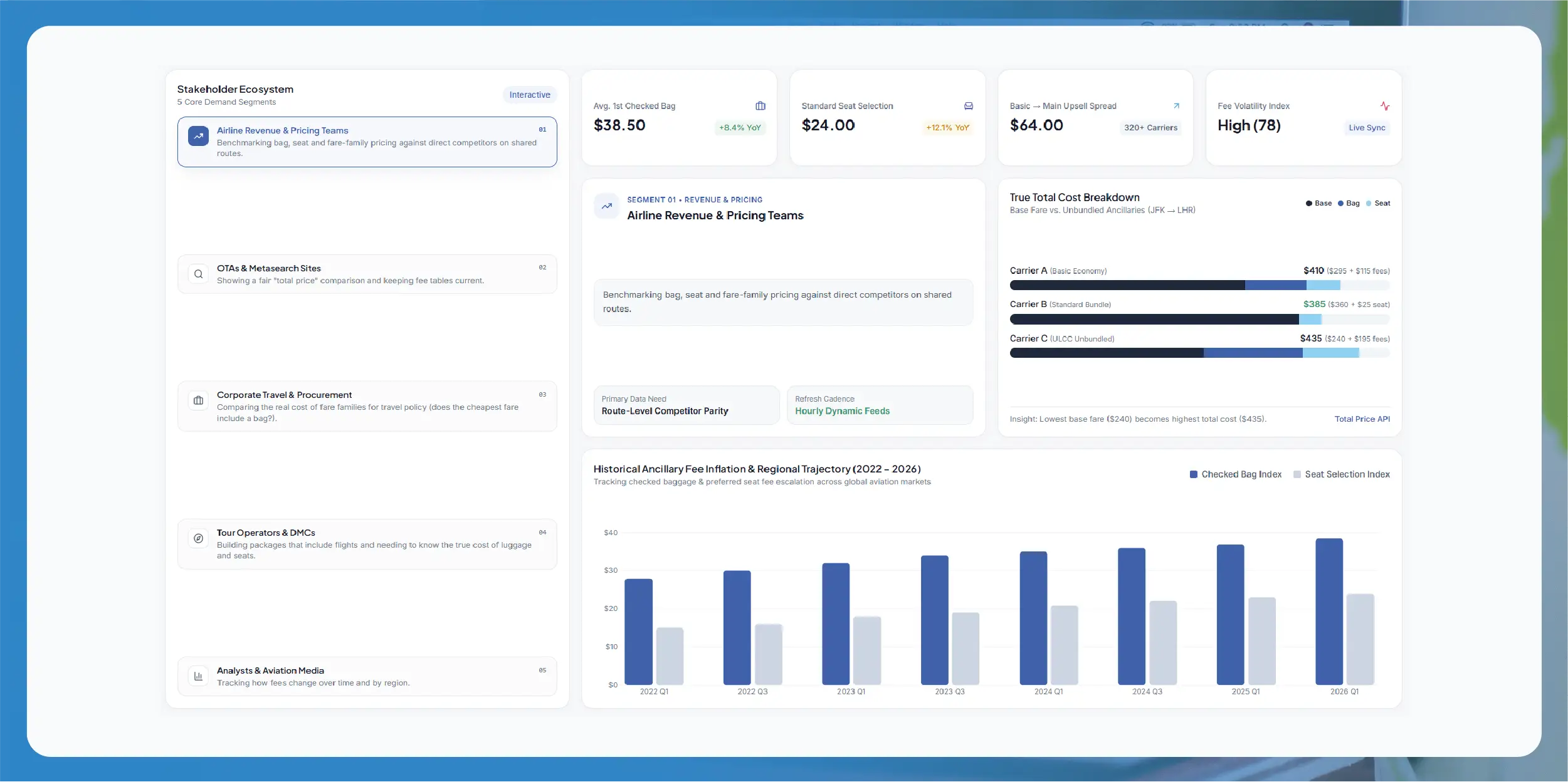
- Airline revenue and pricing teams benchmarking bag, seat and fare-family pricing against direct competitors on shared routes.
- OTAs and metasearch sites showing a fair "total price" comparison and keeping fee tables current.
- Corporate travel and procurement teams comparing the real cost of fare families for travel policy (does the cheapest fare include a bag?).
- Tour operators and DMCs building packages that include flights and needing to know the true cost of luggage and seats.
- Analysts and media tracking how fees change over time and by region.
What ancillary data points can you collect?
Airlines publish fees in two places: static fee pages (bag and service fee tables) and the booking flow (fare-family inclusions and seat prices for a specific flight). A complete dataset combines both, using only publicly shown information.
| Data point |
Where it appears |
Example use |
| Checked bag fee (1st, 2nd bag, by weight) |
Fee page and booking flow |
Total trip cost comparison |
| Cabin bag / personal item rules |
Fee page, fare family |
Low-cost vs full-service comparison |
| Seat selection fee by seat type |
Booking flow (seat map) |
Seat pricing benchmark |
| Fare family name and inclusions |
Booking flow |
Branded fare comparison |
| Change / cancellation rules and fees |
Fare rules |
Flexibility value |
| Priority boarding, lounge, extra legroom |
Booking flow |
Upsell benchmarking |
| Currency, route, travel date, booking date |
Context |
Trend and advance-purchase analysis |
Fare families: why the cheapest fare is not always cheapest
Most airlines now sell branded fare families – for example a basic fare with no bag, a standard fare with a bag and seat, and a flexible fare with free changes. Comparing only the lowest fare misleads: a low-cost carrier's base fare plus a checked bag and seat can be higher than a full-service carrier's standard fare on the same route.
The table below shows how a total-trip-cost view is built. Values are illustrative placeholders, not measured data.
| Airline (route X, same date) |
Base fare |
+ 1 checked bag |
+ standard seat |
Total trip cost |
| Airline A – basic fare |
No Data |
No Data |
No Data |
No Data |
| Airline A – standard fare |
No Data |
Included |
Included |
No Data |
| Airline B – lowest fare |
No Data |
No Data |
No Data |
No Data |
| Airline C – economy |
No Data |
Included |
No Data |
No Data |
How do you collect ancillary fees at scale?
- Define the routes and dates – priority city pairs, departure dates and advance-purchase windows (for example 7, 14, 30 and 60 days out).
- Capture fare families per flight from airline sites and, where useful, OTAs – with inclusions mapped to a standard list (bag, seat, changes, refund).
- Collect static fee tables for bags and services, versioned so you can see when a fee changes.
- Normalise weights, currencies and seat categories so carriers can be compared.
- Deliver and alert – a daily or weekly file, plus alerts when a competitor changes a bag fee or fare-family rule.
Live fares are collected going forward from the start of a project. Historical fares from past years are not something we offer; if you need trends, start collection early and build your own history.
For broader airline and travel data collection requirements, explore our travel data scraping services.
Ancillary benchmarking by region
| Region |
What to watch |
Typical sources |
| United States |
Bag fee changes, basic economy rules, seat fees |
Airline sites, OTAs, metasearch |
| Europe |
Cabin bag rules on low-cost carriers, seat fees |
Airline sites, OTAs |
| Middle East |
Fare-family inclusions, baggage allowance by fare |
Airline sites, OTAs |
| India |
Seat and meal fees, bag allowance on domestic fares |
Airline sites, OTAs |
For a wider flight-price comparison perspective, see our Google Flights and hotel data scraping services.
Common pitfalls in ancillary fee data
- Route and date dependence: many airlines price bags and seats differently by route, date and how early you book. A single fee page rarely tells the full story.
- Online vs airport prices: bag fees are often lower when bought online in advance than at the airport; record which price you collected.
- Fare-family names change: airlines rename and restructure branded fares; keep a mapping table and review it monthly.
- Per-segment vs per-journey fees: a fee shown per flight segment doubles on a connecting itinerary. Normalise to per-journey totals.
- Currency and taxes: compare fees in one currency and note whether taxes are included.
A good dataset records the route, the travel date, the booking date and the exact page or step where each fee was shown. That context makes the numbers defensible when they are used in pricing meetings or in a published comparison.
Use cases
- Fee change alerts: know the day a competitor raises a checked-bag fee or changes cabin bag rules.
- Fare-family positioning: see what each rival includes at each price point and where your bundle sits.
- Total-price display: OTAs and metasearch sites keep fee tables current for fair comparisons.
- Travel policy: corporate buyers compare the real cost of "lowest fare" vs "standard fare" by route.
- Package pricing: tour operators include accurate luggage and seat costs in holiday prices.
What does a weekly ancillary fee report include?
A weekly report for revenue or travel teams usually fits on one page per market. It lists the routes in scope, the lowest fare and the cheapest fare that includes a checked bag for each airline, the seat-selection price range, and any fee or fare-family rule that changed since last week – with the date first seen. A short "changes" section at the top saves readers from scanning every row, and a link to the full file keeps the detail available for analysts who need it.
Legal and compliance basics
Collect only publicly displayed fares, fees and rules, without logging into customer accounts or completing bookings. Respect site terms and keep request rates moderate. We do not extract data from GDS systems; collection is from public airline and OTA pages. Keep a timestamp, route, date and source URL with every record.
Build vs buy: what to ask a provider
- Can you capture fare-family inclusions, not just the lowest fare?
- How do you map different airlines' fare names to a common structure?
- Do you version static fee pages so changes are dated?
- Which routes, dates and booking windows are in scope, and how often?
- What is excluded (for example GDS data, past-date fares, logged-in content)?
Actowiz Solutions runs airline fare and route intelligence as a managed service and can add ancillary fees and fare-family mapping to the same feed. See our airline flight fare and route intelligence page for the standard scope.
To discuss route coverage, fare-family mapping and ancillary fee monitoring requirements, contact Actowiz Solutions.
Frequently Asked Questions
What are airline ancillary fees?
Charges on top of the base fare – bags, seats, priority boarding, changes, meals and similar extras – shown on airline fee pages and in the booking flow.
Can you track fare families across airlines?
Yes. We capture each fare family's name, price and inclusions and map them to a common list so different airlines can be compared.
Do you provide historical ancillary fees?
We collect live data going forward. Past-date fares are not available, so we recommend starting collection early to build history.
How often can fees be refreshed?
Static fee pages weekly; fares and fare families daily or several times a day on priority routes.
Do you use GDS data?
No. Data comes from publicly visible airline and OTA pages.
 Actowiz Solutions

 By industry
 Pricing & Promotions
 Brand & Intelligence
 Digital Shelf & Search
 Assortment
 For Retailers
 E-Commerce Dashboard
 Flipkart Insights (Live)
 Grocery Intelligence
.svg) Grocery Price (U.S.)
.svg) Quick Commerce (India)
 Food & Restaurant
 Fashion Intelligence
 Automotive
 Travel & Hospitality
 Real Estate
 Food Delivery Intelligence
 OTT & Streaming
 Fuel & EV Charging Price Tracker
 By Use Case
 Pricing Intelligence
 Digital Shelf Analytics
 MAP Monitoring
 Cross-Border Price Parity
 Share of Search
 Review Sentiment
 Kitchen Market Gaps
 Dynamic Pricing / AI Repricing
 Promotions & Deals Alerts
 B2B / POI & Lead Data
 AI Search Visibility Dashboard
 Baby Products on Quick Commerce
 Hotel & Flight Rate Parity
 By Region
 Flipkart Real-Time Insights
 Quick Commerce — Zepto · Blinkit
 Pincode Price Tracker
 GCC Q-Commerce — Talabat · Noon
 UK Grocery — Tesco, Sainsbury's, Asda
 AU Grocery — Coles & Woolworths
 Marketplace Scrapers
 Developer APIs
 Universal APIs
 Delivery & SDKs
 Knowledge Center
 Guides & Playbooks
 Downloads & Tools
 Trust & Company







































 4.8/5 Average Rating
 50+ Video Testimonials
 92% Client Retention
 50+ Countries Served