🎃 HALLOWEEN OFF Spooky Savings Event! Get FLAT 20% OFF on all Web Scraping & Data Extraction Plans 20% OFF Web Scraping Plans!
Ends in: 00d : 00h : 00m : 00s
🦇
👻
🎃 Spooktacular Limited Offer

Don’t Let High Data Costs Haunt You! 🎃

Get FLAT 20% OFF

T&C Apply

Scrape competitor prices, monitor MAP, and extract real-time datasets at a spooky discount this Halloween.

Offer Expires In:
00d : 00h : 00m : 00s
⚡ Claim 20% Discount Now
🎃
Promo Code Copied!
SPOOKY30 (20% OFF Applied)
Core services
Enterprise Data Extraction

Scalable web, app and AI-powered collection across 40+ countries.

All 58 services →
New 2026
AI Training Data

Corpus building with provenance and opt-out compliance.

Learn more →
Free pilot
24-hour sample

We run collection on your own sources before you commit.

Get a sample →
58Services
40+Countries
DEVELOPER

Ready-Made Scrapers

Pre-built for top platforms. Self-serve, no setup.

View All →
TRY FREE

API Playground

Test endpoints instantly. No credit card.

Start Free →
28Tools
2SDKs
icons Delivery & SDKs
Streaming Crawl API Scheduler Realtime Alerts Webhook Delivery 🐍 Python SDK 💚 Node.js SDK
Need it managed instead?

Fixed monthly retainer, named engineer, no per-request metering.

Managed Data API →
HOT

Case Studies

How brands use Actowiz, with named outcomes.

Read →
FREE

Sample Datasets

Real output, no signup.

Download →
NEW

ROI Calculator

Model the return on a data engagement.

Calculate →

The Head of E-commerce at an Indian consumer products manufacturer needing a daily, reliable view of the real landed price on its own SKUs and on the competing SKUs it benchmarks against.

Industry
Consumer products / FMCG manufacturing
Region
India
Data type
Daily marketplace pricing, promotions, coupons, bank offers, effective price
Delivery
Daily delivery (format and destination agreed with client)

The client

The Head of E-commerce at an Indian consumer products manufacturer came to us with a problem their team could describe precisely but not measure. The company sells a defined range of consumer goods through India's two largest marketplaces, alongside its own channels and offline distribution.

Like most Indian brands selling through marketplaces, they faced a structural blind spot. They set a list price and a trade scheme, but what a shopper actually pays on Amazon or Flipkart on any given day is the result of a stack of discounts the brand does not fully control — platform coupons, seller-level promotions, card-issuer offers, exchange credits and EMI constructs — applied by multiple sellers on the same listing.

What the Head of E-commerce needed was a daily, reliable view of the real landed price on the company's own SKUs and on the competing SKUs it benchmarks against.

The challenge

  • The listed price is not the price. On an Indian marketplace listing, the number in large type is the starting point. Below it sit a clip-to-apply coupon, a percentage or flat discount from a named bank on a named card type with a minimum cart value and a cap, a no-cost-EMI option that changes financing cost rather than price, an exchange offer limited to certain categories, and sometimes a cashback that pays later rather than reducing the invoice. Any of these may be seller-specific, so the same listing shows a different effective price depending on which seller holds the buy box.
  • Offer-stack reconstruction. Reconstructing what a shopper actually pays means parsing the whole offer stack and modelling how the components combine — which stack, which are mutually exclusive, which are capped, and which do not reduce the invoice at all. That is the hard part here, and it is an accounting problem as much as a collection problem.
  • Intraday volatility. Listings are not static within a day. Buy-box seller, availability, coupon presence and offer terms all change through the day, independently on the two platforms. A weekly snapshot tells you almost nothing about a category that reprices daily.
  • Matching complexity. The client's internal SKU list, the marketplace listings and the competitor set all use different naming and packaging conventions. The same product appears with different pack-size descriptions, different model suffixes, and sometimes as a multipack that must be normalised to a per-unit basis before any comparison is meaningful.

What we collected

Field Type Notes
capture_date / captured_at date / timestamp IST and UTC
marketplace enum Amazon IN / Flipkart
listing_id string ASIN or Flipkart product ID
listing_url string Canonical
client_sku_id string Client's internal SKU, where matched
match_confidence enum Exact / high / review-needed
product_title string As displayed
brand string Normalised
category_path array Marketplace breadcrumb
pack_size / pack_unit / units_per_pack parsed For per-unit normalisation
mrp decimal Where displayed
price_listed decimal Selling price shown
discount_pct_displayed decimal As shown by the platform
seller_name / seller_id string Buy-box holder
fulfilment_type enum Platform-fulfilled / seller-fulfilled
coupon_present boolean
coupon_type enum Percentage / flat
coupon_value decimal
coupon_terms text Min cart, cap, verbatim
bank_offers array One object per offer
bank_offer.issuer string Named bank or issuer
bank_offer.instrument enum Credit / debit / EMI / wallet / UPI
bank_offer.type enum Instant discount / cashback
bank_offer.value / .value_type decimal / enum Amount or percentage
bank_offer.min_txn / .max_cap decimal Qualifying conditions
no_cost_emi_available boolean
emi_tenures array Months offered
exchange_offer_present boolean
exchange_offer_max_value decimal Headline maximum
price_effective_best decimal Derived — see method
price_effective_invoice decimal Derived, instant reductions only
price_effective_per_unit decimal Derived
effective_price_basis text Which components were applied, and why
availability enum In stock / out of stock / limited
rating / review_count decimal / int Context only
offer_raw_text text Retained verbatim for audit

How we built it

Source analysis and an offer taxonomy

Before writing collection code, we catalogued every offer construct the two platforms present on the client's categories, and wrote it up as a taxonomy: what the construct is called, where on the page it appears, what its qualifying conditions are, whether it reduces the invoice or pays back later, and whether it stacks with the others. That taxonomy is the backbone of the project. Without it, "effective price" is a number somebody made up. With it, every derived price can be traced to a named list of applied components.

Collection design and daily scheduling

Each SKU-marketplace pair is a collection unit, scheduled within a defined daily window so every capture in a day's file is comparable. Buy-box and offer blocks are read in the same pass as the price, so seller attribution and offer stack are internally consistent. We collect pincode-resolved where the platform varies price or availability by delivery location, using a fixed set of reference pincodes agreed with the client so the series stays comparable over time.

The effective-price engine

This is the substance of the engagement. Rather than compute one number, we compute a small family of them, each with a stated basis:

  • price_effective_invoice. Listed price minus coupon minus instant bank discount, with the coupon's minimum-cart and the bank offer's cap and minimum-transaction conditions applied at single-unit quantity. This is what appears on the invoice.
  • price_effective_best. The lowest achievable price for a shopper who holds every qualifying instrument, applying the best single offer from each mutually exclusive group and stacking only where the platform's own terms permit stacking.
  • price_effective_per_unit. The invoice-basis price divided by parsed units per pack, which is the only figure comparable across pack sizes.

Cashback is recorded but excluded from invoice basis. No-cost EMI is recorded as a financing attribute, not a discount. Exchange offers are recorded with their headline maximum and excluded from the calculation. Every derived price carries effective_price_basis: a plain-text record of which components were applied and which were skipped, with the reason.

Anti-bot posture and reliability

A defined SKU list at daily cadence is a modest, steady workload, and we ran it that way: conservative per-source concurrency, realistic session and header behaviour, jittered request pacing, and a rendering path only where offer blocks require it. Reliability is retry discipline plus honest reporting. Each unit is tracked in a job ledger with attempt count and failure reason, and transient failures retry with backoff inside the daily window. A unit that cannot be captured is delivered as an explicit gap row with a reason code, never as a silently carried-forward price from yesterday.

Matching and normalisation

Client SKUs are matched to listings in stages: identifier match where a shared code exists, then brand-plus-model-plus-pack, then tokenised title similarity with pack-size agreement as a hard constraint. Anything below the confidence threshold goes to human review and is delivered flagged, not guessed. Confirmed matches persist in a mapping table, so the match set is stable day to day.

Quality assurance
  • Day-over-day change validation. Every price movement beyond a per-category threshold is flagged for review before delivery.
  • Zero and null guards. No zero prices, no null effective price where a listed price exists.
  • Offer-arithmetic checks. Effective price never exceeds listed price; never below a floor implied by the parsed offer terms; caps and minimums respected.
  • Basis consistency. Every derived price has a populated effective_price_basis naming the components applied.
  • Parse-rate monitoring. Per-field fill rates tracked against a trailing baseline per platform.
  • Match audit. A sampled set of matches re-verified against the live listings each cycle.
  • Cross-platform coherence. The same SKU's parsed pack size must agree across platforms.
  • Completeness. Expected SKU-marketplace rows versus delivered rows, with reason codes on every gap.
  • Manual spot check. A daily sample of rows opened against the live page, with the offer stack re-read by a human.

Results

These figures must be taken from the project records before publication. Do not estimate.

  • SKUs tracked daily across both marketplaces: as per project records.
  • Daily row volume delivered: as per project records.
  • Delivery punctuality against the agreed daily SLA: as per project records.
  • Capture completeness per cycle: as per project records.
  • Match precision on the confirmed mapping table: as per project records.
  • Offer-stack parse coverage: as per project records.
  • Engagement duration to date: as per project records.

Why this approach worked

We treated effective price as a modelling problem with documented rules rather than a single number to be scraped. Publishing three bases — invoice, best-achievable and per-unit — with an audit trail on each meant the Head of E-commerce and their commercial team could argue about which basis to use for a decision instead of arguing about whether the data was right.

The second thing that mattered was refusing to fill gaps. Delivering an explicit reason-coded gap on a SKU we could not capture is less comfortable than delivering yesterday's price, and it is why the feed can be trusted for pricing decisions. A dataset that never admits a gap is a dataset nobody can rely on.

Client Feedback

“We finally have a daily view of what shoppers actually pay on Amazon and Flipkart — not just the listed price, but coupons, bank offers and the real effective price. Actowiz delivered three price bases with an audit trail, so we argue about strategy, not about whether the data is right.”

— Head of E-commerce, FMCG Manufacturer

Need daily marketplace price and offer tracking?

Request a free sample dataset for your category. Visit actowizsolutions.com to discuss your data requirement.

Social Proof That Converts

Trusted by Global Leaders Across Q-Commerce, Travel, Retail, and FoodTech

Our web scraping expertise is relied on by 4,000+ global enterprises including Zomato, Tata Consumer, Subway, and Expedia — helping them turn web data into growth.

4,000+ Enterprises Worldwide
50+ Countries Served
20+ Industries
Join 4,000+ companies growing with Actowiz →
Real Results from Real Clients

Hear It Directly from Our Clients

Watch how businesses like yours are using Actowiz data to drive growth.

▶
1 min
★★★★★
"Actowiz Solutions offered exceptional support with transparency and guidance throughout. Anna and Saga made the process easy for a non-technical user like me. Great service, fair pricing!"
TG
Thomas Galido
Co-Founder / Head of Product at Upright Data Inc.
▶
2 min
★★★★★
"Actowiz delivered impeccable results for our company. Their team ensured data accuracy and on-time delivery. The competitive intelligence completely transformed our pricing strategy."
II
Iulen Ibanez
CEO / Datacy.es
▶
1:30
★★★★★
"What impressed me most was the speed — we went from requirement to production data in under 48 hours. The API integration was seamless and the support team is always responsive."
FC
Febbin Chacko
-Fin, Small Business Owner
icons 4.8/5 Average Rating
icons 50+ Video Testimonials
icons 92% Client Retention
icons 50+ Countries Served

Join 4,000+ Companies Growing with Actowiz

From Zomato to Expedia — see why global leaders trust us with their data.

Why Global Leaders Trust Actowiz

Backed by automation, data volume, and enterprise-grade scale — we help businesses from startups to Fortune 500s extract competitive insights across the USA, UK, UAE, and beyond.

icons
7+
Years of Experience
Proven track record delivering enterprise-grade web scraping and data intelligence solutions.
icons
4,000+
Projects Delivered
Serving startups to Fortune 500 companies across 50+ countries worldwide.
icons
200+
In-House Experts
Dedicated engineers across scrapers, AI/ML models, APIs, and data quality assurance.
icons
9.2M
Automated Workflows
Running weekly across eCommerce, Quick Commerce, Travel, Real Estate, and Food industries.
icons
270+ TB
Data Transferred
Real-time and batch data scraping at massive scale, across industries globally.
icons
380M+
Pages Crawled Weekly
Scaled infrastructure for comprehensive global data coverage with 99% accuracy.

AI Solutions Engineered
for Your Needs

→
LLM-Powered Attribute Extraction: High-precision product matching using large language models for accurate data classification.
→
Advanced Computer Vision: Fine-grained object detection for precise product classification using text and image embeddings.
→
GPT-Based Analytics Layer: Natural language query-based reporting and visualization for business intelligence.
→
Human-in-the-Loop AI: Continuous feedback loop to improve AI model accuracy over time.
icons Product Matching icons Attribute Tagging icons Content Optimization icons Sentiment Analysis icons Prompt-Based Reporting

Connect the Dots Across
Your Retail Ecosystem

We partner with agencies, system integrators, and technology platforms to deliver end-to-end solutions across the retail and digital shelf ecosystem.

icons
Analytics Services
icons
Ad Tech
icons
Price Optimization
icons
Business Consulting
icons
System Integration
icons
Market Research
Become a Partner →

Popular Datasets — Ready to Download

Browse All Datasets →
icons
Amazon
eCommerce
Free 100 rows
icons
Zillow
Real Estate
Free 100 rows
icons
DoorDash
Food Delivery
Free 100 rows
icons
Walmart
Retail
Free 100 rows
icons
Booking.com
Travel
Free 100 rows
icons
Indeed
Jobs
Free 100 rows

Latest Insights & Resources

View All Resources →
thumb
Blog

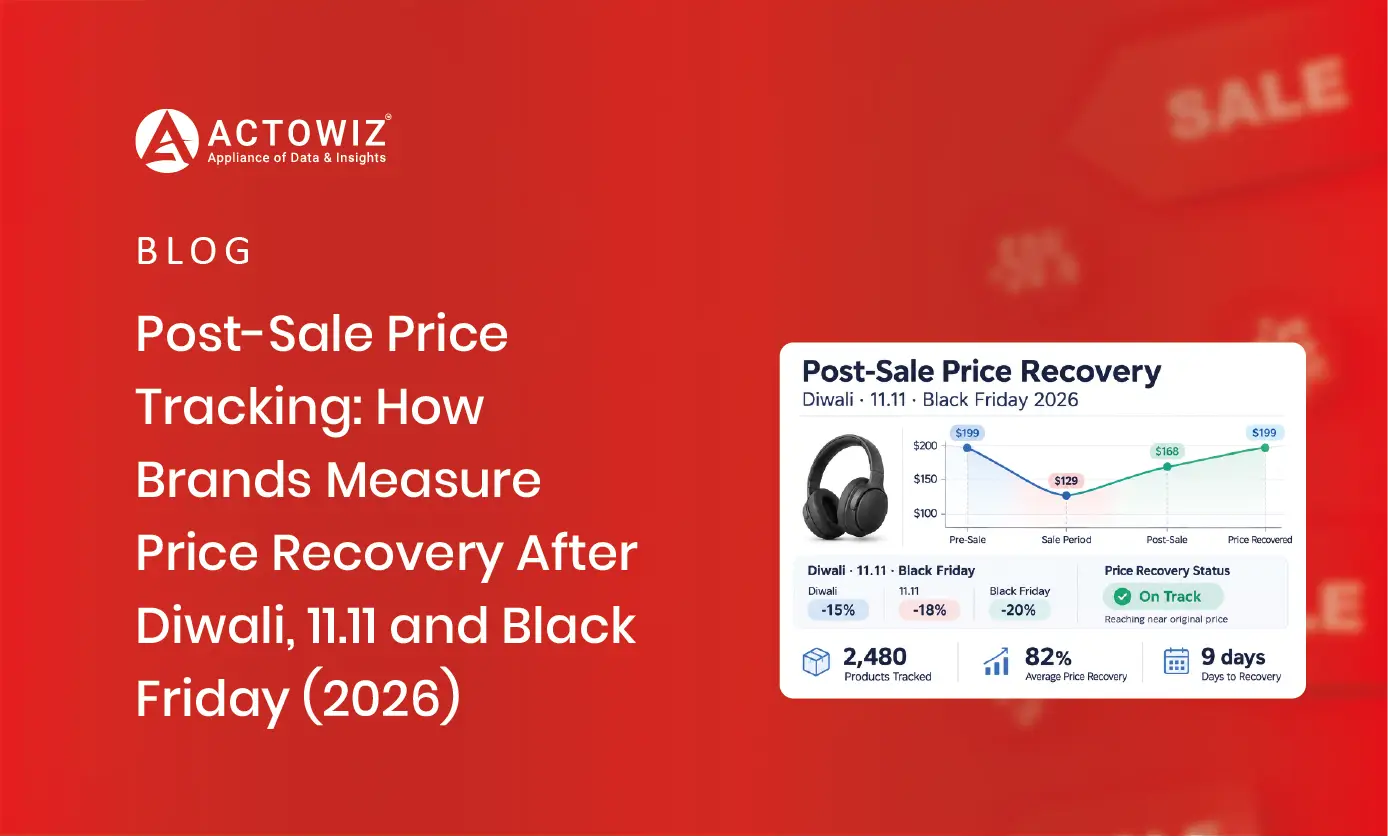
Post-Sale Price Tracking: How Brands Measure Price Recovery After Diwali, 11.11 and Black Friday (2026)

Track how prices recover after Diwali, 11.11 and Black Friday: fields, recovery KPIs, cadence and EU prior-price rules for brands. 

thumb
Case Study

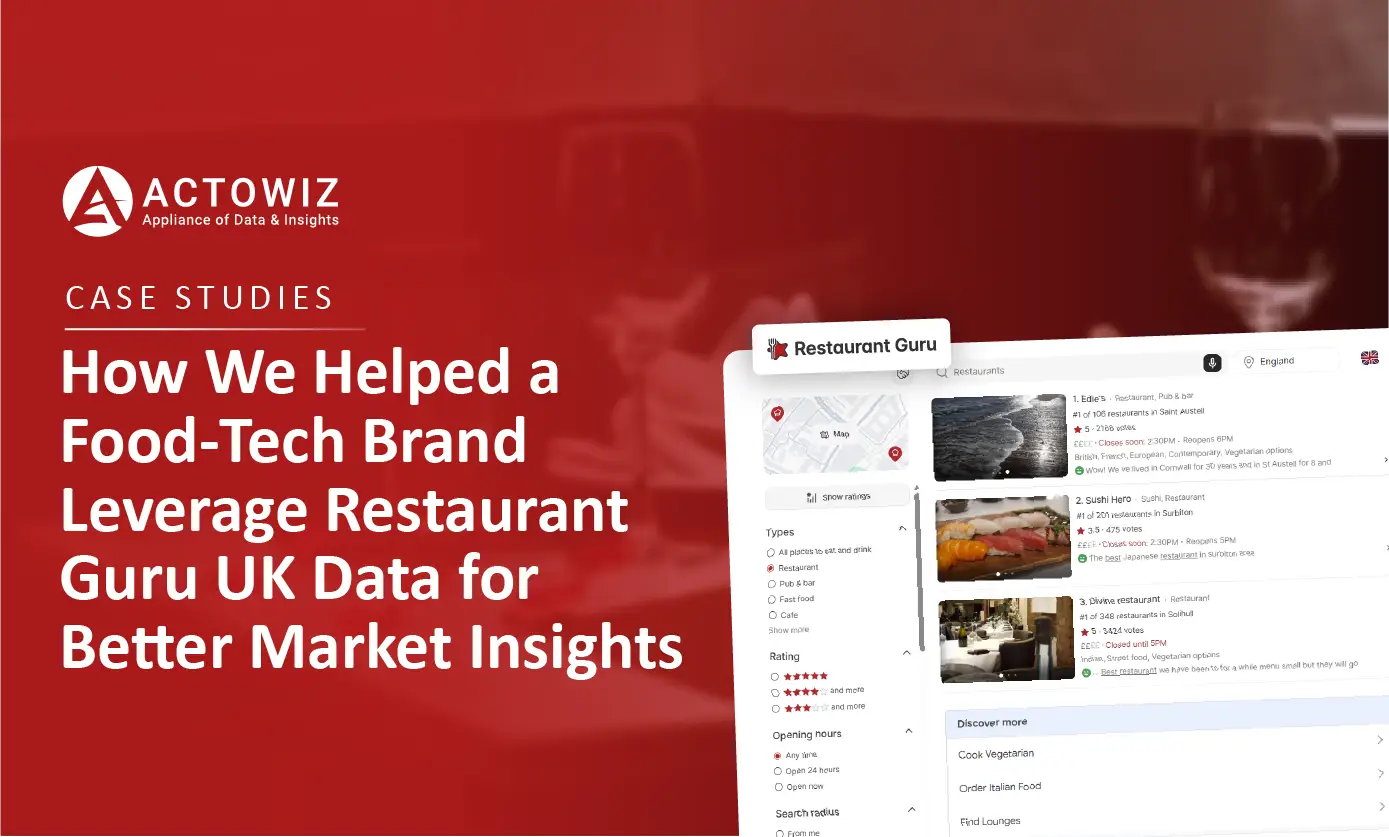
How We Helped a Leading Food-Tech Brand Leverage Restaurant & Menu Data from RestaurantGuru UK for Smarter Market Analysis

Explore Restaurant & Menu Data from RestaurantGuru UK to analyze restaurant listings, menus, pricing, ratings, and dining trends.

thumb
Report

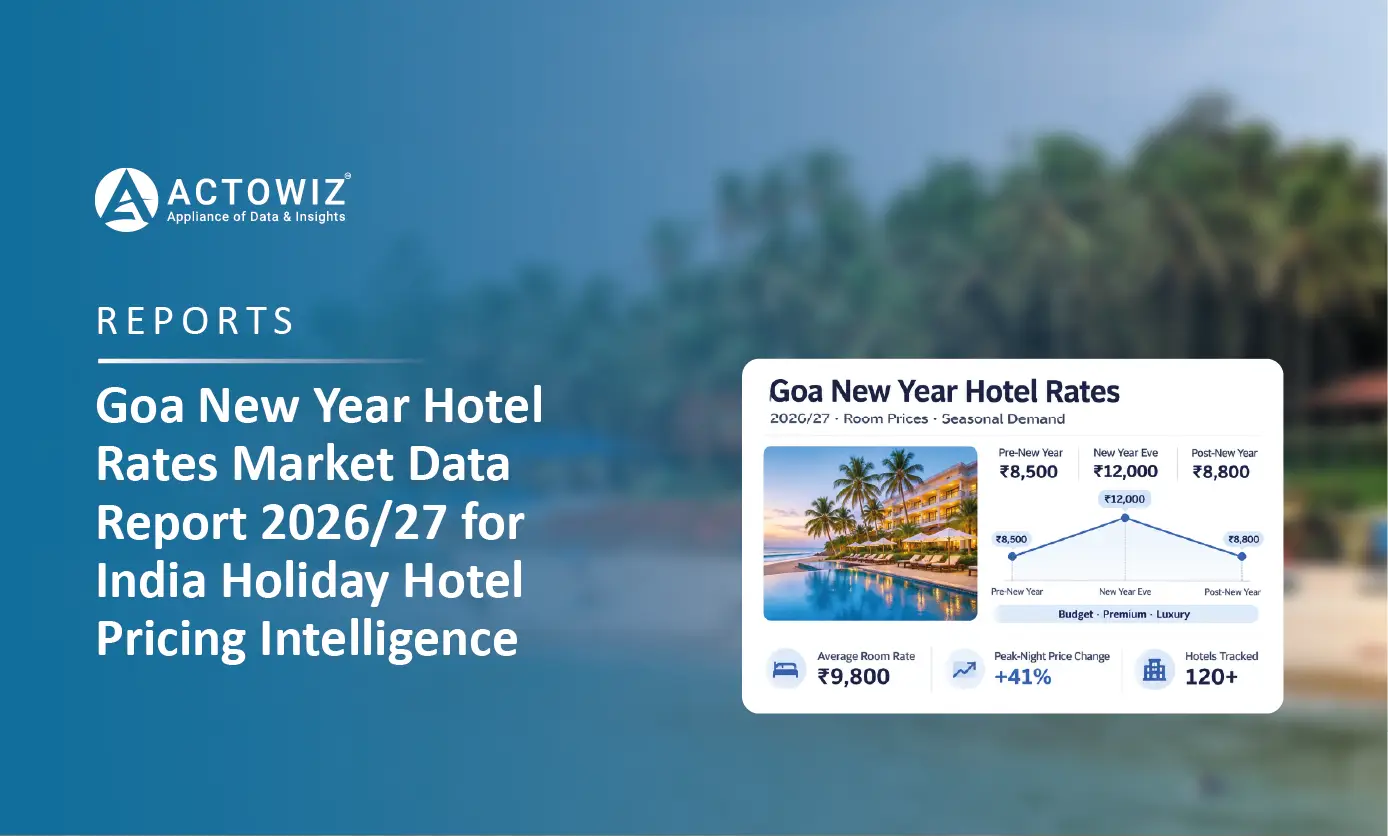
Goa New Year Hotel Rates Market Data Report 2026/27 for India Holiday Hotel Pricing Intelligence

Goa New Year hotel rates report 2026/27: tourist demand, tariff trends and what to track on OTAs for Christmas–New Year stays.

Start Where It Makes Sense for You

Whether you're a startup or a Fortune 500 — we have the right plan for your data needs.

icons
Enterprise
Book a Strategy Call
Custom solutions, dedicated support, volume pricing for large-scale needs.
icons
Growing Brand
Get Free Sample Data
Try before you buy — 500 rows of real data, delivered in 2 hours. No strings.
icons
Just Exploring
View Plans & Pricing
Transparent plans from $500/mo. Find the right fit for your budget and scale.

Request Free Sample Data

Our team will reach out within 2 hours with 500 rows of real data — no credit card required.

+1 ▼
✓ Free 500-row sample · No credit card · Response within 2 hours