🎃 HALLOWEEN OFF Spooky Savings Event! Get FLAT 20% OFF on all Web Scraping & Data Extraction Plans 20% OFF Web Scraping Plans!
Ends in: 00d : 00h : 00m : 00s
🦇
👻
🎃 Spooktacular Limited Offer

Don’t Let High Data Costs Haunt You! 🎃

Get FLAT 20% OFF

T&C Apply

Scrape competitor prices, monitor MAP, and extract real-time datasets at a spooky discount this Halloween.

Offer Expires In:
00d : 00h : 00m : 00s
⚡ Claim 20% Discount Now
🎃
Promo Code Copied!
SPOOKY30 (20% OFF Applied)
Core services
Enterprise Data Extraction

Scalable web, app and AI-powered collection across 40+ countries.

All 58 services →
New 2026
AI Training Data

Corpus building with provenance and opt-out compliance.

Learn more →
Free pilot
24-hour sample

We run collection on your own sources before you commit.

Get a sample →
58Services
40+Countries
DEVELOPER

Ready-Made Scrapers

Pre-built for top platforms. Self-serve, no setup.

View All →
TRY FREE

API Playground

Test endpoints instantly. No credit card.

Start Free →
28Tools
2SDKs
icons Delivery & SDKs
Streaming Crawl API Scheduler Realtime Alerts Webhook Delivery 🐍 Python SDK 💚 Node.js SDK

Need it managed instead?

Fixed monthly retainer, named engineer, no per-request metering.

Managed Data API →
HOT

Case Studies

How brands use Actowiz, with named outcomes.

Read →
FREE

Sample Datasets

Real output, no signup.

Download →
NEW

ROI Calculator

Model the return on a data engagement.

Calculate →

Introduction

Australia supermarket price transparency has moved from a consumer issue to a board-level topic for FMCG suppliers. The ACCC's Supermarkets Inquiry final report, released on 21 March 2025, found the sector is "highly concentrated with an oligopoly structure, dominated by Coles and Woolworths", and that more than half of products bought at Coles and Woolworths are on promotion. A mandatory Food and Grocery Code of Conduct has applied since 1 April 2025, and the Grocery Unit Pricing Code is under review.

In short: Australia supermarket price transparency data means public shelf prices, promotion labels, unit prices, pack sizes and availability, collected on a regular schedule from Coles, Woolworths, ALDI, IGA and other retailers, normalised to AUD per unit and mapped to your products. FMCG suppliers use it to check price position, promotion depth and pack-size changes by state, retailer and week.

This report covers market structure, promotion and unit-price mechanics, store and postcode sampling, loyalty pricing, seasonal events and supplier metrics. Official figures are cited; our measured values appear as placeholders until your category scope is agreed.

What does the Australian supermarket market look like in 2026?

The ACCC estimates that Woolworths has 38% of supermarket grocery sales nationally, Coles 29%, ALDI 9%, and Metcash – as a proxy for the independent supermarkets it supplies, such as IGA stores – 7% (ACCC final report, p. 1). The report adds that Coles and Woolworths together hold two-thirds of supermarket grocery sales, and that Metcash-supplied independents have been losing share over time at a national level.

The ACCC also found that ALDI, Coles and Woolworths are "some of the most profitable supermarket businesses among global peers". It described ALDI as a hard discounter that constrains Coles and Woolworths on a more limited range of products, so supplier comparisons must separate like-for-like branded items from private-label ranges.

Other channels matter too: Costco Australia (bulk packs), Amazon Australia (online pantry and household), Harris Farm Markets (fresh and premium) and Chemist Warehouse (health and beauty). The ACCC did not publish shares for these, so we do not estimate them.

Retailer / group Share of supermarket grocery sales (ACCC estimate) Note for supplier analysis
Woolworths 38% Prices and availability vary by selected store/postcode
Coles 29% Weekly specials cycle; store selection matters
ALDI Australia 9% Mostly private label – compare on unit price
Metcash-supplied independents (IGA and others) 7% Owner-set prices; store-level sampling
Costco Australia Not estimated Public prices only – no UPC/GTIN mapping
Amazon Australia Not estimated Many seller offers per product
Harris Farm Markets Not estimated Fresh and premium lines
Chemist Warehouse Not estimated Health and beauty only

Source for shares: ACCC Supermarkets Inquiry final report (released 21 March 2025).

How do price and promotion mechanics work, and what has the ACCC said?

Australian grocery promotions follow a weekly rhythm: half-price specials, multibuys ("2 for $X"), longer-term reductions under branded programmes such as Woolworths "Prices Dropped" and Coles "Down Down", everyday low pricing and catalogue features. The ACCC noted that these practices can make value for money hard to assess.

In September 2024 the ACCC began Federal Court proceedings against Woolworths and Coles over certain "Prices Dropped" and "Down Down" claims. It alleged that, for 266 Woolworths products and 245 Coles products, regular prices were raised by at least 15% for a short period before the products were promoted at a price at or above the earlier regular price. On 14 May 2026 the ACCC reported that the Federal Court found Coles made false or misleading representations about its "Down Down" discounts, with penalties to be decided later. At that date the Court had reserved judgment in the separate Woolworths case. We report these matters only as stated by the ACCC.

For suppliers, a promotion label alone does not show the real discount. A price history per product lets the "was" price be checked against the regular price observed in earlier weeks. The ACCC also recommended minimum information requirements for discount promotions (Recommendation 4).

Promotion mechanic How it is measured Actowiz 2026 observation
Half-price special Depth vs. 8-week observed regular price Pending
Multibuy (e.g. 2 for $X) Effective unit price vs. single-unit price Pending
Longer-term reduction programme Weeks on programme; price vs. prior regular price Pending
Everyday low price Price changes per quarter Pending
Catalogue feature Share of category SKUs featured Pending

How should unit prices be compared across Australian retailers?

Unit pricing is the most useful single field for comparing value across pack sizes and retailers. Large Australian grocery retailers display unit prices under the Grocery Unit Pricing Code, a prescribed industry code. In its final report the ACCC supported the government's proposal to consult on changes to the code (Recommendation 5), and recommended that supermarkets publish notices when pack sizes change in a way that is adverse to consumers (Recommendation 6).

Treasury opened consultation on strengthening the code on 1 September 2025. The options included improving the readability and prominence of unit prices, fixing inconsistent units of measure, expanding the range of retailers covered, introducing a shrinkflation notification regime and applying civil penalties. Public submissions dated May 2026 refer to a further targeted Treasury consultation on unit pricing reforms. Check Treasury for the current status before relying on any final rule.

Because displayed units vary (per 100 g, per kg, per each), we recalculate unit prices from shelf price and parsed pack size, then check them against the retailer's displayed figure.

Step Method Output field
1. Capture Shelf and promo price (AUD), displayed unit price, pack size text price_aud, unit_price_displayed
2. Parse pack size "6 x 375mL" or "1.2kg" into quantity and unit pack_qty, pack_unit
3. Standardise Per 100 g, 100 mL, kg, L or each; cross-check displayed value unit_price_std
4. Multibuys Effective price when the offer is taken unit_price_effective
5. Pack changes Same product, new pack size pack_change_flag
6. Match products Brand, name, size and public barcode; human sample check match_id, match_confidence

Our measured cross-retailer unit-price gap for your categories: Pending.

Do supermarket prices differ by state, region and postcode?

The ACCC found that price competition between the major chains generally takes place on a national or state-wide basis, and that consumers in some regional areas can benefit from these pricing policies. It also found that grocery prices may be significantly higher in remote locations, with higher freight costs a significant contributor, and that some remote stores did not display price labels. The ACCC supports a requirement for all stores to display prices.

So one national price is not enough. Online prices and availability at Coles and Woolworths depend on the selected store or postcode. A sound design samples a fixed postcode panel in each state and territory, including regional and remote locations, and keeps it stable so week-on-week changes are real.

Record postcode and store ID with every price. Independent stores need their own sample because owners set prices.

Sample cell (example design) Postcodes Price index vs. national (Actowiz) Availability rate (Actowiz)
NSW – Sydney metro 3–5 Pending Pending
VIC – Melbourne metro 3–5 Pending Pending
QLD – Brisbane and regional 3–5 Pending Pending
WA – Perth and regional 3–5 Pending Pending
SA, TAS, ACT 2–3 each Pending Pending
NT and remote Where online ordering exists Pending Pending

The final postcode panel is agreed per project.

How should loyalty pricing (Flybuys, Everyday Rewards) be treated?

Coles runs the Flybuys programme and Woolworths runs Everyday Rewards. The ACCC found that "it can be difficult for consumers to assess how much value they obtain from loyalty programs". It recommended that Coles and Woolworths give members periodic loyalty information summaries (Recommendation 7), and that loyalty practices be reviewed in three years (Recommendation 8).

We record loyalty information only where it is publicly displayed on a product page without signing in, such as a points offer or a member price shown to every visitor, and keep it in separate fields from the shelf price. We do not log in, collect personalised offers or collect member data.

Field Included?
Public shelf price and promotion (AUD) Yes
Public points offer or member price on product page Yes, separate field
Personalised boosted offers (sign-in required) No
Member account or purchase data No – personal information

Which seasonal events shape Australian grocery and FMCG pricing?

Australian grocery pricing follows a weekly cycle, but several annual events change promotion intensity and category focus. Easter (chocolate, hot cross buns, seafood), the end of the financial year in June (household, health and online bulk buying), the Click Frenzy online sale events, Black Friday and Cyber Monday in late November, and Christmas (confectionery, beverages, entertaining) all deserve their own measurement windows.

Chemist Warehouse and Amazon Australia matter more around EOFY, Click Frenzy and Black Friday than around the weekly catalogue. Compare each event window with a baseline of several normal weeks: which products were promoted, for how long, and was the regular price stable beforehand?

Event Typical timing Categories to watch Actowiz promo share vs. baseline
Easter March–April (moves yearly) Chocolate, bakery, seafood Pending
EOFY June Health, beauty, household Pending
Click Frenzy Check organiser dates Beauty, household, pantry online Pending
Black Friday / Cyber Monday Late November Beauty, household, beverages Pending
Christmas December Confectionery, beverages, snacks Pending

How can an FMCG supplier measure its competitive position?

Price data becomes useful when it is turned into a few stable metrics that category and key-account teams review each week.

Food price inflation is the context for every conversation with a retailer. The ABS reports that annual inflation for food and non-alcoholic beverages was 3.0% in the 12 months to August 2026, compared with headline CPI of 4.0% (ABS, released 30 September 2026). A supplier can compare its own shelf-price movement with this official benchmark, but should label any comparison as indicative, because the CPI basket is not the same as a supplier's range.

Under the Food and Grocery Code, which is mandatory for supermarkets and wholesalers with more than $5 billion in annual supermarket or grocery wholesale revenue, suppliers have protections such as written grocery supply agreements, good-faith dealing and protection from retribution. Accurate, time-stamped shelf data helps suppliers prepare fact-based conversations with retailers. This report does not give legal advice on the code.

Metric Definition Actowiz value for your category
Price index vs. category Your unit price ÷ category median × 100 Pending
Gap to private label Unit price vs. nearest private-label equivalent Pending
Promotion share % of weeks on promotion, by retailer Pending
Promotion depth Discount vs. observed regular price Pending
Availability rate % of sampled postcodes in stock Pending
State price spread Max minus min price across states Pending
Pack-size change events Pack changes with unit-price impact Pending

Is collecting public supermarket price data allowed under Australian privacy law?

The Privacy Act 1988 regulates personal information. The OAIC explains that personal information is information or an opinion that could identify an individual, depending on whether the person is identified or reasonably identifiable in the circumstances. Public shelf prices, promotion labels, unit prices and pack sizes are information about products, not about people.

Actowiz collects only publicly available business data, respects site terms, does not log in or bypass access controls, and does not collect personal data such as reviewer identities or loyalty member details. This is general information, not legal advice; your legal team should review any use case.

How Actowiz Solutions Helps

The requirement types we see most often in Australia in 2026 are weekly product and price feeds for Coles, Woolworths and ALDI Australia, and Coles product data with promotion price, stock status and pack size. We build around those needs.

  • Retailer and postcode coverage. Coles, Woolworths, ALDI, IGA stores with public online prices, Costco Australia (prices only, no UPC/GTIN mapping), Amazon Australia, Harris Farm and Chemist Warehouse, across an agreed postcode panel.
  • Freshness you choose. Weekly feeds aligned to the catalogue cycle, with daily collection available for key SKUs or event windows such as EOFY and Black Friday.
  • Comparable fields. Shelf, promo and "was" price, offer text, standardised unit price, pack size, availability, store ID, postcode and timestamp, with cross-retailer matching.
  • Delivery in your stack. REST API, CSV or JSON files, or direct delivery to Amazon S3, Snowflake, Google BigQuery or Azure, with an agreed SLA for delivery times.
  • Quality assurance. Automated checks for missing fields, price outliers and unit-price mismatches, plus sample-based human review of product matches.
  • Security and usage rights. Public business data only, collected in line with site terms; access-controlled delivery; usage terms agreed in writing. Results from past projects.

Conclusion

Australian supermarket pricing is under closer official scrutiny than at any time in recent years. The ACCC has described a concentrated market, found that more than half of products bought at the two largest chains are on promotion, and recommended more price transparency, including online price publication by ALDI, Coles and Woolworths and dynamic price APIs from Coles and Woolworths. A mandatory Food and Grocery Code now applies to the largest retailers and wholesalers, and the Unit Pricing Code is being reviewed.

For FMCG suppliers, the answer is a consistent, well-sampled public price dataset – standardised unit prices, promotion depth against price history, postcode coverage, separate loyalty fields and pack-size flags – so teams can measure their position each week with evidence.

Request the full report or an enterprise sample (48-hour turnaround) – use your company email and tell us your categories, retailers, states and refresh frequency.
Frequently Asked Questions

What is Australia supermarket price transparency data?

Public shelf price, promotion, unit price, pack size and availability data from Australian grocery retailers, collected on a schedule, standardised to AUD per unit and matched across retailers.

Which retailers does this report cover?

Coles, Woolworths, ALDI Australia, IGA and other Metcash-supplied independents with public online prices, Costco Australia (prices only, without UPC/GTIN mapping), Amazon Australia, Harris Farm Markets and Chemist Warehouse for health and beauty.

Do you collect Flybuys or Everyday Rewards member prices?

Only where a loyalty offer or member price is publicly shown on a product page without signing in. We do not log in, collect personalised offers or collect any member data.

How often is the data refreshed?

Weekly is the standard for catalogue-cycle analysis. Daily collection can be set up for priority SKUs or for event windows. Freshness and delivery times are agreed in the SLA.

How quickly can we see a sample?

We aim to deliver an enterprise sample within 48 hours of agreeing scope. Use your company email and tell us your retailers, categories, states and refresh frequency.

Download the full Australia Supermarket Price Transparency Report 2026 or request an enterprise sample (24-hour turnaround). Use your company email and tell us your categories, retailers (Coles, Woolworths, ALDI, IGA, Costco AU, Amazon AU, Harris Farm, Chemist Warehouse), states/postcodes, refresh frequency and preferred delivery (API, CSV/JSON, S3, Snowflake, BigQuery or Azure).

Contact Us Today!
Social Proof That Converts

Trusted by Global Leaders Across Q-Commerce, Travel, Retail, and FoodTech

Our web scraping expertise is relied on by 4,000+ global enterprises including Zomato, Tata Consumer, Subway, and Expedia — helping them turn web data into growth.

4,000+ Enterprises Worldwide
50+ Countries Served
20+ Industries
Join 4,000+ companies growing with Actowiz →
Real Results from Real Clients

Hear It Directly from Our Clients

Watch how businesses like yours are using Actowiz data to drive growth.

▶
1 min
★★★★★
"Actowiz Solutions offered exceptional support with transparency and guidance throughout. Anna and Saga made the process easy for a non-technical user like me. Great service, fair pricing!"
TG
Thomas Galido
Co-Founder / Head of Product at Upright Data Inc.
▶
2 min
★★★★★
"Actowiz delivered impeccable results for our company. Their team ensured data accuracy and on-time delivery. The competitive intelligence completely transformed our pricing strategy."
II
Iulen Ibanez
CEO / Datacy.es
▶
1:30
★★★★★
"What impressed me most was the speed — we went from requirement to production data in under 48 hours. The API integration was seamless and the support team is always responsive."
FC
Febbin Chacko
-Fin, Small Business Owner
icons 4.8/5 Average Rating
icons 50+ Video Testimonials
icons 92% Client Retention
icons 50+ Countries Served

Join 4,000+ Companies Growing with Actowiz

From Zomato to Expedia — see why global leaders trust us with their data.

Why Global Leaders Trust Actowiz

Backed by automation, data volume, and enterprise-grade scale — we help businesses from startups to Fortune 500s extract competitive insights across the USA, UK, UAE, and beyond.

icons
7+
Years of Experience
Proven track record delivering enterprise-grade web scraping and data intelligence solutions.
icons
4,000+
Projects Delivered
Serving startups to Fortune 500 companies across 50+ countries worldwide.
icons
200+
In-House Experts
Dedicated engineers across scrapers, AI/ML models, APIs, and data quality assurance.
icons
9.2M
Automated Workflows
Running weekly across eCommerce, Quick Commerce, Travel, Real Estate, and Food industries.
icons
270+ TB
Data Transferred
Real-time and batch data scraping at massive scale, across industries globally.
icons
380M+
Pages Crawled Weekly
Scaled infrastructure for comprehensive global data coverage with 99% accuracy.

AI Solutions Engineered
for Your Needs

→
LLM-Powered Attribute Extraction: High-precision product matching using large language models for accurate data classification.
→
Advanced Computer Vision: Fine-grained object detection for precise product classification using text and image embeddings.
→
GPT-Based Analytics Layer: Natural language query-based reporting and visualization for business intelligence.
→
Human-in-the-Loop AI: Continuous feedback loop to improve AI model accuracy over time.
icons Product Matching icons Attribute Tagging icons Content Optimization icons Sentiment Analysis icons Prompt-Based Reporting

Connect the Dots Across
Your Retail Ecosystem

We partner with agencies, system integrators, and technology platforms to deliver end-to-end solutions across the retail and digital shelf ecosystem.

icons
Analytics Services
icons
Ad Tech
icons
Price Optimization
icons
Business Consulting
icons
System Integration
icons
Market Research
Become a Partner →

Popular Datasets — Ready to Download

Browse All Datasets →
icons
Amazon
eCommerce
Free 100 rows
icons
Zillow
Real Estate
Free 100 rows
icons
DoorDash
Food Delivery
Free 100 rows
icons
Walmart
Retail
Free 100 rows
icons
Booking.com
Travel
Free 100 rows
icons
Indeed
Jobs
Free 100 rows

Latest Insights & Resources

View All Resources →
thumb
Blog

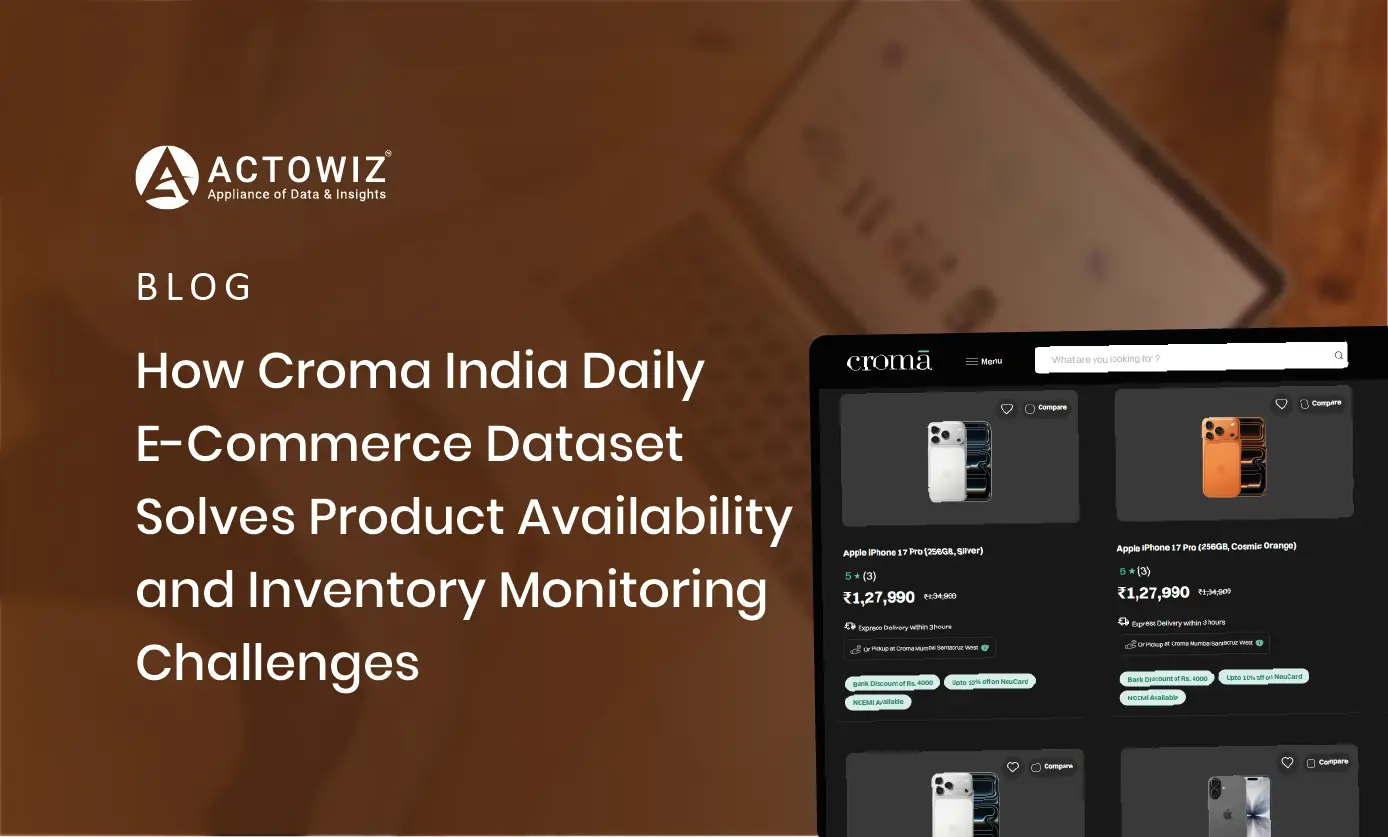
How Croma India Daily E-Commerce Dataset Solves Product Availability and Inventory Monitoring Challenges

Croma India Daily E-Commerce Dataset helps track product prices, availability, discounts, ratings, and market trends for smarter retail decisions.

thumb
Case Study

How CarDekho Data API 2026 Enables Automotive Brands to Monitor Images, Pricing, Specs, and Reviews

CarDekho Data API 2026 helps businesses track vehicle images, pricing, specs, and reviews for smarter automotive market and competitor analysis.

thumb
Report

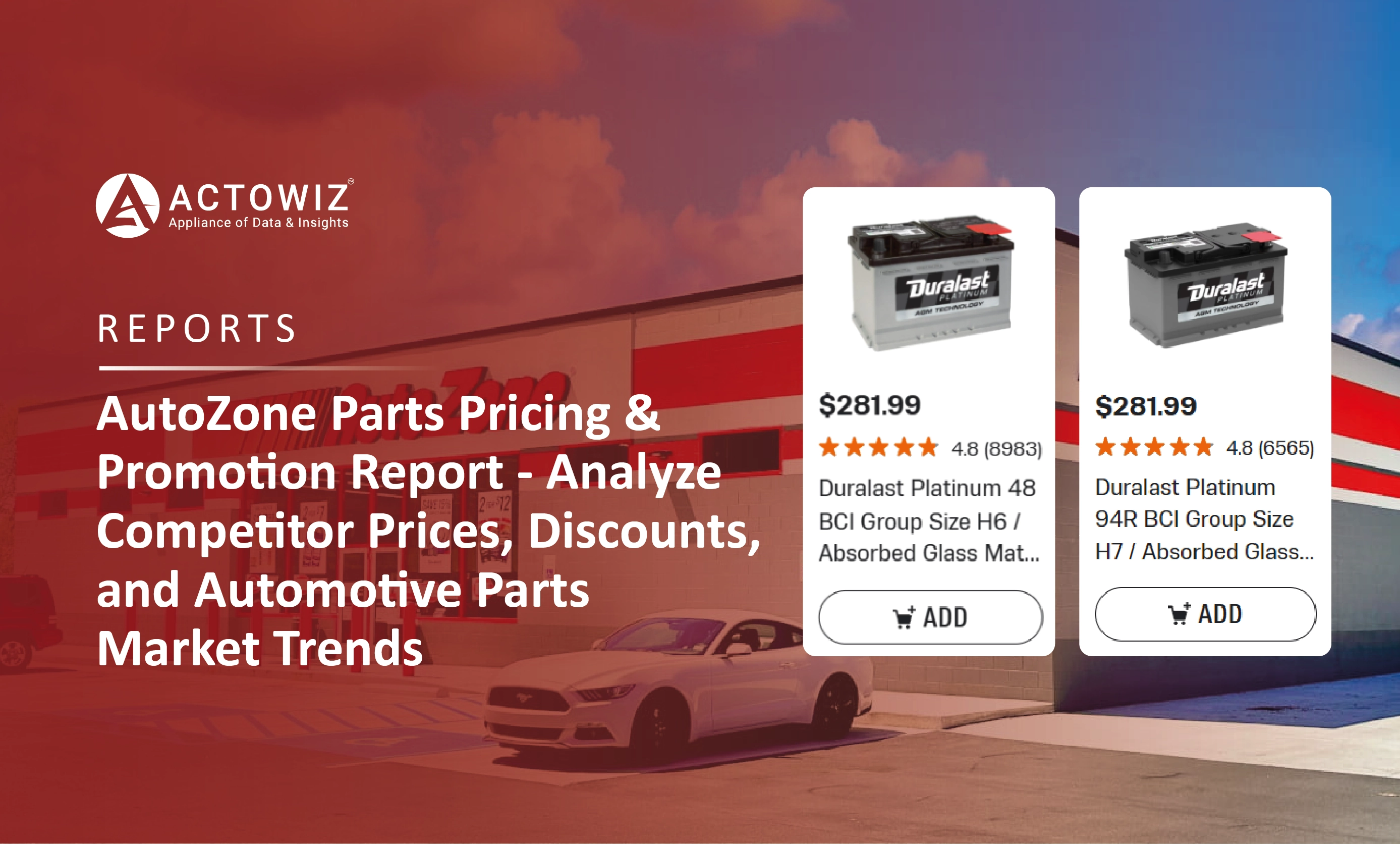
AutoZone Parts Pricing & Promotion Report - Analyze Competitor Prices, Discounts, and Automotive Parts Market Trends

The AutoZone Parts Pricing & Promotion Report tracks automotive parts prices, discounts, promotions, and competitor pricing trends.

Start Where It Makes Sense for You

Whether you're a startup or a Fortune 500 — we have the right plan for your data needs.

icons
Enterprise
Book a Strategy Call
Custom solutions, dedicated support, volume pricing for large-scale needs.
icons
Growing Brand
Get Free Sample Data
Try before you buy — 500 rows of real data, delivered in 2 hours. No strings.
icons
Just Exploring
View Plans & Pricing
Transparent plans from $500/mo. Find the right fit for your budget and scale.

Request Free Sample Data

Our team will reach out within 2 hours with 500 rows of real data — no credit card required.

+1 ▼
✓ Free 500-row sample · No credit card · Response within 2 hours