🎃 HALLOWEEN OFF Spooky Savings Event! Get FLAT 20% OFF on all Web Scraping & Data Extraction Plans 20% OFF Web Scraping Plans!
Ends in: 00d : 00h : 00m : 00s
🦇
👻
🎃 Spooktacular Limited Offer

Don’t Let High Data Costs Haunt You! 🎃

Get FLAT 20% OFF

T&C Apply

Scrape competitor prices, monitor MAP, and extract real-time datasets at a spooky discount this Halloween.

Offer Expires In:
00d : 00h : 00m : 00s
⚡ Claim 20% Discount Now
🎃
Promo Code Copied!
SPOOKY30 (20% OFF Applied)
Core services
Enterprise Data Extraction

Scalable web, app and AI-powered collection across 40+ countries.

All 58 services →
New 2026
AI Training Data

Corpus building with provenance and opt-out compliance.

Learn more →
Free pilot
24-hour sample

We run collection on your own sources before you commit.

Get a sample →
58Services
40+Countries
DEVELOPER

Ready-Made Scrapers

Pre-built for top platforms. Self-serve, no setup.

View All →
TRY FREE

API Playground

Test endpoints instantly. No credit card.

Start Free →
28Tools
2SDKs
icons Delivery & SDKs
Streaming Crawl API Scheduler Realtime Alerts Webhook Delivery 🐍 Python SDK 💚 Node.js SDK
Need it managed instead?

Fixed monthly retainer, named engineer, no per-request metering.

Managed Data API →
HOT

Case Studies

How brands use Actowiz, with named outcomes.

Read →
FREE

Sample Datasets

Real output, no signup.

Download →
NEW

ROI Calculator

Model the return on a data engagement.

Calculate →

Introduction

The AutoZone Parts Pricing & Promotion Report examines how automotive retailers, distributors, and market researchers can evaluate product prices, promotional offers, discounts, and competitive movements in the automotive aftermarket. By combining Automotive Data Scraping Services with structured market research, businesses can organize publicly available product information, monitor pricing changes, and understand how merchandise and promotions are presented across digital retail channels. The objective is to build a reliable foundation for pricing decisions using verifiable observations rather than assumptions.

AutoZone is a major automotive replacement-parts retailer operating across the United States, Mexico, and Brazil. According to its fiscal 2025 annual report, the company operated 7,657 stores across these markets as of August 30, 2025, and generated approximately $18.9 billion in net sales during fiscal 2025. Its product range includes replacement parts, maintenance products, accessories, and other merchandise. These characteristics make its online catalog and promotional pages relevant sources for structured retail intelligence. Source: AutoZone’s 2025 Form 10-K.

This report explores six areas: product-price collection, promotional monitoring, discount analysis, SKU-level data organization, pricing intelligence, and catalog coverage. Publicly reported financial results provide historical business context, while individual product prices and discounts require dated product-level observations. The report does not treat company revenue as a substitute for SKU prices or claim that a historical price series exists where one has not been verified.

How can automotive product prices be collected and compared?

AutoZone Parts Pricing Data Scraping can help organize publicly available product information into consistent records for research and comparison. A useful record may include product name, brand, part number or SKU when displayed, listed price, product URL, availability status, category, and collection timestamp. These fields help analysts distinguish between products that appear similar but have different specifications or fitment requirements.

For automotive parts, product matching is especially important. Brake components, batteries, filters, spark plugs, and fluids can vary by vehicle compatibility, dimensions, formulation, brand, and warranty. A meaningful comparison must therefore match equivalent items rather than simply compare product names. The same item may also have different displayed prices or availability depending on the selected location, delivery option, or offer conditions. These variables should be recorded whenever the website exposes them.

Real-Time Price Monitoring can provide a dated record of observed changes. Instead of overwriting the previous price, a monitoring workflow stores each observation with its timestamp and source URL. This allows analysts to identify when a listed price changes, whether a promotion is displayed, and whether an item becomes unavailable. A change should be flagged only after checking that the product identity and comparison conditions remain consistent.

AutoZone’s official product website provides the starting point for reviewing its product assortment and displayed listings. The resulting dataset should reflect what was actually observed, with missing fields left blank rather than inferred.

Verified company sales context, 2020–2026
Fiscal year Reported net sales Source or status
2020 $12.63 billion AutoZone fiscal 2020 results
2021 $14.63 billion AutoZone annual report
2022 $16.25 billion AutoZone annual report
2023 $17.46 billion AutoZone annual report
2024 $18.49 billion AutoZone annual report
2025 $18.94 billion AutoZone annual report
2026 $20.3 billion Fiscal 2026 annual sales announced by AutoZone

Sources: Fiscal 2020 results, 2025 Form 10-K, including 2021–2025 results, and AutoZone investor relations. Figures are company-wide annual sales, not prices for individual parts. Fiscal 2026 sales were announced in September 2026.

These figures demonstrate the scale of the business but do not establish how much any specific part cost in a particular year. Historical product-price analysis requires its own dated observations.

How can promotional activity and discounts be monitored?

AutoZone Parts Promotion Tracking focuses on the offers attached to products and categories, including coupons, advertised markdowns, rewards-related offers, and other promotional conditions. AutoZone maintains an official Deals and Discounts page that presents offers across categories such as brakes, vehicle maintenance, tools, performance chemicals, and wash-and-wax products. The page also describes rewards-related terms and limitations. As these offers can change, each observation should include the date collected and any displayed expiration date.

A useful promotion record separates the advertised offer from the product’s standard listed price. Relevant fields can include offer description, eligible category or SKU, coupon code when shown, minimum purchase requirements, exclusions, membership conditions, start and end dates, and the associated product URL. If a page states that an offer applies only to selected merchandise or online orders, that restriction should remain attached to the record. A discount should not be assumed to apply to every item in the category.

AI-Powered Scraping Services can support the classification of collected page content, helping organize offer descriptions into structured fields for review. Automated classification should not be treated as proof that an offer is valid. Human or rule-based validation is important when wording is ambiguous, terms have changed, or a promotional page contains multiple conditions.

Publicly verifiable promotion features
Feature What the official source confirms Research implication
Category-based deals AutoZone lists offers across multiple automotive product categories Record the category and linked products
Coupons and promotional codes The deals page presents coupon and discount information Capture code, eligibility, and exclusions when displayed
Rewards offers Some offers are identified as rewards-member benefits Keep member-only terms distinct
Expiration conditions Offers may include end dates and specific terms Store collection time and displayed validity dates

Source: AutoZone Deals & Discounts.

These are documented features of AutoZone’s public promotional pages, not a claim that a particular offer remained available throughout 2020–2026. To measure long-term promotion frequency, researchers would need archived or previously collected records from each period. Without that evidence, an annual discount trend cannot be reliably calculated.

What can discount data reveal about retail pricing?

AutoZone auto parts discount data Extraction can help analysts distinguish between a standard listed price, a promotional price, a coupon-based reduction, and a rewards-related benefit. These are not necessarily interchangeable. An advertised deal may apply only to selected products, require a qualifying purchase, or exclude specific brands and merchandise. Recording these conditions prevents a misleading comparison between an unconditional price and a conditional offer.

The AutoZone Parts Pricing & Promotion Report should therefore treat discount information as a separate data layer linked to the relevant product record. When both the regular price and promotional price are explicitly shown for the same item, the displayed reduction can be calculated. When only a percentage or coupon condition is available, the dataset should retain the published wording rather than derive a price that the source does not disclose.

Discount observations can be grouped by category, brand, product, offer type, and collection date. Analysts may then evaluate questions such as whether a category repeatedly appears in advertised promotions, how long an offer is displayed, or whether a specific product’s observed price differs between two dates. Conclusions should be limited to the coverage and collection frequency of the dataset. A single snapshot cannot establish how frequently AutoZone discounts a category over an entire year.

The company’s official savings page also illustrates why offer terms matter: promotions can specify minimum spending thresholds, shipping restrictions, excluded merchandise, and expiration dates. These conditions affect whether a consumer can actually obtain the advertised saving.

Discount analysis framework
Metric Calculation or observation method Evidence required
Displayed price difference Regular displayed price minus promotional displayed price Both prices for the same product and observation
Displayed discount percentage Price difference divided by regular price, multiplied by 100 Two valid comparable prices
Offer duration End date minus start date Verified offer dates
Promotion coverage Number of observed promoted SKUs divided by all observed eligible SKUs Defined catalog and collection period
Repeated offer frequency Count of separately dated observations showing an offer Consistent historical collection

The table describes analytical methods, not measured AutoZone results. No discount percentages or offer frequencies are supplied because a complete, verified historical SKU-level dataset was not established for this report. This distinction keeps the findings reproducible and prevents illustrative values from being mistaken for real market data.

Why does SKU-level product information matter?

A SKU-level data structure connects pricing observations to a specific item rather than to a broad product category. This is essential in automotive retail because products that share a general description may not be compatible with the same vehicles or provide equivalent specifications. For instance, two listings for a replacement component should not be treated as direct substitutes until their part identifiers, fitment information, brand, and relevant product details have been checked.

An AutoZone SKU-level pricing Data API can be understood as a desired structured delivery format for validated product observations; the phrase does not imply that AutoZone provides a public API with unrestricted access to its catalog. A data service can deliver approved records in a documented schema, whether the underlying collection uses an authorized feed, a permitted integration, or another compliant source.

A robust record should preserve product identifiers, title, brand, category, fitment details where available, current displayed price, currency, availability, product URL, collection timestamp, and any associated promotion. It should also distinguish between an unavailable field and a value of zero. That difference matters when analysts calculate averages, identify missing coverage, or compare products across observation periods.

Data validation should check duplicate identifiers, unexpected price formats, stale observations, and inconsistent units. If the source changes a product title or URL, the workflow should avoid automatically treating the item as a new SKU without checking the available identifiers. Likewise, historical records should remain immutable or auditable so analysts can understand which source observation produced a reported change.

The public AutoZone catalog is the source for verifying what its product pages display. Its 2025 Form 10-K describes the company’s broad replacement-parts and accessories business, but the financial filing does not provide a historical price list for every individual SKU.

For Actowiz Solutions, the practical priority is to define the data schema and validation rules before calculating competitive pricing metrics. Structured data is only useful when records represent comparable products and their source, date, and conditions remain traceable.

How can collected information support pricing intelligence?

AutoZone parts pricing Data intelligence turns individual observations into organized comparisons that help teams understand product positioning and changes over time. Useful analyses include price movement for the same item, differences between matched products, the distribution of displayed prices by category, the share of observed products with active offers, and the relationship between availability and displayed promotions. These analyses are most defensible when product matching rules and collection coverage are documented.

The AutoZone Parts Pricing & Promotion Report can combine SKU-level observations with public business context, but the two datasets should not be conflated. Annual sales can describe the company’s overall commercial performance; product observations describe prices and offers displayed for particular items at particular times. Revenue growth alone cannot establish that individual parts became more expensive, that discounts increased, or that a competitor changed its pricing strategy.

AutoZone’s fiscal reports provide a verified historical series for business performance. The company reported net sales of approximately $12.63 billion in fiscal 2020, $14.63 billion in fiscal 2021, $16.25 billion in fiscal 2022, $17.46 billion in fiscal 2023, $18.49 billion in fiscal 2024, and $18.94 billion in fiscal 2025. In September 2026, AutoZone announced fiscal 2026 annual sales of $20.3 billion. Sources: AutoZone annual reports and investor relations.

Research indicators and their evidence requirements
Indicator What it measures Required data
Price movement Change in the displayed price for the same item Dated, matched SKU observations
Category price distribution Differences among comparable products in a category Product attributes and consistent category labels
Promotion share Portion of observed eligible products showing an offer Complete, dated observations of eligible products
Price and availability relationship Whether displayed prices coincide with availability changes Repeated price and availability records
Competitive price gap Difference between comparable retailer listings Matched products, dates, locations, and terms

This framework can help pricing teams prioritize categories for further review and identify where additional observations are needed. However, no competitor price gaps or historical SKU trends are claimed here because those results require a verified comparison dataset. A sound intelligence report should clearly state the observation period, product coverage, matching methodology, and limitations before presenting findings.

How can catalog collection improve product coverage?

AutoZone parts catalog Data Collection involves organizing the product information exposed through public catalog pages into a searchable and maintainable dataset. Depending on what a page provides, this may include product titles, brand, part identifiers, category, fitment information, specifications, displayed prices, availability, images, and links to related items. The exact fields available can differ by product page, so collection rules should accommodate missing or differently formatted attributes.

Catalog coverage is important because price monitoring is only as useful as the products it represents. If a dataset captures only promoted products, it may not support a representative view of regular pricing. If it misses products that are temporarily unavailable, it may also distort comparisons over time. Researchers should record collection coverage and report gaps rather than assuming every product was captured successfully.

The AutoZone Parts Pricing & Promotion Report can use catalog records to connect promotional observations with the correct product and category. A product identifier or source URL helps distinguish a price change from a change in the item being displayed. Category and fitment fields help analysts avoid comparing incompatible components. Timestamps preserve the context needed to determine when a price or offer was observed.

AutoZone’s official website and deals page provide publicly viewable examples of product and promotion information. The company’s annual-report archive supplies a separate source for corporate financial history. These sources serve different purposes: catalog pages support product-level observations, while annual reports establish company-level financial facts.

A practical catalog workflow should include duplicate checks, normalization of product attributes, consistent currency and price formatting, timestamp preservation, and periodic quality reviews. Collection should follow applicable website terms, access restrictions, and legal requirements. The resulting dataset can support repeatable analysis without presenting unobserved prices or unavailable historical information as established facts.

Actowiz Solutions can position its data services around structured collection, validation, and delivery of publicly available automotive retail information, subject to source permissions and applicable terms.

For pricing research, the value is not simply collecting more records; it is making sure that those records can be matched, audited, and analyzed consistently.

An Automotive Dashboard can bring validated price observations, offer records, category coverage, and collection timestamps into a shared view. Depending on the available dataset, users could review observed price changes, track the products included in a promotion, filter by category, and identify gaps that need further collection. The dashboard should distinguish current observations from historical records and make the collection date visible.

A dependable workflow can include:

  • Structured data collection: Organize product and promotional details into a consistent schema.
  • Quality validation: Flag missing identifiers, duplicate products, inconsistent formats, and suspicious changes for review.
  • Historical traceability: Preserve timestamps and source URLs so analysts can retrace observations.
  • Product matching: Use available identifiers and attributes to compare like-for-like items.
  • Reporting support: Present verified results alongside coverage notes, methods, and limitations.

AutoZone’s published annual results and official promotional pages offer useful source material, but they do not remove the need for product-level validation. Any commercial deliverable should explain which pages and products were observed, the collection dates, and whether the dataset is comprehensive or sample-based. That transparency helps decision-makers understand the strength of the evidence before acting on a pricing insight.

Conclusion

Automotive retail pricing analysis depends on accurate product matching, dated price observations, transparent promotional terms, and clear separation between company-level performance and SKU-level evidence. AutoZone’s public catalog and deals pages provide starting points for observing product and promotional information, while its annual reports provide verified historical financial context. Neither source should be used to invent historical prices or discount trends that have not been directly documented.

For businesses seeking repeatable market intelligence, a structured process can connect product identifiers, displayed prices, offers, availability, and collection timestamps into a dataset that supports comparison over time. Results should always identify their coverage, source, observation date, and limitations.

Contact Actowiz Solutions to discuss a tailored automotive retail data workflow using a compliant Web Crawling service and Web Data Mining approach to organize product, pricing, and promotion observations into actionable research!

Social Proof That Converts

Trusted by Global Leaders Across Q-Commerce, Travel, Retail, and FoodTech

Our web scraping expertise is relied on by 4,000+ global enterprises including Zomato, Tata Consumer, Subway, and Expedia — helping them turn web data into growth.

4,000+ Enterprises Worldwide
50+ Countries Served
20+ Industries
Join 4,000+ companies growing with Actowiz →
Real Results from Real Clients

Hear It Directly from Our Clients

Watch how businesses like yours are using Actowiz data to drive growth.

▶
1 min
★★★★★
"Actowiz Solutions offered exceptional support with transparency and guidance throughout. Anna and Saga made the process easy for a non-technical user like me. Great service, fair pricing!"
TG
Thomas Galido
Co-Founder / Head of Product at Upright Data Inc.
▶
2 min
★★★★★
"Actowiz delivered impeccable results for our company. Their team ensured data accuracy and on-time delivery. The competitive intelligence completely transformed our pricing strategy."
II
Iulen Ibanez
CEO / Datacy.es
▶
1:30
★★★★★
"What impressed me most was the speed — we went from requirement to production data in under 48 hours. The API integration was seamless and the support team is always responsive."
FC
Febbin Chacko
-Fin, Small Business Owner
icons 4.8/5 Average Rating
icons 50+ Video Testimonials
icons 92% Client Retention
icons 50+ Countries Served

Join 4,000+ Companies Growing with Actowiz

From Zomato to Expedia — see why global leaders trust us with their data.

Why Global Leaders Trust Actowiz

Backed by automation, data volume, and enterprise-grade scale — we help businesses from startups to Fortune 500s extract competitive insights across the USA, UK, UAE, and beyond.

icons
7+
Years of Experience
Proven track record delivering enterprise-grade web scraping and data intelligence solutions.
icons
4,000+
Projects Delivered
Serving startups to Fortune 500 companies across 50+ countries worldwide.
icons
200+
In-House Experts
Dedicated engineers across scrapers, AI/ML models, APIs, and data quality assurance.
icons
9.2M
Automated Workflows
Running weekly across eCommerce, Quick Commerce, Travel, Real Estate, and Food industries.
icons
270+ TB
Data Transferred
Real-time and batch data scraping at massive scale, across industries globally.
icons
380M+
Pages Crawled Weekly
Scaled infrastructure for comprehensive global data coverage with 99% accuracy.

AI Solutions Engineered
for Your Needs

→
LLM-Powered Attribute Extraction: High-precision product matching using large language models for accurate data classification.
→
Advanced Computer Vision: Fine-grained object detection for precise product classification using text and image embeddings.
→
GPT-Based Analytics Layer: Natural language query-based reporting and visualization for business intelligence.
→
Human-in-the-Loop AI: Continuous feedback loop to improve AI model accuracy over time.
icons Product Matching icons Attribute Tagging icons Content Optimization icons Sentiment Analysis icons Prompt-Based Reporting

Connect the Dots Across
Your Retail Ecosystem

We partner with agencies, system integrators, and technology platforms to deliver end-to-end solutions across the retail and digital shelf ecosystem.

icons
Analytics Services
icons
Ad Tech
icons
Price Optimization
icons
Business Consulting
icons
System Integration
icons
Market Research
Become a Partner →

Popular Datasets — Ready to Download

Browse All Datasets →
icons
Amazon
eCommerce
Free 100 rows
icons
Zillow
Real Estate
Free 100 rows
icons
DoorDash
Food Delivery
Free 100 rows
icons
Walmart
Retail
Free 100 rows
icons
Booking.com
Travel
Free 100 rows
icons
Indeed
Jobs
Free 100 rows

Latest Insights & Resources

View All Resources →
thumb
Blog

How to Use Costco India Weekly E-Commerce Dataset to Track Product Availability and Demand Trends

Explore Costco India Weekly E-Commerce Dataset insights to monitor product prices, track availability, compare competitors, and identify retail trends.

thumb
Case Study

How CarDekho Data API 2026 Enables Automotive Brands to Monitor Images, Pricing, Specs, and Reviews

CarDekho Data API 2026 helps businesses track vehicle images, pricing, specs, and reviews for smarter automotive market and competitor analysis.

thumb
Report

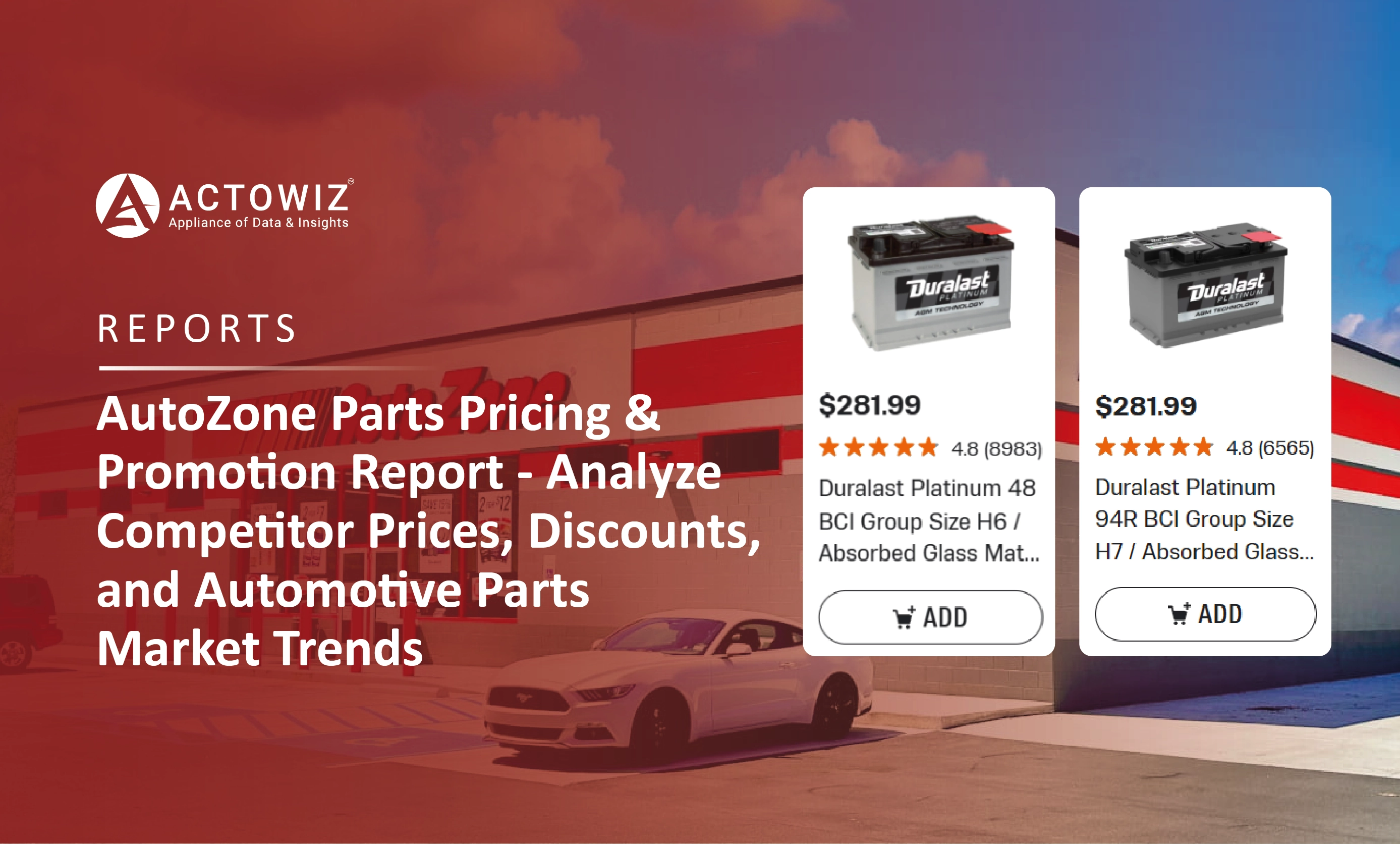
AutoZone Parts Pricing & Promotion Report - Analyze Competitor Prices, Discounts, and Automotive Parts Market Trends

The AutoZone Parts Pricing & Promotion Report tracks automotive parts prices, discounts, promotions, and competitor pricing trends.

Start Where It Makes Sense for You

Whether you're a startup or a Fortune 500 — we have the right plan for your data needs.

icons
Enterprise
Book a Strategy Call
Custom solutions, dedicated support, volume pricing for large-scale needs.
icons
Growing Brand
Get Free Sample Data
Try before you buy — 500 rows of real data, delivered in 2 hours. No strings.
icons
Just Exploring
View Plans & Pricing
Transparent plans from $500/mo. Find the right fit for your budget and scale.

Request Free Sample Data

Our team will reach out within 2 hours with 500 rows of real data — no credit card required.

+1 ▼
✓ Free 500-row sample · No credit card · Response within 2 hours