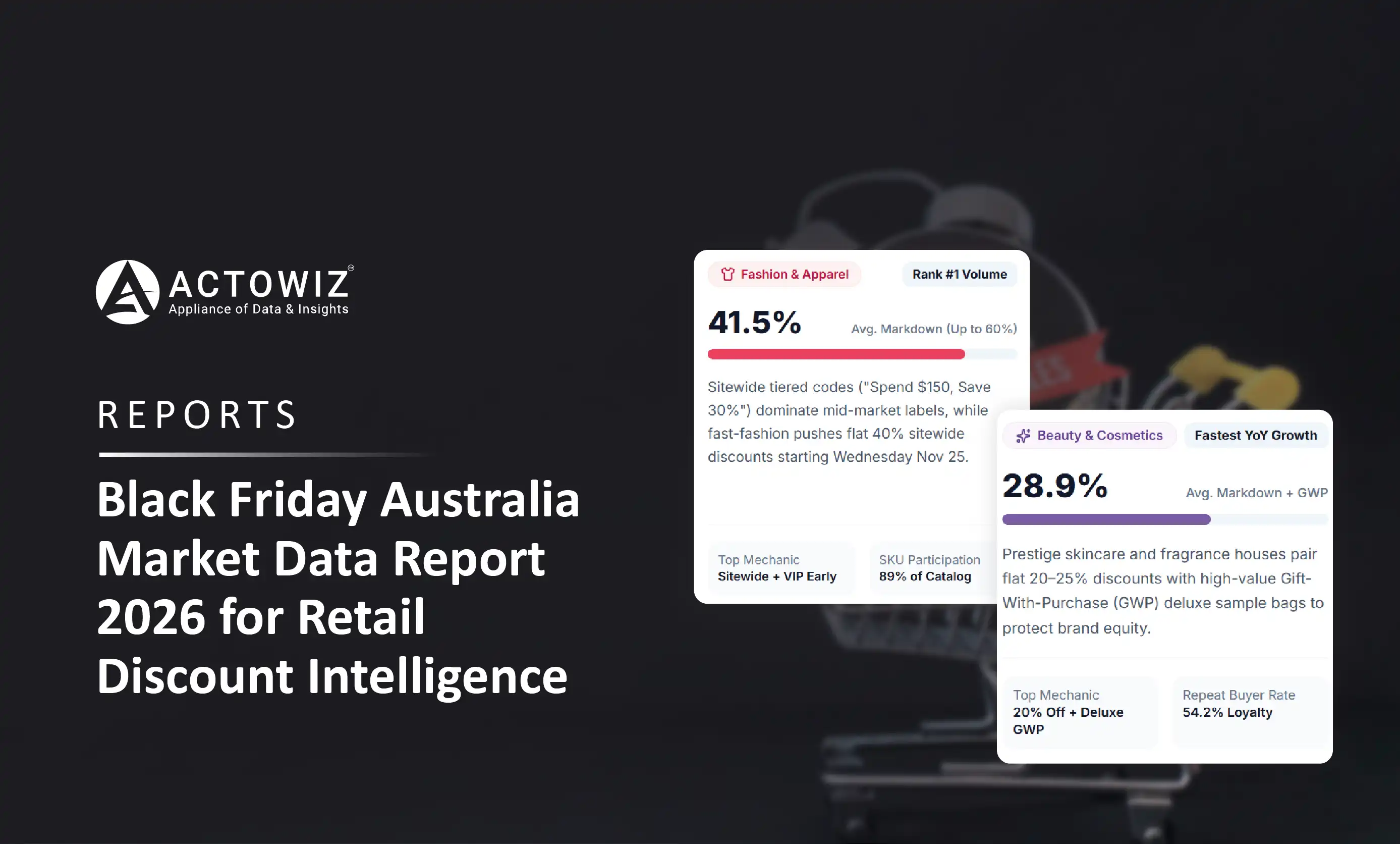
Black Friday 2026 Australia preview: spend trends, expected discount ranges by category, retailer list and ACCC pricing rules.
Black Friday 2026 in Australia falls on Friday 27 November, with Cyber Monday on 30 November. Most major retailers are expected to start sales from around Monday 23 November (Source: Mozo). Based on recent years, expect record-level spend, average online discounts in the low-to-mid 20% range, and closer ACCC checks on "was/now" claims.
This report is a preview. Black Friday has not happened yet, so it contains no live 2026 price data. Every figure below comes from a published source and is labelled as either a past result or "Estimate / forecast based on <sources>". Where no source publishes a number, we leave a placeholder for Actowiz tracked data.
The report is written for pricing, trading and brand teams that sell through Amazon.com.au, JB Hi-Fi, The Good Guys, Harvey Norman, Myer, David Jones, THE ICONIC, Kmart, Target, Big W, eBay AU, and grocers Coles and Woolworths. It sets out what the data says so far, how discounts may vary by category, and what to track during the sale.
Black Friday in Australia has grown each year in published forecasts. The Australian Retailers Association (ARA) and Roy Morgan forecast four-day Black Friday to Cyber Monday spend at $6.2 billion in 2022, rising to $6.8 billion in 2025. Bank card data for 2025 shows $23.8 billion spent over the wider two-week Black Friday period.
These are two different measures, so they should not be compared directly. The ARA and Roy Morgan figure is a pre-event forecast for the four-day weekend, based on a consumer survey. The CommBank iQ figure is an after-the-event total for a two-week window, based on de-identified transactions of about 7 million customers, and it covers all spending, including travel and services (Source: CommBank).
There is also a gap in the growth numbers. The ARA said the 2025 forecast of $6.8 billion was a 4% rise "on last year", yet its 2024 forecast was $6.7 billion, which would imply growth closer to 1.5%. The ARA did not publish its 2024 base in the 2025 release, so we show both figures and flag the range.
| Year | ARA / Roy Morgan BFCM forecast (4 days) | Stated growth | Other published measure | 2026 status |
|---|---|---|---|---|
| 2022 | $6.2 billion (25–28 Nov) | +$200 million on 2021 | – | – |
| 2023 | $6.36 billion (24–27 Nov) | +3.0% | Salesforce cited a ~30% average global discount | – |
| 2024 | $6.7 billion (29 Nov–2 Dec) | +5.5% | Salesforce AU average online discount 25% | – |
| 2025 | $6.8 billion (28 Nov–1 Dec) | +4% | CommBank iQ: $23.8 billion over two weeks, +4.6% YoY; Salesforce AU average discount 23%; Finder: $4.5 billion on Black Friday itself | – |
| 2026 | Not yet published as of 20 October 2026 | – | – | No Data |
Sources: ARA 2022 and 2023 releases; Roy Morgan 2024 and 2025 releases; CommBank iQ; Salesforce; Finder (full URLs in Sources).
Australia's Black Friday is led by electronics chains, department stores, discount department stores, fashion and the major marketplaces. ShopBack lists JB Hi-Fi, The Good Guys and Big W pages for 2026, and names Harvey Norman, Amazon Australia, Officeworks, Kmart, Myer and David Jones as other retailers with events (Source: ShopBack, 8 October 2026).
One change matters for anyone using older lists. Wesfarmers closed Catch.com.au, and the site stopped operating on 30 April 2025 (Source: Information Age / ACS). Some consumer guides still list Catch, so remove it from any 2026 tracking plan.
The CommBank data also shows where money moved in 2025. Marketplaces grew 7.3% year on year and apparel grew 5.3%, while department stores fell 0.5% and discount department stores fell 1.8% (Source: CommBank). That makes marketplace and fashion pricing especially worth watching in 2026.
| Retailer / marketplace | Main category focus | 2026 participation status | What to track |
|---|---|---|---|
| Amazon.com.au | All categories, devices | Listed by ShopBack and Mozo | Deal price, other sellers, coupons, Prime-only prices |
| JB Hi-Fi | TVs, laptops, phones, audio, gaming | 2026 Black Friday page live (ShopBack) | Price, "was" price, stock, bundles |
| The Good Guys | Appliances, TVs, kitchen | 2026 Black Friday page live (ShopBack) | Price, "was" price, delivery and installation |
| Harvey Norman | Electronics, furniture, appliances | Named by ShopBack and Mozo | Price, promo badges, finance offers |
| Myer / David Jones | Fashion, beauty, homewares | Named by ShopBack and Mozo | Sitewide claims, member-only prices |
| THE ICONIC | Fashion, footwear | No Data | Category-wide percentage claims |
| Kmart / Target AU | Value homewares, toys, apparel | Kmart named by ShopBack and Mozo | Price drops on key lines |
| Big W | Toys, gifts, entertainment | 2026 Black Friday page live (ShopBack) | Toy prices, early-deal dates |
| eBay AU | Marketplace, refurbished | Verify 2026 event | Listing price, delivery, condition |
| Coles / Woolworths | Grocery, household | Weekly specials; no Black Friday discount data published | Weekly specials, half-price lines |
| Catch.com.au | Closed 30 April 2025 | Not operating | Remove from tracking |
Expected Black Friday 2026 discounts in Australia range from about 25% to 50% on featured electronics, fashion and toys, while the average online discount across all products was 23–25% in the last two years. These are estimates based on ShopBack editorial ranges and Salesforce data, not guarantees.
Salesforce reported an average Australian online discount of 25% for Cyber Week 2024 and 23% for Cyber Week 2025 (Source: Salesforce). Its 2025 release describes 23% as a 4-point increase on the previous year, which does not match its own 2024 figure, so treat the overall average as a 23–25% range.
Category ranges are harder to source. The only published Australian ranges we found are ShopBack's "typical discount" estimates, which the author describes as editorial estimates based on prior sale events, with no dataset or method stated (Source: ShopBack sales comparison). Use them as a planning guide only, and replace them with tracked data after the sale.
| Category | Expected Black Friday 2026 discount | Label |
|---|---|---|
| All products, online average | 23%–25% | Estimate / forecast based on Salesforce Cyber Week 2024 and 2025 Australia data |
| Premium TVs | 30%–50% | Estimate / forecast based on ShopBack editorial ranges |
| Entry-level TVs and headphones | 25%–45% | Estimate / forecast based on ShopBack editorial ranges |
| International fashion | 30%–50% | Estimate / forecast based on ShopBack editorial ranges |
| Toys | 25%–50% | Estimate / forecast based on ShopBack editorial ranges |
| Laptops | No Black Friday range published (ShopBack gives 15%–25% for EOFY only) | No Data |
| Whitegoods and appliances | No Black Friday range published (ShopBack gives 20%–35% for EOFY only) | No Data |
| Beauty and skincare | No Australian Black Friday range published | No Data |
| Grocery (Coles / Woolworths) | No Black Friday discount data published | No Data |
Shopper intent supports a focus on fashion and electronics. In Finder's October 2025 survey, 68% of planned Black Friday shoppers intended to buy clothes or shoes and 44% electronics or gadgets (Source: Finder).
Price movement during Black Friday is best judged against each product's own price history, not against the "was" price on the page. That means collecting prices from early November, so the sale price can be compared with what shoppers actually paid in the weeks before.
Two recent ACCC actions show why. In June 2026, JB Hi-Fi began refunding more than $250,000 to about 200 consumers after the ACCC raised concerns that 17 products were shown as discounted from a higher price that was never offered, offered only briefly, or offered long before the promotion. The ACCC said the "was" prices were largely due to system or human error (Source: ACCC, 11 June 2026). In September 2026, digiDirect paid $99,000 in penalties over strikethrough discount claims on electronics, an issue the ACCC first noticed during a Black Friday sweep (Source: ACCC, 21 September 2026).
Availability matters as much as price. A deep discount on a product that sells out in the first hour gives a very different picture from a modest discount that stays in stock all weekend. Tracking stock status at the same time as price lets teams separate real price pressure from short "doorbuster" offers.
| Signal | Why it matters | Suggested cadence in sale week |
|---|---|---|
| Selling price | Core input for price index and deal depth | Several times a day on priority SKUs |
| "Was" / strikethrough price | Shows the claimed discount; compare with history | Daily, plus at each price change |
| Price history from early November | Tests whether the discount is real | Daily from collection start |
| Stock status | Separates real offers from quick sell-outs | Several times a day |
| Promo badge and end time | Checks timer and "ends soon" claims | At each collection run |
| Delivery and add-on charges | Shows total cost to the shopper | Daily |
The ACCC is the national regulator for misleading pricing in Australia. For Black Friday, it focuses on "was/now" and strikethrough prices, "up to X% off" claims, sitewide claims with hidden exclusions, fine print, and countdown timers that do not match the real sale length. Retailers should expect the same focus in 2026.
Before the 2025 sale, the ACCC put retailers on notice and said it would check these five areas (Source: ACCC, 10 November 2025). In April 2026 it reported that about half of 50 retailers it reviewed had made concerning claims, and that it had opened several investigations (Source: ACCC, 14 April 2026). Earlier, Michael Hill, MyHouse and Hairhouse each paid $19,800 over 2024 "sitewide" claims (Source: AAP via The Canberra Times).
Drip pricing rules are also tightening. The Competition and Consumer Amendment (Unfair Trading Practices) Act 2026 passed on 2 July 2026. It requires transaction-based charges to be shown next to the base price, and starts on 1 July 2027, so it will not apply to Black Friday 2026 (Source: Ashurst). Under current law, the ACCC says misleading conduct can lead to fines of up to $50 million if it goes to court (Source: AAP via The Canberra Times).
| ACCC focus area | What it looks for | What to track |
|---|---|---|
| Was/now and strikethrough prices | A "was" price never or rarely charged | Price history from collection start |
| "Up to X% off" | Few products actually at the top discount | Share of products at each discount level |
| Sitewide or storewide claims | Hidden product exclusions | Discount coverage across the range |
| Countdown timers and "3 days only" | Timers that reset or sales that run on | Promo start and end times |
| Fine print and member-only deals | Conditions that undercut the headline | Member vs non-member price |
| Drip pricing (from 1 July 2027) | Transaction fees not shown with base price | Fees added at checkout |
This section is general information, not legal advice.
Competitive position during Black Friday is measured by comparing the same products across retailers at the same time, then tracking how that position changes through the sale week. A price index, discount depth, stock share and promotion timing together show who is leading on price and who is following.
Online is growing faster than in-store. In the CommBank data, online spend rose 9.3% to $8 billion in the 2025 Black Friday fortnight, about a third of the total, while in-store rose 2.3% (Source: CommBank). Salesforce reported 7% online sales growth in Australia over Cyber Week 2025 (Source: Salesforce).
For grocery, Coles and Woolworths run weekly specials rather than a single Black Friday event, so the useful comparison is the specials cycle around late November against earlier weeks.
| Metric | Definition | 2026 value |
|---|---|---|
| Price index vs cheapest | Your price divided by the lowest matched competitor price | No Data |
| Average discount depth | Average gap between sale price and pre-sale tracked price | No Data |
| Share of genuine discounts | Share of "was" prices seen in tracked history | No Data |
| Out-of-stock rate | Share of promoted SKUs out of stock at each check | No Data |
| Sale start date by retailer | First day a Black Friday price is seen | No Data |
Black Friday 2026 in Australia is likely to follow the recent pattern: steady growth in spend, online sales growing faster than stores, and average online discounts around the low-to-mid 20% range, with deeper cuts on featured TVs, fashion and toys. These are estimates and forecasts based on published sources, and the 2026 ARA forecast had not been released at the time of writing.
The bigger shift is scrutiny. With recent ACCC action on "was" prices and timers, retailers and brands need tracked price history, not just the claimed discount. Download the research report or contact our sales team to set up tracking before the sale starts. We will update this report with live tracked data after the sale.
Black Friday 2026 is Friday 27 November and Cyber Monday is Monday 30 November. Most major retailers are expected to start sales from around Monday 23 November, and some run into early December (Source: Mozo).
The ARA and Roy Morgan forecast had not been published at 20 October 2026. For context, their 2025 forecast was $6.8 billion over four days, and CommBank iQ recorded $23.8 billion over the wider two-week 2025 period.
Estimate / forecast based on Salesforce and ShopBack: an average online discount of about 23–25%, with featured premium TVs at 30–50%, entry TVs and headphones at 25–45%, and fashion and toys at 25–50%.
No. Wesfarmers closed Catch.com.au and it stopped operating on 30 April 2025, so it should be removed from 2026 tracking lists.
It checks "was/now" and strikethrough prices, "up to X% off" claims, sitewide claims with exclusions, fine print and countdown timers. In its 2025 sweep, about half of 50 retailers reviewed made concerning claims.
After the sale. We will add tracked prices, discount depth and stock data from Actowiz collection once Black Friday and Cyber Monday 2026 are over.
Our web scraping expertise is relied on by 4,000+ global enterprises including Zomato, Tata Consumer, Subway, and Expedia — helping them turn web data into growth.
Watch how businesses like yours are using Actowiz data to drive growth.
From Zomato to Expedia — see why global leaders trust us with their data.
Backed by automation, data volume, and enterprise-grade scale — we help businesses from startups to Fortune 500s extract competitive insights across the USA, UK, UAE, and beyond.
We partner with agencies, system integrators, and technology platforms to deliver end-to-end solutions across the retail and digital shelf ecosystem.
Track your products on idealo (Germany) and Cdiscount (France): lowest offers, sellers, shipping and price history signals. A 2026 guide for EU brands.
Explore Restaurant & Menu Data from RestaurantGuru UK to analyze restaurant listings, menus, pricing, ratings, and dining trends.
Black Friday 2026 Australia preview: spend trends, expected discount ranges by category, retailer list and ACCC pricing rules.
Whether you're a startup or a Fortune 500 — we have the right plan for your data needs.