Introduction
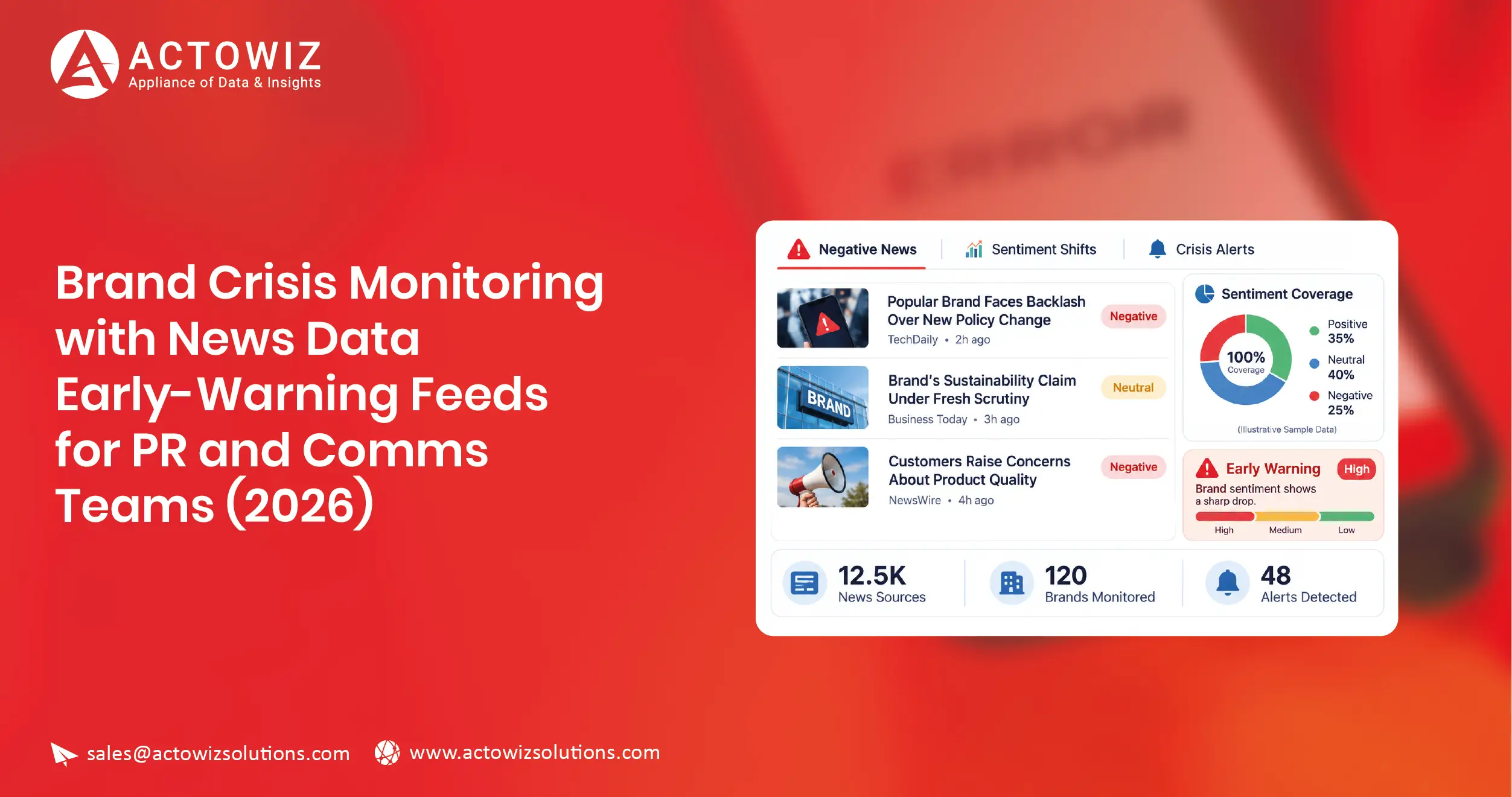
Brand crisis monitoring with news data means collecting public news articles about your brand, executives, products and industry on a fixed schedule, then scoring them for volume, tone and reach. PR and comms teams use the feed as an early-warning system, so they see a story building before it peaks. Google News and media data scraping services can help collect relevant public coverage for this monitoring process.
Most crises do not start on the front page. They start as one local report, a trade article, a regulator notice or a syndicated wire story that other outlets pick up hours later. Teams that watch the right sources at the right cadence get that time back.
This guide covers which news sources to watch, the fields a crisis feed needs, how to set baselines and alert thresholds, and how to turn alerts into a response plan.
Why early warning matters for PR teams
Disruption is now normal. PwC's Global Crisis and Resilience Survey of 1,812 business leaders in 42 countries found that 91% of organisations had faced at least one disruption other than the pandemic, with about three and a half disruptions on average over two years. 76% said their most serious disruption had a medium-to-high impact on operations (PwC press release, 10 April 2023).
For comms teams, that means:
- Less time to react. Stories move from one outlet to many through syndication and aggregators.
- More sources to cover. National press, trade titles, local outlets, wire services and international editions all matter.
- Leaders want evidence. Executives ask "how big is this?" A news feed with counts, outlets and trends answers that quickly.
- Recovery needs proof. After a crisis, the same data shows when coverage returned to normal.
News sources to monitor
| Source type |
What it gives you |
Speed |
Notes |
| Google News search and topic pages |
Broad coverage across many publishers |
Fast |
Good for discovery; results vary by country and language edition |
| Publisher sites and RSS feeds |
Full headline, summary, author, time |
Fast |
Pick the outlets that matter in your sector |
| Wire services |
First version of many stories |
Very fast |
Watch for syndication to many outlets |
| Trade and industry press |
Sector-specific issues, early signals |
Medium |
Often first to report supply, recall or regulator news |
| Regulator and court notice pages |
Recalls, fines, filings |
Medium |
Public notices only |
| Local and regional news |
Store, plant or incident-level stories |
Medium |
Many crises start locally |
Social platforms also matter, but this guide focuses on news. Many teams combine a news feed with their social listening tool. A structured news and media data collection process can help bring coverage from relevant public sources into one monitoring feed.
The data fields a crisis news feed needs
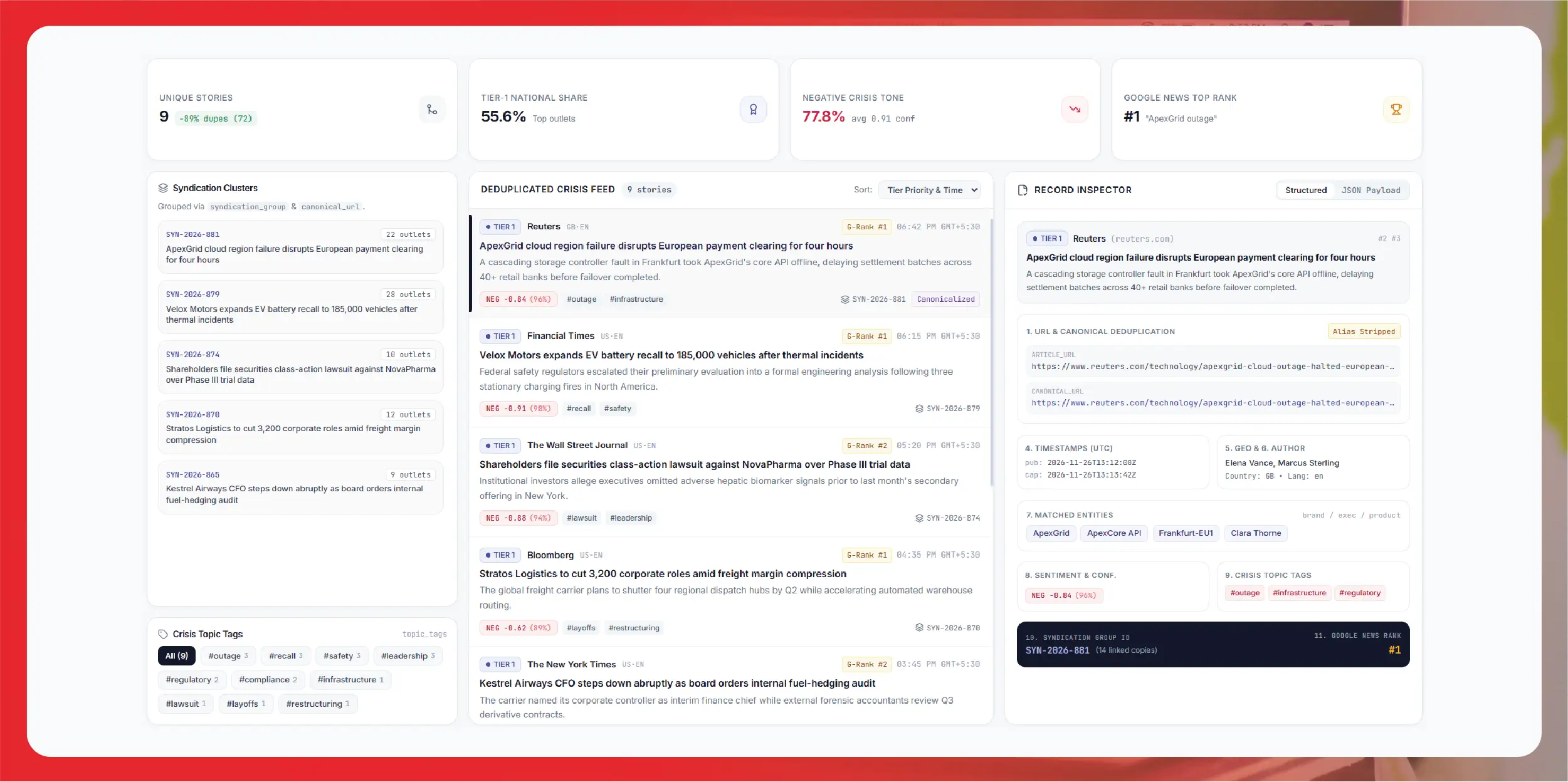
- article_url and canonical_url – to remove duplicates
- headline and summary – as published
- publisher and domain – mapped to an outlet tier you define
- published_at and captured_at – both timestamps, with time zone
- country and language
- author – byline as shown publicly
- matched_entities – brand, product, executive or topic keywords that matched
- sentiment_score – negative, neutral or positive, with a confidence value
- topic_tags – recall, lawsuit, outage, layoffs, leadership, safety and so on
- syndication_group – ID linking the same story across many outlets
- search_rank – position in Google News results for key queries, where tracked
Keep the outlet tier list in your own hands. A story in a top national title is not the same as a copy on a small aggregator.
How to set baselines and alert thresholds
Define your watch list. Brand names, product names, common misspellings, executive names, and a short list of risk words such as "recall", "breach", "lawsuit" or "outage". Add competitor and category terms for context.
Collect a baseline first. Agility PR Solutions suggests starting with 90 days of historical data (Agility PR, 16 March 2026). Use it to learn what a normal week looks like for volume and negative share.
Set a threshold. Agility PR's guidance is to set alerts at 20 to 30% above your weekly negative-mention average. Treat that as a starting point and tune it to your brand: a brand with steady coverage can use a tighter band; a brand with spiky news cycles may need a wider one.
Add speed triggers. Volume is not the only signal. Alert when the same story appears in several outlets within a short window, when a top-tier outlet covers a risk topic, or when a risk word appears with an executive's name.
Pick a cadence. Check priority sources every 15 to 60 minutes during working hours and at least hourly overnight for global brands. Lower-risk sources can be checked a few times a day. A daily news article data collection process across multiple websites can support scheduled monitoring across selected sources.
Route alerts. Send high-severity alerts to a named on-call person, and send a daily digest to the wider team.
From alert to response: a simple playbook
| Signal level |
Example in the data |
Response |
| Watch |
Negative share slightly above baseline, one low-tier outlet |
Log it, check facts, no public action |
| Alert |
Negative mentions 20–30% above weekly average, or one top-tier article |
Brief comms lead, prepare holding statement |
| Escalate |
Same story syndicated across many outlets within hours |
Convene crisis team, align legal and leadership |
| Crisis |
Top-tier coverage plus regulator or executive mention |
Publish statement, brief spokespeople, monitor hourly |
| Recovery |
Volume and negative share back near baseline |
Close the incident, review timeline and lessons |
Agility PR also recommends mapping out your five most likely crisis scenarios in advance. Pair each scenario with the keywords and sources that would show it first.
Use cases
- Early-warning alerts – spot a building story before it reaches national outlets.
- Executive reputation – track coverage of named leaders alongside the brand.
- Product recall and safety – watch trade press and regulator notices for your categories.
- Competitor crises – learn from how similar issues spread in your sector.
- Board and leadership reporting – show volume, tone and outlet mix in one weekly view.
- Post-crisis review – measure how long coverage lasted and when it returned to baseline.
Common mistakes in brand crisis monitoring
- No baseline. Without a normal week to compare against, every spike looks like a crisis or none does.
- Counting duplicates. Syndicated copies inflate volume; group them and count unique stories plus reach.
- Keyword lists that are too narrow. Missing product nicknames, misspellings or local-language names leaves gaps.
- Trusting sentiment scores blindly. Automated tone is a guide. Have a person review high-severity items.
- Slow cadence on priority sources. A daily check is too slow for wire and top-tier outlets.
- Alerts with no owner. Every alert level needs a named person and a clear next step.
A simple weekly news risk report
Even in quiet weeks, a short report keeps the feed useful and the team ready. Keep it to one page: total unique stories, negative share against the 90-day baseline, the top five outlets by coverage, any alerts raised and how they were closed, and the risk topics that grew most. Add one line on competitor or category stories that could spill over to your brand. Use the same layout every week so leaders can read trends at a glance, and attach the underlying article list for anyone who wants detail. Over time, these reports also show whether your thresholds are too loose or too tight.
Legal and compliance basics
Collect only publicly available news pages, headlines, summaries and metadata. Do not log in to paywalled content or bypass access controls, and respect each publisher's terms and robots rules. Store links and short summaries rather than republishing full articles. Do not build profiles of private individuals; focus on your brand, products and public figures in their public roles.
Build vs buy
Setting up a few Google Alerts is easy. Running a reliable feed is harder: many sources, de-duplication, syndication grouping, time zones, sentiment checks and alerts that fire at 2 a.m. when they should. Actowiz Solutions delivers news monitoring data from Google News, publisher sites and public feeds as CSV, JSON, dashboard or API, with the cadence and alert rules you set. Source counts, such as [Insert Actowiz dataset value] outlets per market, are confirmed per project. For teams evaluating collection methods, AI-powered news article scraping with Python is another relevant resource for understanding automated news collection.
Frequently Asked Questions
What is brand crisis monitoring?
It is the ongoing tracking of news and media coverage about a brand to spot negative stories early and support a fast, informed response.
Which news sources should we monitor?
Google News, the publishers that matter in your sector, wire services, trade press, regulator notice pages and local outlets near your sites.
How do we set an alert threshold?
Build a 90-day baseline, then start with alerts at 20 to 30% above your weekly negative-mention average, as Agility PR suggests, and tune from there.
How often should news be collected?
Every 15 to 60 minutes for priority sources, and a few times a day for lower-risk sources.
Can past news coverage be included?
Public articles that are still online can often be collected for a baseline. Your own tracking history, such as alerts and scores, builds from the start of collection.
 Actowiz Solutions

 By industry
 Pricing & Promotions
 Brand & Intelligence
 Digital Shelf & Search
 Assortment
 For Retailers
 E-Commerce Dashboard
 Flipkart Insights (Live)
 Grocery Intelligence
.svg) Grocery Price (U.S.)
.svg) Quick Commerce (India)
 Food & Restaurant
 Fashion Intelligence
 Automotive
 Travel & Hospitality
 Real Estate
 Food Delivery Intelligence
 OTT & Streaming
 Fuel & EV Charging Price Tracker
 By Use Case
 Pricing Intelligence
 Digital Shelf Analytics
 MAP Monitoring
 Cross-Border Price Parity
 Share of Search
 Review Sentiment
 Kitchen Market Gaps
 Dynamic Pricing / AI Repricing
 Promotions & Deals Alerts
 B2B / POI & Lead Data
 AI Search Visibility Dashboard
 Baby Products on Quick Commerce
 Hotel & Flight Rate Parity
 By Region
 Flipkart Real-Time Insights
 Quick Commerce — Zepto · Blinkit
 Pincode Price Tracker
 GCC Q-Commerce — Talabat · Noon
 UK Grocery — Tesco, Sainsbury's, Asda
 AU Grocery — Coles & Woolworths
 Marketplace Scrapers
 Developer APIs
 Universal APIs
 Delivery & SDKs
 Knowledge Center
 Guides & Playbooks
 Downloads & Tools
 Trust & Company







































 4.8/5 Average Rating
 50+ Video Testimonials
 92% Client Retention
 50+ Countries Served