Introduction
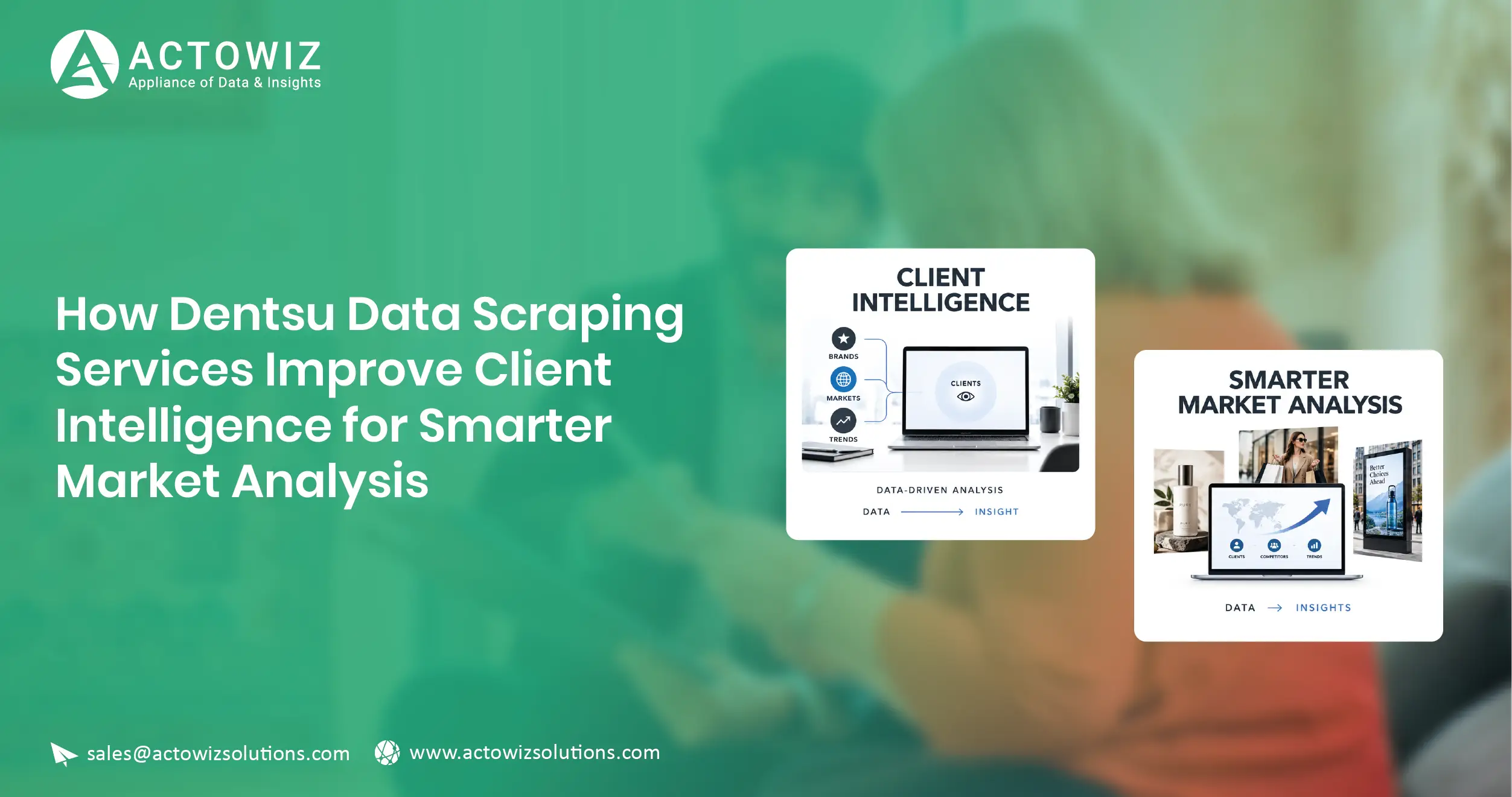
Businesses cannot build reliable client strategies from fragmented market
information. Dentsu Data Scraping Services can help agencies and enterprises collect structured
public web data covering competitors, products, prices, campaigns, customer sentiment, digital
channels, and market movements, turning scattered information into actionable intelligence.
Modern marketing decisions increasingly depend on timely external data. WARC
forecasts the global advertising market to reach $1.19 trillion in 2025, with 2026 growth
forecast at 9.1%. It also expects Alphabet, Amazon, and Meta to account for 58% of global
advertising spend excluding China in 2026.
This concentration makes competitive monitoring more important for agencies managing
multiple clients and channels. A strong Data Intelligence
Services workflow can collect,
normalize, validate, and organize external market signals so analysts spend less time gathering
information and more time interpreting it.
The core question is straightforward: How can marketing teams improve client
intelligence? The answer is to combine repeatable web and digital data collection with
historical storage, entity matching, analytics, dashboards, and automated monitoring. This
creates a consistent evidence layer for market analysis.
Dentsu itself describes an increasingly client-centric and AI-driven operating
direction in its 2026 Integrated Report, including an AI-native operating model and stronger
client growth focus.
For agencies, the opportunity is not simply collecting more information. It is
creating a reliable external-data layer that connects market activity with client-specific
business questions.
What Makes External Market Data Valuable for Client Intelligence?
Client intelligence becomes more useful when internal CRM, campaign, sales, and
customer information can be evaluated alongside relevant external signals.
A marketing team may already know how its client's campaigns are performing.
However, it may not know:
- What competitors are promoting.
- Which products competitors are emphasizing.
- How competitor prices are changing.
- Which customer complaints are increasing.
- Which keywords are gaining visibility.
- How competitors position products.
- Which channels are becoming more active.
- What new offers are entering the market.
- How category-level demand is changing.
External data fills these gaps.
Core Data Categories
| Data Category |
Example Information |
Client Intelligence Use |
| Competitor Data |
Products, prices, offers |
Competitive benchmarking |
| Customer Data |
Reviews, ratings, feedback |
Sentiment analysis |
| Product Data |
Features, categories, availability |
Product intelligence |
| Advertising Data |
Campaign messages, placements |
Messaging analysis |
| Content Data |
Articles, landing pages, social content |
Content benchmarking |
| Market Data |
Trends, categories, demand signals |
Market sizing |
| Pricing Data |
Discounts and price movements |
Pricing strategy |
| Seller Data |
Sellers, assortment, ratings |
Marketplace analysis |
The result is a more complete view of the environment surrounding a client.
How Can Structured Marketing Data Improve Client Understanding?
Dentsu Marketing Data intelligence can be designed around the information agencies
need to understand a client's competitive and market environment.
Marketing data becomes significantly more valuable when it is standardized. Consider
competitor pricing. One source may show "$49.99," another "$50," and another "$45 after
discount." Without normalization, analysts may incorrectly interpret these values as unrelated
records.
A structured pipeline can standardize:
- Currency
- Product names
- Categories
- Brand names
- Competitor identities
- Prices
- Discounts
- Dates
- Locations
- URLs
- Product identifiers
- Availability
This creates a common analytical structure.
Example Marketing Intelligence Dataset
| Field |
Example |
Analytical Purpose |
| Brand |
Example Brand |
Brand benchmarking |
| Product |
Running Shoes |
Product comparison |
| Category |
Footwear |
Category analysis |
| Current Price |
$79 |
Pricing benchmark |
| Previous Price |
$89 |
Price-change tracking |
| Discount |
11.2% |
Promotion analysis |
| Availability |
In Stock |
Supply monitoring |
| Rating |
4.5/5 |
Customer perception |
| Review Count |
1,250 |
Engagement indicator |
| Date Captured |
2026-09-22 |
Historical analysis |
For agencies, this structure makes it easier to create repeatable reports.
Instead of asking analysts to manually research competitors every week, a scheduled
collection system can produce standardized snapshots. Analysts can then focus on interpretation.
Three Intelligence Layers
Layer 1 — Collection: Gather relevant public information.
Layer 2 — Enrichment: Normalize, categorize, match, and validate records.
Layer 3 — Intelligence: Calculate changes, identify patterns, and generate
client-ready insights.
This distinction is important because raw scraping alone does not create business
intelligence. The analytical value comes from transforming raw information into a usable
decision framework.
How Can Agencies Build a Broader View of Client Markets?
Web Data for Client Data intelligence can connect client research with information
published across competitor websites, marketplaces, review platforms, news sources, public
catalogs, and other accessible digital properties.
For example, an agency working with a consumer electronics client may monitor:
- Competitor product launches
- Product specifications
- Prices
- Discounts
- Stock status
- Customer reviews
- Ratings
- Product bundles
- Warranty information
- Promotional messaging
The same framework can be adapted for travel, automotive, retail, healthcare,
finance, hospitality, real estate, and B2B markets, subject to source availability and
applicable access requirements.
Example Cross-Source Intelligence
| Source Type |
Data Collected |
Possible Insight |
| Competitor Website |
Products and pricing |
Competitive positioning |
| Marketplace |
Listings and sellers |
Assortment comparison |
| Review Platform |
Ratings and reviews |
Customer sentiment |
| Search Results |
Visibility signals |
Discovery trends |
| News Website |
Company announcements |
Market developments |
| Public Catalog |
Product attributes |
Catalog comparison |
| Social Platform |
Public content signals |
Topic monitoring |
This broader view can reveal gaps that internal client data cannot explain.
For example, if a client's sales decline in one category, external data can help
investigate whether competitors launched new products, reduced prices, increased promotions,
expanded assortment, or gained customer attention.
Why Data Freshness Matters
Marketing environments can change quickly. A competitor can change a price today,
introduce a promotion tomorrow, and remove it several days later.
A monthly report may miss these events.
For strategic planning, historical monthly snapshots can still be useful. For
pricing and campaign monitoring, daily or more frequent collection may be more appropriate.
The correct refresh frequency should therefore depend on the business question
rather than applying the same schedule to every dataset.
How Can Agencies Connect Market Signals With Campaign Decisions?
Digital Marketing Data Analytics combines collected external information with
campaign, audience, product, and performance data to create a more complete analytical picture.
WARC's 2026 marketer research shows how important data and AI have become to
marketing workflows. Its survey reports that 74% of marketers use AI for competitor and category
analysis, while 60% use it for customer insights.
This creates a practical requirement for agencies: AI and analytics systems need
usable, structured data.
Example Analytical Framework
| Business Question |
External Data |
Internal Data |
Output |
| Why is conversion declining? |
Competitor offers |
Conversion rate |
Competitive diagnosis |
| Is pricing competitive? |
Competitor prices |
Client prices |
Price gap |
| Which products are gaining attention? |
Product activity |
Sales data |
Product opportunity |
| Are customers dissatisfied? |
Reviews |
Support tickets |
Issue comparison |
| Which competitors are expanding? |
Product/catalog changes |
Client assortment |
Market expansion signal |
| Which campaigns need adjustment? |
Competitor messaging |
Campaign results |
Messaging analysis |
A useful analytical model should distinguish correlation from causation. If a
competitor reduces price and a client's sales decline at the same time, that does not
automatically prove the price reduction caused the decline. It is a signal requiring further
investigation.
This is especially important when presenting client-facing insights.
Useful Marketing KPIs
- Competitor price gap
- Share of monitored listings
- Promotion frequency
- Product availability rate
- Review sentiment
- Rating distribution
- New-product frequency
- Content-publishing frequency
- Campaign message overlap
- Category growth
- Competitor assortment expansion
These metrics can be incorporated into client dashboards and recurring reports.
What Does an Agency-Ready Data Collection Workflow Look Like?
web data scraping for marketing agencies needs to support multiple clients,
industries, sources, data formats, and refresh schedules without creating excessive manual
workload.
A scalable workflow begins with client-specific requirements.
For Client A, the priority may be competitor pricing.
For Client B, the focus may be product assortment.
For Client C, the requirement may be customer reviews.
For Client D, the agency may need marketplace seller intelligence.
A reusable data architecture allows these requirements to coexist while maintaining
separate datasets.
Scalable Workflow
| Stage |
Activity |
Output |
| Requirement Mapping |
Identify sources and fields |
Data specification |
| Source Discovery |
Select relevant public sources |
Source list |
| Collection |
Gather records |
Raw dataset |
| Parsing |
Extract structured fields |
Structured records |
| Cleaning |
Remove errors and duplicates |
Clean dataset |
| Normalization |
Standardize values |
Comparable data |
| Validation |
Check quality |
Validated dataset |
| Storage |
Preserve historical snapshots |
Data repository |
| Analytics |
Calculate KPIs |
Intelligence layer |
| Delivery |
Dashboard/API/files |
Client-ready output |
This architecture can reduce repetitive research.
It also enables agencies to create standardized client reporting templates.
Agency Benefits
Faster research: Automated collection reduces repetitive manual browsing.
Consistent methodology: The same validation and normalization rules can be applied
across projects.
Historical visibility: Dated records enable trend analysis.
Scalable reporting: One data pipeline can support recurring reports.
Custom segmentation: Data can be filtered by geography, category, competitor, brand,
product, or other project-specific dimensions.
Better client conversations: Analysts can discuss observable market changes using
structured evidence rather than anecdotal observations.
How Should Client Data Be Analyzed for Strategic Decisions?
Client Intelligence Data Analysis should move beyond simple counts and dashboards.
The objective is to explain what changed, where it changed, and why the change may matter to the
client.
A practical analytical framework has four stages.
1. Descriptive Analysis
This answers:
- What happened?
- How many products changed?
- Which competitors changed prices?
- Which categories expanded?
- How many new listings appeared?
2. Diagnostic Analysis
This asks:
- Why did the change occur?
- Was the movement isolated?
- Did multiple competitors make similar changes?
- Was the change seasonal?
- Did product availability change?
3. Comparative Analysis
This evaluates:
- Client vs competitor
- Current vs historical
- Category vs category
- Product vs product
- Market vs market
4. Action-Oriented Analysis
This converts findings into business questions:
- Should the client investigate pricing?
- Should a category receive more attention?
- Is an assortment gap emerging?
- Are customer complaints increasing?
- Is a competitor expanding into a new segment?
Example Intelligence Scorecard
| Metric |
Previous Period |
Current Period |
Change |
| Competitor Listings |
10,000 |
11,500 |
+15% |
| Average Price |
$82 |
$79 |
-3.7% |
| Promotions |
1,200 |
1,480 |
+23.3% |
| Average Rating |
4.2 |
4.3 |
+2.4% |
| New Products |
450 |
620 |
+37.8% |
| Out-of-Stock Rate |
8% |
6% |
-2 pp |
The value comes from connecting these metrics.
For example, an increase in competitor listings combined with increased promotions
could indicate a more competitive category. However, the agency should validate the finding
against seasonality, campaign calendars, product launches, and other relevant factors.
How Can Automation Make Competitive Research More Efficient?
AI-Powered Scraping can support large-scale
data workflows by helping automate
classification, entity matching, categorization, anomaly detection, summarization, and pattern
identification.
The role of AI should complement—not replace—data validation.
For example, an AI-assisted workflow can help classify thousands of product titles
into standardized categories. It can also identify similar product descriptions across different
websites or summarize recurring customer-review themes.
WARC reports that marketers are increasingly using AI for competitor/category
analysis and customer insights, demonstrating the growing role of AI in marketing intelligence
workflows.
AI-Assisted Data Pipeline
| AI Function |
Example |
| Classification |
Categorize product listings |
| Entity Matching |
Match similar competitor products |
| Sentiment Analysis |
Classify review themes |
| Summarization |
Summarize competitor campaigns |
| Anomaly Detection |
Flag unusual price movements |
| Trend Detection |
Identify recurring market patterns |
| Data Enrichment |
Add structured categories |
| Query Assistance |
Generate analytical questions |
Dentsu's 2026 Integrated Report also identifies AI-driven business transformation
and an AI-native operating model as part of its strategic direction.
The practical implication for agencies is significant. A modern pipeline can combine
automated collection with AI-supported processing and human review.
Example Automated Alert
Condition: Competitor price falls by more than 15%.
Action: Validate the price change.
Enrichment: Identify product, category, competitor, previous price, current price,
and timestamp.
Output: Send an alert to the relevant analyst.
This converts a large dataset into an actionable workflow.
What Changed Between 2020 and 2026?
From 2020 to 2026, marketing intelligence shifted from periodic research toward more
continuous, data-rich monitoring. In 2020, many teams still relied heavily on campaign reports,
surveys, manually compiled competitor spreadsheets, and periodic market studies. As digital
channels expanded, agencies increasingly needed structured information from websites,
marketplaces, review platforms, social environments, and other online sources. WARC reports that
global advertising growth has consistently outpaced GDP growth since 2021, reflecting the
expanding importance of advertising and digital channels. By 2025, WARC forecast global
advertising expenditure at $1.19 trillion, with digital advertising accounting for more than 81%
of total spend. Social advertising alone was forecast at $286.2 billion in 2025 and expected to
exceed $300 billion in 2026. At the same time, AI moved from experimentation toward practical
marketing applications. WARC's 2026 marketer research found competitor/category analysis and
customer insights among the leading AI use cases. Dentsu's 2026 strategy also highlights
AI-driven transformation and an AI-native operating model. These developments have increased the
value of continuously updated external data. In 2026, client intelligence increasingly requires
structured, historical, machine-readable information that can feed dashboards, analytics
systems, AI workflows, and client reporting.
How Can Actowiz Solutions Help?
Actowiz Solutions can design customized data collection and intelligence workflows
for agencies, brands, research organizations, and enterprises that need structured
external-market information.
Dentsu Data Scraping Services can be configured around specific sources, fields,
competitors, categories, regions, refresh schedules, and delivery requirements.
The workflow can include:
- Source identification
- Automated data collection
- Data parsing
- Data cleaning
- Deduplication
- Entity matching
- Product categorization
- Price normalization
- Review analysis
- Historical storage
- Quality validation
- Dashboard integration
- API delivery
A Web Scraping API can also provide structured
records to internal systems where
API-based delivery is more practical than recurring file exports.
Example Solution Architecture
| Component |
Purpose |
| Data Sources |
Websites, marketplaces, public digital sources |
| Scraping Layer |
Automated collection |
| Processing Layer |
Parsing and normalization |
| Validation Layer |
Accuracy and completeness checks |
| Storage Layer |
Historical data |
| Intelligence Layer |
KPIs and trend calculations |
| API Layer |
Programmatic delivery |
| Dashboard |
Visualization and reporting |
| Alerting |
Significant-change notifications |
Actowiz Solutions can also tailor the output according to the client's analytical
environment. Depending on the project, structured data may be delivered through CSV, Excel,
JSON, database environments, APIs, or customized datasets.
For agencies, this can make external research more repeatable. Instead of rebuilding
the same competitor research manually for every reporting cycle, teams can establish a
structured collection process and refresh the underlying dataset according to business
requirements.
Why Does Historical Data Matter for Marketing Intelligence?
Historical data provides context that current snapshots cannot.
A competitor's current price tells an analyst the current state. A six-month history
can show whether that price is normal, seasonal, promotional, or unusual.
Historical records can support:
- Month-over-month comparisons
- Competitor trend analysis
- Campaign benchmarking
- Product lifecycle monitoring
- Price movement analysis
- Review sentiment tracking
- Category growth analysis
- Assortment changes
- Market-entry monitoring
- Client performance comparisons
The appropriate historical depth depends on the business question.
A fast-moving pricing project may require daily observations. A strategic market
study may work with weekly or monthly snapshots.
What Are the Main Benefits for Marketing Agencies?
A well-designed external-data pipeline can solve several recurring agency problems.
| Challenge |
Data-Driven Approach |
Potential Outcome |
| Manual competitor research |
Automated collection |
Less repetitive work |
| Fragmented sources |
Unified schema |
Easier comparison |
| Outdated reports |
Scheduled refreshes |
More current insights |
| Unstructured information |
Normalization |
Better analysis |
| No historical context |
Time-series storage |
Trend visibility |
| Large datasets |
Automated processing |
Scalable research |
| Difficult client reporting |
Dashboards/API |
Faster reporting |
| Repetitive analysis |
AI-assisted processing |
Higher analyst productivity |
The goal is not to collect every available piece of information. It is to collect
the information that directly supports the client's business questions.
That distinction helps control costs, improve data quality, and make reports more
relevant.
Conclusion
Client intelligence is strongest when marketing teams can combine internal
performance information with structured external market signals. Competitor prices, product
changes, reviews, promotions, content activity, and category movements can provide valuable
context for understanding client performance.
The Dentsu Data Scraping Services approach can support this process by turning
publicly accessible online information into structured, historical, analytics-ready datasets.
For agencies, the key advantage is repeatability. Data can be collected according to
defined schedules, standardized across sources, validated, stored historically, and delivered to
dashboards or analytical systems.
Web Scraping, Mobile App Scraping, and a Real-time
dataset can support different data requirements
depending on the sources, use case, and desired refresh frequency.
Actowiz Solutions helps businesses build customized data collection workflows
designed around their specific market intelligence requirements.
You can also reach us for all your mobile app
scraping, data collection, web scraping, and instant data scraper service requirements!

 By industry🏷 By platform🌐 By market
 Pricing & Promotions
MAP Violations Brand Protection Counterfeit Detection Price Intelligence AI HOT Data Intelligence
Pricing & Promotions
MAP Violations Brand Protection Counterfeit Detection Price Intelligence AI HOT Data Intelligence Brand & Intelligence
Share of Search Content Audit & PDP Reviews & Ratings Retail Media Buy Box Monitoring Social Commerce HOT Live Commerce NEW Agentic Commerce NEW
Brand & Intelligence
Share of Search Content Audit & PDP Reviews & Ratings Retail Media Buy Box Monitoring Social Commerce HOT Live Commerce NEW Agentic Commerce NEW Digital Shelf & Search
Assortment Planning Competitive Benchmarking Product Availability Q-Commerce NEW
Digital Shelf & Search
Assortment Planning Competitive Benchmarking Product Availability Q-Commerce NEW AssortmentE-commerce Intelligence Hyperlocal Insights POI & Store Locator DTC Brand Analytics NEW
 For Retailers
 E-Commerce Dashboard
 Flipkart Insights (Live) #1
 Grocery Intelligence
.svg) Grocery Price (U.S.)
Grocery Price (U.S.)
.svg) Quick Commerce (India) HOT
Quick Commerce (India) HOT
 Food & Restaurant
 Fashion Intelligence
 Automotive
 Travel & Hospitality
 Real Estate
 Food Delivery Intelligence NEW
 OTT & Streaming NEW
 Fuel & EV Charging Price Tracker NEW
 By Use Case
 Pricing Intelligence
 Digital Shelf Analytics
 MAP Monitoring HOT
 Cross-Border Price Parity NEW
 Share of Search
 Review Sentiment
 Kitchen Market Gaps NEW
 Dynamic Pricing / AI Repricing NEW
 Promotions & Deals Alerts NEW
 B2B / POI & Lead Data NEW
 AI Search Visibility Dashboard NEW
 Baby Products on Quick Commerce NEW
 Hotel & Flight Rate Parity NEW
 By Region🇮🇳 India 🇺🇸 USA 🇦🇪 Middle East 🇬🇧 UK 🇦🇺 Australia 🌏 SE Asia 🇪🇺 Europe 🌎 LATAMIndia
 Flipkart Real-Time Insights
 Quick Commerce — Zepto · Blinkit
 Pincode Price Tracker
Middle East
Pincode Price Tracker
Middle East GCC Q-Commerce — Talabat · Noon NEW
UK & Australia
GCC Q-Commerce — Talabat · Noon NEW
UK & Australia UK Grocery — Tesco, Sainsbury's, Asda
 AU Grocery — Coles & Woolworths NEW
 Marketplace Scrapers
Amazon API TikTok Shop API HOT Uber Eats API Airbnb API Zepto / Blinkit API Instacart API NEW Talabat API NEW
Marketplace Scrapers
Amazon API TikTok Shop API HOT Uber Eats API Airbnb API Zepto / Blinkit API Instacart API NEW Talabat API NEW Developer APIsWeb Extract API Reviews API SERP API Pricing Webhook NEW
 Universal APIsStreaming Crawl API Scheduler Realtime Alerts Webhook Delivery 🐍 Python SDK 💚 Node.js SDK
 Delivery & SDKs
 Knowledge Center
Digital Shelf Playbook MAP Compliance Guide Pricing Intel Guide Scraping Compliance TikTok Shop Guide NEW Cross-Border Guide NEW
Knowledge Center
Digital Shelf Playbook MAP Compliance Guide Pricing Intel Guide Scraping Compliance TikTok Shop Guide NEW Cross-Border Guide NEW Guides & Playbooks
🎉 Seasonal & event tracking NEWBlack Friday pricing report Festive season, India Ramadan, GCC grocery All seasonal reportsSample Datasets HOT ROI Calculator NEW API Postman Collection Demo Dashboards Free API Playground NEW Press Kit
Guides & Playbooks
🎉 Seasonal & event tracking NEWBlack Friday pricing report Festive season, India Ramadan, GCC grocery All seasonal reportsSample Datasets HOT ROI Calculator NEW API Postman Collection Demo Dashboards Free API Playground NEW Press Kit Downloads & Tools
Trust Center About Us FAQs Careers
Downloads & Tools
Trust Center About Us FAQs Careers Trust & CompanyRetail shelf research NEWRetail shelf research






































 4.8/5 Average Rating
 50+ Video Testimonials
 92% Client Retention
 50+ Countries Served