Introduction
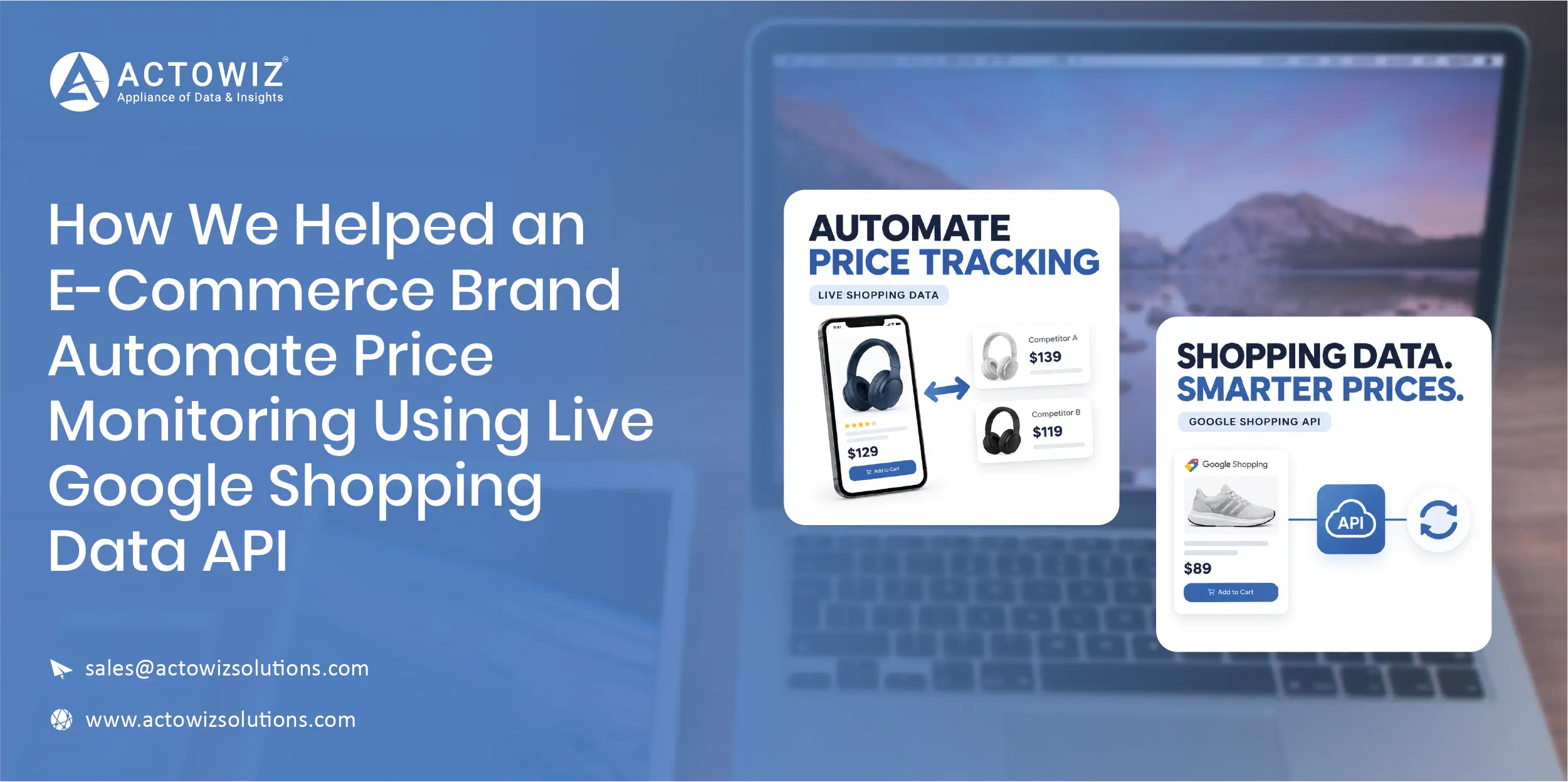
An e-commerce brand competing across multiple product categories needs timely visibility into competitor prices, product availability, sellers, and marketplace positioning. In this representative engagement, Actowiz Solutions helped an e-commerce brand automate its price-monitoring workflow using Live Google Shopping Data API and a structured approach to Scrape Google Shopping & Marketplace Data.
The client was previously dependent on manual product searches and spreadsheet updates to identify pricing changes. This process was time-consuming and made it difficult to maintain historical price records across a growing product universe.
Actowiz Solutions designed a scalable data collection workflow that organized product titles, SKUs, prices, sellers, availability, product URLs, ratings, and other relevant shopping attributes into structured records.
The objective was to give the client's pricing and product teams a more consistent data foundation for competitive monitoring. By automating repetitive collection and introducing timestamp-based records, the workflow was designed to improve price visibility, reduce manual research, and support faster commercial analysis.
About the Client
The client was a growing e-commerce brand operating in a highly competitive online retail environment. Its target customers regularly compared products, prices, offers, ratings, and seller information before making purchasing decisions.
The company managed a broad product assortment and competed against multiple brands and sellers offering similar products through online shopping channels. As the catalog expanded, its pricing team needed a reliable way to understand how competitor prices changed over time.
The existing process relied heavily on manual searches. Analysts searched for selected products, copied competitor prices into spreadsheets, and periodically compared those values with internal pricing. This approach became increasingly difficult to scale.
The client therefore partnered with Actowiz Solutions to establish a structured product and pricing intelligence workflow.
A key requirement was Google Shopping SKU Data API, which enabled the solution to organize shopping observations around product identifiers and other matching attributes wherever available. This helped create a more consistent foundation for recurring product-level monitoring and competitive analysis.
Challenges & Objectives
What Challenges Did the Client Face?
- Manual price monitoring: Analysts spent significant time searching for products and recording competitor prices manually.
- Limited historical visibility: Previous price observations were not consistently retained, making it difficult to identify pricing trends.
- Product matching difficulties: Similar products could appear with different titles, sellers, or descriptions.
- Slow competitive analysis: Data preparation delayed pricing decisions and marketplace reporting.
What Were the Project Objectives?
- Automate price collection: Establish a recurring process for collecting relevant shopping information.
- Improve product matching: Organize product observations around SKUs and other available identifiers.
- Create historical price intelligence: Preserve timestamped observations for comparison and trend analysis.
- Support faster decisions: Deliver structured data that pricing and product teams could use in dashboards and reports.
The project was therefore designed to create an ongoing pricing intelligence process rather than a one-time product dataset.
Our Strategic Approach
1. How Did We Build the Product Monitoring Framework?
The first stage focused on creating a consistent data structure around the client's product universe. Product names, SKUs, categories, brands, prices, sellers, availability, ratings, URLs, and other relevant attributes were mapped into a standardized schema.
The collection workflow was designed around recurring observations. Each record could be associated with a timestamp so that current information could be compared with previous observations.
Normalization rules helped standardize product titles, numerical values, currencies, categories, and other fields. Where multiple listings represented the same or closely related products, matching logic could be applied using available product identifiers and relevant attributes.
This approach created a reusable foundation for price monitoring.
Rather than simply collecting individual search results, the workflow was structured around business questions such as:
- Which competitors changed prices?
- Which products became unavailable?
- Which products received discounts?
- Which categories showed significant price movement?
- How did competitor prices compare with internal prices?
This transformed raw shopping information into structured commercial intelligence.
2. How Did We Support Continuous Price Intelligence?
The second stage focused on recurring collection and historical analysis. The client required a workflow that could detect changes instead of simply showing the latest available value.
A Live Google Shopping product price and availability API workflow could support recurring observations of product pricing and availability fields where the source and access method permit.
The collected records were organized so analysts could compare:
- Current price versus previous price
- Original price versus discounted price
- Competitor price versus internal price
- Available versus unavailable status
- Seller-level pricing differences
- Category-level pricing movements
Timestamped data also allowed the team to identify pricing events and understand whether changes were temporary or sustained.
The workflow was designed to support downstream reporting and analytics rather than forcing analysts to repeatedly conduct manual searches.
Technical Roadblocks
1. Product Matching Across Shopping Results
The same or similar products can appear with different titles, descriptions, sellers, and URLs. Simple text matching can therefore produce duplicate or incorrect matches.
How it was handled: The workflow prioritized available product identifiers and combined them with normalized titles, brands, categories, specifications, and other relevant attributes to improve product matching.
2. Frequently Changing Search Results
Shopping results can change based on product availability, seller information, pricing, location, promotions, and other factors. A result observed during one collection cycle may not appear identically later.
How it was handled: The solution used timestamped observations and structured historical records. This allowed the client to analyze changes instead of treating each collection as an isolated snapshot.
3. Inconsistent Listing Attributes
Different sellers can present similar information in different formats. Prices, discounts, product names, ratings, and availability indicators may require normalization before analysis.
How it was handled: The workflow applied field-level validation and normalization rules. Records were checked for missing or malformed values before being prepared for downstream analytics.
The resulting Google Shopping product listings Data Extraction workflow was designed to emphasize consistency, traceability, and historical usability.
Our Solutions
Actowiz Solutions implemented a structured product and pricing intelligence workflow that connected product discovery, data extraction, normalization, validation, and recurring monitoring. The solution captured relevant product information such as product titles, SKUs, brands, categories, sellers, prices, discounts, ratings, availability, images, and URLs where available. Each observation could be timestamped, enabling the client to maintain a historical record rather than replacing previous values with new ones. The collected information was then normalized into an analytics-ready structure. Product matching rules helped associate recurring observations with the appropriate product records, while validation checks identified incomplete or inconsistent data. The resulting Google Shopping product catalog and pricing dataset could support competitive benchmarking, pricing analysis, product research, assortment monitoring, and reporting. The workflow was also designed to accommodate additional sources and fields as the client's requirements evolved, creating a scalable foundation for broader Ecommerce Data Scraping initiatives.
Results & Key Metrics
The representative engagement was designed to improve the efficiency, coverage, and consistency of the client's price-monitoring operations. The following KPIs illustrate the intended impact areas and should be replaced with verified production figures before being presented as actual client results.
1. Reduced Manual Research
Automating recurring product collection reduced the need for analysts to repeatedly search for products and manually transfer prices into spreadsheets.
2. Improved Monitoring Coverage
A structured workflow allowed the business to monitor a broader product universe than was practical through manual checks alone.
3. Faster Price Change Detection
Timestamped observations helped analysts identify price movements between collection cycles and prioritize products requiring attention.
4. Better Historical Visibility
Historical records enabled comparison between current and previous prices, supporting trend analysis and competitive benchmarking.
5. Improved Availability Intelligence
The solution also incorporated Google Shopping Live product availability, allowing product availability signals to be considered alongside price observations.
| KPI |
Previous Workflow |
Automated Workflow |
| Price collection |
Manual |
Automated |
| Product coverage |
Limited by analyst capacity |
Scalable |
| Historical records |
Inconsistent |
Timestamped |
| Price comparison |
Spreadsheet-based |
Structured dataset |
| Availability checks |
Manual |
Recurring monitoring |
| Reporting |
Manual consolidation |
Analytics-ready |
The broader architecture also supported Live Google Shopping Data API requirements by organizing shopping information into a reusable data layer.
Client Feedback
“The automated workflow gave our pricing team a more consistent view of marketplace changes. Instead of spending significant time collecting individual prices, the team could focus more on analyzing price movements and competitive patterns.”
— Representative Client Feedback, Head of E-commerce Pricing
The feedback reflects the intended business outcome of the engagement: reducing repetitive data collection while improving the availability and consistency of pricing information.
The resulting Pricing & Product Data structure provided a common foundation for product research, competitive benchmarking, pricing analysis, and management reporting.
Why Partner with Actowiz Solutions?
Actowiz Solutions combines data engineering, web data extraction, normalization, validation, and analytics-focused delivery to create customized e-commerce intelligence workflows.
1. Business-Centric Data Design
We design schemas around the client's specific business questions rather than collecting unnecessary information.
2. Scalable Collection
Workflows can be designed to support large product catalogs, recurring monitoring, and expanding data requirements.
3. Data Quality Controls
Normalization, validation, matching, and duplicate checks help improve the consistency of the resulting dataset.
4. Flexible Delivery
Structured information can be prepared for dashboards, databases, analytics platforms, APIs, or other downstream environments.
5. Custom Monitoring Requirements
Collection frequency and fields can be adapted according to pricing, product, availability, catalog, or competitive intelligence requirements.
For businesses looking for Ecommerce Data Scraping, Actowiz Solutions can develop customized workflows covering product catalogs, prices, sellers, availability, ratings, reviews, and marketplace information. The Live Google Shopping Data API architecture can similarly be adapted to the client's required data fields, monitoring frequency, and delivery format.
Conclusion
This representative case study demonstrates how an e-commerce brand can move from manual price checks toward a structured and scalable product intelligence workflow. By combining product information, pricing, availability, seller details, and historical observations, businesses can establish a stronger foundation for competitive monitoring.
Actowiz Solutions focuses on automation, data quality, normalization, recurring collection, and analytics-ready delivery.
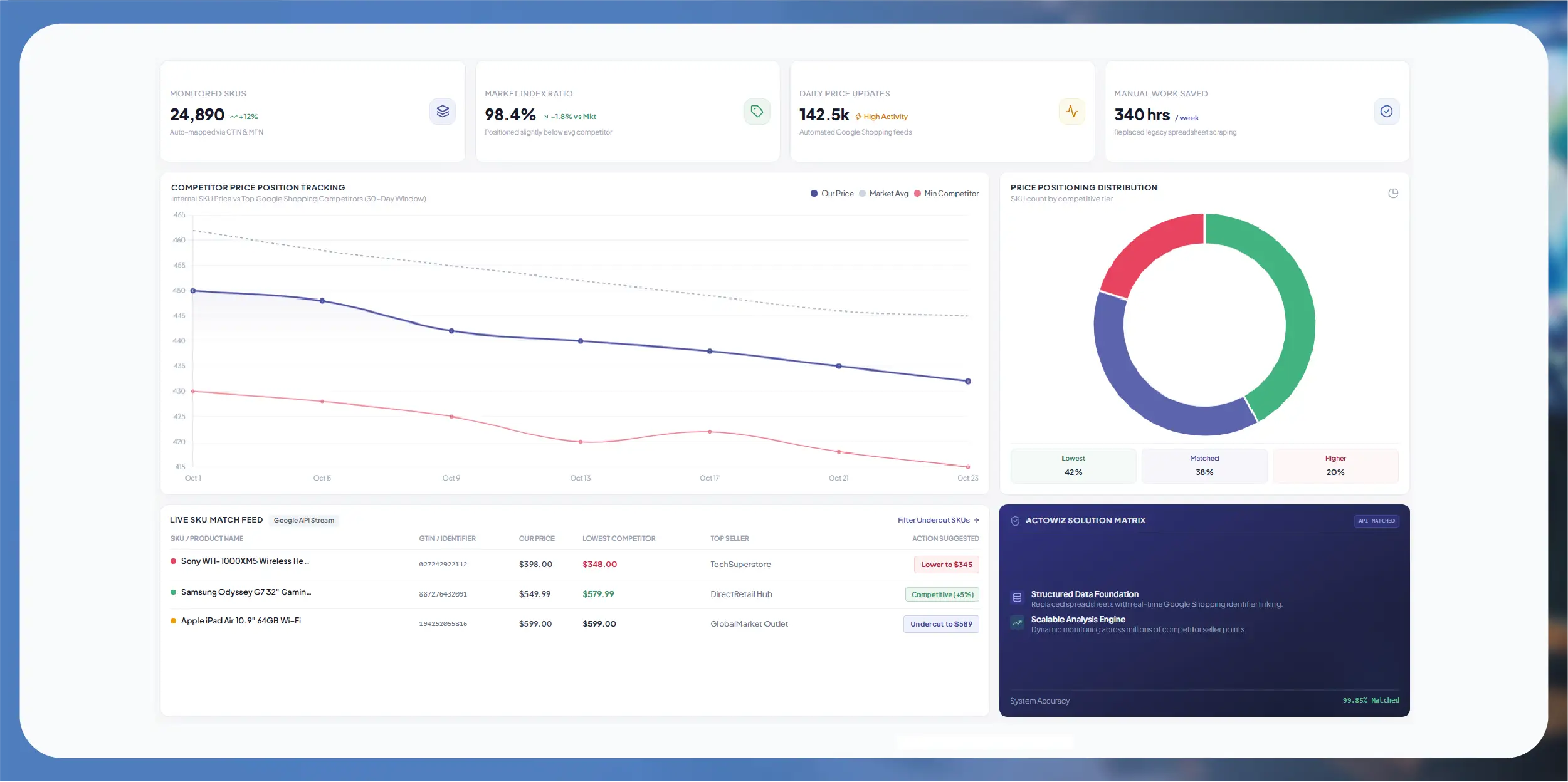
The resulting E-commerce Dashboard can bring product and pricing KPIs into a centralized environment. A Web scraping API can support automated data delivery, while Custom Datasets can address specific research requirements. Businesses can also use an instant data scraper approach for targeted extraction needs.
Ready to automate your e-commerce price monitoring? Contact Actowiz Solutions to discuss your product intelligence and marketplace data requirements!
FAQs
1. What is a Google Shopping data API used for?
A Google Shopping data API can be used to structure shopping information for applications such as product research, price monitoring, competitive intelligence, seller analysis, availability monitoring, and e-commerce analytics. Depending on the available source data and project requirements, fields may include product titles, prices, sellers, ratings, availability, product URLs, images, categories, and other attributes. Businesses can use these structured records to reduce manual research and support recurring monitoring workflows.
2. How does automated price monitoring help e-commerce brands?
Automated price monitoring allows businesses to collect pricing observations repeatedly instead of relying on occasional manual checks. When observations are stored with timestamps, teams can compare current prices against previous values and identify changes. This can support competitor benchmarking, internal pricing reviews, promotion analysis, and category-level research. Automation also reduces repetitive spreadsheet work and allows analysts to spend more time interpreting pricing patterns.
3. Can Google Shopping data be monitored over time?
Yes, recurring data collection can create a historical dataset where each observation is associated with a collection timestamp. This makes it possible to analyze price movements, availability changes, product additions, and other observable listing changes over time. Monitoring frequency should be determined according to the business requirement and the characteristics of the source.
4. What information can be included in a product pricing dataset?
A customized dataset can include product title, SKU or product identifier, brand, category, seller, current price, original price where available, discount, rating, review count, availability, product URL, image information, and collection timestamp. The exact schema should be based on the client's analytical requirements. Additional fields can be incorporated when they are available and relevant to the project.
5. Can Actowiz Solutions create customized shopping data workflows?
Yes. Actowiz Solutions can design customized workflows around specific product categories, markets, fields, collection frequencies, and delivery requirements. Data can be normalized and prepared for dashboards, databases, APIs, research workflows, or other analytics environments. A project can also combine product, pricing, availability, seller, and promotional information to create a broader e-commerce intelligence dataset.
 Actowiz Solutions

 By industry
 Pricing & Promotions
 Brand & Intelligence
 Digital Shelf & Search
 Assortment
 For Retailers
 E-Commerce Dashboard
 Flipkart Insights (Live)
 Grocery Intelligence
.svg) Grocery Price (U.S.)
.svg) Quick Commerce (India)
 Food & Restaurant
 Fashion Intelligence
 Automotive
 Travel & Hospitality
 Real Estate
 Food Delivery Intelligence
 OTT & Streaming
 Fuel & EV Charging Price Tracker
 By Use Case
 Pricing Intelligence
 Digital Shelf Analytics
 MAP Monitoring
 Cross-Border Price Parity
 Share of Search
 Review Sentiment
 Kitchen Market Gaps
 Dynamic Pricing / AI Repricing
 Promotions & Deals Alerts
 B2B / POI & Lead Data
 AI Search Visibility Dashboard
 Baby Products on Quick Commerce
 Hotel & Flight Rate Parity
 By Region
 Flipkart Real-Time Insights
 Quick Commerce — Zepto · Blinkit
 Pincode Price Tracker
 GCC Q-Commerce — Talabat · Noon
 UK Grocery — Tesco, Sainsbury's, Asda
 AU Grocery — Coles & Woolworths
 Marketplace Scrapers
 Developer APIs
 Universal APIs
 Delivery & SDKs
 Knowledge Center
 Guides & Playbooks
 Downloads & Tools
 Trust & Company


 4.8/5 Average Rating
 50+ Video Testimonials
 92% Client Retention
 50+ Countries Served