Introduction
Food delivery profitability depends on more than menu prices. Delivery fees, platform commissions, discounts, packaging costs, and customer acquisition expenses can all affect the final economics of an order. For restaurants operating across Southeast Asia, these variables can differ by city, restaurant, delivery distance, campaign, and customer eligibility.
Grab operates a food delivery marketplace across markets including Singapore, Malaysia, and the Philippines. Its consumer-facing prices and promotions can vary according to the selected location and order conditions. Restaurants therefore need a consistent way to observe relevant marketplace changes rather than relying on occasional manual checks.
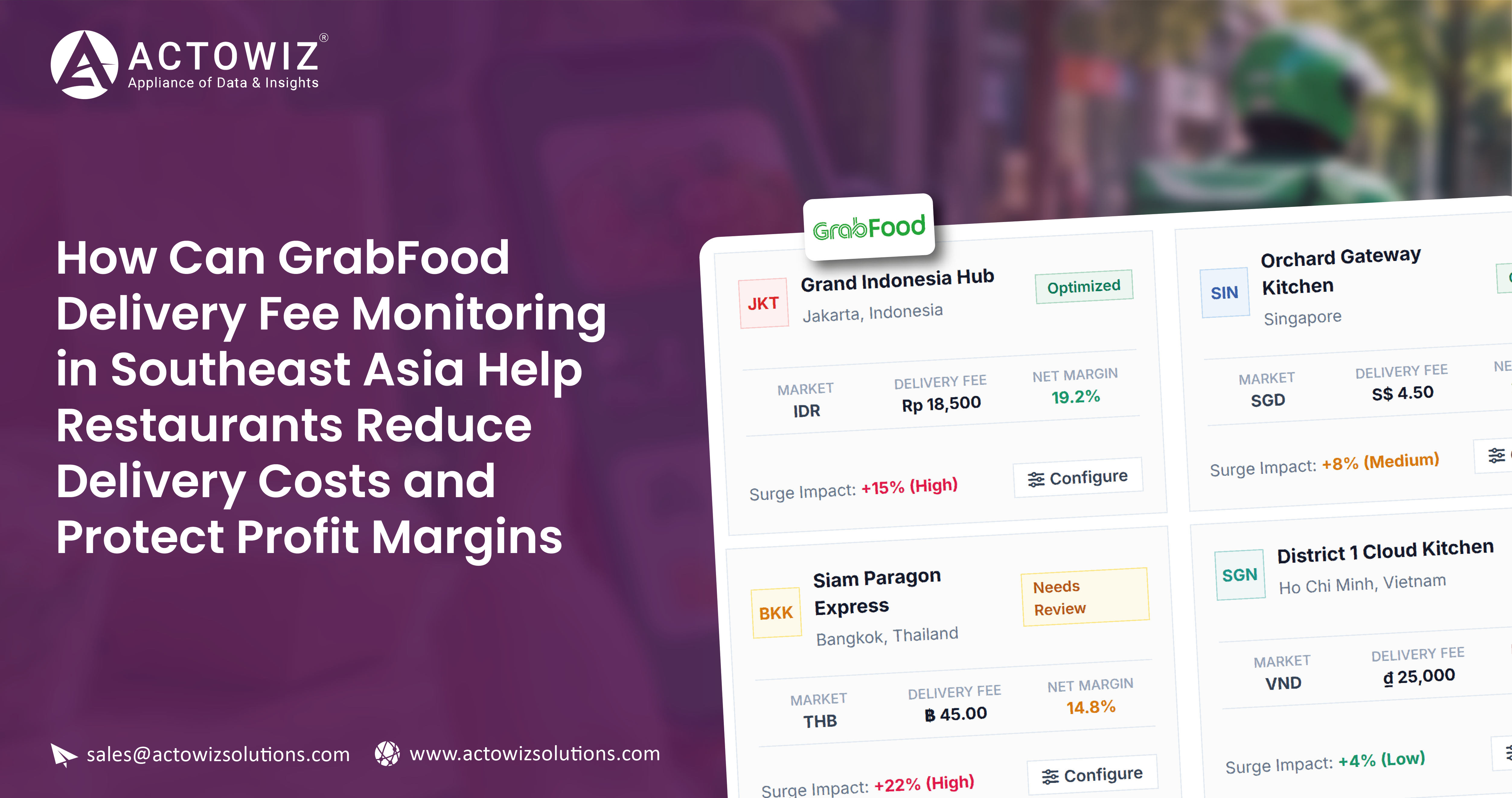
A structured approach to GrabFood Delivery Fee Monitoring in Southeast Asia can help restaurants evaluate competitor delivery charges, compare customer-facing offers, and distinguish delivery fees from menu prices and other checkout costs. Meanwhile, Web Scraping weekly Delivery Fees Data From GrabFood can support a recurring collection workflow where access is permitted and the relevant information is available from the source.
For Actowiz Solutions, the business objective is to turn accessible marketplace information into organized, decision-ready data. This helps restaurant operators assess pricing patterns, review promotional positioning, and investigate where delivery costs may be creating friction for customers. It does not guarantee lower fees or higher margins; outcomes depend on how businesses interpret the data and which pricing decisions they can control.
How can restaurants compare delivery charges across different markets?
Restaurants operating in the Philippines, Singapore, and Malaysia face different customer expectations, local currencies, operating conditions, and competitive environments. Comparing delivery fees requires more than collecting a single displayed price. Teams need to record the delivery area, restaurant, time of observation, order conditions, and any visible promotional adjustments.
Monitor GrabFood delivery charges across PH, SG and MY by collecting permitted, publicly accessible observations from consistent locations and comparable ordering scenarios. Grab’s official consumer guidance explains that delivery charges can depend on distance, while its Singapore and Malaysia help pages also describe small-order fees and potential changes during periods of high demand or bad weather. See the Grab Philippines delivery information, Singapore fee guidance, and Malaysia fee guidance.
Regional market growth makes this comparison commercially relevant. Momentum Works reported that Southeast Asian food delivery platform gross merchandise value (GMV) reached US$22.7 billion in 2025, increasing 18% year over year. GMV represents the value of transactions facilitated by platforms, not restaurant profit or delivery fees. Source: Momentum Works, January 2026.
| Year |
Southeast Asian food delivery GMV |
Reported annual growth |
| 2020 |
US$11.9 billion |
183% |
| 2021 |
US$15.5 billion |
30% |
| 2022 |
US$16.3 billion |
5% |
| 2023 |
US$17.1 billion |
5% |
| 2024 |
US$19.3 billion |
13% |
| 2025 |
US$22.7 billion |
18% |
| 2026 |
Full-year figure not yet available |
Not yet established |
Source for 2020–2025: Momentum Works research reported by Maybank Investment Banking Group and Momentum Works’ 2025 market update. Growth rates are rounded as reported. No full-year 2026 result is included.
For restaurant operators, the practical takeaway is to maintain separate country-level records instead of combining every fee into one regional average. Currency conversion should be handled separately, and comparisons should account for delivery distance, order timing, and offer eligibility. This creates a fairer basis for evaluating customer-facing costs and identifying where further investigation is warranted.
What should a reliable city-level comparison contain?
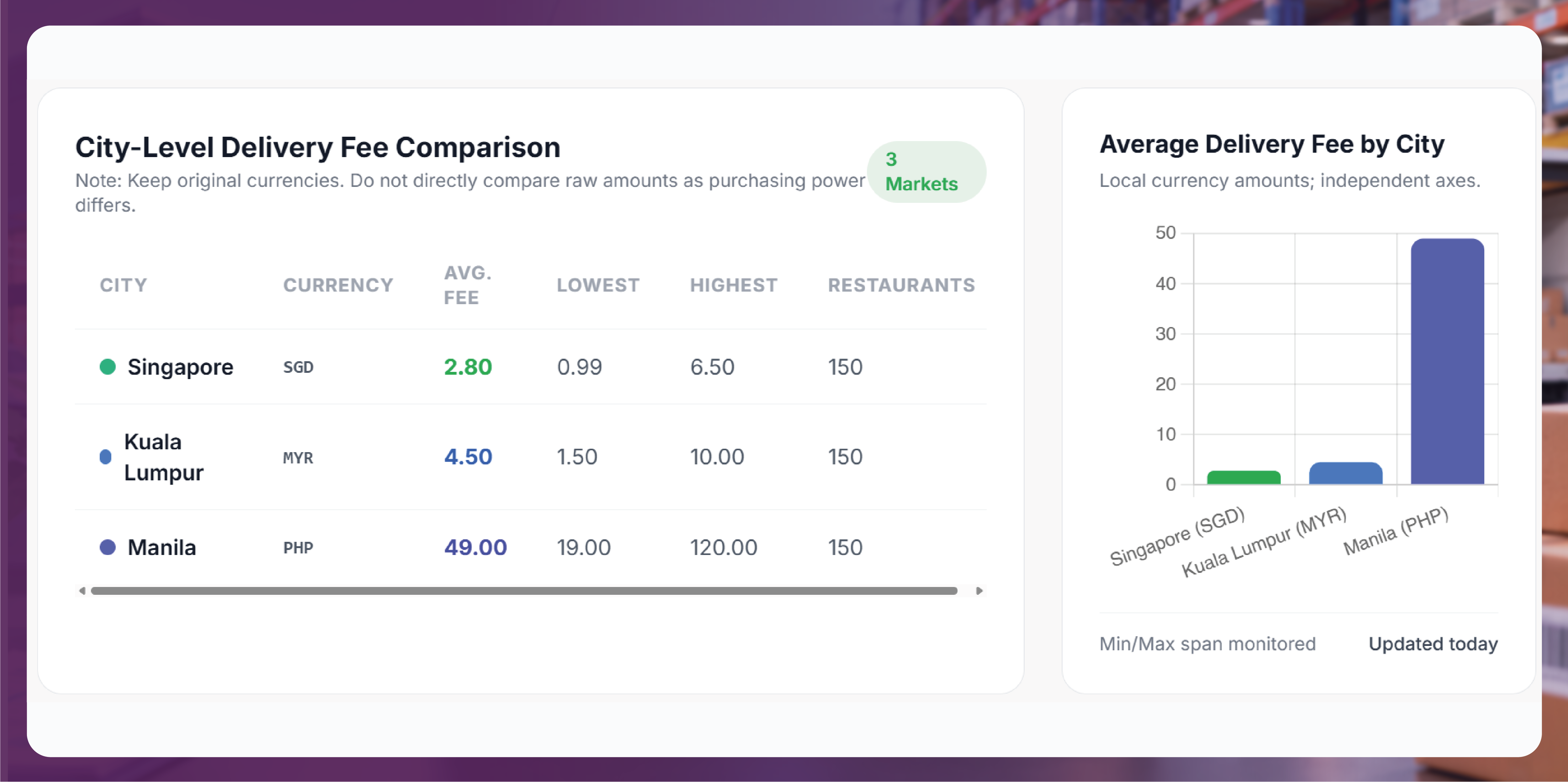
A useful delivery-fee comparison dataset must connect each observation to the circumstances in which it was collected. A fee without location, timestamp, or order context may be misleading because the same restaurant can display different charges to customers in different delivery areas.
A GrabFood delivery fee comparison dataset by city and restaurant should contain structured fields for the market, city, restaurant identifier, cuisine category, delivery fee, displayed menu prices, small-order fee where applicable, minimum order condition, promotion details, and collection timestamp. The dataset should preserve the currency shown by the source rather than converting every value during initial collection.
For example, a restaurant group could use separate records for comparable delivery areas in Singapore, Kuala Lumpur, and Manila. Analysts could then compare observed fee distributions within each market before considering cross-country comparisons. This is a recommended analytical design, not a claim that any particular fee levels have been measured.
Weekly collection can help identify whether a fee change is isolated or persistent. However, weekly snapshots may miss short-lived campaigns or temporary demand-related changes. Businesses that need more granular analysis can schedule additional permitted observations around important trading periods.
Recommended validation checks include:
- Confirming that the restaurant and delivery area match the intended comparison.
- Keeping delivery fees separate from platform fees and small-order charges.
- Recording whether an offer is visible, eligible, and applied at checkout.
- Flagging missing, duplicated, or unusually changed values for review.
- Retaining the observation date so analysts can distinguish current conditions from historical records.
These controls help commercial teams avoid treating different fees as directly comparable when they were collected under different conditions. They also make the resulting dataset more useful for finance, operations, marketing, and regional management.
Which order-level costs should restaurants monitor?
Restaurants should examine the full customer-facing order cost rather than focusing exclusively on the delivery fee. A delivery charge is only one part of the checkout experience, and a lower delivery fee does not necessarily mean that the total order is less expensive.
Extract delivery fees, menu prices and minimum order charges, GrabFood Delivery Fee Monitoring in Southeast Asia as a structured, permission-compliant workflow that separates each cost component. This is important because Grab’s official Singapore guidance distinguishes the delivery fee, small-order fee, and platform fee. Its Philippines guidance also explains that delivery charges depend on distance and that a small-order amount may apply when the order falls below a minimum threshold. Refer to the Singapore fee explanation and Philippines ordering information.
The data model should distinguish the following fields:
| Data field |
What it tells the restaurant |
| Menu item price |
The displayed price of an individual dish |
| Delivery fee |
The charge displayed for delivery to the observed area |
| Small-order fee |
An additional charge when the order does not meet the applicable minimum |
| Minimum order condition |
The stated threshold or requirement, where displayed |
| Platform or service fee |
A separate checkout charge, where applicable |
| Promotion or voucher |
The discount, eligibility conditions, and validity period shown |
| Final payable total |
The displayed total after applicable fees and discounts |
| Observation timestamp |
When the price and fee information was captured |
A sound analysis should calculate the observed checkout total from its individual components only when all relevant values are available. If taxes, service charges, or other conditions are missing, the record should be flagged rather than presented as a complete order total.
Restaurants can also compare menu prices with their own dine-in or direct-order prices. This can help teams assess channel-level pricing differences, but any decision to adjust prices should account for contractual obligations, platform rules, customer expectations, and internal profitability data.
The key benefit is clarity: operators can see which costs are visible to customers, which variables may be influencing conversion, and which elements they can realistically influence through menu design, minimum basket strategy, or eligible promotions.
How can pricing intelligence improve restaurant decisions?
Restaurant pricing decisions become more useful when marketplace observations are combined with the business’s own menu, cost, and sales information. Delivery-fee monitoring can show what customers see before ordering, while internal records can reveal whether a promotion or pricing adjustment makes commercial sense.
GrabFood Delivery Restaurant pricing intelligence can bring together observed menu prices, delivery charges, promotional visibility, restaurant availability, and historical changes. This information supports competitor benchmarking and helps teams investigate why an offer appears more attractive in one area than another.
Consider three analytical questions:
- Is the delivery charge creating friction? Compare customer-facing delivery costs across similar restaurants and delivery areas. If one area repeatedly shows higher costs, investigate distance, timing, minimum-order rules, and applicable promotions before making assumptions.
- Are menu prices competitive? Compare equivalent dishes and portion sizes where product matching is reliable. Avoid comparing different serving sizes or bundles as though they were identical products.
- Are discounts supporting sustainable orders? Examine the promotion alongside the restaurant’s own ingredient, packaging, labor, and platform-related costs. A visible discount alone does not establish profitability.
Market context supports the need for careful analysis. Momentum Works reported that regional food delivery GMV grew 13% in 2024 to US$19.3 billion and 18% in 2025 to US$22.7 billion. These figures demonstrate growth in transaction value, but they do not measure restaurant-level margins or prove that delivery fees caused the growth. Source: Momentum Works’ 2024 findings and 2025 findings.
The most actionable output is a regularly reviewed set of exceptions: locations with notable fee changes, comparable dishes with substantial price differences, and offers whose conditions need checking. Managers can prioritize those cases rather than manually reviewing every restaurant listing.
Importantly, competitor data should inform—not automatically dictate—pricing. A restaurant’s cost structure, brand positioning, delivery radius, and customer mix may differ significantly from its competitors.
How should restaurants evaluate free delivery and promotional campaigns?
Free delivery offers can change the customer’s perception of value, but the label does not necessarily mean that every order qualifies or that the delivery cost disappears. Eligibility conditions, basket thresholds, campaign dates, and voucher restrictions can all influence the final payable amount.
Monitor free delivery offers and promotional discounts on GrabFood, GrabFood Delivery Fee Monitoring in Southeast Asia to track the offers displayed in selected markets and compare them with the corresponding checkout conditions. Grab’s Philippines ordering page identifies a Free Delivery section and explains that the platform offers limited-time promotions and discounts. The exact offers available can vary, so businesses should verify them at the time of collection. Source: GrabFood Philippines.
A useful campaign dataset should record the promotion name or description, observed discount, eligible restaurant or menu items, minimum spend, validity dates, relevant delivery area, and whether the offer appears to apply to the observed order. Where the source does not expose a condition, record it as unavailable rather than inferring it.
| Promotional indicator |
Business question it helps answer |
| Free delivery label |
Which restaurants are visibly promoting delivery savings? |
| Minimum spend |
Does the offer require a larger customer basket? |
| Voucher value or discount |
How much savings are explicitly displayed? |
| Eligible menu or restaurant |
Which products and merchants qualify? |
| Campaign validity |
Is the promotion temporary or still active? |
| Checkout conditions |
Does the offer apply to the selected order? |
The commercial value comes from comparing like with like. A restaurant offering free delivery on a qualifying order may not be more affordable overall than a competitor charging for delivery but offering lower menu prices. Likewise, a large voucher may be restricted to particular customers or payment methods.
Restaurant teams should compare the final payable total for matched baskets, retain the original fee and discount fields, and review how their own promotions affect contribution margin. They should also avoid interpreting an advertised discount as proof of incremental sales without order-level performance evidence.
A campaign monitoring process can help marketing teams identify changing competitor tactics, review the visibility of their own eligible offers, and make more informed decisions about campaign timing. It cannot establish a promotion’s true profitability without the restaurant’s internal sales and cost records.
What makes a data collection service suitable for this task?
A reliable monitoring workflow needs consistent collection, quality checks, historical storage, and clear reporting. Simply accumulating screenshots or isolated price records will not give management a dependable view of changes across multiple markets.
Food Data Scraping Services, GrabFood Delivery Fee Monitoring in Southeast Asia can be organized around the restaurant group’s business questions and permitted source access. Before implementation, the collection team should establish which fields are available, how often they need to be refreshed, which locations matter, and what platform terms and applicable laws permit.
A practical workflow has five stages:
- Define the scope. Select target markets, cities, restaurant categories, delivery areas, and comparable menu items.
- Collect available observations. Capture permitted listing and checkout information, along with timestamps and source context. Do not bypass access controls or collect private customer information.
- Normalize the records. Standardize restaurant identifiers, currencies, timestamps, fee categories, and promotion fields while retaining the original displayed values.
- Validate changes. Check missing fields, duplicates, implausible changes, and mismatches between listing prices and checkout conditions.
- Deliver decision-ready outputs. Provide structured datasets, historical comparisons, exception reports, and visual summaries for the relevant business teams.
Weekly collection can be an appropriate starting point for longer-term competitor analysis. A restaurant operating frequent campaigns may require more frequent observations, subject to source availability and permitted access. Collection frequency should be agreed against business needs instead of promising that every fee change will be captured immediately.
The service should also preserve data provenance. Every record should make it possible to identify when it was observed and what market or ordering conditions applied. If a value could not be confirmed, the system should flag it for review.
This approach allows restaurant operators to use marketplace data as a consistent input into pricing and promotional decisions while keeping the limits of the data visible. The result is a more auditable analytical process, not a guarantee of savings or improved margins.
How can Actowiz Solutions support restaurant fee monitoring?
Actowiz Solutions can help businesses design a structured data collection and analysis workflow around their restaurant intelligence requirements. The scope can be tailored to the target countries, required fields, collection schedule, and permitted source access.
With Scrape GrabFood Delivery Fee Data, the objective is to organize accessible delivery charges, menu prices, minimum-order conditions, and promotional information into consistent records that analysts can compare over time.
The workflow can include:
- Data collection planning: Define the relevant restaurants, cities, delivery areas, and observation frequency.
- Data extraction and normalization: Structure available fee and menu information into consistent fields while preserving source context.
- Quality assurance: Identify incomplete records, duplicate observations, and unexplained price changes.
- Historical analysis: Compare observations across dates and locations to identify patterns that deserve further investigation.
- Reporting and integration: Deliver structured data for internal analysis, reporting systems, and business intelligence workflows.
Actowiz Solutions can also help businesses assess how different technologies fit the collection requirements. Web Scraping may support the collection of permitted information from accessible web pages, while Mobile App Scraping requirements need to be evaluated against the app’s access controls, terms, technical constraints, and applicable law. Neither approach should be assumed to provide access to every field shown in an application.
Where the required information is available and collection frequency supports it, a Real-time dataset or more frequent refresh schedule may help teams investigate time-sensitive changes. Availability and refresh speed depend on the source and the agreed implementation.
For management teams, a Food Delivery Dashboard can bring selected indicators together, such as delivery-fee movements, competitor price comparisons, promotional visibility, and data freshness. The dashboard should distinguish observed values from calculated metrics and flag incomplete information instead of presenting estimates as verified facts.
The final deliverable can be designed around practical business decisions: identifying unusual fee changes, comparing matched restaurant offers, evaluating promotional conditions, and supporting market-level pricing reviews. Results should be assessed against the restaurant’s internal costs and performance data before any pricing or promotional change is implemented.
Conclusion
Delivery-fee monitoring can help restaurants understand the costs customers see, compare competing offers, and identify marketplace changes that warrant attention. A consistent process should capture delivery fees separately from menu prices, small-order charges, platform fees, and discounts, with each observation tied to its location and timestamp.
For restaurants operating across Southeast Asia, GrabFood Delivery Fee Monitoring in Southeast Asia offers a structured way to support competitive analysis and more informed pricing decisions. Its value comes from reliable observations, comparable records, and careful interpretation—not from assuming that every delivery charge is controllable or that monitoring alone guarantees higher margins.
Actowiz Solutions can help businesses build a data collection workflow aligned with their market coverage, reporting needs, and permitted access requirements.
Ready to strengthen your food delivery pricing intelligence?
You can also reach us for all your mobile app scraping, data collection, web scraping, and instant data scraper service requirements!
 Actowiz Solutions

 By industry
 Pricing & Promotions
 Brand & Intelligence
 Digital Shelf & Search
 Assortment
 For Retailers
 E-Commerce Dashboard
 Flipkart Insights (Live)
 Grocery Intelligence
.svg) Grocery Price (U.S.)
.svg) Quick Commerce (India)
 Food & Restaurant
 Fashion Intelligence
 Automotive
 Travel & Hospitality
 Real Estate
 Food Delivery Intelligence
 OTT & Streaming
 Fuel & EV Charging Price Tracker
 By Use Case
 Pricing Intelligence
 Digital Shelf Analytics
 MAP Monitoring
 Cross-Border Price Parity
 Share of Search
 Review Sentiment
 Kitchen Market Gaps
 Dynamic Pricing / AI Repricing
 Promotions & Deals Alerts
 B2B / POI & Lead Data
 AI Search Visibility Dashboard
 Baby Products on Quick Commerce
 Hotel & Flight Rate Parity
 By Region
 Flipkart Real-Time Insights
 Quick Commerce — Zepto · Blinkit
 Pincode Price Tracker
 GCC Q-Commerce — Talabat · Noon
 UK Grocery — Tesco, Sainsbury's, Asda
 AU Grocery — Coles & Woolworths
 Marketplace Scrapers
 Developer APIs
 Universal APIs
 Delivery & SDKs
 Knowledge Center
 Guides & Playbooks
 Downloads & Tools
 Trust & Company


 4.8/5 Average Rating
 50+ Video Testimonials
 92% Client Retention
 50+ Countries Served