.webp)
Introduction
Instacart price and availability data shows CPG brands how their products appear on Instacart for each retailer and ZIP code: the selling price, any promotion, whether the item is in stock, where it ranks in search and how it compares with competitors. Brands use it to check channel pricing, fix out-of-stocks and measure their share of the digital grocery shelf. Explore our Instacart web scraping API for structured product and pricing data collection.
Instacart is a large shelf to watch. In its second-quarter 2026 results, Instacart reported gross transaction value of $10.35 billion and 90.3 million orders, and said it partners with more than 2,200 retail banners representing nearly 100,000 stores. For a brand, each of those banners and stores can show a different price, promotion and stock status.
This guide explains what makes Instacart data different from retailer websites, which fields to collect, how to compare Instacart prices with in-store prices, and how to set up ZIP-level monitoring with public data.
Why does Instacart data matter for CPG brands?
Instacart sits between shoppers and hundreds of grocers, so it is one of the few places where a brand can see many retailers' online shelves in a single format. That makes it useful for sales, pricing and e-commerce teams alike.
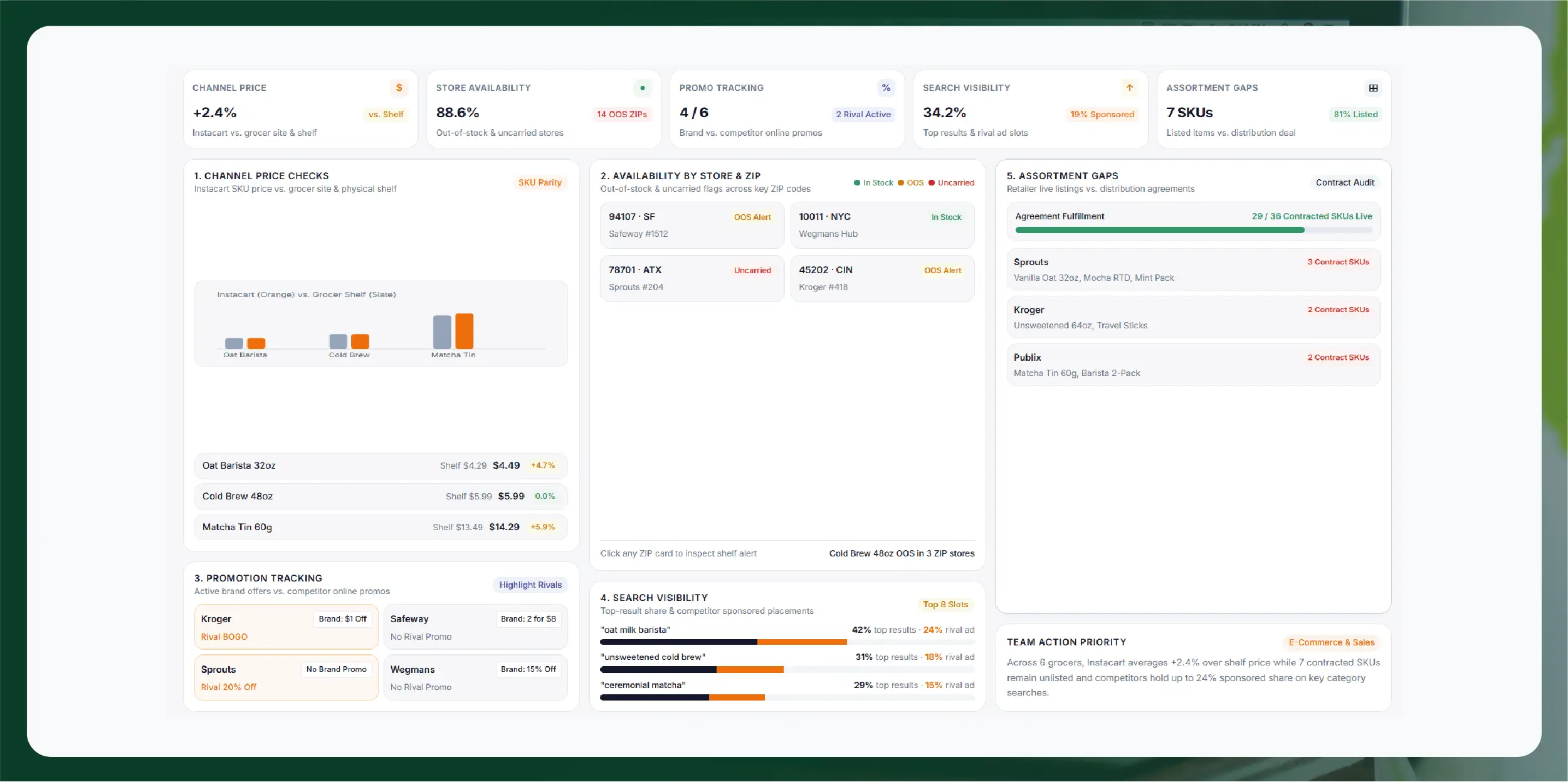
- Channel price checks: see the price each retailer shows for your SKUs on Instacart and how it compares with the retailer's own site or shelf.
- Availability by store: find which stores and ZIP codes show your items as out of stock or not carried.
- Promotion tracking: see which retailers are running your promotions online, and which are running competitors'.
- Search visibility: measure how often your brand appears in the first results for category keywords, and where competitors buy sponsored slots.
- Assortment gaps: compare the range each retailer lists for you against your distribution agreements.
How is Instacart data different from retailer website data?
The retailer is a dimension inside Instacart, not the platform itself. The same SKU can appear under many banners, and each banner sets its own price. Instacart's help pages say that retailers set item prices on the platform, that some retailers may set Instacart prices that differ from in-store prices, and that some in-store sales or promotions may not apply.
| Dimension |
On Instacart |
On a retailer's own site |
| Who sets the price |
Each retailer, per banner (Instacart Help) |
The retailer |
| Price vs shelf |
May differ from in-store; some in-store promos may not apply |
Usually the retailer's online or store price |
| Location |
Store / ZIP selected by the shopper |
Store selected on the retailer's site |
| Coverage |
Many banners in one interface |
One retailer only |
| Promotions |
Instacart-listed offers and coupons |
Retailer offers, loyalty prices |
| Ads |
Sponsored product placements via Instacart Ads |
Retailer media network, if any |
Because of these differences, brands usually collect Instacart and retailer-site data side by side and match the same product across both. Our Instacart grocery data extraction case study provides an example of collecting structured grocery information from the platform.
The 10 data fields CPG brands collect from Instacart
- Retailer banner and store – which grocer and which store the listing belongs to.
- ZIP code – the delivery location used for the check.
- Product identifiers – product name, brand, size and, where shown, UPC; plus the platform's own item ID.
- Current price – the price displayed for that store at that time.
- Unit price – price per ounce, pound or count, for pack-price comparisons.
- Promotion – sale price, multi-buy or coupon text, and its end date when shown.
- Availability – in stock, low stock or unavailable at that store.
- Search rank – position for a keyword, marked organic or sponsored.
- Category position – where the item appears in aisle and category pages.
- Ratings and content – images, description and any ratings shown.
| Field |
Example value |
Used for |
| retailer_banner |
Regional grocer A |
Channel comparison |
| store_zip |
60601 |
Location analysis |
| product_title |
Brand X Greek Yogurt, 32 oz |
Matching |
| upc |
No Data |
Matching to your master data |
| price |
6.49 |
Price index |
| unit_price |
0.20 / oz |
Pack-price ladder |
| promo_text |
Buy 2, save $1 |
Promotion tracking |
| availability |
In stock |
Stock-out alerts |
| search_rank |
3 (sponsored) |
Share of search |
| captured_at |
2026-10-19 09:00 CT |
Time series |
Example values are illustrative, not measured data.
Instacart prices vs in-store prices: what should brands measure?
Instacart prices can differ from in-store shelf prices because retailers set them. In December 2025, a study by Groundwork Collaborative, Consumer Reports and More Perfect Union, as reported by ConsumerAffairs, also found that the same item could show different prices to different shoppers at the same store and time: 437 participants in four US cities tested identical carts, 74% of tested items appeared at more than one price, and those items showed an average 13% gap between lowest and highest price. Instacart said the differences came from price tests with a small group of retail partners, and on 22 December 2025 announced it was ending all item price tests, according to The Packer.
For brands, the lesson is to measure price as a time series, at the store and ZIP level, rather than relying on a single check. A sound method compares the Instacart price with the same retailer's own site or shelf price for the same UPC and pack size, at the same time. For additional analysis, explore our competitive grocery pricing analysis and data scraping solutions.
| Comparison |
How to measure |
Output |
| Instacart vs retailer site |
Same UPC, same store, same hour |
Price gap % by retailer |
| Instacart vs MSRP / list price |
Your list price file vs observed price |
Compliance flags |
| Brand vs competitor |
Unit price for matched pack sizes |
Price index by category |
| Promo vs non-promo |
Promo flag and depth over time |
Promo calendar by retailer |
| Store vs store |
Same banner, different ZIPs |
Regional price spread |
How to track availability and assortment by store and ZIP
Availability on Instacart is local. An item can be in stock at one store and unavailable at another store of the same banner a few miles away. Brands therefore track a fixed panel of stores and ZIP codes – for example the top 50 ZIPs by sales for each key retailer – at a regular time each day or week. Our ZIP-level grocery price monitoring in the US helps track these location-specific price and availability changes.
- Define the panel – retailers, stores and ZIP codes that matter most to your sales.
- Load your SKU list – UPCs, sizes and competitor SKUs to watch.
- Match listings – map each SKU to the right item on each banner, including size variants.
- Set the schedule – daily for availability and promotions, weekly for assortment and price trends.
- Flag exceptions – stock-outs, missing listings and price changes beyond a threshold.
- Deliver – CSV, API or dashboard, joined with your retailer sell-through data.
Search, sponsored placements and Carrot Ads
Visibility on Instacart is partly paid. Instacart Ads sells sponsored product placements to brands, and its Carrot Ads technology powers retail media for other retailers and platforms. In April 2025 Instacart said Carrot Ads gives access to demand from more than 7,000 brands and is used by more than 220 retailer banners, and that Uber Eats would use it to offer sponsored items to US CPG advertisers. That makes share of search a useful KPI: track a fixed list of category keywords by store and ZIP, and split results into organic and sponsored positions.
Use cases
- Revenue management: monitor price gaps between Instacart and retailer sites and spot unplanned price moves.
- Sales and key accounts: send weekly stock-out and missing-listing reports to each retailer's category team.
- Trade promotion: check that agreed promotions appear online at the right stores and dates.
- E-commerce and media: measure share of search and the effect of sponsored campaigns.
- Competitive intelligence: track competitor launches, price changes and promotions by region.
Legal and compliance basics
Collect only publicly visible product listing data – prices, promotions, availability and product content shown to any shopper for a ZIP code. Do not collect shopper accounts, order history or personal data, and respect the platform's terms. Ask your provider how data is collected, stored and secured.
Build vs buy: choosing a provider
In-house scrapers can work for a handful of SKUs, but store- and ZIP-level monitoring across many banners needs scheduling, matching and maintenance when pages change. Managed providers handle collection, product matching and quality checks, and deliver data in your format. Actowiz offers three models: a managed data service with scheduled delivery, API access for on-demand checks, and one-time extractions for studies such as a holiday pricing review.
Frequently Asked Questions
Can I track Instacart prices by store and ZIP code?
Yes. Prices and availability on Instacart depend on the retailer and store selected, so monitoring is set up for a panel of stores and ZIP codes.
Are Instacart prices the same as in-store prices?
Not always. Instacart says retailers set prices on the platform and that some may differ from in-store prices, and some in-store promotions may not apply.
Did Instacart stop showing different prices to different shoppers?
Instacart announced on 22 December 2025 that it was ending all item price tests, after a study found the same items shown at different prices.
Which fields matter most for CPG brands?
Retailer, store, ZIP, UPC, price, unit price, promotion, availability and search rank – collected at the same time so they can be compared.
How often should Instacart data be collected?
Daily for availability and promotions; weekly is usually enough for price trends and assortment.
Can Instacart data be matched with retailer websites?
Yes. Matching by UPC and pack size lets you compare Instacart prices with each retailer's own site or shelf price.
 Actowiz Solutions

 By industry
 Pricing & Promotions
 Brand & Intelligence
 Digital Shelf & Search
 Assortment
 For Retailers
 E-Commerce Dashboard
 Flipkart Insights (Live)
 Grocery Intelligence
.svg) Grocery Price (U.S.)
.svg) Quick Commerce (India)
 Food & Restaurant
 Fashion Intelligence
 Automotive
 Travel & Hospitality
 Real Estate
 Food Delivery Intelligence
 OTT & Streaming
 Fuel & EV Charging Price Tracker
 By Use Case
 Pricing Intelligence
 Digital Shelf Analytics
 MAP Monitoring
 Cross-Border Price Parity
 Share of Search
 Review Sentiment
 Kitchen Market Gaps
 Dynamic Pricing / AI Repricing
 Promotions & Deals Alerts
 B2B / POI & Lead Data
 AI Search Visibility Dashboard
 Baby Products on Quick Commerce
 Hotel & Flight Rate Parity
 By Region
 Flipkart Real-Time Insights
 Quick Commerce — Zepto · Blinkit
 Pincode Price Tracker
 GCC Q-Commerce — Talabat · Noon
 UK Grocery — Tesco, Sainsbury's, Asda
 AU Grocery — Coles & Woolworths
 Marketplace Scrapers
 Developer APIs
 Universal APIs
 Delivery & SDKs
 Knowledge Center
 Guides & Playbooks
 Downloads & Tools
 Trust & Company






































 4.8/5 Average Rating
 50+ Video Testimonials
 92% Client Retention
 50+ Countries Served