Introduction
For large e-commerce brands, monitoring thousands of marketplace SKUs requires more than occasional product research. Product prices, availability, discounts, ratings, sellers, and catalog information can change frequently, making manual tracking difficult to maintain at scale. Actowiz Solutions helped a leading e-commerce brand establish a structured approach to marketplace SKU monitoring by integrating JD.com Product Data API for SKU Monitoring into its product intelligence workflow.
The project focused on collecting consistent product-level information from JD.com, organizing records by SKU, and creating a repeatable process for tracking changes over time. Through Jd.com Data Scraping, the brand could transform marketplace information into structured datasets suitable for pricing analysis, assortment monitoring, competitive research, and internal reporting.
The objective was to create a scalable data foundation that reduced repetitive research while improving visibility into product-level marketplace movements. The resulting workflow supported more consistent SKU tracking and helped commercial teams work with organized, analysis-ready product data.
About the Client
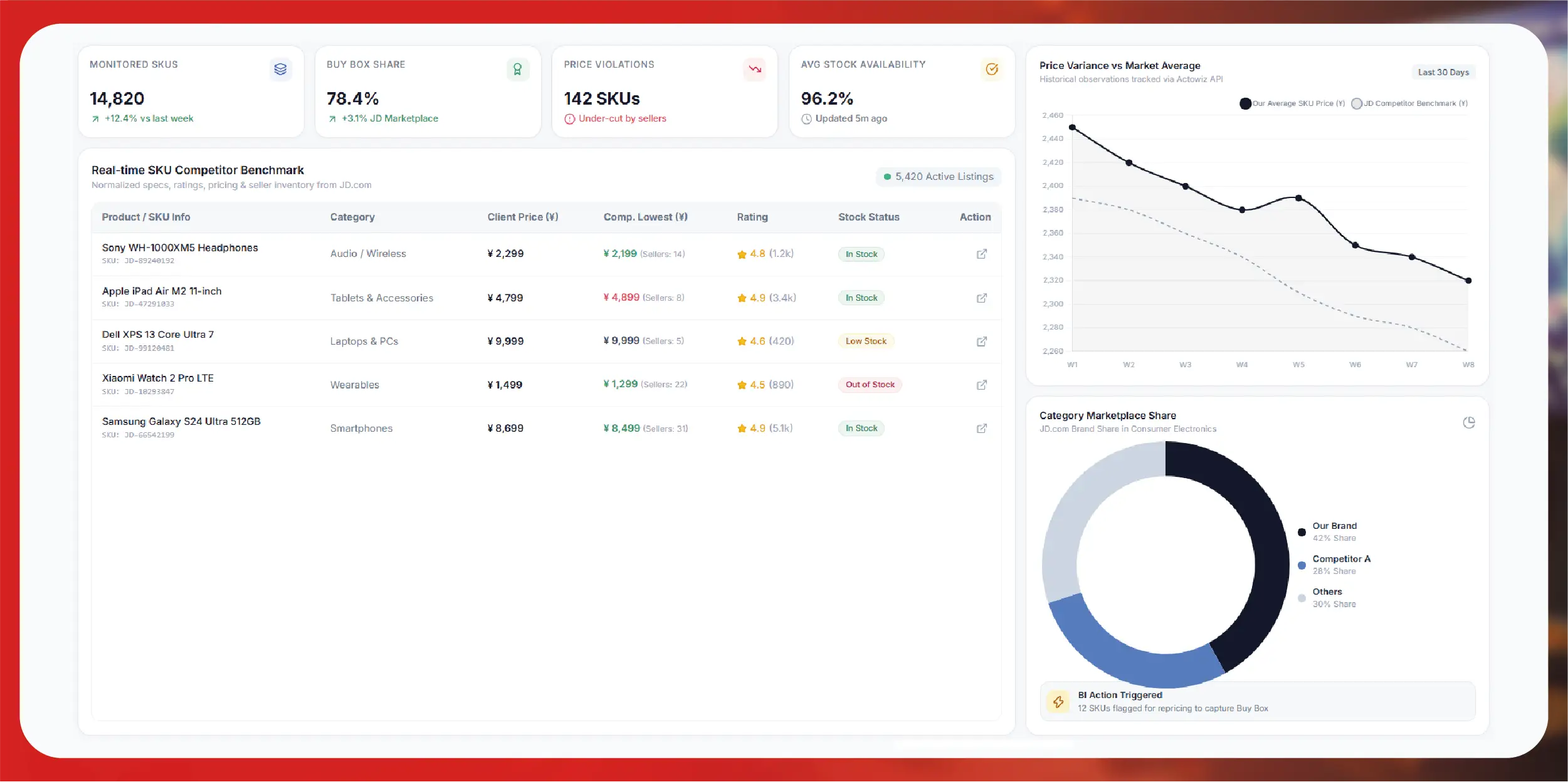
The client was a leading e-commerce brand operating in a highly competitive consumer electronics marketplace. Its target market included online shoppers comparing product specifications, prices, discounts, availability, sellers, ratings, and reviews before purchasing. With a broad assortment of products and a large number of marketplace listings, the client needed better visibility into how its products and competing products were represented on JD.com.
The existing monitoring process depended heavily on manual product research and spreadsheet-based updates. As the number of SKUs increased, maintaining accurate and current information became increasingly difficult. Teams also needed a structured way to compare historical observations and identify meaningful marketplace changes.
Actowiz Solutions designed the data collection workflow around JD.com electronics product data & SKU monitoring API, enabling product information to be captured and organized at SKU level. The approach supported recurring collection, normalization, validation, and delivery of marketplace information in a format that could be used by pricing, product, category, and business intelligence teams.
Challenges & Objectives
Key Challenges
- Difficulty maintaining consistent SKU-level product information across a large electronics catalog.
- Manual tracking created delays when prices, discounts, or availability changed.
- Product records were stored in inconsistent formats, limiting efficient comparison and analysis.
- Commercial teams lacked a reliable historical foundation for monitoring marketplace changes.
Challenges
The client needed to monitor a large and continuously changing product catalog without depending on repetitive manual research. Price changes, promotional discounts, stock conditions, product attributes, and marketplace listings needed to be captured consistently. Another challenge was maintaining SKU-level accuracy when product information changed between collection cycles. The existing process also made historical comparisons difficult because information was updated manually rather than stored as timestamped observations.
To address these issues, the project required an automated collection framework capable of handling large volumes of product records while preserving product identifiers and important marketplace attributes. Data consistency, validation, scalability, and reliable scheduling were therefore key technical requirements.
Objectives
The primary objective was to establish a structured marketplace monitoring workflow that could collect and organize product information at SKU level. The client also wanted to improve price visibility and reduce the time spent on manual product research.
The solution was designed to support recurring data collection, historical price comparison, availability monitoring, product catalog analysis, and competitive intelligence. Another objective was to standardize raw marketplace information into consistent fields that could be consumed by dashboards and internal analytics systems.
The JD.com Product Pricing Data API component was incorporated into the workflow to support structured pricing observations and enable teams to analyze product-level price movements over time.
Our Strategic Approach
1. SKU-Centric Data Architecture
Actowiz Solutions first designed a SKU-centric data architecture in which every product record was associated with a consistent product or SKU identifier. This created a reliable foundation for joining product attributes, pricing information, availability, seller details, and other marketplace signals.
The workflow collected relevant product fields and normalized them into predefined schemas. Duplicate records were identified, inconsistent values were standardized, and important fields were validated before delivery. Timestamping each observation allowed the client to distinguish current marketplace conditions from historical records.
This structure also made the dataset easier to integrate with business intelligence tools. Product teams could analyze assortment changes, while pricing teams could compare price movements and promotional activity across collection periods.
2. Review, Rating & Product Intelligence Layer
The second component focused on expanding SKU monitoring beyond basic product and pricing fields. Product reputation can influence marketplace performance, particularly in electronics categories where buyers often compare ratings and customer feedback before purchasing.
The workflow incorporated JD.com Product Review & Rating Data Collection into the broader data architecture. Review counts, ratings, and relevant review-level signals could be organized alongside product and SKU information where available.
This created a more comprehensive product intelligence layer. Instead of analyzing price independently, the client could evaluate pricing alongside customer feedback, product availability, and catalog attributes. The combined dataset supported broader competitive analysis and provided category teams with a more contextual view of marketplace activity.
Technical Roadblocks
1. Large-Scale SKU Processing
One of the primary technical challenges was processing a large number of electronics SKUs while maintaining consistent identifiers across collection cycles. The solution used structured extraction rules and SKU-level validation to reduce duplication and preserve relationships between product records.
2. Dynamic Product Information
Marketplace information can change between collection cycles. Prices, discounts, availability, seller information, and product attributes may not remain static. Actowiz Solutions addressed this by designing recurring extraction workflows with timestamped records. This allowed changes to be stored as new observations instead of overwriting previous values.
3. Electronics Catalog Complexity
Electronics catalogs commonly contain numerous specifications, variants, models, configurations, and product attributes. Mapping these fields into a consistent structure required careful schema design and normalization.
The JD.com Electronics Product Scraper workflow was structured to capture relevant product attributes while keeping the resulting dataset consistent for downstream analysis. Validation rules were applied to improve field-level consistency and identify incomplete or anomalous records before delivery.
Our Solutions
Actowiz Solutions developed a scalable marketplace data workflow designed around recurring SKU-level product monitoring. The solution collected product identifiers, product names, categories, brands, specifications, prices, discounts, availability, seller information, ratings, reviews, URLs, and other accessible attributes based on the client's requirements. JD.com Product Price Data Scraping was integrated into the workflow so pricing observations could be captured consistently across collection cycles. Each record was normalized into a predefined structure and associated with the relevant SKU or product identifier. Timestamp-based storage helped preserve historical observations, enabling teams to compare changes instead of relying only on the latest snapshot. The JD.com Product Data API for SKU Monitoring workflow also supported scheduled collection and validation, reducing repetitive manual research. The resulting dataset could be delivered in analytics-ready formats and integrated with internal dashboards, reporting systems, or business intelligence workflows for pricing, product, category, and competitive analysis.
Results & Key Metrics
The implementation was designed to improve the consistency, scalability, and usability of the client's marketplace monitoring process. Rather than relying on isolated manual checks, the business gained a repeatable workflow for collecting structured product observations across its target SKU universe.
Improved SKU Coverage
The automated workflow enabled the client to monitor a broader set of marketplace products through scheduled collection rather than relying on manual sampling. This created more comprehensive visibility across targeted electronics categories.
Faster Product Monitoring
Automating repetitive collection reduced the amount of time teams needed to spend searching for individual product updates. Commercial teams could work with refreshed datasets instead of manually compiling information from multiple listings.
Better Price Visibility
Timestamped pricing records created a historical foundation for identifying increases, decreases, discounts, and other price movements. This supported more systematic pricing and competitive analysis.
Structured Product Intelligence
The JD.com electronics product data and SKU monitoring API workflow brought product attributes, pricing, availability, and marketplace signals into a consistent dataset. This improved the usability of the information for dashboards and analytical workflows.
Representative KPI Impact
For a typical implementation of this type, key performance indicators can include SKU coverage, extraction success rate, data completeness, refresh frequency, price-change detection, duplicate-record rate, and manual research hours saved. These KPIs provide a measurable framework for evaluating the effectiveness of the monitoring workflow without relying on unsupported performance claims.
Client Feedback
“The structured marketplace data workflow gave our teams a much more consistent way to monitor products and pricing. Having SKU-level records and historical observations made it easier to identify marketplace changes and reduced the dependence on repetitive manual research.”
— Representative Client Feedback, E-Commerce Product Intelligence Manager
The feedback reflects the intended business value of the implementation: better data consistency, improved monitoring visibility, and a more efficient foundation for product and pricing analysis. The testimonial is representative because a verified client statement was not provided for publication.
Why Partner with Actowiz Solutions?
Actowiz Solutions combines web data engineering, e-commerce intelligence, structured extraction, data normalization, validation, and custom delivery workflows to support large-scale marketplace monitoring requirements.
Scalable Data Collection
The team can design collection workflows around large product catalogs and recurring monitoring requirements, allowing businesses to scale beyond manual research.
Structured & Validated Data
Raw marketplace information is transformed into organized datasets with consistent schemas, field validation, normalization, and duplicate handling.
Custom Business Requirements
Different businesses need different product fields, monitoring frequencies, geographies, categories, and delivery formats. Workflows can be customized around those requirements.
Analytics-Ready Delivery
Collected information can be structured for dashboards, databases, reporting platforms, and business intelligence workflows. This allows commercial teams to move from raw marketplace information toward actionable analysis.
Ongoing Support
Actowiz Solutions can support recurring data collection and evolving requirements as product catalogs, monitoring needs, and analytical use cases change.
For businesses looking to strengthen Pricing & Product Data intelligence, the solution can provide a structured foundation for marketplace monitoring without requiring teams to manage large-scale manual collection themselves.
Conclusion
The project demonstrated how a structured SKU monitoring workflow can help an e-commerce brand improve marketplace product visibility. By automating collection, organizing records around product identifiers, and preserving historical observations, Actowiz Solutions helped establish a more consistent foundation for product, pricing, availability, and competitive analysis.
The approach can be adapted to different categories, SKU volumes, monitoring frequencies, and analytical requirements. Businesses can also combine marketplace data with internal sales or pricing information to create broader intelligence workflows.
If your business needs scalable marketplace monitoring, Real-Time Price Monitoring, a Web scraping API, Custom Datasets, or an instant data scraper , Actowiz Solutions can design a data collection workflow around your specific requirements.
FAQs
1. What is JD.com Product Data API for SKU Monitoring?
It refers to a structured data collection approach for monitoring JD.com products at SKU level. Depending on the required dataset, businesses can collect product names, SKU identifiers, categories, prices, discounts, availability, seller information, ratings, reviews, specifications, URLs, and other accessible marketplace attributes. SKU-based organization makes it easier to compare product records across collection cycles and identify changes over time.
2. Why is SKU-level monitoring important for e-commerce brands?
SKU-level monitoring provides more granular visibility than category-level tracking. Each SKU can be associated with its own product attributes, price observations, availability status, seller information, and other signals. This allows pricing teams to identify product-specific changes and helps category teams analyze assortment and competitive positioning more systematically.
3. What data can be collected from JD.com?
The exact fields depend on the client's requirements and the information accessible from the marketplace. Common fields may include product name, SKU or product ID, brand, category, specifications, price, discount, availability, seller information, ratings, reviews, product URL, and other catalog attributes. Custom schemas can be created around specific business use cases.
4. How can JD.com product data support pricing intelligence?
Historical product price observations can be used to identify price increases, decreases, promotional changes, and other marketplace movements. When records are timestamped, businesses can compare current observations with previous collection cycles. This can support competitive pricing research, assortment analysis, promotional monitoring, and broader marketplace intelligence.
5. Can Actowiz Solutions provide custom JD.com datasets?
Yes. A custom dataset can be structured around the client's target categories, SKU universe, required fields, collection frequency, and delivery format. Depending on the use case, data can be prepared for dashboards, databases, spreadsheets, APIs, or other analytics workflows. The implementation can also include validation, normalization, recurring collection, and monitoring requirements.
 Actowiz Solutions

 By industry
 Pricing & Promotions
 Brand & Intelligence
 Digital Shelf & Search
 Assortment
 For Retailers
 E-Commerce Dashboard
 Flipkart Insights (Live)
 Grocery Intelligence
.svg) Grocery Price (U.S.)
.svg) Quick Commerce (India)
 Food & Restaurant
 Fashion Intelligence
 Automotive
 Travel & Hospitality
 Real Estate
 Food Delivery Intelligence
 OTT & Streaming
 Fuel & EV Charging Price Tracker
 By Use Case
 Pricing Intelligence
 Digital Shelf Analytics
 MAP Monitoring
 Cross-Border Price Parity
 Share of Search
 Review Sentiment
 Kitchen Market Gaps
 Dynamic Pricing / AI Repricing
 Promotions & Deals Alerts
 B2B / POI & Lead Data
 AI Search Visibility Dashboard
 Baby Products on Quick Commerce
 Hotel & Flight Rate Parity
 By Region
 Flipkart Real-Time Insights
 Quick Commerce — Zepto · Blinkit
 Pincode Price Tracker
 GCC Q-Commerce — Talabat · Noon
 UK Grocery — Tesco, Sainsbury's, Asda
 AU Grocery — Coles & Woolworths
 Marketplace Scrapers
 Developer APIs
 Universal APIs
 Delivery & SDKs
 Knowledge Center
 Guides & Playbooks
 Downloads & Tools
 Trust & Company


 4.8/5 Average Rating
 50+ Video Testimonials
 92% Client Retention
 50+ Countries Served