Introduction
Retail businesses need structured market intelligence to understand changing product demand, pricing patterns, assortment movements, and customer-facing availability. For a leading retail brand operating in the competitive UK market, gaining a consistent view of online product information was essential for strengthening competitive analysis and improving merchandising decisions. The project focused on building a structured data workflow around Marks & Spencer UK Market Performance, covering product information, pricing, availability, categories, and other relevant marketplace attributes.
Actowiz Solutions designed a scalable data collection framework capable of gathering and organizing product-level information across relevant digital touchpoints. The workflow also supported the ability to Extract Marks & Spencer API Product Data in a structured format for analysis and downstream reporting. Data was normalized, validated, and organized into analytics-ready datasets, enabling the client to compare product trends, identify pricing movements, monitor assortment changes, and improve visibility into the broader omnichannel retail environment.
About the Client
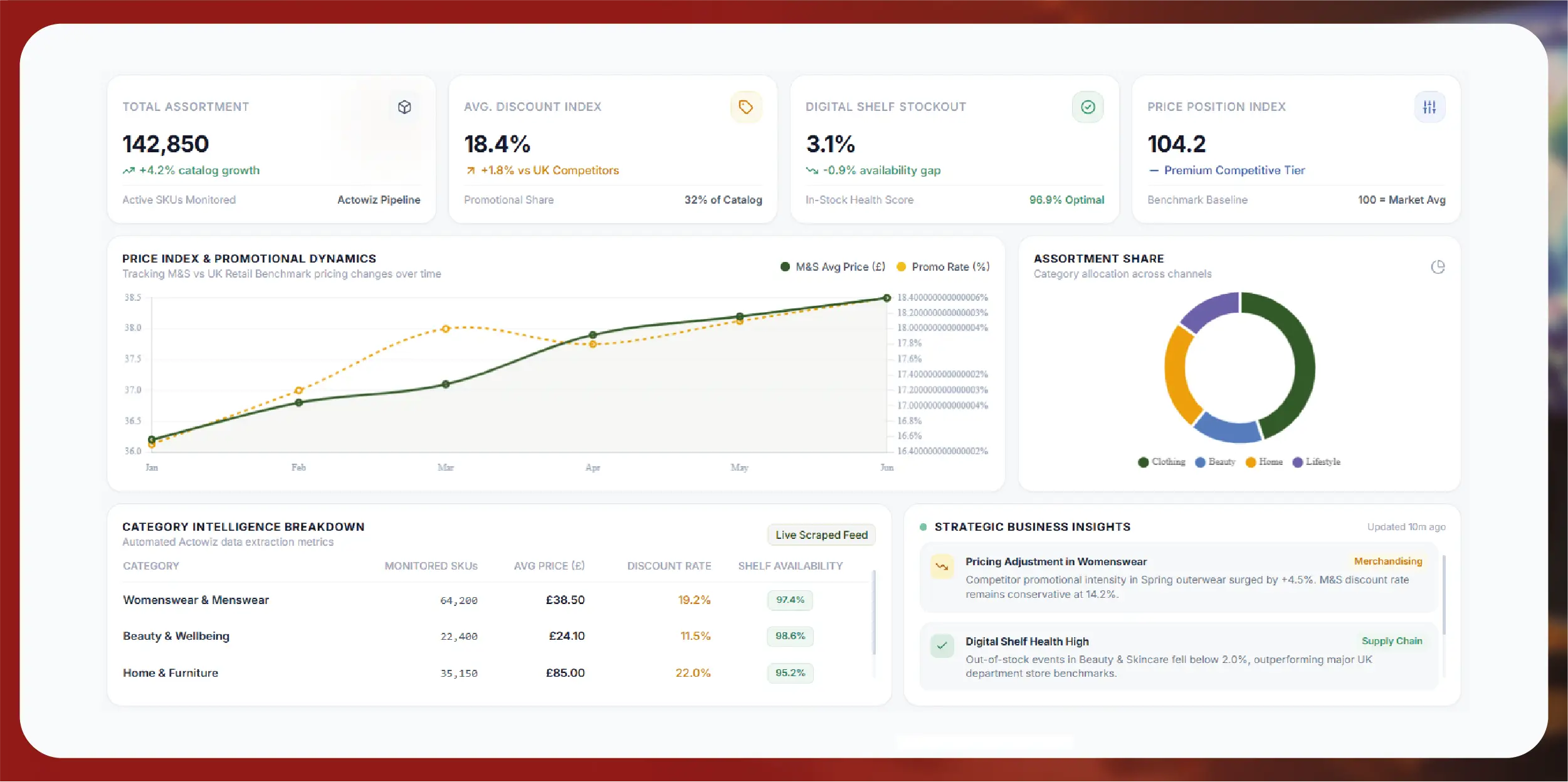
The client was a leading retail brand seeking deeper visibility into the UK fashion, clothing, beauty, home, and lifestyle market. Its business operations depended on understanding product assortment, customer demand, pricing changes, promotions, availability, and digital shelf visibility across multiple retail touchpoints.
Operating within a highly competitive retail environment, the client needed a reliable source of structured market information rather than manually reviewing individual product pages. Its existing processes made it difficult to consolidate product-level information and identify meaningful changes across categories over time.
Actowiz Solutions developed a customized data collection and analysis workflow designed around the client's competitive intelligence requirements. The project generated structured datasets covering product attributes, prices, discounts, availability, categories, and related information. These datasets helped create actionable Marks & Spencer market performance Data Insights by giving the client a more consistent view of product and pricing activity. The resulting data could support merchandising teams, pricing analysts, category managers, and business intelligence teams in their ongoing market-monitoring activities.
Challenges & Objectives
Key Challenges
- Fragmented product information across digital touchpoints
- Frequent changes in pricing, promotions, and availability
- Difficulty maintaining consistent SKU-level records
- Limited visibility into historical product and market movements
Challenges
The client faced difficulties in collecting consistent retail data from a large and frequently changing product environment. Product attributes, pricing, discounts, availability, and category information could change regularly, making manual monitoring inefficient and difficult to scale. Another challenge involved maintaining standardized records when product information appeared in different formats across digital channels. The client also required historical visibility to compare market movements rather than relying solely on individual snapshots. Data quality was another concern because missing values, duplicate records, inconsistent product names, and changing page structures could affect downstream analysis. These challenges created a need for an automated, repeatable, and validation-driven data collection framework.
Objectives
The primary objective was to create a scalable workflow for Marks & Spencer omnichannel Data Scraping that could consistently capture product-level information for competitive analysis. The solution needed to collect relevant product attributes, prices, discounts, availability, categories, and identifiers while maintaining structured records over recurring collection cycles. Another objective was to normalize and validate incoming information so business teams could use the datasets without extensive manual preparation. The client also wanted to improve historical comparison capabilities, identify pricing and assortment movements, and support internal dashboards. The resulting framework was designed to make retail intelligence more accessible for pricing, merchandising, category management, and strategic decision-making teams.
Our Strategic Approach
1. Structured Product Intelligence Framework – 100 Words
Actowiz Solutions established a structured workflow focused on comprehensive Marks & Spencer product catalog data Collection. The process began by defining the required product fields, categories, identifiers, pricing attributes, availability indicators, and other relevant information. Automated collection routines were then configured to capture product records at the required frequency. Incoming information was standardized into consistent schemas, allowing products to be compared across collection periods. Product identifiers were used wherever available to reduce duplication and improve record continuity. Validation rules checked required fields, formatting, and unusual changes before datasets moved into the analytics layer. This approach created a repeatable foundation for product monitoring and competitive intelligence.
2. Recurring Data Processing & Validation – 100 Words
The second part of the strategy focused on maintaining data quality across recurring collection cycles. Captured records were processed through normalization, deduplication, validation, and consistency checks. Pricing fields were standardized, product names and categories were organized, and availability values were mapped into consistent formats. Historical records were retained so the client could identify changes rather than viewing each collection as an isolated snapshot. Automated exception checks highlighted missing or unexpected values for further review. The processed datasets were then structured for dashboards, reporting, and analytical workflows. This enabled business teams to work with a consistent data foundation while reducing repetitive manual preparation.
Technical Roadblocks
1. Dynamic Product Information
One major challenge involved capturing product information from pages where content and attributes could change dynamically. The workflow was designed to identify relevant product elements consistently while accounting for changes in page structures. Automated validation checks helped identify incomplete records before delivery.
2. Price & Availability Variations
Pricing and availability could change between collection cycles, creating challenges for historical comparison. Actowiz Solutions implemented structured extraction and timestamping processes so each dataset could preserve the relevant observation period. This supported reliable comparison of pricing and stock-status changes over time.
3. Data Standardization
Another technical challenge was ensuring that product records remained consistent when attributes differed across categories. Marks & Spencer product Price Data Extraction was therefore integrated with normalization and validation processes. Currency, price fields, discount values, product identifiers, category information, and availability indicators were mapped into predefined structures. Duplicate checks and quality controls further improved dataset consistency. These measures allowed the resulting information to remain suitable for recurring analysis, reporting, and dashboard integration despite ongoing changes in the underlying retail environment.
Our Solutions
Actowiz Solutions implemented an end-to-end retail data workflow that transformed fragmented product information into structured, analytics-ready datasets. The solution was designed to Extract Marks & Spencer SKU data along with product names, categories, prices, discounts, availability, product URLs, identifiers, and other accessible attributes required by the client. Automated collection processes captured the information at defined intervals, while normalization routines standardized product records and pricing fields. Validation checks helped identify missing values, duplicates, formatting inconsistencies, and unexpected changes before the data reached the analytical layer.
The workflow also supported Marks & Spencer UK Market Performance monitoring by preserving historical observations and enabling product-level comparisons across collection periods. Data was organized into structured datasets that could be connected to reporting workflows and business intelligence systems. This gave pricing, merchandising, and category teams a consistent foundation for monitoring assortment changes, evaluating competitive pricing movements, and identifying availability patterns. By combining automated collection with quality controls and structured delivery, the solution reduced manual research requirements while creating a scalable framework that could be expanded across additional categories, products, and monitoring frequencies as business requirements evolved.
Results & Key Metrics
1. Improved Product Visibility
The structured workflow gave the client a more consistent view of M&S product pricing and availability data UK, helping teams monitor product-level changes across recurring collection cycles. Standardized records made it easier to identify price movements, discount changes, and availability variations.
2. Better Historical Comparison
Historical datasets enabled business teams to compare observations across different collection periods rather than relying on isolated snapshots. This supported trend identification and improved the ability to investigate changes in assortment, pricing, and product visibility.
3. Reduced Manual Monitoring
Automated data collection reduced the need for repetitive manual product-page checks. Teams could work with prepared datasets instead of repeatedly gathering and formatting individual records, allowing analysts to focus more time on interpretation and reporting.
4. Scalable Intelligence
The framework was designed to scale across categories and product groups as requirements expanded. Recurring processing and validation supported a more reliable data pipeline for ongoing Marks & Spencer UK Market Performance monitoring.
Overall, the project established a structured foundation for competitive retail intelligence, enabling the client to use product-level information more efficiently across pricing, merchandising, category analysis, and business reporting workflows.
Client Feedback
“The project gave our teams a much clearer and more structured way to work with retail product information. Instead of spending significant time gathering product and pricing records manually, we could work with organized datasets designed around our analytical requirements. The consistency of the data also made recurring comparisons easier for our internal teams. The solution provided a practical foundation for monitoring products, prices, and availability while supporting our broader reporting requirements. The workflow was flexible enough to accommodate changing data requirements and provided useful inputs for our Pricing & Product Data initiatives.”
— Head of Digital Commerce, Retail Industry
Why Partner with Actowiz Solutions
1. E-Commerce Data Expertise
Actowiz Solutions combines experience in structured web data collection, product intelligence, marketplace monitoring, and retail analytics. Its workflows can be customized around business-specific fields, categories, frequencies, and delivery requirements.
2. Scalable Technology
The team develops automated pipelines capable of handling large product datasets while incorporating normalization, validation, deduplication, and quality checks. This supports recurring data collection without relying heavily on manual research.
3. Flexible Data Delivery
Actowiz Solutions can organize collected information into formats suitable for analytics, E-commerce Dashboard, databases, and internal reporting workflows. The approach can also be adapted as monitoring requirements expand.
4. Business-Focused Support
The objective is not simply to collect records but to create usable datasets that support commercial analysis. With Ecommerce Data Scraping expertise and a structured approach to Marks & Spencer UK Market Performance, businesses can develop repeatable data workflows aligned with pricing, merchandising, and competitive intelligence requirements.
Conclusion
The project demonstrated how structured retail data collection can help businesses build a more consistent view of product, pricing, availability, and assortment movements. By developing an automated workflow around Marks & Spencer UK Market Performance, Actowiz Solutions transformed fragmented product observations into organized datasets suitable for recurring analysis and reporting.
The resulting framework supported SKU-level monitoring, historical comparisons, and omnichannel retail intelligence while reducing repetitive manual research. Businesses can further extend the workflow across categories, marketplaces, and digital channels according to their requirements. Actowiz Solutions can support these initiatives through a Web scraping API, Custom Datasets, and an instant data scraper designed around specific data collection needs.
FAQs
1. What type of data can be collected for Marks & Spencer products?
A structured retail data workflow can capture product names, SKUs or product identifiers, categories, product URLs, prices, discounts, availability, brand information, and other publicly accessible attributes. The exact fields depend on the project requirements and the data available through the relevant digital channels.
2. How can retail data support omnichannel analysis?
Omnichannel analysis brings information from multiple customer-facing channels into a common analytical structure. When product, pricing, availability, and assortment information is standardized, businesses can compare observations across channels and collection periods. This can help teams identify changes in product visibility, pricing, and availability while supporting broader retail intelligence initiatives.
3. How frequently should product data be collected?
Collection frequency depends on the business objective. Daily monitoring may be appropriate for highly dynamic pricing and availability requirements, while weekly or monthly collection can support broader assortment and market-trend analysis. Actowiz Solutions can design recurring workflows around the required monitoring frequency and dataset size.
4. Can the collected data be integrated with dashboards?
Yes. Structured datasets can be prepared for integration with business intelligence platforms, databases, spreadsheets, and other analytical environments. The delivery format can be defined according to the client's existing technology stack. Historical data can also be retained to support trend analysis and recurring reporting.
5. Can the solution be expanded to other retailers or categories?
Yes. A scalable data collection framework can be extended to additional retailers, categories, products, and digital channels based on project requirements. Standardized schemas and validation workflows make it easier to incorporate additional sources while maintaining consistent data structures for comparative analysis.
 Actowiz Solutions

 By industry
 Pricing & Promotions
 Brand & Intelligence
 Digital Shelf & Search
 Assortment
 For Retailers
 E-Commerce Dashboard
 Flipkart Insights (Live)
 Grocery Intelligence
.svg) Grocery Price (U.S.)
.svg) Quick Commerce (India)
 Food & Restaurant
 Fashion Intelligence
 Automotive
 Travel & Hospitality
 Real Estate
 Food Delivery Intelligence
 OTT & Streaming
 Fuel & EV Charging Price Tracker
 By Use Case
 Pricing Intelligence
 Digital Shelf Analytics
 MAP Monitoring
 Cross-Border Price Parity
 Share of Search
 Review Sentiment
 Kitchen Market Gaps
 Dynamic Pricing / AI Repricing
 Promotions & Deals Alerts
 B2B / POI & Lead Data
 AI Search Visibility Dashboard
 Baby Products on Quick Commerce
 Hotel & Flight Rate Parity
 By Region
 Flipkart Real-Time Insights
 Quick Commerce — Zepto · Blinkit
 Pincode Price Tracker
 GCC Q-Commerce — Talabat · Noon
 UK Grocery — Tesco, Sainsbury's, Asda
 AU Grocery — Coles & Woolworths
 Marketplace Scrapers
 Developer APIs
 Universal APIs
 Delivery & SDKs
 Knowledge Center
 Guides & Playbooks
 Downloads & Tools
 Trust & Company


 4.8/5 Average Rating
 50+ Video Testimonials
 92% Client Retention
 50+ Countries Served