Core services
Enterprise Data Extraction

Scalable web, app and AI-powered collection across 40+ countries.

All 58 services →
New 2026
AI Training Data

Corpus building with provenance and opt-out compliance.

Learn more →
Free pilot
24-hour sample

We run collection on your own sources before you commit.

Get a sample →
58Services
40+Countries
DEVELOPER

Ready-Made Scrapers

Pre-built for top platforms. Self-serve, no setup.

View All →
TRY FREE

API Playground

Test endpoints instantly. No credit card.

Start Free →
28Tools
2SDKs
icons Delivery & SDKs
Streaming Crawl API Scheduler Realtime Alerts Webhook Delivery 🐍 Python SDK 💚 Node.js SDK

Need it managed instead?

Fixed monthly retainer, named engineer, no per-request metering.

Managed Data API →
HOT

Case Studies

How brands use Actowiz, with named outcomes.

Read →
FREE

Sample Datasets

Real output, no signup.

Download →
NEW

ROI Calculator

Model the return on a data engagement.

Calculate →
Navratri Mega Sale Price Tracking

Introduction

Korean fashion has become an increasingly influential part of the global fashion ecosystem, with digital marketplaces providing valuable signals around product demand, pricing, assortment, brands, and consumer preferences. For international fashion brands, monitoring these signals can help identify emerging styles, benchmark competitors, and make more informed assortment decisions.

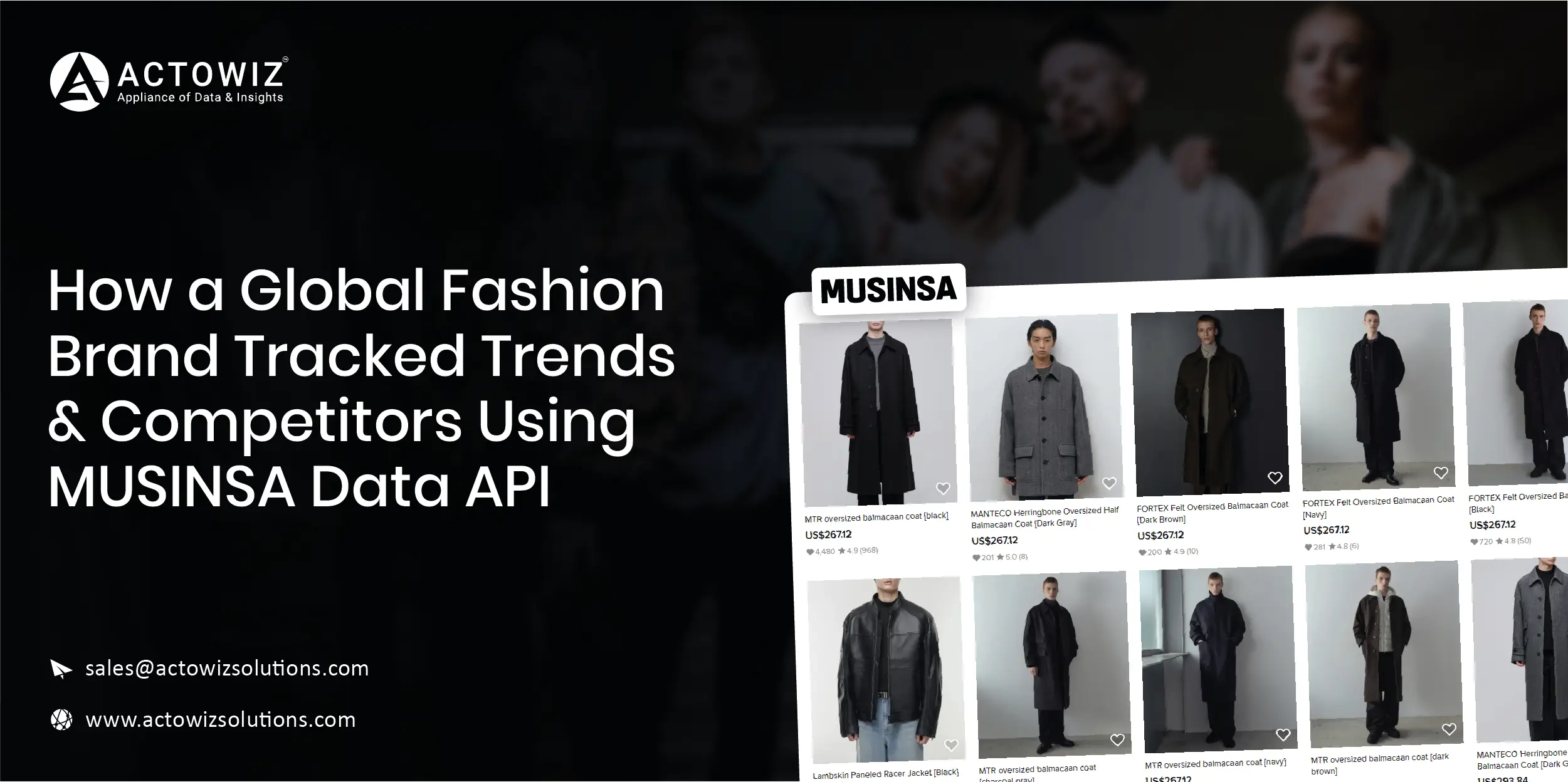
Actowiz Solutions helped a global fashion brand establish a structured marketplace intelligence workflow using the MUSINSA Data API. The project focused on collecting and organizing product, pricing, brand, category, SKU, review, and rating information into a centralized data environment.

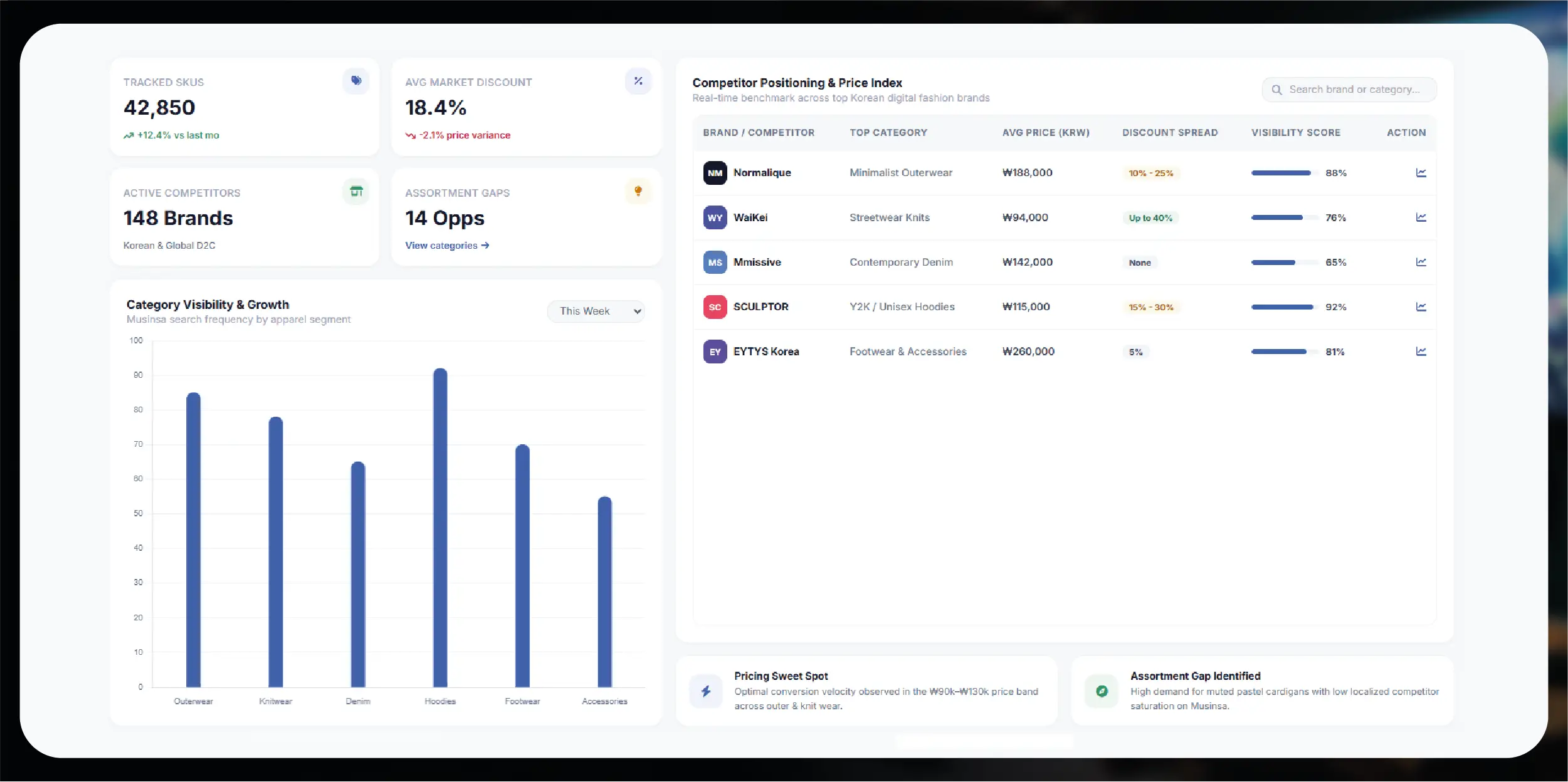
An E-commerce Dashboard was developed as the analytical layer, enabling business teams to examine marketplace information through structured views and comparisons. Instead of relying on periodic manual research, the brand could work with standardized data and historical records to understand market movements.

The objective was to create a scalable intelligence framework that could support trend discovery, competitor monitoring, pricing analysis, assortment planning, and product strategy. This case study explains how Actowiz Solutions converted marketplace information into actionable Korean fashion market intelligence.

About the Client

Navratri Mega Sale Price Tracking

The client was a global fashion brand with an established presence across international digital markets. Its business focused on apparel and fashion products, targeting digitally active consumers who closely followed emerging styles, brands, pricing changes, and seasonal collections.

As the brand explored opportunities within the Korean fashion ecosystem, its teams needed better visibility into local marketplace activity. Competitor products were changing frequently, while pricing, discounts, product availability, and assortment could vary across categories. Manual research made it difficult to maintain a consistent market view.

Actowiz Solutions developed a MUSINSA Products Price Data API workflow to organize relevant product and pricing information into a structured format. The data was designed to support product benchmarking, competitor analysis, pricing research, and trend identification.

The client wanted to understand which brands and product categories were gaining visibility, how competitors positioned their products, and where pricing or assortment gaps could create opportunities. The resulting framework provided a scalable foundation for market intelligence while reducing repetitive manual research and enabling teams to work with consistent marketplace information.

Challenges & Objectives

Challenges
  • Fragmented Market Information: Product, pricing, brand, and category information was distributed across a large marketplace catalog, making manual competitive research difficult to scale.
  • Fast-Moving Fashion Trends: New products, collections, discounts, and styles could emerge frequently, creating challenges for maintaining an up-to-date market view.
  • Pricing Variations: Competitor prices and promotional activity could change regularly, making historical comparisons difficult without structured data collection.
  • Limited SKU-Level Visibility: The client needed detailed product identifiers and attributes to distinguish individual products and track changes accurately.
Objectives
  • Build a Centralized Dataset: Create a structured repository of relevant marketplace product, brand, pricing, SKU, and customer-feedback information.
  • Monitor Competitors: Compare competing brands, products, categories, and price points to identify market opportunities.
  • Identify Fashion Trends: Detect emerging categories, styles, brands, and product attributes that could inform assortment planning.
  • Enable Data-Driven Strategy: Provide business teams with consistent information for pricing, product development, market research, and competitive decision-making.

Our Strategic Approach

Building a Localized Market Intelligence Framework

The first stage involved establishing a data structure specifically designed around the requirements of the Korean fashion market. The MUSINSA Korean Fashion Market Data intelligence framework organized product information by brand, category, SKU, price, discount, availability, and other relevant attributes. We developed extraction workflows capable of processing large product catalogs while maintaining relationships between product-level and brand-level information. Standardization was applied to product names, categories, pricing fields, and identifiers to support consistent analysis. The workflow also retained historical information where recurring monitoring was required. This allowed the client to examine marketplace changes rather than relying solely on current snapshots. By creating a localized data framework, the global fashion brand gained a clearer understanding of Korean marketplace dynamics and could compare local competitors using a consistent analytical structure.

Mapping Products and Competitive Assortments

The second stage focused on catalog-level competitive analysis. Through MUSINSA Product Catalog Data Extraction, the project collected relevant product attributes across selected fashion categories and brands. Product records were organized into comparable structures so the client could examine assortment breadth, product categories, price ranges, discounts, and brand participation. The workflow helped identify products entering or leaving the monitored catalog and provided greater visibility into competitive assortment changes. The data was also prepared for dashboard analysis, enabling business teams to filter products by brand, category, price, and other relevant attributes. This approach transformed a large marketplace catalog into a more manageable competitive intelligence resource. It supported decisions around assortment planning, product positioning, pricing strategy, and identifying potential gaps in the client's own product portfolio.

Technical Roadblocks

1. Large and Dynamic Product Catalogs

Fashion marketplaces can contain extensive product catalogs that change continuously. Products may be added, removed, discounted, or updated, while categories and product attributes can change over time. We designed flexible extraction workflows capable of processing changing catalog structures and incorporated validation checks to identify incomplete or unexpected records.

2. Product and Pricing Standardization

Fashion products frequently have variations in names, sizes, colors, categories, and pricing information. The MUSINSA Fashion Products Price Dataset therefore required consistent field structures before it could be used for reliable competitive analysis. We introduced normalization rules for relevant attributes and separated product-level information from variant-level details where appropriate. Pricing fields were also standardized to support historical comparison and competitor benchmarking.

3. Maintaining Product Identity

A further challenge involved ensuring that products could be tracked consistently across collection cycles. Product names alone may not always provide reliable identification because descriptions and promotional information can change. We incorporated SKU and product-level identifiers wherever available and used validation rules to maintain record relationships. This improved the accuracy of historical tracking and reduced the possibility of treating the same product as multiple unrelated records.

Our Solutions

Actowiz Solutions built a scalable fashion marketplace intelligence pipeline that combined data collection, product parsing, normalization, validation, historical storage, and analytical preparation. The solution was designed to provide the client with structured information covering products, brands, categories, pricing, discounts, availability, and product identifiers. MUSINSA SKU ID Data Scraping supported detailed product-level tracking by capturing relevant identifiers and associating them with corresponding product attributes. This allowed the client to follow individual products across collection periods and examine changes in pricing or marketplace status. Data-quality controls were applied to identify duplicates, incomplete records, inconsistent pricing formats, and unexpected structural changes. The resulting dataset was prepared for integration with the client's dashboard and analytics environment. Business teams could then filter and compare products by brand, category, price range, discount, and other attributes. The solution created a repeatable intelligence process that could support competitor monitoring, trend research, assortment planning, pricing analysis, and strategic market expansion.

Results & Key Metrics

The project established a structured intelligence framework that improved the client's visibility into Korean fashion marketplace activity.

  • Catalog Visibility: The client gained a centralized view of monitored products, categories, brands, pricing, and product attributes.
  • Competitive Benchmarking: Teams could compare competing products and brands using standardized product and pricing fields.
  • Pricing Intelligence: Historical records enabled the brand to identify price movements, discount patterns, and changes in competitor positioning.
  • SKU-Level Monitoring: Product identifiers supported more precise tracking of individual products and reduced ambiguity during historical comparisons.
  • Trend Discovery: Category and assortment information helped teams identify emerging products, brands, and fashion segments.
  • Decision Efficiency: Structured data reduced the dependence on repetitive manual marketplace research and gave business teams faster access to comparable information.

The ability to Scrape MUSINSA Review & Rating Data added a customer-feedback layer to the product intelligence framework. Review and rating signals could be analyzed alongside product and pricing information to provide additional context around customer response.

The project also created a scalable foundation for future integrations with the MUSINSA Data API, allowing the client to expand the data fields, monitored brands, product categories, or reporting requirements as its market strategy evolved.

Overall, the solution connected product intelligence with competitive analysis and customer-facing signals, creating a more comprehensive view of the Korean fashion marketplace.

Client Feedback

“The marketplace intelligence framework gave our team a much clearer understanding of Korean fashion trends and competitor positioning. We can now compare products, pricing, assortment, and customer signals in a structured environment rather than relying on fragmented manual research. The ability to track product-level changes has been particularly valuable for our planning process.”

— Global Head of Market Intelligence, Client Fashion Brand

The client highlighted improved visibility, easier competitive comparisons, and stronger access to structured marketplace information as key benefits of the project.

Why Partner with Actowiz Solutions?

Actowiz Solutions combines data engineering, marketplace intelligence, automation, analytics, and customized reporting to help fashion brands make better decisions from digital marketplace information.

  • Fashion Data Expertise: Our workflows can be customized around fashion categories, brands, SKUs, products, pricing, discounts, and customer feedback.
  • Scalable Collection: Real-Time Price Monitoring workflows can support recurring observation of pricing movements and competitive changes.
  • Data Quality: Normalization, validation, and deduplication processes help maintain reliable datasets for analysis.
  • Customized Intelligence: Brands can define their target competitors, product categories, markets, fields, collection frequencies, and delivery requirements.
  • Dashboard Integration: Structured data can be connected with dashboards and internal analytics systems for easier decision-making.
  • Ongoing Support: Monitoring frameworks can evolve as product catalogs, marketplace structures, and business priorities change.

The MUSINSA Data API approach provides a practical foundation for businesses seeking structured marketplace information for fashion intelligence. Actowiz Solutions focuses on transforming large volumes of digital data into organized resources that can support competitive research, pricing strategy, assortment planning, and market expansion.

Conclusion

The global fashion brand needed better visibility into Korean fashion trends, competitor products, pricing, assortment, and customer response. Actowiz Solutions addressed this requirement by developing a structured marketplace intelligence workflow designed around product and SKU-level information.

The project helped the brand organize complex marketplace data and transform it into actionable intelligence for competitive benchmarking and product strategy. Pricing & Product Data provided an important foundation for understanding competitor positioning and identifying market opportunities.

With a Web scraping API, the brand can integrate structured marketplace data into existing technology systems, while Custom Datasets can be created around specific categories, competitors, and business requirements. An instant data scraper can also support rapid collection needs.

Want deeper visibility into Korean fashion trends and competitor strategies? Partner with Actowiz Solutions to build a customized fashion marketplace intelligence solution!

FAQs

1. What type of fashion data can be collected from MUSINSA?

A customized marketplace data solution can collect a broad range of publicly available product information, depending on the project requirements and source structure. Typical fields may include product names, brands, categories, prices, discounts, product identifiers, availability, colors, sizes, ratings, review indicators, and other relevant product attributes. The exact schema can be designed around the client's business objectives. A fashion brand may prioritize pricing and assortment, while a market research team may require broader category and brand-level information. Organizing these attributes into a structured dataset makes it easier to compare products, monitor competitors, identify trends, and support product strategy.

2. How can marketplace data help fashion brands?

Marketplace data provides a direct view of competitive product activity. Brands can use it to understand which categories are expanding, how competitors price products, which brands are gaining visibility, and what types of products are appearing in the market. When historical information is retained, teams can also identify changes over time. This can support assortment planning, pricing decisions, competitor benchmarking, market-entry research, and trend analysis. Combining product data with reviews and ratings provides an additional customer-focused perspective that can help brands understand how shoppers respond to competing products.

3. Can pricing changes be monitored over time?

Yes. Recurring collection can create historical pricing records that allow brands to compare current and previous prices. This can help identify discount patterns, promotional periods, competitor price changes, and broader category-level pricing movements. Historical pricing information can be particularly useful when evaluating whether a competitor's price change is temporary or part of a longer-term strategy. Price monitoring can also be combined with product availability and assortment information to provide greater context around competitive positioning.

4. Can individual SKUs be tracked?

Yes. Where stable product or SKU identifiers are available, they can be incorporated into the data model. Tracking products through identifiers rather than relying only on names can improve historical analysis and reduce confusion when product descriptions or promotional details change. SKU-level monitoring can help brands identify when products are added, removed, repriced, discounted, or otherwise updated. This can be particularly useful for fashion businesses with large assortments and frequent product changes.

5. Can Actowiz Solutions customize a MUSINSA data project?

Yes. Actowiz Solutions can customize the data workflow around the client's target brands, categories, products, SKUs, geographic market, data fields, monitoring frequency, and preferred delivery format. Data can be prepared for dashboards, APIs, internal databases, analytical platforms, or customized reporting environments. Additional processing may include normalization, validation, deduplication, categorization, historical tracking, and competitive benchmarking. Businesses can begin with a focused set of categories or competitors and expand coverage as their requirements grow. This creates a flexible foundation for ongoing Korean fashion market intelligence and data-driven decision-making.

Social Proof That Converts

Trusted by Global Leaders Across Q-Commerce, Travel, Retail, and FoodTech

Our web scraping expertise is relied on by 4,000+ global enterprises including Zomato, Tata Consumer, Subway, and Expedia — helping them turn web data into growth.

4,000+ Enterprises Worldwide
50+ Countries Served
20+ Industries
Join 4,000+ companies growing with Actowiz →
Real Results from Real Clients

Hear It Directly from Our Clients

Watch how businesses like yours are using Actowiz data to drive growth.

▶
1 min
★★★★★
"Actowiz Solutions offered exceptional support with transparency and guidance throughout. Anna and Saga made the process easy for a non-technical user like me. Great service, fair pricing!"
TG
Thomas Galido
Co-Founder / Head of Product at Upright Data Inc.
▶
2 min
★★★★★
"Actowiz delivered impeccable results for our company. Their team ensured data accuracy and on-time delivery. The competitive intelligence completely transformed our pricing strategy."
II
Iulen Ibanez
CEO / Datacy.es
▶
1:30
★★★★★
"What impressed me most was the speed — we went from requirement to production data in under 48 hours. The API integration was seamless and the support team is always responsive."
FC
Febbin Chacko
-Fin, Small Business Owner
icons 4.8/5 Average Rating
icons 50+ Video Testimonials
icons 92% Client Retention
icons 50+ Countries Served

Join 4,000+ Companies Growing with Actowiz

From Zomato to Expedia — see why global leaders trust us with their data.

Why Global Leaders Trust Actowiz

Backed by automation, data volume, and enterprise-grade scale — we help businesses from startups to Fortune 500s extract competitive insights across the USA, UK, UAE, and beyond.

icons
7+
Years of Experience
Proven track record delivering enterprise-grade web scraping and data intelligence solutions.
icons
4,000+
Projects Delivered
Serving startups to Fortune 500 companies across 50+ countries worldwide.
icons
200+
In-House Experts
Dedicated engineers across scrapers, AI/ML models, APIs, and data quality assurance.
icons
9.2M
Automated Workflows
Running weekly across eCommerce, Quick Commerce, Travel, Real Estate, and Food industries.
icons
270+ TB
Data Transferred
Real-time and batch data scraping at massive scale, across industries globally.
icons
380M+
Pages Crawled Weekly
Scaled infrastructure for comprehensive global data coverage with 99% accuracy.

AI Solutions Engineered
for Your Needs

→
LLM-Powered Attribute Extraction: High-precision product matching using large language models for accurate data classification.
→
Advanced Computer Vision: Fine-grained object detection for precise product classification using text and image embeddings.
→
GPT-Based Analytics Layer: Natural language query-based reporting and visualization for business intelligence.
→
Human-in-the-Loop AI: Continuous feedback loop to improve AI model accuracy over time.
icons Product Matching icons Attribute Tagging icons Content Optimization icons Sentiment Analysis icons Prompt-Based Reporting

Connect the Dots Across
Your Retail Ecosystem

We partner with agencies, system integrators, and technology platforms to deliver end-to-end solutions across the retail and digital shelf ecosystem.

icons
Analytics Services
icons
Ad Tech
icons
Price Optimization
icons
Business Consulting
icons
System Integration
icons
Market Research
Become a Partner →

Popular Datasets — Ready to Download

Browse All Datasets →
icons
Amazon
eCommerce
Free 100 rows
icons
Zillow
Real Estate
Free 100 rows
icons
DoorDash
Food Delivery
Free 100 rows
icons
Walmart
Retail
Free 100 rows
icons
Booking.com
Travel
Free 100 rows
icons
Indeed
Jobs
Free 100 rows

Latest Insights & Resources

View All Resources →
thumb
Blog

How to Scrape Lidl UK Product Data (2026 Guide)

Extract Lidl UK product and price data at scale. What Lidl Plus data is app-gated and off-limits, Middle of Lidl capture, discounter matching and compliance.

thumb
Case Study

How Multi-Channel Marketplace Inventory Scraping API Helps Brands Monitor Inventory Across Amazon, Flipkart, and Myntra

Multi-Channel Marketplace Inventory Scraping API helps brands monitor product stock, availability, and inventory changes across Amazon, Flipkart, and Myntra.

thumb
Report

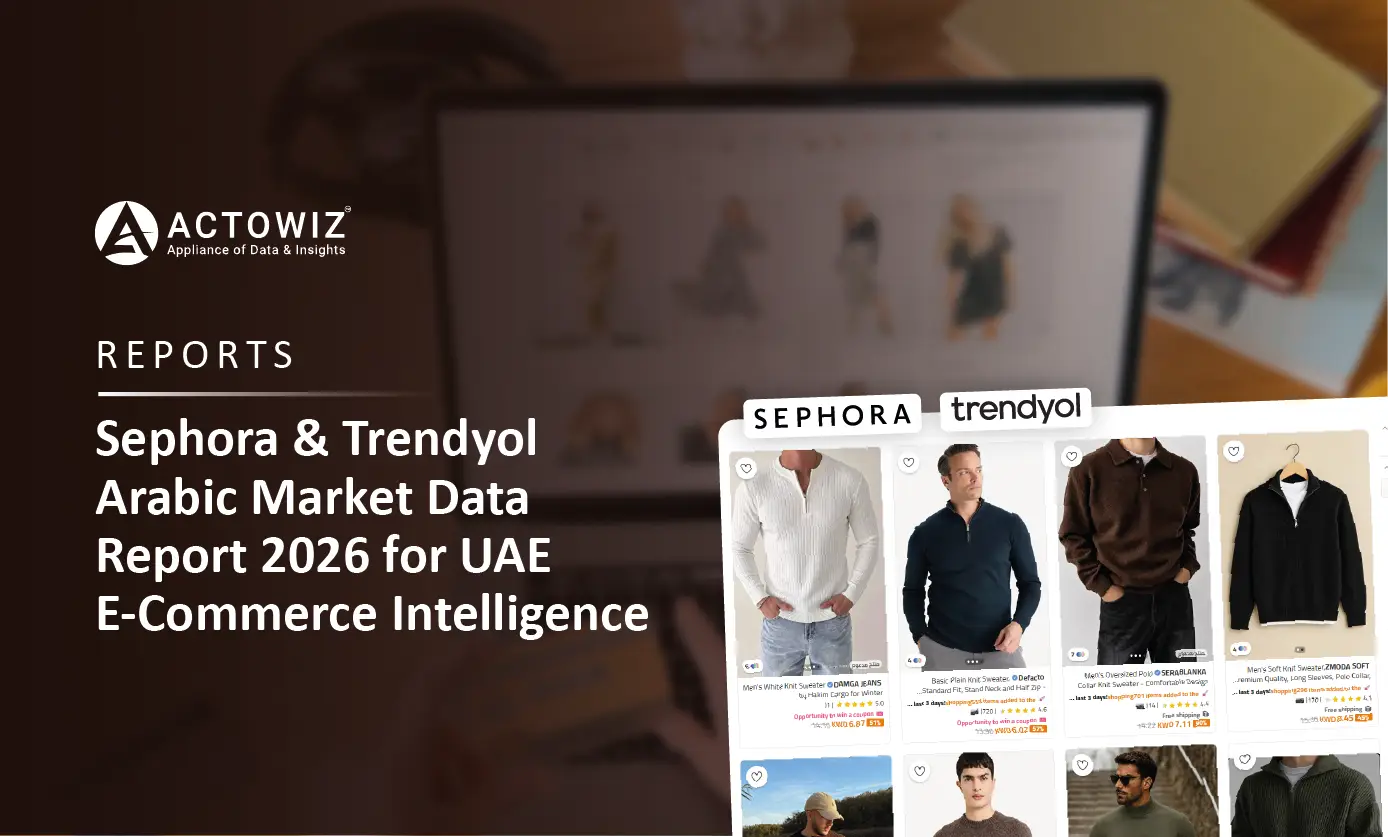
Sephora & Trendyol Arabic Market Data Report 2026 for UAE E-Commerce Intelligence

Sephora & Trendyol Arabic Market Data Report 2026 delivers UAE e-commerce intelligence on products, pricing, trends, and customer demand.

Start Where It Makes Sense for You

Whether you're a startup or a Fortune 500 — we have the right plan for your data needs.

icons
Enterprise
Book a Strategy Call
Custom solutions, dedicated support, volume pricing for large-scale needs.
icons
Growing Brand
Get Free Sample Data
Try before you buy — 500 rows of real data, delivered in 2 hours. No strings.
icons
Just Exploring
View Plans & Pricing
Transparent plans from $500/mo. Find the right fit for your budget and scale.

Request Free Sample Data

Our team will reach out within 2 hours with 500 rows of real data — no credit card required.

+1 ▼
✓ Free 500-row sample · No credit card · Response within 2 hours