Core services
Enterprise Data Extraction

Scalable web, app and AI-powered collection across 40+ countries.

All 58 services →
New 2026
AI Training Data

Corpus building with provenance and opt-out compliance.

Learn more →
Free pilot
24-hour sample

We run collection on your own sources before you commit.

Get a sample →
58Services
40+Countries
DEVELOPER

Ready-Made Scrapers

Pre-built for top platforms. Self-serve, no setup.

View All →
TRY FREE

API Playground

Test endpoints instantly. No credit card.

Start Free →
28Tools
2SDKs
icons Delivery & SDKs
Streaming Crawl API Scheduler Realtime Alerts Webhook Delivery 🐍 Python SDK 💚 Node.js SDK

Need it managed instead?

Fixed monthly retainer, named engineer, no per-request metering.

Managed Data API →
HOT

Case Studies

How brands use Actowiz, with named outcomes.

Read →
FREE

Sample Datasets

Real output, no signup.

Download →
NEW

ROI Calculator

Model the return on a data engagement.

Calculate →

Introduction

India's quick-commerce sector has moved from a convenience-focused delivery model into a significant digital retail channel covering groceries, packaged foods, beverages, FMCG products, household essentials, personal care, electronics, and other categories. The rapid expansion of dark stores, broader assortments, and increasing adoption across metropolitan and non-metro markets has created a large volume of product, pricing, availability, and category information for businesses to analyze.

The Quick Commerce Food Data Report 2026 examines how structured data from Blinkit and Instamart can help businesses understand product assortments, prices, discounts, availability, brands, pack sizes, and evolving consumer-facing retail patterns. The report focuses on the 2020–2026 period to show how quick commerce developed from an immediate grocery-delivery proposition into a broader retail model.

Quick Commerce Data Scraping Services can help convert publicly accessible marketplace information into structured datasets suitable for competitive intelligence, pricing analysis, assortment monitoring, FMCG research, and category-level reporting. Swiggy's FY2024–25 annual report, for example, reported 1,021 active Instamart dark stores at the end of FY2025, up from 523 a year earlier, while its dark-store footprint reached 4 million square feet. (Swiggy)

The scale of the sector makes systematic data collection increasingly relevant for FMCG brands, retailers, distributors, market researchers, and analytics teams.

Mapping Product and Pricing Patterns

The first requirement for quick-commerce intelligence is a consistent view of what products are available, how they are priced, and how those attributes change across locations and collection periods. Blinkit & Instamart Food Data Analysis enables businesses to compare product names, categories, brands, pack sizes, listed prices, discounts, availability, and other accessible attributes across two major platforms.

For FMCG companies, this can reveal differences in assortment and pricing at the platform or category level. A brand may have different product visibility, pack sizes, promotional pricing, or availability across marketplaces. Structured data makes these observations easier to compare.

Data Point Business Application
Product name Product identification
Brand Brand visibility analysis
Category Category benchmarking
Pack size Pack-level comparison
Listed price Price benchmarking
Discount Promotion monitoring
Availability Stock visibility
Product URL Product-level tracking
2020–2026 Perspective

Instamart launched in 2020, initially focused heavily on grocery and immediate household needs. Swiggy's FY2024–25 annual report describes the evolution of quick commerce from a 2020 model centered on immediate top-ups toward a broader "everything store" proposition covering groceries, FMCG, electronics, toys, books, stationery, and other categories. (Swiggy)

By FY2025, Instamart had expanded to 124 cities, with roughly one in four new users coming from non-metro cities, according to Swiggy. Its larger dark-store formats were designed to accommodate significantly more SKUs, including megapods capable of holding more than 50,000 SKUs. (Swiggy)

Industry research also shows the increasing scale of the sector. A 2025 MMA/Publicis Commerce report described Blinkit, Zepto, and Instamart as the leading quick-commerce platforms, together accounting for more than 85% of daily order volume at the time of its study. (MMA / Marketing + Media Alliance)

These developments make product-level data increasingly useful for businesses seeking to understand assortment depth, pricing differences, and platform-specific availability.

Year Quick-Commerce Development
2020 Instamart launched in India
2021 Quick commerce expanded beyond limited use cases
2022 Dark-store networks and product assortments expanded
2023 FMCG and grocery became major quick-commerce categories
2024 Platforms expanded geographic reach and assortment
2025 Instamart reached 124 cities and 1,021 active dark stores in FY2025
2026 Quick commerce continues expanding into broader retail categories

Understanding the Expanding FMCG Opportunity

Quick commerce has become increasingly important for FMCG brands because it provides a digital shelf where consumers can discover and purchase frequently used products within a short delivery window. The growing number of products and locations makes manual monitoring difficult, particularly for brands operating across multiple categories.

Quick Commerce FMCG Market Intelligence can help businesses monitor product visibility, price positioning, promotional activity, assortment breadth, and competitive presence across platforms. By combining product-level information with historical observations, companies can identify changes in the digital shelf and understand how their category environment evolves.

FMCG Intelligence Area What Businesses Can Monitor
Brand presence Platform visibility
Product assortment SKU availability
Pricing Listed and promotional prices
Pack sizes Size-level positioning
Discounts Promotional intensity
Availability Stock visibility
Category Competitive assortment
2020–2026 Perspective

The evolution from emergency top-ups to routine shopping has expanded the role of quick commerce in FMCG. Swiggy's FY2024–25 report specifically describes this shift, noting that Instamart moved from a narrower immediate-need proposition toward daily, weekly, and planned purchases across grocery and FMCG categories. (Swiggy)

The expansion of larger fulfillment facilities also supports greater product depth. Swiggy reported that larger Instamart stores could house up to 20,000 SKUs, while its 44 megapods covered 10,000–12,000 square feet and could hold more than 50,000 SKUs across grocery, FMCG, home and kitchen, toys, stationery, and other categories. (Swiggy)

By 2026, quick-commerce platforms were also expanding beyond traditional grocery. August 2026 industry data reported by Moneycontrol showed India's major quick-commerce platforms collectively crossing 9 million daily orders, with businesses increasingly adding premium foods, specialty beverages, and other categories. (Moneycontrol)

For FMCG brands, these developments increase the importance of tracking not just price but also assortment, availability, and competitive shelf presence.

Measuring Changes Across One Major Platform

Blinkit has become a major source of digital retail data for businesses tracking grocery and FMCG products. Its marketplace environment can contain multiple brands, categories, pack sizes, price points, and promotional offers, making recurring product monitoring valuable for competitive analysis.

Blinkit product and pricing analysis can help businesses compare product-level prices, identify discount patterns, monitor availability, and study assortment differences across categories. Historical observations can also help determine whether a price change is temporary or part of a broader pattern.

Blinkit Metric Example Business Use
Product price Competitive benchmarking
Discount Promotion tracking
Brand Brand visibility
Pack size Pack-level comparison
Availability Stock monitoring
Category Assortment analysis
Location Geographic comparison
2020–2026 Perspective

The quick-commerce market expanded considerably during the 2020–2026 period. The early model focused primarily on groceries and urgent purchases, but platforms subsequently increased assortment depth and geographic coverage.

By 2025, industry research continued to identify Blinkit as one of India's leading quick-commerce platforms. An MMA/Publicis Commerce report published in 2025 estimated Blinkit at 35% of order share in its market snapshot, compared with 22% for Instamart and 31% for Zepto. (MMA / Marketing + Media Alliance) A separate March 2025 Statista dataset also tracked market shares of India's major quick-commerce brands based on order volumes. (Statista)

Later 2026 reporting illustrates the continued scale of the sector. Moneycontrol reported in August 2026 that India's major quick-commerce platforms collectively exceeded 9 million daily orders, while Entrepreneur India reported Blinkit at approximately 3.4–3.6 million daily orders in that month's industry data. (Moneycontrol)

These figures are market measurements from different sources and periods, so they should not be treated as directly interchangeable. For brands, recurring product-level data provides a more granular view than market-level order estimates alone.

Tracking Assortment and Pricing on the Second Platform

Instamart has expanded from a grocery-oriented quick-commerce service into a broader digital retail platform. Its assortment now spans grocery, FMCG, household products, electronics, toys, stationery, and other categories, creating opportunities for detailed product and pricing research.

Instamart product and pricing analysis can help businesses examine product availability, pricing, promotions, category depth, brand presence, pack sizes, and changes over time. Comparing these observations across different locations can also help identify geographic differences in assortment and pricing.

Data Category Potential Analysis
Product SKU monitoring
Price Price benchmarking
Discount Promotion analysis
Category Category depth
Brand Competitive visibility
Availability Stock monitoring
Location Geographic assortment
2020–2026 Perspective

Swiggy launched Instamart in 2020, and its FY2024–25 annual report shows substantial expansion during the following years. Active dark stores increased from 301 in FY2022 to 1,021 in FY2025, while dark-store footprint reached 4 million square feet. (Swiggy)

The platform also expanded to 124 cities by FY2025. Swiggy reported that approximately one in four new users came from Tier 2 and Tier 3 cities, demonstrating the expansion of quick commerce beyond India's largest metropolitan markets. (Swiggy)

The broader product proposition also changed. Swiggy reported that larger formats could house up to 20,000 SKUs, while megapods could accommodate more than 50,000 SKUs. (Swiggy)

Swiggy's 2025 consumer-order analysis also highlighted demand beyond conventional grocery, including electronics and other non-grocery purchases. (Swiggy) This evolution means product and pricing research can no longer focus only on staple grocery items; it can also examine the expansion of FMCG and adjacent categories.

Capturing the Digital FMCG Shelf

FMCG brands increasingly need visibility into how their products appear on quick-commerce platforms. Product assortment, price positioning, promotional offers, availability, and competitor presence can all influence how consumers encounter a brand's digital shelf.

Businesses can Scrape FMCG product data from Blinkit & Instamart to create structured records containing product names, brands, categories, pack sizes, prices, discounts, availability, and other accessible information. With recurring collection, these records can be compared across time to monitor changes.

Dataset Field Intelligence Value
SKU/Product name Product identification
Brand Brand monitoring
Category Category benchmarking
Pack size Pack architecture
Price Price intelligence
Discount Promotion monitoring
Availability Stock visibility
Timestamp Historical tracking
2020–2026 Perspective

Between 2020 and 2026, quick commerce developed from a narrow convenience service into a broader digital retail channel. Instamart's reported evolution from immediate top-ups toward grocery, FMCG, electronics, toys, books, and other categories illustrates this transition. (Swiggy)

The scale of infrastructure also changed the potential depth of the digital shelf. In FY2025, Instamart reported 1,021 active dark stores and 4 million square feet of dark-store footprint. (Swiggy)

By 2026, industry reports showed continued expansion. Moneycontrol reported more than 9 million daily quick-commerce orders across major platforms in August 2026, while Entrepreneur India reported 3.4–3.6 million daily Blinkit orders and 1.3–1.45 million daily Instamart orders for that month. (Moneycontrol)

For FMCG companies, this scale creates a need for repeatable monitoring. A single manual check cannot capture changes occurring across thousands of products and locations. Structured datasets can instead support recurring digital-shelf analysis.

Monitoring Localized Delivery and Grocery Availability

Quick-commerce operates through hyperlocal fulfillment, meaning product availability can differ according to city, neighborhood, dark-store coverage, inventory, and demand. This makes location-specific data particularly important for businesses seeking a realistic view of digital grocery availability.

Scrape Blinkit Grocery Delivery Data can help businesses structure accessible information around grocery products, prices, categories, availability, and location-specific observations. When collection is repeated across selected locations, the resulting dataset can support geographic comparisons and historical monitoring.

Location-Level Metric Possible Insight
Product availability Local stock visibility
Product price Geographic price comparison
Category assortment Local assortment depth
Brand presence Regional brand visibility
Delivery availability Service-area monitoring
Collection timestamp Historical comparison
2020–2026 Perspective

Hyperlocal coverage has been central to quick-commerce development. The model depends on dark stores or fulfillment centers positioned close enough to customers to support rapid delivery. As platforms expanded into new cities, the geographic dimension of product data became increasingly important.

Swiggy reported that Instamart expanded to 124 cities in FY2025 and that roughly one-third of dark-store additions that year were in new cities. (Swiggy) The company also reported 1,021 active dark stores at the end of FY2025. (Swiggy)

In 2026, Swiggy's reported quick-commerce network had expanded further, with a later directors' report citing approximately 130 locations and 1,143 active dark stores, alongside an average order value of ₹691 for FY2025–26. (The Economic Times)

This geographic expansion creates more opportunities for location-level product research. Businesses can examine whether assortment and pricing are consistent across markets or whether localized availability and demand create meaningful differences.

Actowiz Solutions can help businesses transform online quick-commerce information into structured datasets designed for research, monitoring, and analytics. The process can combine data collection, normalization, validation, categorization, and recurring delivery so that businesses receive consistent information for ongoing analysis.

The Quick Commerce Food Data Report 2026 demonstrates how product and pricing intelligence can be used to understand Blinkit and Instamart at multiple levels, from individual SKUs and brands to broader category and geographic trends.

A scalable workflow can support recurring Instamart Data Scraping for product names, prices, discounts, categories, availability, pack sizes, and other accessible attributes. Similar workflows can be applied to Blinkit and other quick-commerce platforms depending on project requirements and data availability.

The resulting datasets can support FMCG brands, retailers, distributors, market researchers, pricing teams, and business intelligence professionals. Instead of relying exclusively on manual checks, businesses can establish repeatable data pipelines that make historical comparison and trend analysis more practical.

Actowiz Solutions can also structure outputs for spreadsheets, databases, dashboards, APIs, or analytical environments, depending on the client's requirements.

Conclusion

Quick commerce has developed rapidly between 2020 and 2026, expanding from immediate grocery delivery into a broader digital retail environment covering FMCG, packaged foods, household products, electronics, toys, personal care, and other categories. The expansion of dark stores and geographic coverage has created a large and continually changing source of product, pricing, assortment, and availability information.

The Quick Commerce Food Data Report 2026 shows how structured marketplace data can support competitive pricing analysis, FMCG intelligence, product monitoring, category research, and location-level comparisons. Swiggy's reported expansion of Instamart from 301 active dark stores in FY2022 to 1,021 in FY2025 illustrates the scale of infrastructure growth, while 2026 industry reports indicate continued expansion of daily quick-commerce orders. (Swiggy)

Businesses can combine Web Crawling service capabilities with Web Data Mining methodologies to organize recurring online retail observations into analytics-ready datasets. These workflows can help reduce manual research and provide a structured foundation for monitoring rapidly changing digital shelves.

Partner with Actowiz Solutions to build scalable quick-commerce data solutions for product, pricing, FMCG, assortment, and competitive market intelligence!

Social Proof That Converts

Trusted by Global Leaders Across Q-Commerce, Travel, Retail, and FoodTech

Our web scraping expertise is relied on by 4,000+ global enterprises including Zomato, Tata Consumer, Subway, and Expedia — helping them turn web data into growth.

4,000+ Enterprises Worldwide
50+ Countries Served
20+ Industries
Join 4,000+ companies growing with Actowiz →
Real Results from Real Clients

Hear It Directly from Our Clients

Watch how businesses like yours are using Actowiz data to drive growth.

▶
1 min
★★★★★
"Actowiz Solutions offered exceptional support with transparency and guidance throughout. Anna and Saga made the process easy for a non-technical user like me. Great service, fair pricing!"
TG
Thomas Galido
Co-Founder / Head of Product at Upright Data Inc.
▶
2 min
★★★★★
"Actowiz delivered impeccable results for our company. Their team ensured data accuracy and on-time delivery. The competitive intelligence completely transformed our pricing strategy."
II
Iulen Ibanez
CEO / Datacy.es
▶
1:30
★★★★★
"What impressed me most was the speed — we went from requirement to production data in under 48 hours. The API integration was seamless and the support team is always responsive."
FC
Febbin Chacko
-Fin, Small Business Owner
icons 4.8/5 Average Rating
icons 50+ Video Testimonials
icons 92% Client Retention
icons 50+ Countries Served

Join 4,000+ Companies Growing with Actowiz

From Zomato to Expedia — see why global leaders trust us with their data.

Why Global Leaders Trust Actowiz

Backed by automation, data volume, and enterprise-grade scale — we help businesses from startups to Fortune 500s extract competitive insights across the USA, UK, UAE, and beyond.

icons
7+
Years of Experience
Proven track record delivering enterprise-grade web scraping and data intelligence solutions.
icons
4,000+
Projects Delivered
Serving startups to Fortune 500 companies across 50+ countries worldwide.
icons
200+
In-House Experts
Dedicated engineers across scrapers, AI/ML models, APIs, and data quality assurance.
icons
9.2M
Automated Workflows
Running weekly across eCommerce, Quick Commerce, Travel, Real Estate, and Food industries.
icons
270+ TB
Data Transferred
Real-time and batch data scraping at massive scale, across industries globally.
icons
380M+
Pages Crawled Weekly
Scaled infrastructure for comprehensive global data coverage with 99% accuracy.

AI Solutions Engineered
for Your Needs

→
LLM-Powered Attribute Extraction: High-precision product matching using large language models for accurate data classification.
→
Advanced Computer Vision: Fine-grained object detection for precise product classification using text and image embeddings.
→
GPT-Based Analytics Layer: Natural language query-based reporting and visualization for business intelligence.
→
Human-in-the-Loop AI: Continuous feedback loop to improve AI model accuracy over time.
icons Product Matching icons Attribute Tagging icons Content Optimization icons Sentiment Analysis icons Prompt-Based Reporting

Connect the Dots Across
Your Retail Ecosystem

We partner with agencies, system integrators, and technology platforms to deliver end-to-end solutions across the retail and digital shelf ecosystem.

icons
Analytics Services
icons
Ad Tech
icons
Price Optimization
icons
Business Consulting
icons
System Integration
icons
Market Research
Become a Partner →

Popular Datasets — Ready to Download

Browse All Datasets →
icons
Amazon
eCommerce
Free 100 rows
icons
Zillow
Real Estate
Free 100 rows
icons
DoorDash
Food Delivery
Free 100 rows
icons
Walmart
Retail
Free 100 rows
icons
Booking.com
Travel
Free 100 rows
icons
Indeed
Jobs
Free 100 rows

Latest Insights & Resources

View All Resources →
thumb
Blog

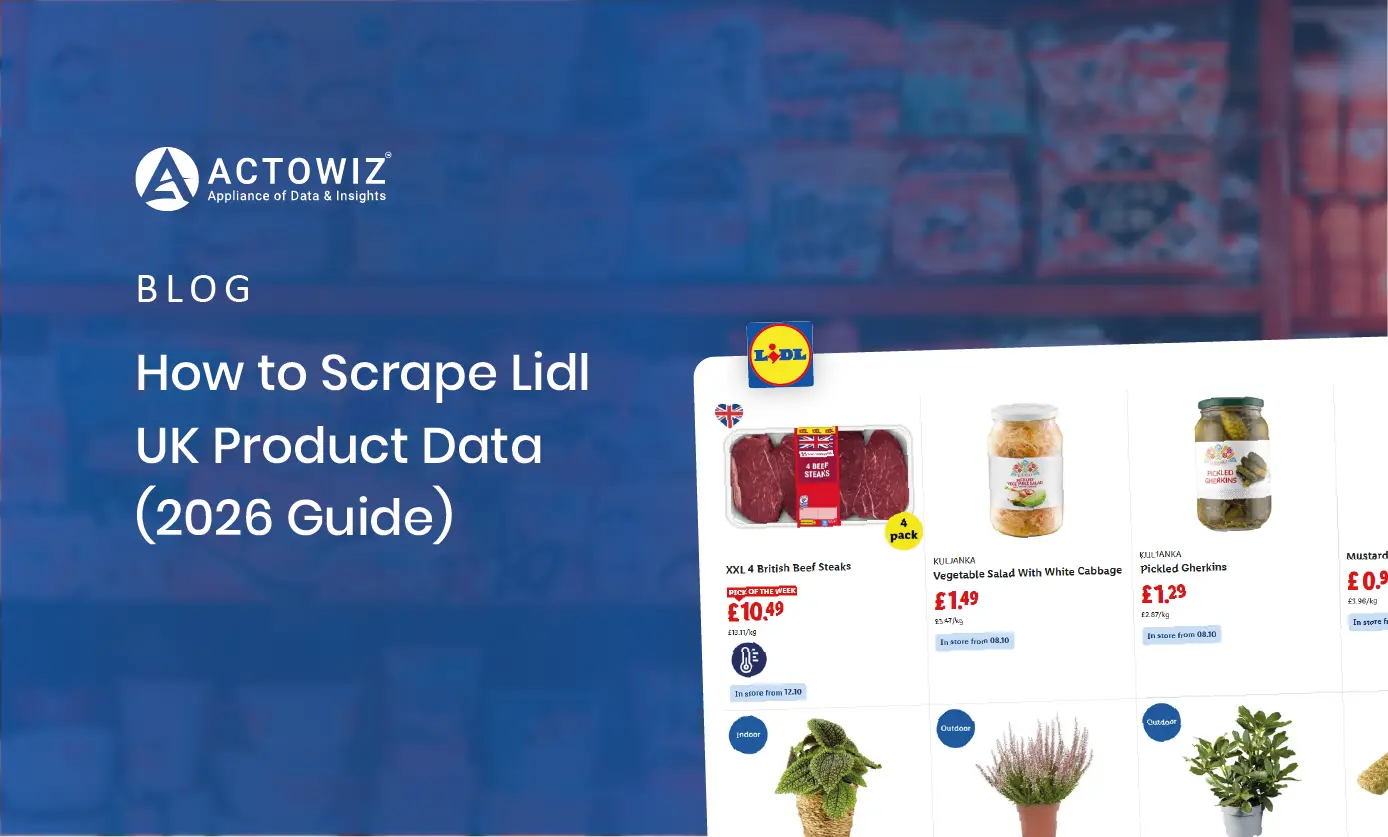
How to Scrape Lidl UK Product Data (2026 Guide)

Extract Lidl UK product and price data at scale. What Lidl Plus data is app-gated and off-limits, Middle of Lidl capture, discounter matching and compliance.

thumb
Case Study

How Multi-Channel Marketplace Inventory Scraping API Helps Brands Monitor Inventory Across Amazon, Flipkart, and Myntra

Multi-Channel Marketplace Inventory Scraping API helps brands monitor product stock, availability, and inventory changes across Amazon, Flipkart, and Myntra.

thumb
Report

Sephora & Trendyol Arabic Market Data Report 2026 for UAE E-Commerce Intelligence

Sephora & Trendyol Arabic Market Data Report 2026 delivers UAE e-commerce intelligence on products, pricing, trends, and customer demand.

Start Where It Makes Sense for You

Whether you're a startup or a Fortune 500 — we have the right plan for your data needs.

icons
Enterprise
Book a Strategy Call
Custom solutions, dedicated support, volume pricing for large-scale needs.
icons
Growing Brand
Get Free Sample Data
Try before you buy — 500 rows of real data, delivered in 2 hours. No strings.
icons
Just Exploring
View Plans & Pricing
Transparent plans from $500/mo. Find the right fit for your budget and scale.

Request Free Sample Data

Our team will reach out within 2 hours with 500 rows of real data — no credit card required.

+1 ▼
✓ Free 500-row sample · No credit card · Response within 2 hours