Core services
Enterprise Data Extraction

Scalable web, app and AI-powered collection across 40+ countries.

All 58 services →
New 2026
AI Training Data

Corpus building with provenance and opt-out compliance.

Learn more →
Free pilot
24-hour sample

We run collection on your own sources before you commit.

Get a sample →
58Services
40+Countries
DEVELOPER

Ready-Made Scrapers

Pre-built for top platforms. Self-serve, no setup.

View All →
TRY FREE

API Playground

Test endpoints instantly. No credit card.

Start Free →
28Tools
2SDKs
icons Delivery & SDKs
Streaming Crawl API Scheduler Realtime Alerts Webhook Delivery 🐍 Python SDK 💚 Node.js SDK

Need it managed instead?

Fixed monthly retainer, named engineer, no per-request metering.

Managed Data API →
HOT

Case Studies

How brands use Actowiz, with named outcomes.

Read →
FREE

Sample Datasets

Real output, no signup.

Download →
NEW

ROI Calculator

Model the return on a data engagement.

Calculate →
Food delivery commission and menu price markup analysis for restaurants

Introduction

Saudi Arabia is one of the most data-hungry retail markets in the Gulf. The Ministry of Commerce counted 43,854 e-commerce commercial registrations at the end of Q4 2025, up from 40,041 a year earlier, with Riyadh, Makkah and Eastern provinces leading (Sharikat Mubasher, citing MoC). More online sellers mean more prices, more promotions and more catalogue changes to track every day.

What is a retail data API for Saudi Arabia? A retail data API for Saudi Arabia is a managed feed that collects public product, price, promotion, stock and seller data from KSA marketplaces and retailer websites, matches Arabic and English listings to one product record, normalises prices in SAR (including 15% VAT), and delivers it on a fixed schedule through REST API, S3, Snowflake or BigQuery.

This guide is for data and analytics heads, e-commerce directors and pricing teams at brands, retailers and distributors selling in KSA. It focuses on the engineering and governance side: which sources matter, how bilingual matching works, what a realistic SLA looks like, what the Saudi PDPL means for a public-data feed, and what to put in your RFP.

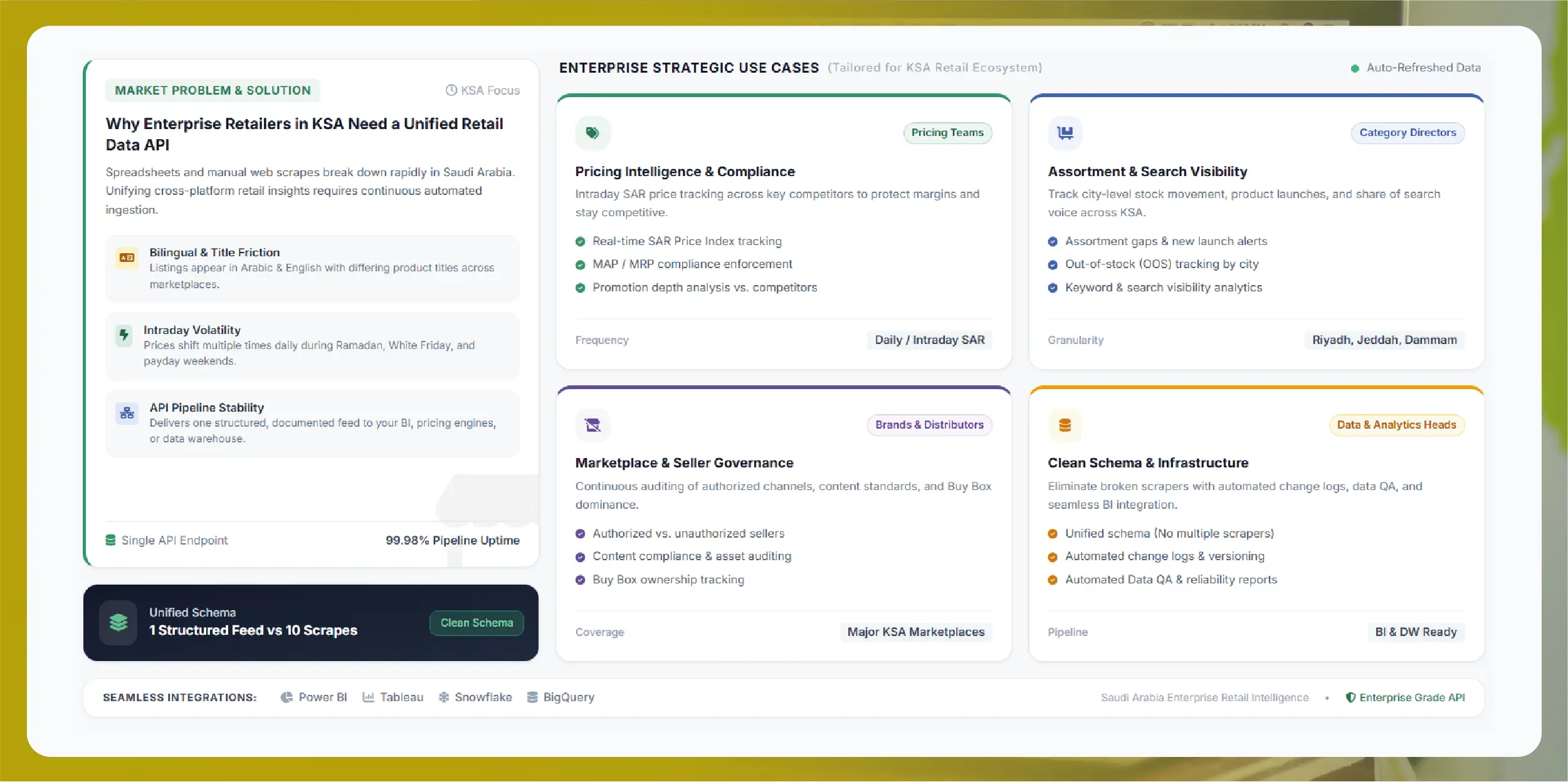
Why do enterprises in Saudi Arabia need a retail data API?

Food delivery commission and menu price markup analysis for restaurants

Spreadsheets and one-off scrapes break down quickly in KSA. Listings appear in Arabic and English, the same product carries different titles on each platform, and prices change several times a day around Ramadan, White Friday and payday weekends. A retail data API turns this into a stable, documented feed that your BI, pricing engine or data warehouse can rely on.

  • Pricing teams use daily or intraday SAR prices to check price index, MAP / MRP compliance and promotion depth versus key competitors.
  • E-commerce and category directors track assortment gaps, new launches, out-of-stocks and search visibility by city.
  • Brands and distributors monitor authorised and unauthorised sellers, content compliance and Buy Box ownership on marketplaces.
  • Data and analytics heads need one clean schema, change logs and QA reports – not ten different scraper outputs.

Which Saudi platforms and retailers should a retail data API cover?

Coverage should follow where your category actually sells. The table below shows the main public online channels in KSA and what each one typically adds to a feed. Exact coverage, fields and refresh are confirmed during scoping, and only publicly visible data is collected.

Channel type Examples (public online stores) What it adds to the feed Data notes

Marketplaces Amazon.sa, Noon Multi-seller prices, Buy Box / featured offer, ratings, delivery promises Many sellers per product; Arabic and English page versions
Fashion & lifestyle Namshi, brand stores of global fashion retailers Sizes, colours, size availability, sale prices Large, fast-changing catalogues; frequent markdowns
Electronics & office Jarir, eXtra Model-level prices, bundles, instalment offers, stock by store/city where shown Model numbers help matching; promotions tied to bank cards
Grocery & pharmacy Tamimi Markets Online, Nahdi; other chains with public online stores Pack-size prices, multi-buy promotions, availability by city City or store selection changes price and stock
D2C brand stores Stores built on Salla or Zid Brand-direct prices, launches, bundles Many small stores; consistent templates help scale

In-body image 1: ksa-bilingual-product-matching-flow.png | Alt: 'Arabic and English product titles matched to one canonical SKU'

What data fields should a Saudi retail data feed include?

A good schema is agreed before the first crawl. These are the field groups most enterprise buyers in KSA ask for:

  • Identity: platform, product ID / ASIN / SKU, product URL, brand, model number, GTIN where publicly shown, canonical match ID.
  • Bilingual content: title_en, title_ar, description_en, description_ar, category path in both languages, attributes (size, colour, volume, pack count).
  • Price in SAR: list price, sale price, unit price, currency, VAT-inclusive flag. Consumer prices in KSA are normally shown including VAT, which has been 15% since 1 July 2020 (ZATCA).
  • Promotions: discount %, coupon text, bank-card or BNPL offer text, bundle and multi-buy rules, event tag (Ramadan, White Friday, 11.11).
  • Availability: in stock / out of stock, size-level availability, delivery promise, and city context (Riyadh, Jeddah, Dammam) where the site prices or stocks by location.
  • Sellers: seller name and seller ID as publicly shown for businesses, number of offers, fulfilment type (e.g. marketplace-fulfilled vs seller-fulfilled).
  • Ratings & rank: rating, review count, search or category rank for tracked keywords.
  • Metadata: crawl timestamp (UTC and Asia/Riyadh), source language, change flags versus the previous run.

How does bilingual Arabic-English matching work?

Bilingual matching is where most KSA feeds succeed or fail. The same perfume can appear as an English title on one site, an Arabic title on another, and a mixed title on a third. A solid retail data API handles this in layers:

  • Collect both language versions of each product page where the site offers them (for example /en/ and /ar/ paths), rather than machine-translating one side.
  • Normalise text: unify Arabic letter forms (such as alef and taa marbuta variants), strip diacritics, convert Arabic-Indic digits (٠-٩) to Western digits, and standardise units (مل / ml, جم / g).
  • Use hard keys first: model numbers, GTINs where visible, brand + size + variant.
  • Then fuzzy and semantic matching across languages, with confidence scores and a human review queue for low-confidence pairs.
  • Keep a match table (canonical ID to platform IDs) that you can audit, override and version over time.

How is the feed collected, checked and delivered?

Enterprise buyers should ask for the full pipeline, not just a scraper. A typical Actowiz set-up for KSA looks like this:

Stage What happens What to ask a provider
Collection Scheduled crawls of public pages per platform, city and language; respectful rate limits; no logins bypassed Which pages, which cities, how often, and what happens when a site changes
Normalisation SAR prices parsed, VAT flag set, units and sizes standardised, Arabic text normalised Show a sample with raw vs normalised values
Matching Bilingual product matching to your master list with confidence scores Match-rate on our SKUs; how overrides work
QA Schema checks, null-rate and price-jump alerts, row-count vs previous run, manual spot checks Daily QA report; what is a breach and how fast is it fixed
Change monitoring Diffs on price, stock, title, image and seller; site-layout change alerts Change log format and alert channel
Delivery REST API (JSON), CSV/JSON files to S3 / Azure / GCS, direct loads to Snowflake or BigQuery Delivery time in Asia/Riyadh, retries, history retention

SLA: agree delivery time, freshness (for example daily by 07:00 Riyadh time, or intraday during events), completeness target per source, and response time for breakages. Avoid any provider promising '100% accuracy' – public websites change, and good providers show how they detect and repair gaps. A sample feed can usually be shared within 48 hours of a scoped request.

In-body image 2: ksa-retail-feed-delivery-architecture.png | Alt: 'Saudi retail data feed delivered via REST API, S3, Snowflake and BigQuery'

How should feed frequency change by category and season?

Refresh rate drives cost and value. Match it to how fast each category moves and to the KSA retail calendar. Ramadan and the two Eids follow the Hijri calendar and move roughly 11 days earlier each year; Saudi National Day is fixed on 23 September (Argaam); White Friday runs in late November across Saudi Arabia and the UAE (Amazon Ads); and Amazon.sa has run an 11.11 sale (Arab News, sponsored).

Category / use case Normal refresh Event refresh Key fields
Consumer electronics (Jarir, eXtra, marketplaces) Daily 2–4x daily around White Friday, 11.11 and National Day Model price, bundles, card offers, stock
Fashion & footwear Daily Daily plus markdown diffs during Ramadan/Eid and end-of-season sales Sale price, size availability, new arrivals
Grocery & FMCG Daily or weekly Daily through Ramadan and pre-Eid Pack price, multi-buy, availability by city
Health & beauty / pharmacy Weekly to daily Daily during White Friday and gifting seasons Promo depth, bundles, OOS
Seller / MAP monitoring Daily Intraday on hero SKUs Seller list, lowest offer, Buy Box

In-body image 3: ksa-retail-event-calendar.png | Alt: 'Saudi retail event calendar – Ramadan, Eid, National Day, White Friday, 11.11'

Use cases for a retail data API in Saudi Arabia

  • Price index and competitive response: daily SAR price index by category against named competitors, with VAT handled consistently.
  • Promotion intelligence: depth, mechanics and timing of discounts around Ramadan, Eid, National Day and White Friday.
  • Assortment and launch tracking: new SKUs, delistings and range gaps across Amazon.sa, Noon and specialist retailers.
  • Digital shelf and content compliance: Arabic and English titles, images and attributes versus your brand guidelines.
  • Seller and channel governance: spot unauthorised sellers and below-policy offers on marketplaces.
  • City-level availability: compare stock and delivery promises in Riyadh, Jeddah and Dammam where sites expose them.

What does the Saudi PDPL mean for a retail data feed?

Saudi Arabia's Personal Data Protection Law (PDPL) is overseen by the Saudi Data and Artificial Intelligence Authority (SDAIA; see also SDAIA's PDPL guide). It entered into force on 14 September 2023, and enforcement began after a one-year grace period in September 2024 (Baker McKenzie).

In plain words: the PDPL governs data that identifies people. A retail data feed should be built around product, price, promotion, stock and business-seller data – not shoppers. Actowiz feeds exclude personal data such as reviewer names, profile links or contact details unless there is a clear lawful basis, and we do not log in to or bypass protected areas.

  • Data residency: product and price data is not personal data, but your security team may still prefer storage in a specific cloud region. Ask where the feed is processed and stored, and whether delivery to a KSA or GCC region bucket is possible.
  • Usage rights: agree in the contract how the data may be used internally and whether it can be shared with agencies or partners.
  • Site terms: a provider should respect each site's terms and robots guidance and explain its approach.

This is general information, not legal advice. Speak to your counsel about your specific use case.

Build vs buy: what should go in your RFP?

Some teams start with an in-house scraper and move to a managed feed once bilingual matching, anti-bot changes and event-season load become a full-time job. Use these points to compare options:

RFP item Why it matters in KSA
Source list by platform, category and city Prices and stock can differ between Riyadh, Jeddah and Dammam
Arabic + English capture and matching method Avoids duplicate products and missed competitors
Field dictionary with SAR / VAT rules Keeps price indices comparable across sites
Refresh plan incl. event mode Ramadan, White Friday and 11.11 need higher frequency
Delivery options (API, S3, Snowflake, BigQuery) Fits your existing data stack
SLA, QA reports and change monitoring Defines what 'good' looks like and how breaks are fixed
PDPL position, data residency and security Answers your legal and InfoSec reviews early
48-hour sample on your own SKUs Proves coverage and match quality before you sign

Frequently Asked Questions

What is a retail data API for Saudi Arabia?

It is a managed feed of public product, price, promotion, stock and seller data from KSA marketplaces and retailers, normalised in SAR, matched across Arabic and English listings and delivered by API or cloud storage on a fixed schedule.

Can you deliver both Arabic and English titles and descriptions?

Yes. Where a site offers both language versions, we collect each one and link them to the same product record, so you get title_en and title_ar side by side.

Are prices delivered including VAT?

Consumer prices in KSA are usually shown including the 15% VAT. We capture the displayed SAR price and add a VAT-inclusive flag so you can calculate net prices consistently.

How fresh is the data and how is it delivered?

Daily is the most common cadence, with intraday runs available for hero SKUs and event periods. Delivery options include REST API (JSON), CSV/JSON to S3, Azure or GCS, and loads into Snowflake or BigQuery.

Does the feed include personal data?

No. Feeds are built on product and business-seller data. Shopper or reviewer personal data is excluded, in line with the Saudi PDPL. Please check specific questions with your counsel.

How quickly can we see a sample?

After a short scoping call, a sample on your own SKUs and platforms can usually be shared within 48 hours.

Planning a Saudi retail data feed or preparing an RFP? Share your company email, use case, platforms, cities and SKU volume – we will scope it and send a bilingual sample within 48 hours.
Contact Us Today!

Conclusion

You can also reach us for all your mobile app scraping, data collection, web scraping, and instant data scraper service requirements!

Social Proof That Converts

Trusted by Global Leaders Across Q-Commerce, Travel, Retail, and FoodTech

Our web scraping expertise is relied on by 4,000+ global enterprises including Zomato, Tata Consumer, Subway, and Expedia — helping them turn web data into growth.

4,000+ Enterprises Worldwide
50+ Countries Served
20+ Industries
Join 4,000+ companies growing with Actowiz →
Real Results from Real Clients

Hear It Directly from Our Clients

Watch how businesses like yours are using Actowiz data to drive growth.

▶
1 min
★★★★★
"Actowiz Solutions offered exceptional support with transparency and guidance throughout. Anna and Saga made the process easy for a non-technical user like me. Great service, fair pricing!"
TG
Thomas Galido
Co-Founder / Head of Product at Upright Data Inc.
▶
2 min
★★★★★
"Actowiz delivered impeccable results for our company. Their team ensured data accuracy and on-time delivery. The competitive intelligence completely transformed our pricing strategy."
II
Iulen Ibanez
CEO / Datacy.es
▶
1:30
★★★★★
"What impressed me most was the speed — we went from requirement to production data in under 48 hours. The API integration was seamless and the support team is always responsive."
FC
Febbin Chacko
-Fin, Small Business Owner
icons 4.8/5 Average Rating
icons 50+ Video Testimonials
icons 92% Client Retention
icons 50+ Countries Served

Join 4,000+ Companies Growing with Actowiz

From Zomato to Expedia — see why global leaders trust us with their data.

Why Global Leaders Trust Actowiz

Backed by automation, data volume, and enterprise-grade scale — we help businesses from startups to Fortune 500s extract competitive insights across the USA, UK, UAE, and beyond.

icons
7+
Years of Experience
Proven track record delivering enterprise-grade web scraping and data intelligence solutions.
icons
4,000+
Projects Delivered
Serving startups to Fortune 500 companies across 50+ countries worldwide.
icons
200+
In-House Experts
Dedicated engineers across scrapers, AI/ML models, APIs, and data quality assurance.
icons
9.2M
Automated Workflows
Running weekly across eCommerce, Quick Commerce, Travel, Real Estate, and Food industries.
icons
270+ TB
Data Transferred
Real-time and batch data scraping at massive scale, across industries globally.
icons
380M+
Pages Crawled Weekly
Scaled infrastructure for comprehensive global data coverage with 99% accuracy.

AI Solutions Engineered
for Your Needs

→
LLM-Powered Attribute Extraction: High-precision product matching using large language models for accurate data classification.
→
Advanced Computer Vision: Fine-grained object detection for precise product classification using text and image embeddings.
→
GPT-Based Analytics Layer: Natural language query-based reporting and visualization for business intelligence.
→
Human-in-the-Loop AI: Continuous feedback loop to improve AI model accuracy over time.
icons Product Matching icons Attribute Tagging icons Content Optimization icons Sentiment Analysis icons Prompt-Based Reporting

Connect the Dots Across
Your Retail Ecosystem

We partner with agencies, system integrators, and technology platforms to deliver end-to-end solutions across the retail and digital shelf ecosystem.

icons
Analytics Services
icons
Ad Tech
icons
Price Optimization
icons
Business Consulting
icons
System Integration
icons
Market Research
Become a Partner →

Popular Datasets — Ready to Download

Browse All Datasets →
icons
Amazon
eCommerce
Free 100 rows
icons
Zillow
Real Estate
Free 100 rows
icons
DoorDash
Food Delivery
Free 100 rows
icons
Walmart
Retail
Free 100 rows
icons
Booking.com
Travel
Free 100 rows
icons
Indeed
Jobs
Free 100 rows

Latest Insights & Resources

View All Resources →
thumb
Blog

Multi-Country Ecommerce Data for Singapore Regional HQs: The Complete Guide (2026)

Plan multi-country ecommerce data from Singapore: Shopee, Lazada and grocers in 6 SEA markets, SGD-normalised, one schema.

thumb
Case Study

How Sensitive Skin Skincare Product Data API Helps Brands Track Cleansers, Serums, Moisturizers, and Sunscreens

Sensitive Skin Skincare Product Data API helps brands track cleansers, serums, moisturizers, and sunscreens with structured product data.

thumb
Report

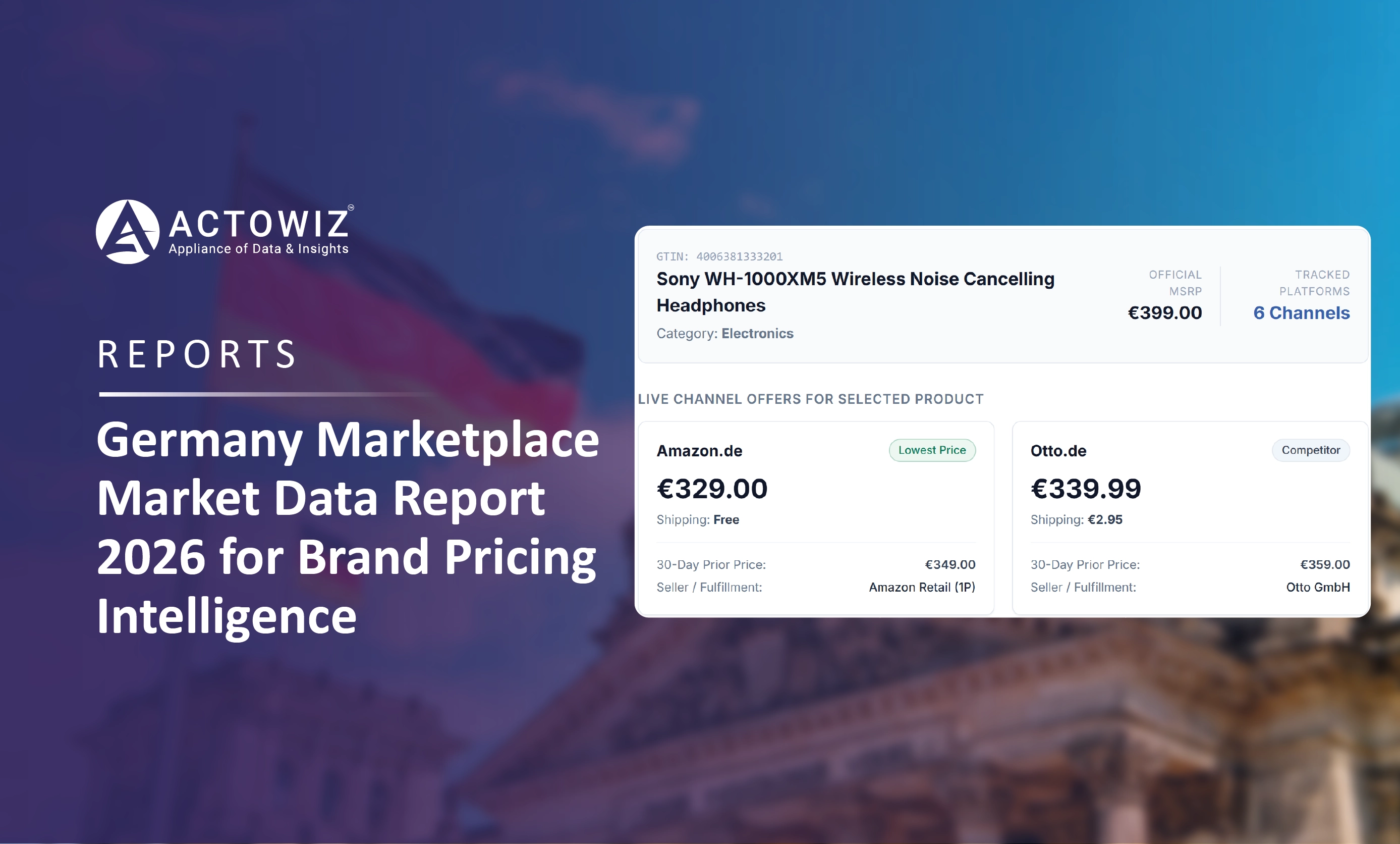
Germany Marketplace Market Data Report 2026 for Brand Pricing Intelligence

German marketplace data report 2026: online retail size, Amazon.de, Otto, Kaufland and Zalando price signals, PAngV rules and peak seasons.

Start Where It Makes Sense for You

Whether you're a startup or a Fortune 500 — we have the right plan for your data needs.

icons
Enterprise
Book a Strategy Call
Custom solutions, dedicated support, volume pricing for large-scale needs.
icons
Growing Brand
Get Free Sample Data
Try before you buy — 500 rows of real data, delivered in 2 hours. No strings.
icons
Just Exploring
View Plans & Pricing
Transparent plans from $500/mo. Find the right fit for your budget and scale.
Get in Touch
Let's Talk About
Your Data Needs
Tell us what data you need — we'll scope it for free and share a sample within hours.
  • icons
    Free Sample in 2 HoursShare your requirement, get 500 rows of real data — no commitment.
  • icons
    Plans from $500/monthFlexible pricing for startups, growing brands, and enterprises.
  • icons
    US-Based SupportOffices in New York & California. Aligned with your timezone.
  • icons
    ISO 9001 & 27001 CertifiedEnterprise-grade security and quality standards.
Request Free Sample Data
Fill the form below — our team will reach out within 2 hours.
+1 ▼
✓ Free 500-row sample · No credit card · Response within 2 hours

Request Free Sample Data

Our team will reach out within 2 hours with 500 rows of real data — no credit card required.

+1 ▼
✓ Free 500-row sample · No credit card · Response within 2 hours