Introduction
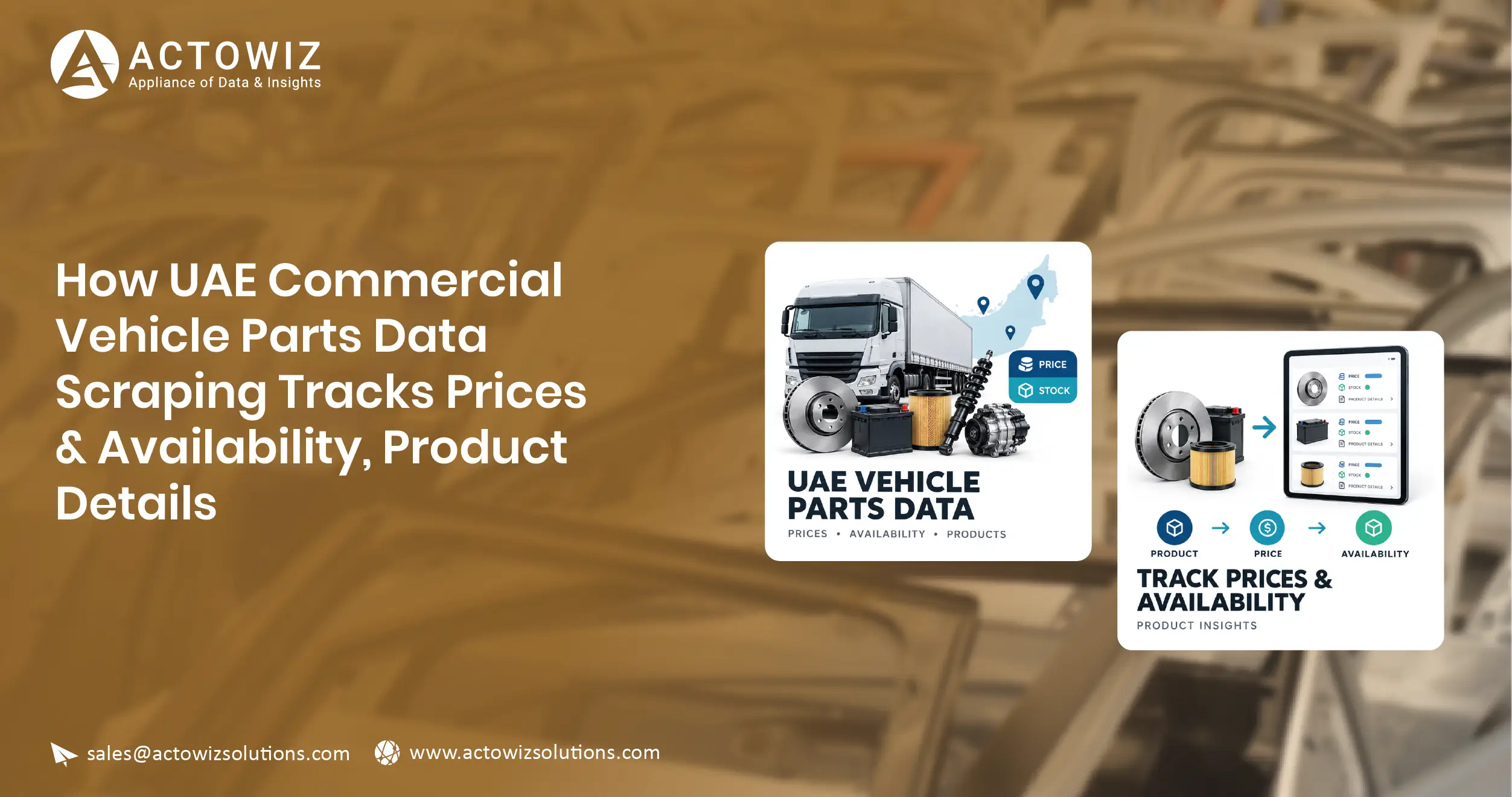
Scrape UAE Commercial Vehicle Parts Data helps automotive businesses overcome fragmented product information by collecting, standardizing, and monitoring commercial vehicle parts data across relevant digital sources. The resulting datasets can support price tracking, availability monitoring, catalog intelligence, competitor research, and market analysis.
The UAE commercial vehicle ecosystem has substantial scale. OICA data shows that UAE commercial vehicle sales increased from 28,810 units in 2020 to 37,403 units in 2024, a 29.8% increase over the period. Commercial vehicle sales also rose 10.8% year over year in 2024.
At the same time, Dubai's Roads and Transport Authority reported that more than 400,000 vehicles were registered in Dubai's commercial and logistics transport sector in 2024, up 31% from 2023. The number of companies operating in that sector increased from 9,000 to 12,100.
This creates a practical data challenge for parts manufacturers, distributors, wholesalers, retailers, fleet operators, and automotive marketplaces. A single commercial vehicle part may be listed under different names, SKUs, brands, specifications, and prices across multiple sellers.
Automotive Data Scraping Services can automate this repetitive process by collecting product names, part numbers, brands, compatibility information, prices, discounts, stock status, specifications, seller information, and URLs into a structured dataset.
The core question is therefore: How can businesses keep track of UAE commercial vehicle parts accurately when prices, inventory, and product information continuously change? The answer is to build a recurring, structured data pipeline that combines automated collection with normalization, validation, deduplication, historical tracking, and analytics.
Why Is Commercial Vehicle Parts Data Difficult to Track Manually?
Commercial vehicle parts catalogs are more complicated than simple product lists. A single component may have an OEM number, aftermarket number, manufacturer reference, vehicle compatibility information, dimensions, material, warranty details, and multiple seller listings.
Manual monitoring becomes particularly difficult when businesses need to compare hundreds or thousands of SKUs across multiple websites.
| Common challenge | Business impact | Data-driven solution |
|---|
| Different product names | Difficult catalog matching | Product-name normalization |
| Multiple part numbers | Duplicate products | SKU and part-number mapping |
| Changing prices | Outdated benchmarks | Recurring price monitoring |
| Stock fluctuations | Poor availability visibility | Scheduled availability checks |
| Different specifications | Incorrect comparisons | Structured attribute extraction |
| Multiple sellers | Fragmented market view | Seller-level datasets |
| New product listings | Delayed catalog updates | Automated discovery |
| Discontinued products | Outdated inventory records | Historical change tracking |
The problem is not simply collecting more information. Businesses need consistent, comparable, and refreshable information.
A reliable commercial vehicle parts dataset can allow users to compare the same product across sellers, identify price movements, detect stock changes, and analyze which product categories are gaining visibility.
How Can Businesses Build a Reliable View of the UAE Parts Market?
UAE Commercial Vehicle Spare Parts Market Data gives businesses a structured foundation for understanding product availability, category coverage, pricing, and competitive activity. When combined with Scrape UAE Commercial Vehicle Parts Data, organizations can move from manually checking individual websites to maintaining a repeatable market-monitoring workflow.
The dataset can include:
- Product name
- Brand
- OEM number
- Part number
- SKU
- Vehicle make
- Vehicle model
- Vehicle year
- Product category
- Product specifications
- Price
- Discount
- Availability
- Seller
- Product URL
- Collection date
What do real-world numbers indicate?
OICA-based data shows that UAE commercial vehicle sales moved upward from 28,810 units in 2020 to 37,403 in 2024. The same series records 32,064 units in 2021, 36,125 in 2022, and 33,753 in 2023.
| Year | UAE commercial vehicle sales |
|---|
| 2020 | 28,810 |
| 2021 | 32,064 |
| 2022 | 36,125 |
| 2023 | 33,753 |
| 2024 | 37,403 |
| 2025 | 45,879 |
Analysis: The data indicates that commercial vehicle sales recovered and expanded after 2020, with 2025 reaching 45,879 units according to the OICA-based series. For parts businesses, increasing vehicle activity can translate into a larger population of vehicles requiring maintenance and replacement components. However, sales volumes alone do not determine aftermarket demand; vehicle age, utilization, operating conditions, maintenance cycles, and parts replacement rates also matter.
The data also shows why historical snapshots are valuable. A business comparing only the current catalog may miss the broader market trajectory.
How Can Price Monitoring Improve Purchasing and Competitive Decisions?
Extract Commercial Vehicle Parts Pricing Data in UAE enables companies to monitor how listed prices differ by seller, brand, product category, and part number.
Price monitoring becomes especially useful when businesses sell or distribute high-volume replacement parts. Instead of maintaining a static price sheet, they can compare recurring observations.
For example, a dataset could contain:
| Product | Part No. | Seller A | Seller B | Seller C | Stock |
|---|
| Brake Pad Set | CV-1001 | AED 245 | AED 239 | AED 260 | In stock |
| Oil Filter | CV-2002 | AED 58 | AED 62 | AED 55 | In stock |
| Air Filter | CV-3004 | AED 84 | AED 79 | AED 91 | Limited |
| Clutch Kit | CV-4012 | AED 875 | AED 899 | AED 840 | In stock |
Illustrative dataset structure; prices above are examples and are not reported UAE market prices.
What market data supports the broader pricing context?
A 2025 UAE automotive aftermarket component market assessment estimated the market at USD 1.61 billion in 2024, with a projected 3.43% CAGR from 2025 to 2032. This is a commercial market-research estimate rather than an official government statistic.
| Indicator | Reported value |
|---|
| UAE aftermarket component market, 2024 | USD 1.61 billion |
| Forecast CAGR, 2025–2032 | 3.43% |
| Forecast 2032 market | USD 2.11 billion |
Analysis: The estimate suggests a substantial market for aftermarket components, while the commercial vehicle segment represents only one part of the broader aftermarket. This distinction matters because businesses should avoid applying total aftermarket figures directly to commercial vehicle parts without segment-specific analysis.
Automated price collection can nevertheless help businesses identify relative pricing patterns, discount changes, product availability differences, and seller-level variation.
How Can Businesses Monitor Competitors More Efficiently?
UAE Commercial Vehicle Parts Competitive Intelligence becomes more actionable when businesses can repeatedly compare product listings, prices, stock status, and seller activity. Scrape UAE Commercial Vehicle Parts Data can support this process by creating structured competitor snapshots at defined intervals.
A competitive dataset can capture:
- Competitor name
- Product name
- Brand
- SKU or part number
- Listed price
- Discount
- Availability
- Product specifications
- Seller location
- Product URL
- Collection timestamp
The timestamp is particularly important. A price without a date is difficult to interpret.
What does the 2020–2026 market trajectory reveal?
OICA-based figures show that UAE commercial vehicle sales increased from 28,810 in 2020 to 37,403 in 2024 and 45,879 in 2025.
Dubai's commercial and logistics transport sector also expanded significantly in 2024. RTA reported more than 400,000 registered vehicles, representing a 31% increase from 2023, while operating companies increased 34% to 12,100.
Analysis: A growing commercial transport ecosystem can create more complex competitive conditions for parts suppliers. More vehicles and operators can mean more product demand, but businesses still need granular data to determine which categories, brands, and SKUs are actually changing.
Competitive intelligence should therefore focus on observed product-level changes, rather than relying only on broad market growth figures.
A recurring monitoring workflow can flag:
- Competitor price increases
- Competitor discounts
- New products
- Removed products
- Stockouts
- Restocked products
- Specification changes
- New brands
- New sellers
This turns raw collection into an operational monitoring system.
How Can Product and Price Data Improve Catalog Management?
UAE Commercial Vehicle Parts Product & Pricing Data can help businesses maintain more consistent catalogs while reducing the effort required to compare product information from multiple sources.
A commercial vehicle parts catalog may contain thousands of records. Without normalization, similar products can appear as separate entries because of differences in spelling, units, descriptions, or part-number formats.
What should a structured product record contain?
| Data layer | Example attributes |
|---|
| Identification | SKU, OEM number, part number |
| Product | Name, description, category |
| Brand | Manufacturer, aftermarket brand |
| Compatibility | Make, model, year |
| Technical | Dimensions, material, specifications |
| Commercial | Price, discount |
| Availability | In stock, out of stock, limited |
| Seller | Seller name and location |
| Source | URL and collection date |
The GCC automotive aftermarket is undergoing increased digitalization. At Automechanika Dubai 2024, industry experts identified digitalization of parts trading and retailing as one of the top three GCC automotive aftermarket trends. The same source reported estimated GCC light-vehicle units in operation of 16.2 billion in 2024 and projected 17 billion by 2027, although the published unit figure appears to represent a reporting convention rather than a conventional vehicle count and should therefore be treated cautiously.
For the UAE specifically, the broader aftermarket remains commercially significant. A 2025 market-research estimate placed the UAE automotive aftermarket at approximately USD 7.3 billion in 2024.
Analysis: The combination of digital parts trading and a large aftermarket creates a stronger need for structured digital catalog intelligence. Businesses can use normalized product data to identify assortment gaps, compare product positioning, and improve catalog consistency.
How Can Market Intelligence Reveal Demand and Competitive Movement?
Commercial Vehicle Parts Market Intelligence combines product, pricing, seller, availability, vehicle, and geographic information to provide a broader market view.
Instead of asking only, “What is the price of this part?”, businesses can investigate:
- Which categories have the largest number of listings?
- Which brands appear most frequently?
- Which products are repeatedly discounted?
- Which sellers maintain deeper availability?
- Which parts have multiple competing SKUs?
- Which categories show frequent price changes?
- Which vehicle models have broader parts coverage?
- Which products repeatedly become unavailable?
How has the market changed from 2020 to 2026?
| Year | UAE commercial vehicle sales | Year-over-year observation |
|---|
| 2020 | 28,810 | Baseline |
| 2021 | 32,064 | Recovery from 2020 |
| 2022 | 36,125 | Continued increase |
| 2023 | 33,753 | Moderate decline |
| 2024 | 37,403 | 10.8% increase |
| 2025 | 45,879 | Strongest value in the series |
Source: OICA-based UAE commercial vehicle sales series.
Analysis: Commercial vehicle sales did not increase every year, which demonstrates why businesses should monitor actual market movements instead of assuming uninterrupted growth. From 2020 to 2025, the reported volume increased by approximately 59%. The 2025 figure is particularly notable, but it represents vehicle sales rather than aftermarket parts demand.
Dubai's commercial transport data adds another perspective. The RTA reported that registered commercial and logistics transport vehicles exceeded 400,000 in 2024, while operating companies reached 12,100.
These statistics indicate a large operating ecosystem, but market intelligence becomes more useful when businesses connect the macro figures to SKU-level observations.
A parts distributor could, for example, combine commercial vehicle growth data with product-level price and availability observations to understand whether certain categories are becoming more competitive.
How Can Automotive Data Intelligence Turn Raw Listings Into Actionable Insights?
Automotive Data Intelligence connects automated extraction with business analytics, allowing organizations to convert raw commercial vehicle parts listings into structured information. Scrape UAE Commercial Vehicle Parts Data can form the collection layer, while normalization, validation, historical storage, and analytics create the intelligence layer.
A complete workflow can follow these stages:
- Step 1: Source discovery – Identify relevant public websites, marketplaces, dealer catalogs, supplier pages, and other permitted sources.
- Step 2: Automated extraction – Collect defined product and commercial attributes according to the agreed schema.
- Step 3: Normalization – Standardize product names, units, brands, part numbers, vehicle models, and categories.
- Step 4: Entity matching – Identify whether multiple listings refer to the same underlying product.
- Step 5: Validation – Check required fields, formatting, availability values, and pricing structures.
- Step 6: Historical storage – Maintain dated snapshots so businesses can compare changes over time.
- Step 7: Analytics – Calculate price changes, availability changes, product coverage, seller activity, and category-level patterns.
- Step 8: Delivery – Provide data through CSV, Excel, JSON, database tables, dashboards, or API-based workflows.
The importance of this approach is illustrated by the UAE's commercial transport expansion. RTA reported that commercial and logistics transport vehicles increased by more than 100,000 in 2024 to exceed 400,000.
Analysis: When the underlying vehicle ecosystem is large and changing, manually maintaining a parts intelligence system becomes progressively more difficult. Automated collection does not eliminate the need for data governance; instead, it makes governance more important because the pipeline may operate at much larger scale.
What Should Businesses Track in a UAE Commercial Vehicle Parts Dataset?
A useful dataset should be designed around business questions rather than collecting every field available.
Product information
- Product name
- Category
- Brand
- SKU
- OEM number
- Part number
- Description
- Technical specifications
Compatibility information
- Vehicle make
- Vehicle model
- Model year
- Engine information
- Vehicle category
- Compatibility notes
Commercial information
- Current price
- Original price
- Discount
- Currency
- Availability
- Seller
- Seller location
Monitoring information
- Product URL
- Source
- Collection date
- Last-seen date
- Previous price
- Price-change status
- Availability-change status
This structure allows businesses to build both current-state dashboards and historical datasets.
For example, a price-monitoring dashboard could display:
| KPI | Example interpretation |
|---|
| Average listed price | Current category benchmark |
| Median price | Less affected by extreme listings |
| Price change | Movement since previous crawl |
| Stock availability | Current product accessibility |
| Seller count | Competitive density |
| Brand count | Assortment diversity |
| New SKUs | Catalog expansion |
| Removed SKUs | Catalog contraction |
These are analytical measures, not universal market benchmarks. Businesses should define their own thresholds according to product category, sourcing strategy, and commercial objectives.
How Can Actowiz Solutions Help?
Actowiz Solutions can design a structured data collection workflow for automotive businesses that need recurring visibility into UAE commercial vehicle parts.
Scrape UAE Commercial Vehicle Parts Data can be configured around specific websites, product categories, vehicle types, brands, sellers, geographic requirements, and monitoring frequencies, subject to source accessibility and applicable terms.
A typical solution can include:
- Source identification
- Automated data collection
- Product catalog extraction
- SKU and part-number capture
- Price monitoring
- Availability monitoring
- Product specification extraction
- Brand and seller identification
- Data normalization
- Deduplication
- Historical tracking
- Data validation
- Custom delivery formats
- Scheduled refreshes
- API integration
Web scraping API
A Web scraping API can help businesses integrate structured parts information into internal applications, dashboards, databases, procurement systems, or analytics platforms. API-based delivery can reduce the need for repeated manual file handling.
Custom Datasets
Custom Datasets can be created around a defined business requirement, such as commercial truck parts, bus components, engine parts, braking components, tires, filters, electrical components, or selected vehicle makes and models.
instant data scraper
An instant data scraper can support targeted collection requirements when businesses need a faster way to extract structured information from defined sources. The exact output depends on source structure, accessibility, permitted use, and the fields requested.
The most useful implementation is not necessarily the largest dataset. It is the dataset that contains the right products, attributes, timestamps, and historical comparisons for a specific commercial decision.
What Business Problems Can Automated Parts Data Solve?
Automated commercial vehicle parts data can address several recurring operational problems.
- Manual price checking – Instead of employees repeatedly visiting websites, scheduled collection can capture price changes automatically.
- Catalog inconsistency – Normalization can make differently formatted product records easier to compare.
- Stock visibility gaps – Availability monitoring can identify products that move from available to unavailable or return to stock.
- Competitor blind spots – Seller-level monitoring can provide a more consistent view of competing listings.
- Slow market research – Structured datasets can reduce the time required to assemble information for category or market analysis.
- Historical data limitations – Recurring snapshots create a time series that a single current catalog cannot provide.
- Fragmented supplier information – Data from multiple permitted sources can be consolidated into one standardized structure.
What Do the 2020–2026 Numbers Tell Businesses?
The available data provides several useful signals.
First, UAE commercial vehicle sales increased from 28,810 units in 2020 to 37,403 in 2024, before reaching 45,879 in 2025 in the OICA-based series.
Second, Dubai reported more than 400,000 registered commercial and logistics transport vehicles in 2024, up 31% from 2023.
Third, the number of companies operating in Dubai's commercial transport sector rose from 9,000 to 12,100, a 34% increase in 2024.
Fourth, Automechanika Dubai reported digitalization of parts trading and retailing as a major GCC aftermarket trend in 2024.
| Indicator | 2020 | 2024/2025 | What it means for data teams |
|---|
| UAE commercial vehicle sales | 28,810 | 37,403 in 2024; 45,879 in 2025 | Larger vehicle-market context |
| Dubai commercial/logistics vehicles | — | 400,000+ in 2024 | Large operating ecosystem |
| Dubai commercial transport companies | — | 12,100 in 2024 | More business entities to monitor |
| UAE aftermarket component market | — | USD 1.61B in 2024* | Significant component market |
| Digital parts trading | Emerging | Major 2024 trend | More online data to monitor |
*Market-research estimate, not an official government statistic.
The central insight is that macro-level growth does not automatically tell a business which SKUs to stock, which competitor changed prices, or which parts are unavailable. Those questions require granular, current, product-level data.
What Is the Best Data Architecture for Commercial Vehicle Parts Monitoring?
A scalable architecture can be organized into five layers:
Source layer → Collection layer → Data-quality layer → Intelligence layer → Delivery layer
- Source layer – Contains permitted websites, directories, marketplaces, dealer catalogs, and public data sources.
- Collection layer – Extracts product and commercial fields on a scheduled basis.
- Data-quality layer – Handles normalization, validation, deduplication, missing values, and field standardization.
- Intelligence layer – Calculates price movements, availability changes, product coverage, seller activity, and historical trends.
- Delivery layer – Makes the resulting data available through files, APIs, databases, dashboards, or other agreed formats.
This architecture allows businesses to scale from a one-time research project to an ongoing monitoring program.
Conclusion
Scrape UAE Commercial Vehicle Parts Data can help automotive manufacturers, distributors, retailers, wholesalers, fleet businesses, and market research teams overcome fragmented product information and manual monitoring.
The UAE commercial vehicle market provides a substantial context for this requirement. OICA-based data shows commercial vehicle sales reaching 37,403 units in 2024 and 45,879 in 2025, while Dubai reported more than 400,000 commercial and logistics transport vehicles in 2024.
The practical value of automated collection comes from connecting these broader market conditions with SKU-level information. Businesses can track prices, availability, product specifications, brands, part numbers, sellers, and historical changes through a structured workflow.
A well-designed pipeline can support pricing intelligence, catalog management, competitor monitoring, procurement research, assortment analysis, and market intelligence while reducing repetitive manual research.
Actowiz Solutions can build workflows around defined sources, fields, monitoring frequency, and delivery requirements, with appropriate attention to source terms, data quality, and applicable legal requirements.
Ready to improve visibility across the UAE commercial vehicle parts market? Contact Actowiz Solutions to build a customized data collection and monitoring solution for your automotive business!
You can also reach us for all your mobile app scraping, data collection, web scraping , and instant data scraper service requirements!

 By industry🏷 By platform🌐 By market
 Pricing & Promotions
MAP Violations Brand Protection Counterfeit Detection Price Intelligence AI HOT Data Intelligence
Pricing & Promotions
MAP Violations Brand Protection Counterfeit Detection Price Intelligence AI HOT Data Intelligence Brand & Intelligence
Share of Search Content Audit & PDP Reviews & Ratings Retail Media Buy Box Monitoring Social Commerce HOT Live Commerce NEW Agentic Commerce NEW
Brand & Intelligence
Share of Search Content Audit & PDP Reviews & Ratings Retail Media Buy Box Monitoring Social Commerce HOT Live Commerce NEW Agentic Commerce NEW Digital Shelf & Search
Assortment Planning Competitive Benchmarking Product Availability Q-Commerce NEW
Digital Shelf & Search
Assortment Planning Competitive Benchmarking Product Availability Q-Commerce NEW AssortmentE-commerce Intelligence Hyperlocal Insights POI & Store Locator DTC Brand Analytics NEW
 For Retailers
 E-Commerce Dashboard
 Flipkart Insights (Live) #1
 Grocery Intelligence
.svg) Grocery Price (U.S.)
Grocery Price (U.S.)
.svg) Quick Commerce (India) HOT
Quick Commerce (India) HOT
 Food & Restaurant
 Fashion Intelligence
 Automotive
 Travel & Hospitality
 Real Estate
 Food Delivery Intelligence NEW
 OTT & Streaming NEW
 Fuel & EV Charging Price Tracker NEW
 By Use Case
 Pricing Intelligence
 Digital Shelf Analytics
 MAP Monitoring HOT
 Cross-Border Price Parity NEW
 Share of Search
 Review Sentiment
 Kitchen Market Gaps NEW
 Dynamic Pricing / AI Repricing NEW
 Promotions & Deals Alerts NEW
 B2B / POI & Lead Data NEW
 AI Search Visibility Dashboard NEW
 Baby Products on Quick Commerce NEW
 Hotel & Flight Rate Parity NEW
 By Region🇮🇳 India 🇺🇸 USA 🇦🇪 Middle East 🇬🇧 UK 🇦🇺 Australia 🌏 SE Asia 🇪🇺 Europe 🌎 LATAMIndia
 Flipkart Real-Time Insights
 Quick Commerce — Zepto · Blinkit
 Pincode Price Tracker
Middle East
Pincode Price Tracker
Middle East GCC Q-Commerce — Talabat · Noon NEW
UK & Australia
GCC Q-Commerce — Talabat · Noon NEW
UK & Australia UK Grocery — Tesco, Sainsbury's, Asda
 AU Grocery — Coles & Woolworths NEW
 Marketplace Scrapers
Amazon API TikTok Shop API HOT Uber Eats API Airbnb API Zepto / Blinkit API Instacart API NEW Talabat API NEW
Marketplace Scrapers
Amazon API TikTok Shop API HOT Uber Eats API Airbnb API Zepto / Blinkit API Instacart API NEW Talabat API NEW Developer APIsWeb Extract API Reviews API SERP API Pricing Webhook NEW
 Universal APIsStreaming Crawl API Scheduler Realtime Alerts Webhook Delivery 🐍 Python SDK 💚 Node.js SDK
 Delivery & SDKs
 Knowledge Center
Digital Shelf Playbook MAP Compliance Guide Pricing Intel Guide Scraping Compliance TikTok Shop Guide NEW Cross-Border Guide NEW
Knowledge Center
Digital Shelf Playbook MAP Compliance Guide Pricing Intel Guide Scraping Compliance TikTok Shop Guide NEW Cross-Border Guide NEW Guides & Playbooks
🎉 Seasonal & event tracking NEWBlack Friday pricing report Festive season, India Ramadan, GCC grocery All seasonal reportsSample Datasets HOT ROI Calculator NEW API Postman Collection Demo Dashboards Free API Playground NEW Press Kit
Guides & Playbooks
🎉 Seasonal & event tracking NEWBlack Friday pricing report Festive season, India Ramadan, GCC grocery All seasonal reportsSample Datasets HOT ROI Calculator NEW API Postman Collection Demo Dashboards Free API Playground NEW Press Kit Downloads & Tools
Trust Center About Us FAQs Careers
Downloads & Tools
Trust Center About Us FAQs Careers Trust & CompanyRetail shelf research NEWRetail shelf research






































 4.8/5 Average Rating
 50+ Video Testimonials
 92% Client Retention
 50+ Countries Served