Introduction
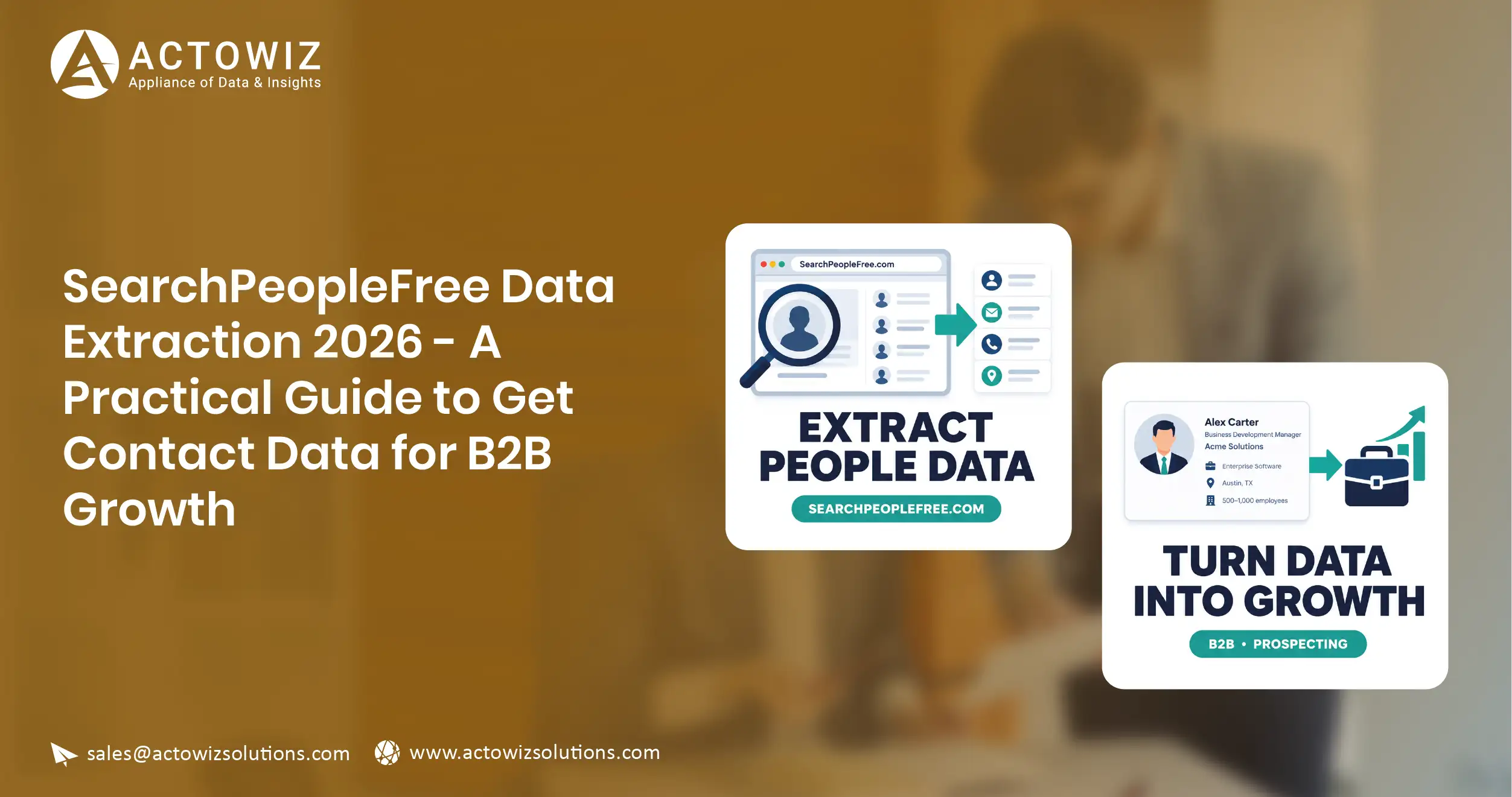
SearchPeopleFree Data Extraction 2026 can be approached as a structured research and data-quality exercise, but businesses should not treat every people-search record as a verified B2B lead or assume that publicly accessible information is automatically suitable for commercial reuse. People-search services aggregate information from multiple sources, and the resulting records may contain personal information that requires careful handling. The U.S. Federal Trade Commission describes people-search sites as a type of data broker and notes that their reports may combine public records, social-media information and information obtained from other data brokers.
For B2B sales teams, the practical objective should therefore be narrower: identify legitimate business information, verify professional relevance, remove duplicates, document sources, and avoid unnecessary collection of sensitive or residential information.
This is where Data Intelligence Services can support a more controlled workflow. Instead of simply gathering the largest possible number of records, businesses can define the exact fields required for account research, establish source-validation rules, and separate business contact information from personal information.
The regulatory environment also matters. India's Digital Personal Data Protection Act, 2023 establishes a framework for processing digital personal data, while the Digital Personal Data Protection Rules, 2025 were notified in November 2025.
For companies working with people-search information in 2026, data provenance, purpose limitation, security, lawful processing, and responsible outreach should be considered part of the dataset—not an afterthought.
How Can Businesses Approach Large-Scale Research Responsibly?
SearchPeopleFree data extraction at scale should begin with a clearly defined business purpose and a restricted data schema. Scaling an extraction workflow without first establishing what information is appropriate to collect can multiply data-quality and privacy problems just as quickly as it multiplies records.
SearchPeopleFree is described by independent privacy resources as a people-search website that can surface information such as names, addresses, phone numbers, email addresses, relatives and other associated information. The FTC similarly explains that people-search sites may compile data from public records, public social profiles and other data brokers.
That means a B2B research project should not automatically collect every available field.
A safer workflow is to establish a minimum dataset:
| Data category |
B2B research value |
Recommended treatment |
| Professional name |
High when professionally relevant |
Verify against business sources |
| Job title |
High |
Confirm current role where possible |
| Employer |
High |
Match against official company information |
| Company website |
High |
Prefer official domain |
| Business location |
High |
Distinguish office from residential address |
| Business email |
Potentially high |
Use only when legitimately sourced and appropriate |
| Personal phone |
Context-dependent |
Avoid unnecessary collection |
| Home address |
Usually unnecessary for B2B |
Do not collect for routine prospecting |
| Relatives/associates |
Usually unnecessary |
Exclude from B2B datasets |
| Sensitive records |
High privacy risk |
Exclude unless a lawful, specifically authorized purpose exists |
The goal is not to create the most detailed personal profile possible. It is to create the smallest useful business dataset.
For 2026 projects, businesses should also maintain source URLs, retrieval dates, field-level validation notes and exclusion rules. These controls make it easier to identify outdated information and explain where a record originated.
The FTC specifically warns that people-search information can include highly personal details and that opting out of a people-search site does not necessarily remove the underlying information from public records.
Consequently, scale should be measured by useful, validated business records—not raw extraction volume.
How Should Address and Contact Information Be Handled?
SearchPeopleFree address and contact data Collection requires particular care because people-search databases can contain both professional and residential information. For B2B purposes, a home address generally provides little legitimate value compared with a verified company address, official business website, or professional role.
SearchPeopleFree's publicly documented opt-out process demonstrates the sensitivity of the information involved. Current privacy guides report that individuals can request removal of records through SearchPeopleFree's opt-out mechanism, and SearchPeopleFree has also responded to BBB complaints concerning record-removal requests.
A commercial data workflow should therefore distinguish between business contact intelligence and personal contact information.
| Information |
Suitable B2B use? |
Data-quality action |
| Company name |
Yes |
Verify with company source |
| Corporate website |
Yes |
Check official domain |
| Office address |
Often |
Confirm business location |
| Professional title |
Yes |
Verify current role |
| Corporate email |
Potentially |
Confirm source and intended use |
| Public business phone |
Potentially |
Confirm business context |
| Residential address |
Generally unnecessary |
Exclude |
| Personal phone |
Generally unnecessary |
Exclude unless specifically justified |
| Family information |
No routine B2B need |
Exclude |
| Age/date of birth |
No routine B2B need |
Exclude |
This approach also improves dataset quality. A database containing unnecessary personal fields creates additional verification and governance requirements without necessarily improving B2B prospecting.
India's DPDP framework is particularly relevant to organizations processing digital personal data. The DPDP Act describes its purpose as regulating the processing of digital personal data while recognizing individuals' rights to protect their personal data and the need to process data for lawful purposes.
Businesses should therefore establish collection rules before extraction begins. They should identify the intended purpose, collect only relevant fields, apply access controls, and establish procedures for handling deletion or objection requests where applicable.
How Can Structured Records Improve Prospect Research?
SearchPeopleFree structured people data extraction is most useful when the output is transformed into a normalized research dataset rather than treated as an unstructured collection of search results.
For B2B teams, normalization can include standardizing names, separating company and person fields, identifying duplicate organizations, recording source references, and distinguishing professional information from personal information.
A useful structure might include:
| Field group |
Example purpose |
| Person identifier |
Distinguish records without unnecessary personal attributes |
| Professional name |
Identify business contact |
| Job title |
Assess relevance to the sales proposition |
| Organization |
Connect person to account |
| Industry |
Segment accounts |
| Business city |
Assign territory |
| Company website |
Verify organization |
| Source |
Establish provenance |
| Verification date |
Monitor freshness |
| Status |
Verified, conflicting, outdated or excluded |
The SearchPeopleFree Data Extraction 2026 workflow should treat source information as evidence rather than unquestioned truth. A people-search record may contain an outdated employer, old address or incorrect association. The fact that information appears in a search result does not establish that it is currently accurate.
This is particularly important when records are used for sales intelligence. A person who previously held a particular role may no longer work for the company. A company address may have changed. A phone number may have been reassigned.
The recommended process is therefore:
- Identify potentially relevant records.
- Separate business-relevant fields from unnecessary personal information.
- Cross-check professional identity against appropriate business sources.
- Remove duplicates.
- Flag conflicting information.
- Preserve source and verification metadata.
- Exclude records that cannot be responsibly validated.
The result is a smaller but more defensible dataset.
Businesses should avoid presenting a record as "verified" merely because an automated extraction successfully retrieved it. Verification should mean that the relevant field has been checked against an appropriate source.
Can Publicly Available Contact Information Be Used for B2B Research?
Extract public contact data from SearchPeopleFree should not be interpreted as permission to collect and redistribute every piece of information displayed by a people-search service.
The FTC explains that people-search services can compile information from public records and other sources, and it highlights the privacy implications of this aggregation. It also explains that people-search sites commonly provide opt-out mechanisms.
For B2B prospecting, a responsible distinction is essential:
Publicly accessible does not automatically mean commercially appropriate.
A company may have a publicly listed business phone number that is directly relevant to customer acquisition. A person's home address may also appear in a people-search result, but that does not make it an appropriate B2B lead field.
What should a responsible collection policy include?
- Collect only information necessary for the stated business purpose.
- Prefer company-published professional information.
- Avoid residential addresses and unrelated family information.
- Maintain source attribution.
- Record when information was obtained or verified.
- Provide mechanisms for handling applicable removal or suppression requests.
- Restrict internal access to personal information.
- Avoid using people-search information for prohibited or regulated decisions.
- Review the laws applicable to the business and the individuals concerned.
The distinction becomes particularly important for U.S. use cases involving employment, housing, credit or insurance. The FTC states that when consumer reports are used for employment decisions, organizations must comply with the Fair Credit Reporting Act (FCRA).
The FTC has also taken enforcement action involving people-search/background-report providers where reports were marketed for employment or tenant screening and FCRA obligations applied.
Therefore, B2B prospecting, background screening, identity verification and eligibility decisions should never be treated as interchangeable use cases.
A well-designed dataset begins with a permitted purpose and collects only the information necessary to fulfill it.
Is There an Official API for Automated Access?
SearchPeopleFree people data extraction Data API is a phrase that businesses may use when researching automated access options, but an important distinction is necessary: this article does not claim that SearchPeopleFree provides a verified official public API for bulk people-data extraction.
Businesses should not assume that a website's searchable interface constitutes authorization for automated bulk collection. Before implementing an automated workflow, buyers should check the current website terms, robots/access policies, licensing terms and any official developer documentation.
If an official API is unavailable or does not authorize the intended use, organizations should consider alternative sources that explicitly license the required business data.
| Requirement |
What buyers should verify |
| API availability |
Is there an official developer interface? |
| Authorization |
Does the provider permit the intended automated use? |
| Data fields |
Are the required fields actually available? |
| Licensing |
Can the resulting data be stored and used commercially? |
| Rate limits |
Are automated requests subject to documented limits? |
| Privacy controls |
Are deletion and suppression workflows supported? |
| Source attribution |
Must source information be retained? |
| Retention |
How long may extracted information be stored? |
For SearchPeopleFree Data Extraction 2026, an API-first assumption could create unnecessary technical and legal risk. The better approach is source-first planning: determine what information is needed, identify a legitimate source, confirm permitted access, then design the technical workflow.
This also improves reliability. If a website changes its layout, a scraper can fail. If a provider changes its terms, an extraction workflow may no longer be suitable. A documented source-governance process allows businesses to respond to these changes instead of treating extraction as a one-time technical task.
How Can AI Improve Data Collection Without Sacrificing Quality?
AI-Powered Scraping Services can assist with large-scale information processing by helping classify records, normalize fields, detect potential duplicates, identify missing information and prioritize records for human review.
AI should not be treated as an automatic truth engine. If the source contains incorrect or outdated information, an AI system can organize that information efficiently but cannot magically establish its accuracy.
A practical human-in-the-loop workflow can include:
| Stage |
Automation opportunity |
Human control |
| Source discovery |
Identify candidate pages |
Approve permitted sources |
| Extraction |
Capture structured fields |
Review extraction rules |
| Classification |
Categorize industries and roles |
Validate ambiguous classifications |
| Deduplication |
Detect similar records |
Resolve uncertain matches |
| Verification |
Flag conflicts |
Confirm important records |
| Privacy filtering |
Remove prohibited/unnecessary fields |
Review policy exceptions |
| Delivery |
Generate structured output |
Final quality review |
AI can also help identify obvious inconsistencies—for example, a job title that conflicts with the current company website or multiple records that appear to represent the same professional. Those cases can be routed to manual review.
The key performance indicators should focus on quality rather than extraction volume:
- Verified-record rate
- Duplicate rate
- Missing-field rate
- Source-traceability rate
- Manual-review rate
- Record freshness
- Excluded-record rate
- Privacy-policy exceptions
No universal accuracy percentage should be promised without testing the actual source, fields, geography and validation methodology.
For businesses operating in 2026, AI-assisted extraction is most effective when automation handles repetitive organization while humans remain responsible for high-impact validation and governance decisions.
How Can Actowiz Solutions Help?
Actowiz Solutions can help businesses design data collection workflows that balance structured extraction, quality assurance and responsible data handling. The project can be scoped around the client's target market, required fields, permitted sources, delivery format and verification requirements.
For a people-search-related project, the recommended starting point is not "collect everything." Instead, Actowiz Solutions can help define which business-relevant information is actually required.
AI Training Data Collection is another area where structured collection workflows can be useful. Where data is lawfully available and appropriately licensed, datasets can be organized, normalized and prepared for downstream analytical or machine-learning purposes.
A project can include:
- Requirement definition — identify the fields and business purpose.
- Source assessment — determine which sources are appropriate and accessible.
- Extraction architecture — establish the suitable collection method.
- Data normalization — standardize records and formats.
- Quality checks — identify duplicates, missing fields and inconsistencies.
- Privacy filtering — remove unnecessary personal or sensitive information.
- Source documentation — retain provenance and verification metadata.
- Dataset delivery — provide the agreed structured output.
What should a buyer provide before starting?
| Requirement |
Example |
| Geography |
Countries, states or cities |
| Target audience |
B2B professionals, companies or specific roles |
| Required fields |
Company, role, business website, office location |
| Excluded fields |
Residential address, relatives, sensitive information |
| Sources |
Approved websites or licensed databases |
| Verification standard |
Source match, manual review or both |
| Output |
CSV, Excel, JSON, database or API-ready format |
| Refresh frequency |
One-time, periodic or event-driven |
The final scope should also account for applicable privacy, data-protection, contractual and platform requirements. A technically successful extraction is not automatically a commercially usable dataset.
Conclusion
The strongest approach to people-search data in 2026 is not simply extracting the largest number of records. It is creating a purpose-specific, source-traceable and quality-controlled dataset that focuses on legitimate business information while minimizing unnecessary personal data.
Businesses should distinguish professional contact intelligence from residential or sensitive information, validate important fields against appropriate sources, document data provenance and establish procedures for handling removal requests. The FTC's guidance confirms that people-search services can aggregate extensive personal information and that consumers may have mechanisms to opt out.
India's DPDP Act and the DPDP Rules, 2025 also make responsible digital-personal-data processing increasingly important for organizations operating in or targeting India.
Actowiz Solutions can help businesses build structured workflows using Web Scraping, Mobile App Scraping, and a Real-time dataset, with the exact approach determined by source availability, authorization, required fields and project-specific compliance requirements.
Ready to build a cleaner, more reliable contact-data workflow? Contact Actowiz Solutions to discuss your data collection, validation, enrichment and dataset requirements!
You can also reach us for all your mobile app scraping, data collection, web scraping, and instant data scraper service requirements!
 Actowiz Solutions

 By industry
 Pricing & Promotions
 Brand & Intelligence
 Digital Shelf & Search
 Assortment
 For Retailers
 E-Commerce Dashboard
 Flipkart Insights (Live)
 Grocery Intelligence
.svg) Grocery Price (U.S.)
.svg) Quick Commerce (India)
 Food & Restaurant
 Fashion Intelligence
 Automotive
 Travel & Hospitality
 Real Estate
 Food Delivery Intelligence
 OTT & Streaming
 Fuel & EV Charging Price Tracker
 By Use Case
 Pricing Intelligence
 Digital Shelf Analytics
 MAP Monitoring
 Cross-Border Price Parity
 Share of Search
 Review Sentiment
 Kitchen Market Gaps
 Dynamic Pricing / AI Repricing
 Promotions & Deals Alerts
 B2B / POI & Lead Data
 AI Search Visibility Dashboard
 Baby Products on Quick Commerce
 Hotel & Flight Rate Parity
 By Region
 Flipkart Real-Time Insights
 Quick Commerce — Zepto · Blinkit
 Pincode Price Tracker
 GCC Q-Commerce — Talabat · Noon
 UK Grocery — Tesco, Sainsbury's, Asda
 AU Grocery — Coles & Woolworths
 Marketplace Scrapers
 Developer APIs
 Universal APIs
 Delivery & SDKs
 Knowledge Center
 Guides & Playbooks
 Downloads & Tools
 Trust & Company


 4.8/5 Average Rating
 50+ Video Testimonials
 92% Client Retention
 50+ Countries Served