Introduction
For many hotels, the competitive set no longer stops at the hotel down the road. In leisure markets and city centres alike, guests compare a hotel room with a two-bedroom apartment on Airbnb, a villa on Vrbo and a serviced flat on Booking.com, often in the same session.
Direct answer: Short-term rental pricing data is structured, public listing data from platforms such as Airbnb, Vrbo and Booking.com: nightly rates, fees, availability calendars, minimum stays, amenities, ratings and listing counts by area. Hotel groups and property managers use it to benchmark rates, forecast compression nights and size alternative-accommodation supply. Our Airbnb data scraping and Vrbo data scraping services cover two of the three platforms directly.
This guide explains which platforms to cover, the fields that matter, how to turn raw listings into a comparable dataset, and how to choose a data partner. All collection described here covers public listing information only. It includes no host or guest personal data.
Why short-term rental pricing data matters for hotels and property managers
The non-hotel segment is large. Airbnb reported 133.6 million Nights and Seats Booked in Q3 2025, up 9% year over year (Source: Airbnb Q3 2025 shareholder letter, SEC, https://www.sec.gov/Archives/edgar/data/1559720/000119312525269432/d40503dex991.htm). Rental Scale-Up estimates that around 36% of Booking.com's more than 1.2 billion room nights in 2025 were alternative accommodations, or about 430 million nights (Source: Rental Scale-Up, https://www.rentalscaleup.com/booking-holdings-vs-airbnb-2026-analysis/). That figure is an analyst estimate derived from company results.
Supply and pricing are also changing. AirDNA's 2026 midyear update forecasts US short-term rental occupancy of 57.4% in 2026, RevPAR growth of 2.9% driven mainly by rate, and supply growth slowing to 2.7% (Source: AirDNA, https://www.airdna.co/blog/u.s.-mid-year-outlook-report-2026). For a hotel revenue manager, a rate-driven market with slower supply growth changes how far you can push your own rates on peak nights.
Who uses it:
- Hotel group revenue management: adds rental rates and availability to the compset view for leisure-heavy and long-stay markets
- Commercial strategy and development: sizes alternative-accommodation supply before a new opening or brand conversion
- Property managers and serviced-apartment operators: benchmarks against nearby listings with similar bedrooms, amenities and ratings
- Asset managers and investors: tracks rate and listing-count trends across a portfolio's markets
- Tourism boards and destination teams: monitors aggregated supply and pricing during events and seasons
Platforms compared: Airbnb, Vrbo and Booking.com
| Platform |
Inventory profile |
Useful public data points |
Watch-outs for comparability |
| Airbnb |
Entire homes, private rooms, unique stays; strong in cities and leisure markets |
Nightly price for set dates, total price incl. fees, calendar availability, minimum nights, bedrooms, amenities, rating and review count, listing type |
Displayed price depends on dates, guests and currency; fees vary by listing and market |
| Vrbo |
Whole-home vacation rentals; strong in US beach, mountain and family markets |
Nightly and total price, availability, bedrooms and sleeps, amenities, rating, property type |
Longer minimum stays and weekly pricing are common, so normalise to per-night |
| Booking.com (apartments, homes, villas) |
Mix of professionally managed apartments and homes, next to hotels on the same platform |
Room or unit price per date, availability, property type, review score, cancellation terms, distance markers |
Hotel and non-hotel inventory share one interface, so classify property type carefully |
Most enterprise programmes cover all three platforms. One platform alone gives a partial view of the market. Inventory overlap (the same unit listed on several platforms) should be flagged during matching, not double-counted.
The 10 data fields that matter
- Listing ID and platform: a stable key for each listing, used to track it over time.
- Location at area level: neighbourhood, city or geohash cell. Approximate map position is enough for market analysis.
- Property attributes: type, bedrooms, bathrooms, maximum guests and size where shown.
- Nightly rate for a check-in date: collected for a fixed grid of stay dates and lengths, for example 1, 3 and 7 nights.
- Fees and total price: cleaning and service fees and the all-in total, so you compare what the guest actually pays.
- Availability calendar: open or blocked nights for the next 90–365 days. Blocked nights are a proxy for bookings, not a confirmed booking.
- Minimum stay and booking rules: minimum nights, instant-book flag and cancellation policy.
- Amenities: pool, parking, kitchen, workspace, pet-friendly and similar features, normalised to one taxonomy.
- Ratings and review count: overall score and review volume as quality signals.
- Listing counts and status: active listings per area, new and delisted units, used for supply tracking.
Data we do not collect
- Host names, photos, profiles or contact details
- Guest names or review author identities
- Anything behind a login or booking flow
Review text can be excluded, or aggregated to topic-level sentiment, depending on your use case.
How to collect, clean and match short-term rental data
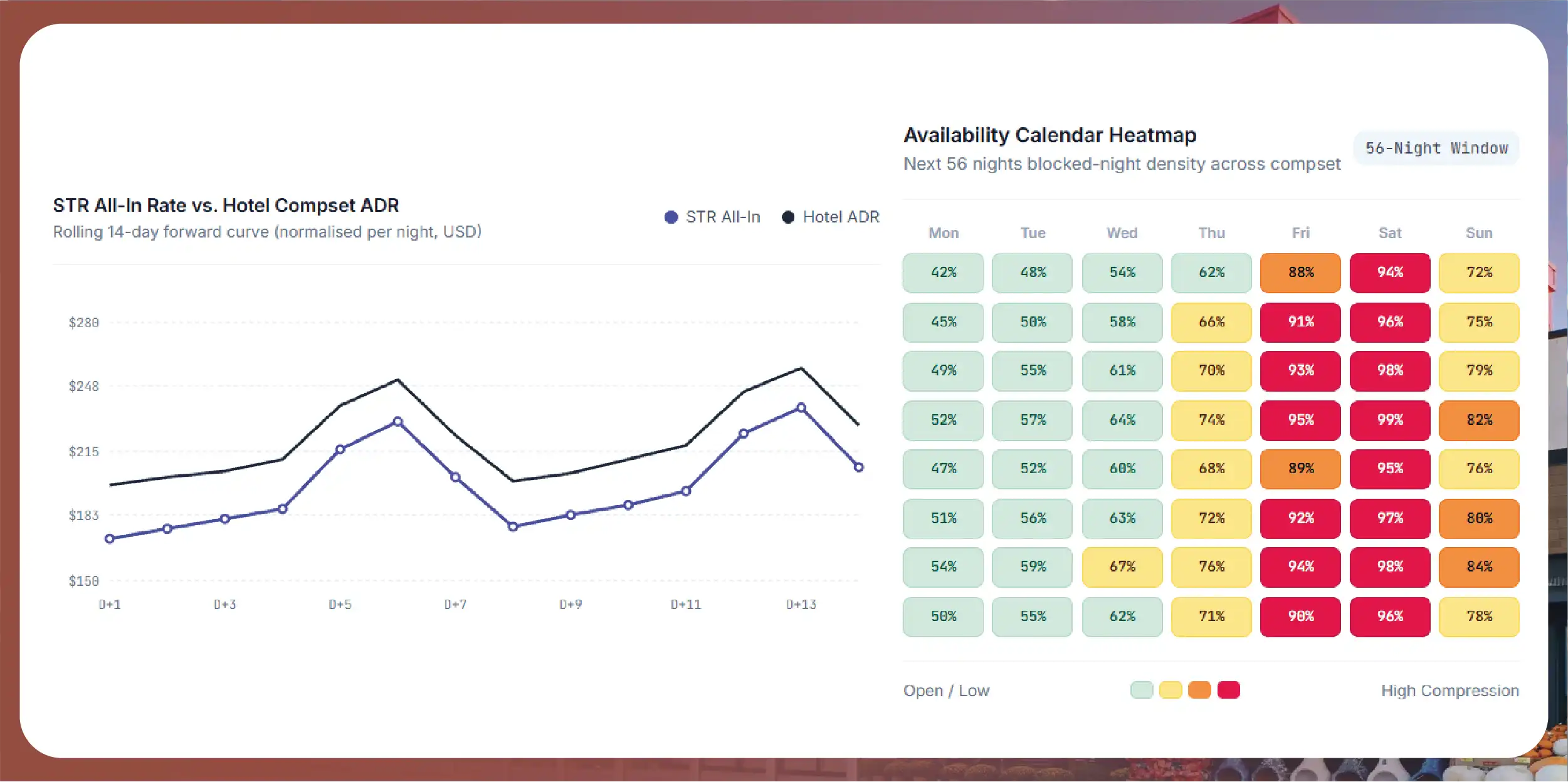
Collection design. Define markets as polygons or city and neighbourhood lists, then run searches across a rolling grid of check-in dates (for example the next 180 days) and stay lengths. Re-collect the same grid on a fixed schedule so you can see how prices move as dates approach.
Cleaning. Convert currencies at a fixed daily rate, separate nightly rate from fees, turn weekly and monthly prices into per-night values, and standardise property types and amenities across platforms.
Matching. Group listings into comparable segments (for example, 2-bedroom entire homes rated 4.7 or higher within 1 km of your property). Flag likely cross-listed units using attribute and location similarity, so supply counts aren't inflated.
Hotel comparability. Compare like with like: a studio against a standard room, and a two-bedroom against a suite or two connecting rooms. Use the total price per guest or per bedroom when your rate structure differs.
Delivery and QA. Enterprise feeds usually arrive through REST API, S3, Snowflake or BigQuery, or as scheduled CSV files, with row-count checks, outlier flags for prices far above market norms, and coverage reports per market. Our Booking.com data scraping services cover the rate-plan structure needed for that comparison.
Strategy by market type and country
| Market type |
Example geographies |
What to track |
Suggested cadence |
| Urban business and leisure |
London, Paris, New York, Dubai, Mumbai |
Studio and 1-bed rates vs hotel ADR, weekday/weekend gap, event compression |
Daily for 90 days ahead |
| Beach and resort |
Florida, Algarve, Bali, Gold Coast |
Whole-home rates, minimum stays, peak-season calendar fill |
Daily in season, weekly off-season |
| Mountain and ski |
Colorado, Alps, Whistler |
Large-unit rates, 7-night pricing, snow-season availability |
Daily from pre-season |
| Event-driven cities |
Host cities for major sports, trade fairs or festivals |
Rate spikes and blocked-night share around event dates |
Daily from 6 months before the event |
| Regulated markets |
Cities with registration or night caps |
Listing count changes, new and delisted units |
Weekly |
Market-level benchmark figures for any of these segments can be filled from your own data.
Use cases
- Rate positioning: set hotel BAR floors and ceilings with knowledge of what comparable apartments charge on the same nights.
- Compression forecasting: watch rental calendars fill ahead of events to spot high-demand nights earlier.
- Long-stay strategy: compare 7- and 28-night rental pricing with extended-stay hotel and serviced-apartment rates.
- Development and conversion feasibility: size alternative-accommodation supply, rates and ratings around a proposed site.
- Portfolio pricing for property managers: benchmark each unit against its micro-market and adjust minimum stays and fees.
- Distribution analysis: see how the same type of inventory is priced across Airbnb, Vrbo and Booking.com.
Legal and compliance basics
Collect only publicly visible listing information, such as rates, availability, amenities, ratings and counts, and don't log in or go through booking steps. Respect each platform's terms and robots guidance, and keep request rates reasonable. Exclude host and guest personal data entirely, and use location at area level rather than exact addresses. Data protection rules such as GDPR still apply to any personal data, which is why a well-designed STR dataset avoids it from the start. Check internal usage with your legal team before you redistribute data externally.
Build vs buy: choosing a short-term rental data provider
Building in-house works for a single market. Multi-country, multi-platform calendars refreshed daily need constant scraper maintenance, currency and fee normalisation, and QA.
Questions to ask a provider:
- Coverage: which platforms, countries and cities, and how markets are defined
- Freshness: collection frequency and how far ahead calendars are captured
- Comparability: fee handling, per-night normalisation, property-type and amenity mapping
- Delivery: API, S3, Snowflake or BigQuery, CSV, or dashboards in Actowiz Metrics
- QA and SLA: coverage reports, outlier handling and support response times
- Compliance: public data only, no personal data, clear usage rights
Actowiz Solutions delivers managed short-term rental pricing data across major rental and hotel platforms in dozens of countries. A free sample for one of your markets is usually ready within 48 hours. For the rate-plan mechanics behind Booking.com collection, see our guide on scraping hotel pricing data from Booking.com.
Ready to benchmark short-term rental rates against your hotel compset? Request a free sample for one of your markets, usually ready within 48 hours.
Contact Us Today!
Frequently Asked Questions
What is short-term rental pricing data?
It is structured public listing data from platforms such as Airbnb, Vrbo and Booking.com: nightly rates, fees, availability, minimum stays, amenities, ratings and listing counts, usually organised by market, property type and stay date.
Can availability calendars show occupancy?
Blocked nights are a useful proxy, but owners also block nights for personal use or maintenance. Treat calendar-based occupancy as an estimate and track trends rather than exact levels.
How do hotel groups compare rental prices with hotel rates?
By matching unit size to room type, using the all-in total price including fees, and comparing the same check-in dates and stay lengths. Segmenting by rating and distance makes the comparison fairer.
Does the data include host or guest information?
No. A compliant dataset covers listing-level public information only. Host profiles, names, photos and guest identities are excluded.
How often should short-term rental data be refreshed?
Daily for the next 60–90 days in priority markets, and weekly for longer horizons or less volatile markets. Increase frequency around major events.
In what formats is the data delivered?
Typically REST API, scheduled CSV or Excel, Amazon S3, or direct loads into Snowflake or BigQuery, plus optional dashboards in Actowiz Metrics.
Conclusion
You can also reach us for all your mobile app scraping, data collection, web scraping , and instant data scraper service requirements!
 Actowiz Solutions

 By industry
 Pricing & Promotions
 Brand & Intelligence
 Digital Shelf & Search
 Assortment
 For Retailers
 E-Commerce Dashboard
 Flipkart Insights (Live)
 Grocery Intelligence
.svg) Grocery Price (U.S.)
.svg) Quick Commerce (India)
 Food & Restaurant
 Fashion Intelligence
 Automotive
 Travel & Hospitality
 Real Estate
 Food Delivery Intelligence
 OTT & Streaming
 Fuel & EV Charging Price Tracker
 By Use Case
 Pricing Intelligence
 Digital Shelf Analytics
 MAP Monitoring
 Cross-Border Price Parity
 Share of Search
 Review Sentiment
 Kitchen Market Gaps
 Dynamic Pricing / AI Repricing
 Promotions & Deals Alerts
 B2B / POI & Lead Data
 AI Search Visibility Dashboard
 Baby Products on Quick Commerce
 Hotel & Flight Rate Parity
 By Region
 Flipkart Real-Time Insights
 Quick Commerce — Zepto · Blinkit
 Pincode Price Tracker
 GCC Q-Commerce — Talabat · Noon
 UK Grocery — Tesco, Sainsbury's, Asda
 AU Grocery — Coles & Woolworths
 Marketplace Scrapers
 Developer APIs
 Universal APIs
 Delivery & SDKs
 Knowledge Center
 Guides & Playbooks
 Downloads & Tools
 Trust & Company


 4.8/5 Average Rating
 50+ Video Testimonials
 92% Client Retention
 50+ Countries Served