Core services
Enterprise Data Extraction

Scalable web, app and AI-powered collection across 40+ countries.

All 58 services →
New 2026
AI Training Data

Corpus building with provenance and opt-out compliance.

Learn more →
Free pilot
24-hour sample

We run collection on your own sources before you commit.

Get a sample →
58Services
40+Countries
DEVELOPER

Ready-Made Scrapers

Pre-built for top platforms. Self-serve, no setup.

View All →
TRY FREE

API Playground

Test endpoints instantly. No credit card.

Start Free →
28Tools
2SDKs
icons Delivery & SDKs
Streaming Crawl API Scheduler Realtime Alerts Webhook Delivery 🐍 Python SDK 💚 Node.js SDK

Need it managed instead?

Fixed monthly retainer, named engineer, no per-request metering.

Managed Data API →
HOT

Case Studies

How brands use Actowiz, with named outcomes.

Read →
FREE

Sample Datasets

Real output, no signup.

Download →
NEW

ROI Calculator

Model the return on a data engagement.

Calculate →
Crex Data Scraping - Solving Accuracy and Data Consistency Issues in Cricket Analytics

Introduction

Most CPG price monitoring programmes track the wrong thing. They watch competitor prices, which is interesting, and miss promotional execution compliance, which is where money actually leaks. If you fund a promotion and it goes live three days late, at the wrong depth, or on the wrong SKU, that is a direct and recoverable loss — but only if you can evidence it within the promotional window. This guide sets out the five monitoring disciplines that matter for a UK grocery brand, the KPIs under each, how to design alerts people actually act on, and where these programmes usually fail.

The question price intelligence is actually answering

Crex Data Scraping - Solving Accuracy and Data Consistency Issues in Cricket Analytics

Brands often buy price data to answer "what are competitors charging". That is a reasonable question, but it is rarely the one with money attached.

The questions with money attached are narrower and more operational:

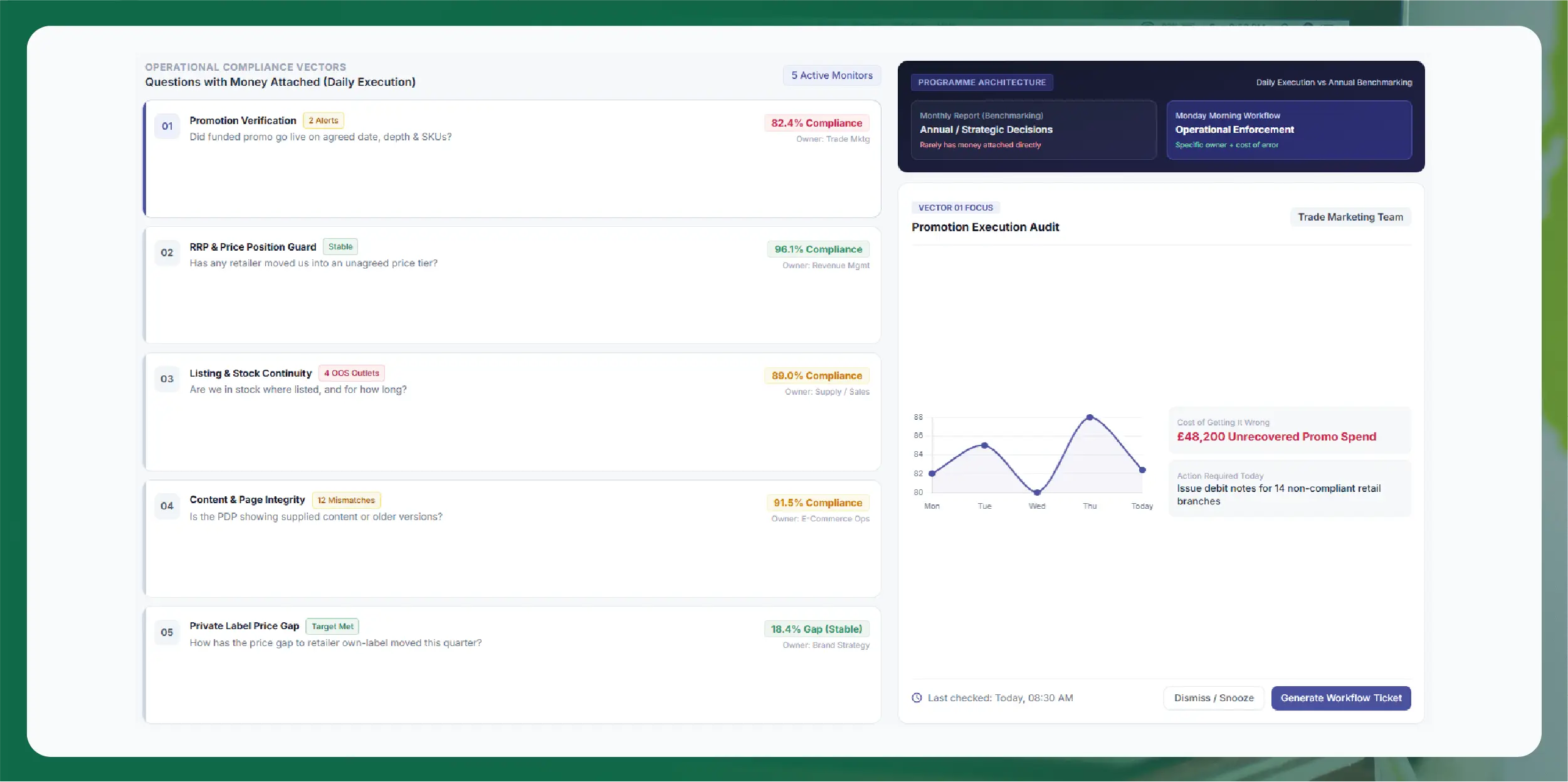
  • Did the promotion we funded go live, on the agreed date, at the agreed depth, on the agreed SKUs?
  • Is our RRP holding, or has a retailer moved us into a price position we did not agree?
  • Are we in stock where we are listed, and for how long have we not been?
  • Is the product page showing the content we supplied, or an older version?
  • How has the price gap to the retailer's own-label equivalent moved this quarter?

Each of these has a specific owner inside a brand, a specific decision attached, and a specific cost of getting it wrong. Competitor price benchmarking, by contrast, usually informs a decision made annually. Both are worth having. Only one of them justifies daily data.

That distinction should drive how you scope a programme. If you build for benchmarking, you will get a monthly report someone skims. If you build for execution compliance, you get a workflow people use on Monday mornings.

The five disciplines

1. Promotional execution compliance

This is the discipline with the clearest financial case, and the one most often missing.

A UK grocery promotion is a commercial agreement: specific SKUs, a specific mechanic, a specific depth, over specific dates, usually with funding attached from the brand. Execution against that agreement is not automatic. Promotions go live late. They go live at the wrong depth. They cover fewer SKUs than agreed. They end early. Sometimes they do not run at all.

Without daily data, none of this is visible until a post-period review — by which point the window has closed, the evidence is gone, and the conversation with the retailer is a negotiation about memory rather than a discussion of a record.

With daily data, it is a documented fact within 24 hours, while there is still time to fix it.

What to track:
Metric Definition
Promo start compliance Did the offer appear on the agreed start date
Promo depth compliance Is the displayed price at the agreed level
SKU coverage What proportion of agreed SKUs are actually on offer
Duration compliance Did the offer run the full agreed window
Mechanic accuracy Is the offer type as agreed (loyalty price vs multibuy vs price drop)

The UK-specific complication: loyalty mechanics differ by retailer and are not interchangeable. A Clubcard Price at Tesco, a Nectar Price at Sainsbury's and a More Card price at Morrisons are all genuine price reductions. ASDA Rewards is not — it credits a cashpot the shopper redeems later, and the shelf price does not move. Morrisons Price Lock is a duration commitment, not a discount.

If your compliance tracking treats all of these as "promotion active: yes", you will report compliance on an ASDA line where the shopper never saw a lower price. Your monitoring has to distinguish the mechanics, which means your data has to as well.

2. RRP and price position monitoring

Retailers set their own retail prices in the UK — a brand cannot dictate them. What a brand can do is monitor where its products actually sit, spot unexpected moves, and understand its price architecture across the market.

What to track:
Metric Definition
Price position vs RRP Gap between actual shelf price and recommended price
Cross-retailer price spread Range between highest and lowest retailer for the same SKU
Price change frequency How often a SKU's price moves, by retailer
Unexpected movement alerts Any change beyond a defined threshold

The cross-retailer spread is the one most brands under-use. A SKU priced consistently across five retailers is in a stable position. The same SKU with a wide spread is a channel conflict waiting to surface — and usually the brand finds out from an angry account manager rather than from its own data.

A compliance note worth taking seriously: in the UK, attempting to fix or control the resale prices of independent retailers raises competition law issues. Monitoring and understanding your price architecture is normal commercial practice. Using that data to coordinate or enforce retail prices is a different activity with legal consequences. Take advice on where your programme sits, and make sure the people using the dashboard understand the line as well as the people who built it.

3. Availability and out-of-stock monitoring

An out-of-stock listing is lost sales at full margin, and at scale it is the single largest recoverable loss in most brand portfolios. It is also invisible from head office without monitoring.

What to track:
Metric Definition
OOS rate Proportion of listed SKUs showing unavailable
OOS duration How long a SKU has been unavailable
OOS by retailer and category Where the problem concentrates
Delisting detection A SKU that disappears entirely rather than showing unavailable
Regional OOS variance Availability differences across a postcode panel

Two points that get missed.

Delisting is not out-of-stock. A SKU showing "unavailable" is a supply issue. A SKU that disappears from the site entirely may have been delisted, which is a commercial event requiring a completely different response. Your data needs to distinguish them, which means it needs to record disappearance as an event rather than letting the row silently vanish from the file.

Fresh categories need intraday capture. Availability in fresh shifts through the day in a way ambient does not. A single 6am snapshot tells you very little about whether shoppers could actually buy your product at 5pm. If availability is the use case and you are in fresh, daily is not enough.

4. Digital shelf and content compliance

The product page is packaging now. If the content is wrong, incomplete or outdated, conversion suffers and — in the case of allergens — the exposure is more serious than commercial.

What to track:
Metric Definition
Content accuracy Does the listing match the content you supplied
Image compliance Correct, current, sufficient number of images
Allergen and nutrition accuracy Do published values match your specification
Search visibility Where your SKU ranks for key category terms on-site
Share of shelf Your listings as a proportion of category listings
Review signals Rating average and volume trend

Content accuracy is often treated as a tidy-up task and it should not be. A product page carrying a superseded allergen statement is a safety issue with regulatory implications, not a merchandising annoyance. Where a brand has changed a formulation, verifying that every retailer listing reflects it is a genuine compliance obligation.

On reviews, a practical note: collect counts and averages only, not review text or reviewer identity. Review content can contain personal data, and UK GDPR obligations attach to it. The commercial signal — is our rating trending down after a formulation change — is fully available from the aggregate numbers.

5. Private label and competitive gap

UK own-label is not a single competitor. Every major grocer runs a three-tier architecture — value, core, premium — and each tier competes with a different part of your portfolio.

What to track:
Metric Definition
Price gap to own-label equivalent By tier, on normalised unit price
Gap trend over time Is the own-label undercut widening
Own-label promotional intensity How often own-label lines are promoted vs yours
Discounter reference pricing Aldi and Lidl equivalents as the value anchor

The methodology point that determines whether this analysis is any good: the comparison must be made on normalised unit price — per 100g, per litre — and tier to tier. Own-label pack sizes are frequently set deliberately different from branded ones, so headline price comparison is meaningless. And comparing your mainstream brand against a retailer's premium tier produces a flattering number that describes nothing real.

Discounter comparison is harder again, because Aldi and Lidl are almost entirely own-label with no shared barcodes. Every matched pair is an attribute-based judgement, and any credible analysis carries a confidence score on each pair. If your vendor's discounter comparison does not expose match confidence, treat the numbers as directional at best.

Designing alerts people actually act on

The most common failure in a price intelligence programme is not bad data. It is good data delivered in a format nobody uses.

A daily 40,000-row CSV is not a monitoring programme. It is a file. The programme is the alert layer on top, and it needs designing with as much care as the data.

Principles that work:

  • Alert on exceptions, report on trends. Anything requiring action today is an alert. Anything informing a decision this quarter is a report. Mixing them trains people to ignore both.
  • Route by owner, not by category. A national account manager for Tesco wants Tesco exceptions, not a portfolio-wide digest they have to filter. Alerts that require the recipient to find the relevant part get ignored within a fortnight.
  • Set thresholds that generate a workable volume. A threshold producing 200 daily alerts is noise. One producing two or three is a workflow. Start deliberately conservative and loosen — it is far easier to widen a threshold than to rebuild trust after a month of spam.
  • Include the evidence in the alert. The alert should carry the SKU, retailer, the agreed terms, what was observed, and the timestamp. An alert that requires the recipient to go and check something will not be acted on.
  • Alert on silence too. If a feed stops delivering, or a field stops populating, that needs to surface immediately. The worst failure mode in monitoring is a system that looks healthy while reporting nothing, because it tells you everything is fine right up until someone checks manually.

A workable default set for a UK grocery brand:

Alert Trigger Route to
Promo failed to launch Agreed start date passed, no offer detected Account manager
Promo depth wrong Displayed price differs from agreed Account manager
Promo ended early Offer absent before agreed end date Account manager
OOS threshold breach SKU unavailable beyond defined duration Supply and account
Suspected delisting SKU absent from site entirely Account manager
Price move beyond threshold Change above defined percentage Revenue growth management
Content mismatch Listing differs from supplied content E-commerce and brand
Data quality failure Field null rate outside expected range Data owner

Who owns this inside a brand

Price intelligence programmes stall when nobody owns them. The usual pattern is that procurement buys a data feed, it lands in a shared drive, and six months later nobody can say what it changed.

The programmes that work have clear ownership per discipline:

  • National account managers own promotional compliance and delisting alerts. They are the ones with the retailer relationship and the ability to act inside the window.
  • Revenue growth management owns price position, cross-retailer spread and private label gap. This is the analytical function that turns monitoring into pricing strategy.
  • Supply chain owns availability alerts, jointly with the account team, because an OOS can be a supply problem or a retailer ordering problem and the data alone will not tell you which.
  • E-commerce and brand teams own digital shelf content and search visibility.
  • A named data owner owns feed health. Somebody must be accountable for whether the data is actually arriving and correct — otherwise a silent failure persists until someone notices the reports have looked suspiciously calm.

If you cannot name a person for each of these before you buy, the programme will underdeliver regardless of the data quality.

Building the business case

Avoid the trap of justifying this on "better visibility". Finance does not fund visibility.

The defensible business case has three components, and you can calculate all three from your own historical data before buying anything:

  • Recoverable promotional non-compliance. Take a sample of recent promotions and audit them manually against what was agreed. Whatever proportion you find that did not execute as agreed, applied across your annual promotional spend, is the recoverable figure. Most brands who do this exercise are surprised, which is the point — you are measuring something you currently cannot see.
  • Out-of-stock lost sales. Your OOS rate multiplied by average daily rate of sale multiplied by margin gives you an annual figure. Even modest improvements in detection speed move this number, because the loss is a function of duration as much as frequency.
  • Analyst time recovered. Count the hours currently spent manually checking retailer sites. In most brands this is a real and surprisingly large number, usually spread across several people who each think it is a small part of their job.

Run those three calculations on your own numbers rather than accepting a vendor's benchmark figures. A business case built on your own data survives scrutiny; one built on a vendor's case study does not.

Where these programmes usually fail

  • Monitoring everything. A programme covering the full portfolio across ten retailers produces alert volumes nobody can action. Start with the SKUs and retailers that carry the most promotional spend, prove the workflow, then widen.
  • Weekly data for daily decisions. Promotional compliance needs daily capture. UK promotional cycles turn over weekly, so weekly monitoring can miss an entire promotion. Worse, some fields — promotional duration, out-of-stock length — are derived from observed state changes and cannot be backfilled. If you did not collect it daily, that history does not exist and never will.
  • No agreed baseline. Compliance monitoring requires a machine-readable record of what was agreed: SKUs, dates, depth, mechanic. Many brands hold this in emails and spreadsheets, which means the system has nothing to compare observations against. Getting the promotional plan into a structured format is often the harder half of the project, and it is worth starting before the data arrives.
  • Treating all loyalty mechanics as equivalent. Covered above, and worth repeating because it is the most common analytical error in UK grocery specifically. Clubcard, Nectar and More Card lower the price. ASDA Rewards does not. Lidl Plus is not even public. A system that flattens these will report compliance that did not happen.
  • No owner for feed health. Parsers break when retailers change their sites. Without someone accountable for whether the data is still correct, a silent failure can run for weeks. Boolean fields are the worst offenders, because a broken parser and a genuine "no promotion" look identical in the file.

Frequently asked questions

How frequently does UK grocery price data need refreshing for brand monitoring?

Daily is the minimum for promotional compliance, because UK promotional cycles typically turn over weekly and a weekly capture can miss a whole promotion. Fresh categories benefit from twice-daily for availability. Competitive benchmarking alone is adequate weekly.

Can promotional compliance be monitored without daily data?

Partially, and badly. You can see whether a promotion ran at some point, but not whether it started on time, ran to the agreed end, or held the agreed depth throughout. Those are the fields with money attached, and they are derived from daily observation — they cannot be reconstructed later.

What is the difference between a promotional mechanic and a promotional depth?

The mechanic is the type of offer — loyalty price, multibuy, straight price reduction, cashpot reward. The depth is how much lower the price actually is. Both need to be tracked separately, because an offer can run at the right depth via the wrong mechanic and reach a completely different set of shoppers than intended.

Should brands monitor Aldi and Lidl?

Yes, as the value anchor. Discounter pricing sets the reference point the big four measure against, and several major retailers operate price-matching schemes referencing Aldi. But the comparison is attribute-based rather than barcode-based, because discounter ranges are almost entirely own-label, so treat the numbers as carefully matched estimates and insist on seeing match confidence.

Is competitor price monitoring legal in the UK?

Collecting publicly displayed factual pricing for analysis is standard commercial practice. Two areas need care: personal data, which is why review content should not be collected; and competition law, where using pricing data to coordinate or enforce prices with other parties is a different activity from monitoring your own market position. Take legal advice on your specific programme.

What should a brand do first?

Pick the retailers carrying the most promotional spend, get your agreed promotional terms into a structured format, and start daily capture on that subset. Prove the compliance workflow with one account team before extending. Programmes that start portfolio-wide almost always stall.

Get started

Actowiz Solutions delivers UK grocery monitoring across Tesco, Sainsbury's, ASDA, Morrisons, Aldi and Lidl, with retailer-specific loyalty mechanics modelled correctly, promotional compliance tracking against your agreed terms, availability and delisting detection, digital shelf content checks, and alerting routed to the people who can act on it.

Free proof of concept: your top 100 SKUs monitored across three retailers for two weeks, with a compliance report at the end.
Contact Us Today!

Conclusion

You can also reach us for all your mobile app scraping, data collection, web scraping , and instant data scraper service requirements!

Social Proof That Converts

Trusted by Global Leaders Across Q-Commerce, Travel, Retail, and FoodTech

Our web scraping expertise is relied on by 4,000+ global enterprises including Zomato, Tata Consumer, Subway, and Expedia — helping them turn web data into growth.

4,000+ Enterprises Worldwide
50+ Countries Served
20+ Industries
Join 4,000+ companies growing with Actowiz →
Real Results from Real Clients

Hear It Directly from Our Clients

Watch how businesses like yours are using Actowiz data to drive growth.

▶
1 min
★★★★★
"Actowiz Solutions offered exceptional support with transparency and guidance throughout. Anna and Saga made the process easy for a non-technical user like me. Great service, fair pricing!"
TG
Thomas Galido
Co-Founder / Head of Product at Upright Data Inc.
▶
2 min
★★★★★
"Actowiz delivered impeccable results for our company. Their team ensured data accuracy and on-time delivery. The competitive intelligence completely transformed our pricing strategy."
II
Iulen Ibanez
CEO / Datacy.es
▶
1:30
★★★★★
"What impressed me most was the speed — we went from requirement to production data in under 48 hours. The API integration was seamless and the support team is always responsive."
FC
Febbin Chacko
-Fin, Small Business Owner
icons 4.8/5 Average Rating
icons 50+ Video Testimonials
icons 92% Client Retention
icons 50+ Countries Served

Join 4,000+ Companies Growing with Actowiz

From Zomato to Expedia — see why global leaders trust us with their data.

Why Global Leaders Trust Actowiz

Backed by automation, data volume, and enterprise-grade scale — we help businesses from startups to Fortune 500s extract competitive insights across the USA, UK, UAE, and beyond.

icons
7+
Years of Experience
Proven track record delivering enterprise-grade web scraping and data intelligence solutions.
icons
4,000+
Projects Delivered
Serving startups to Fortune 500 companies across 50+ countries worldwide.
icons
200+
In-House Experts
Dedicated engineers across scrapers, AI/ML models, APIs, and data quality assurance.
icons
9.2M
Automated Workflows
Running weekly across eCommerce, Quick Commerce, Travel, Real Estate, and Food industries.
icons
270+ TB
Data Transferred
Real-time and batch data scraping at massive scale, across industries globally.
icons
380M+
Pages Crawled Weekly
Scaled infrastructure for comprehensive global data coverage with 99% accuracy.

AI Solutions Engineered
for Your Needs

→
LLM-Powered Attribute Extraction: High-precision product matching using large language models for accurate data classification.
→
Advanced Computer Vision: Fine-grained object detection for precise product classification using text and image embeddings.
→
GPT-Based Analytics Layer: Natural language query-based reporting and visualization for business intelligence.
→
Human-in-the-Loop AI: Continuous feedback loop to improve AI model accuracy over time.
icons Product Matching icons Attribute Tagging icons Content Optimization icons Sentiment Analysis icons Prompt-Based Reporting

Connect the Dots Across
Your Retail Ecosystem

We partner with agencies, system integrators, and technology platforms to deliver end-to-end solutions across the retail and digital shelf ecosystem.

icons
Analytics Services
icons
Ad Tech
icons
Price Optimization
icons
Business Consulting
icons
System Integration
icons
Market Research
Become a Partner →

Popular Datasets — Ready to Download

Browse All Datasets →
icons
Amazon
eCommerce
Free 100 rows
icons
Zillow
Real Estate
Free 100 rows
icons
DoorDash
Food Delivery
Free 100 rows
icons
Walmart
Retail
Free 100 rows
icons
Booking.com
Travel
Free 100 rows
icons
Indeed
Jobs
Free 100 rows

Latest Insights & Resources

View All Resources →
thumb
Blog

Grocery Price Intelligence for UK CPG Brands: What to Track and Why

Discover how UK CPG brands can use grocery price intelligence to track competitor prices, promotions, product availability, assortment, and market trends.

thumb
Case Study

How Multi-Channel Marketplace Inventory Scraping API Helps Brands Monitor Inventory Across Amazon, Flipkart, and Myntra

Multi-Channel Marketplace Inventory Scraping API helps brands monitor product stock, availability, and inventory changes across Amazon, Flipkart, and Myntra.

thumb
Report

Social Media API Data Intelligence Report 2026 - GAB vs Twitter vs Reddit - Comparing Audience, Content, and Engagement Intelligence

Social Media API Data Intelligence Report 2026 compares GAB, Twitter, and Reddit to uncover audience, content, engagement, and market insights.

Start Where It Makes Sense for You

Whether you're a startup or a Fortune 500 — we have the right plan for your data needs.

icons
Enterprise
Book a Strategy Call
Custom solutions, dedicated support, volume pricing for large-scale needs.
icons
Growing Brand
Get Free Sample Data
Try before you buy — 500 rows of real data, delivered in 2 hours. No strings.
icons
Just Exploring
View Plans & Pricing
Transparent plans from $500/mo. Find the right fit for your budget and scale.
Get in Touch
Let's Talk About
Your Data Needs
Tell us what data you need — we'll scope it for free and share a sample within hours.
  • icons
    Free Sample in 2 HoursShare your requirement, get 500 rows of real data — no commitment.
  • icons
    Plans from $500/monthFlexible pricing for startups, growing brands, and enterprises.
  • icons
    US-Based SupportOffices in New York & California. Aligned with your timezone.
  • icons
    ISO 9001 & 27001 CertifiedEnterprise-grade security and quality standards.
Request Free Sample Data
Fill the form below — our team will reach out within 2 hours.
+1 ▼
✓ Free 500-row sample · No credit card · Response within 2 hours

Request Free Sample Data

Our team will reach out within 2 hours with 500 rows of real data — no credit card required.

+1 ▼
✓ Free 500-row sample · No credit card · Response within 2 hours