Introduction
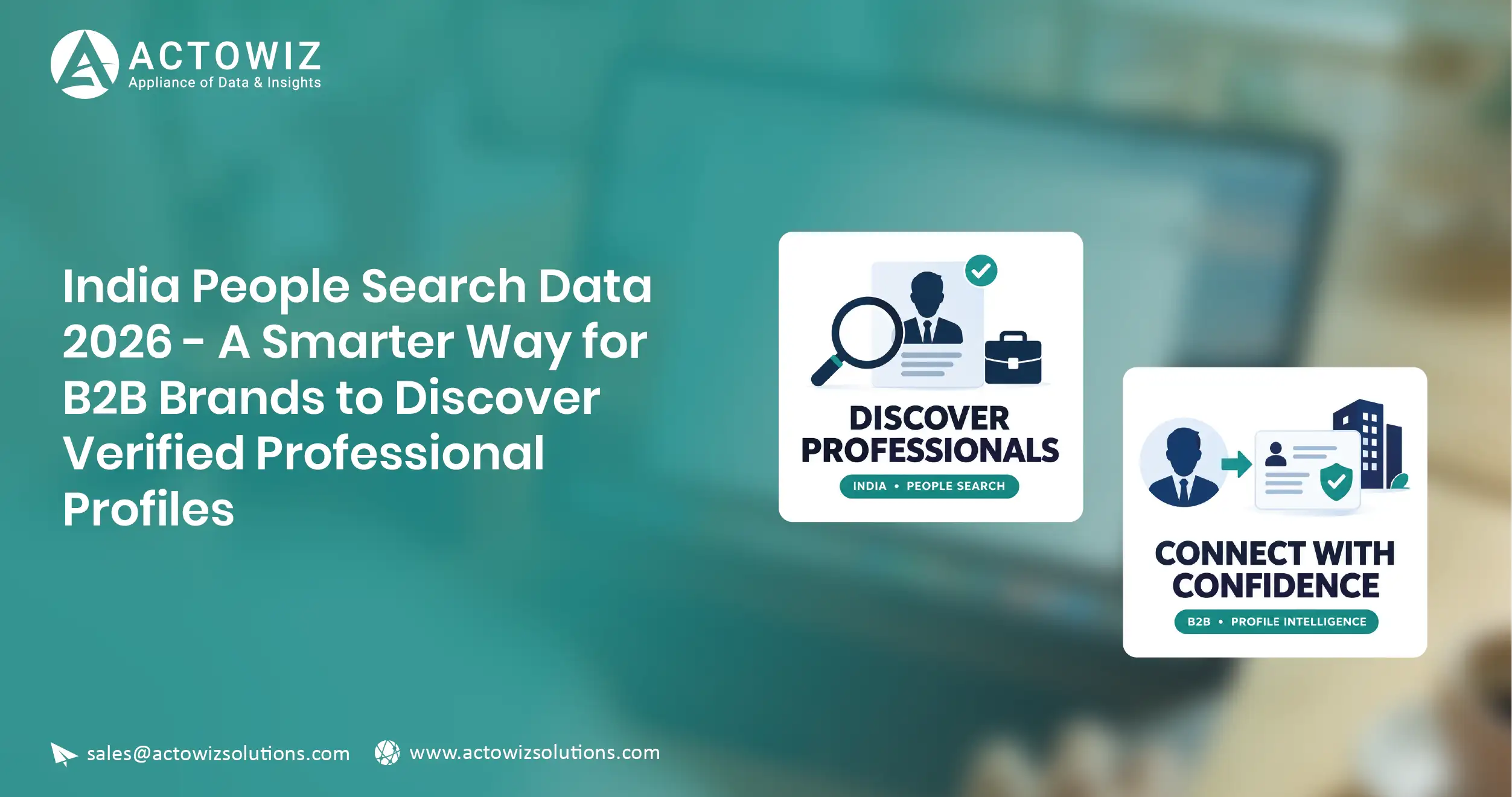
India people search data 2026 can help B2B brands organize professional research, identify relevant business contacts, and build targeted sales pipelines. For companies expanding across India, the priority is not simply collecting names. It is developing accurate, traceable, and appropriately sourced professional information that supports business development.
Sales teams often spend considerable time researching company websites, checking professional roles, identifying business locations, and correcting duplicate records. Disconnected information can slow prospect qualification and make it difficult to prioritize the right accounts. A structured approach helps businesses connect professional profiles with company information, industry classifications, geographic coverage, and publicly listed business contact channels.
Actowiz Solutions helps businesses explore structured data collection and enrichment workflows designed around their research requirements. Its approach can support Build verified B2B lead & location datasets initiatives by organizing relevant information into consistent, research-ready formats.
India's expanding digital infrastructure provides important context for these activities. The Telecom Regulatory Authority of India (TRAI) reported 743.19 million internet subscribers at the end of March 2020 and 954.40 million at the end of March 2024. These figures represent internet subscriptions, not unique people or professional profiles, but they demonstrate the growing scale of India's connected environment.
Source: TRAI performance indicators, March 2024.
For B2B decision-makers, the practical objective is straightforward: build a dependable research foundation, validate important fields, respect applicable privacy requirements, and use relevant information to improve sales prioritization.
How Can Automated Research Improve Professional Discovery?
India professional profile data Scraping for B2B brands can help businesses gather publicly available professional and company information from permitted online sources. Instead of manually copying individual records, teams can establish repeatable workflows for collecting relevant fields, normalizing formats, and checking information against its source.
For example, a software provider expanding into new Indian markets may need to identify companies within a particular industry, understand their locations, and find publicly listed professionals responsible for technology, procurement, or operations. Structured research can bring these details into a common format for subsequent qualification.
The scale of India's internet ecosystem supports the relevance of digital research. TRAI reported 743.19 million internet subscribers in March 2020, 825.30 million in March 2021, 824.89 million in March 2022, 881.25 million in March 2023, and 954.40 million in March 2024. The March 2022 figure was lower than the March 2021 figure, so the series should not be described as uninterrupted annual growth.
| Reference date |
Internet subscribers in India |
| March 2020 |
743.19 million |
| March 2021 |
825.30 million |
| March 2022 |
824.89 million |
| March 2023 |
881.25 million |
| March 2024 |
954.40 million |
| 2025–2026 |
Not included in this historical comparison |
Source: TRAI, Indian Telecom Services Performance Indicators.
These numbers describe subscriptions rather than the number of potential business buyers. They should therefore be used as digital-market context, not as estimates of addressable professional contacts.
For reliable results, research workflows should retain source URLs, record retrieval dates, and distinguish verified information from inferred classifications. Automation can improve consistency, but it cannot independently guarantee that every online profile is accurate or current.
What Should a Professional Contact Dataset Contain?
An India professional profile database for B2B sales should provide enough context for a sales representative to assess whether a contact and their organization match a product's intended customer profile.
A list containing only names is rarely sufficient for account qualification. Sales teams also need company identity, industry, business location, professional role, and a reliable source for important fields. Where available and appropriate, institutional business contact details can support legitimate outreach.
A useful structure separates company-level records from person-level records. This distinction prevents a professional's previous employer, a company's headquarters, and an individual branch office from being treated as the same entity.
| Field |
Purpose |
Recommended validation |
| Company name |
Identify the business account |
Official company website |
| Industry |
Segment relevant accounts |
Published company information |
| Website domain |
Confirm organizational identity |
Official website |
| City and state |
Plan geographic coverage |
Company contact page |
| Professional name |
Identify a relevant contact |
Official leadership or professional source |
| Job title |
Assess decision-making relevance |
Current published profile |
| Business contact channel |
Support appropriate communication |
Officially published contact details |
| Source URL |
Enable verification |
Preserve the original source |
| Last verified date |
Monitor record freshness |
Record the latest successful check |
How should teams assess quality?
Three checks are particularly important.
First, completeness measures whether the required fields are present. Second, accuracy checks whether recorded details match reliable sources. Third, freshness indicates when the information was last verified.
These measures should be reported separately. A record may be complete but outdated, or accurate but missing a direct business contact. Combining every dimension into one unexplained score can conceal important weaknesses.
Teams should also define deduplication rules. A professional appearing on several pages should not automatically become several independent leads. Likewise, employees at different branches may need separate records when they represent distinct business relationships.
For B2B sales leaders, these controls provide a practical basis for deciding whether a dataset is ready for CRM import, additional research, or manual review.
How Can Verified Information Strengthen Sales Decisions?
Verified professional profile data India 2026 should make it easier to understand who a professional is, which organization they represent, and whether their role is relevant to a specific business offering. Verification matters because professional information can change when people move between companies, receive promotions, or update their public profiles.
A reliable workflow checks critical fields against source material instead of treating the first search result as definitive. Company websites, official leadership pages, published business directories, and other authorized sources can contribute to this process. Conflicting details should be flagged rather than silently merged.
The India people search data 2026 workflow should also distinguish a confirmed fact from a business inference. For example, a published title may establish that a person is a technology director. It does not automatically establish that the person controls the budget or intends to purchase a particular solution.
| Verification status |
Meaning |
Recommended action |
| Source confirmed |
Field matches an identifiable source |
Retain source and check date |
| Partially confirmed |
Some details are supported, others are missing |
Use only verified fields |
| Conflicting information |
Sources disagree |
Review manually |
| Outdated |
A source no longer supports the recorded detail |
Recheck before use |
| Unverified |
No suitable supporting source found |
Do not present as confirmed |
What does the 2020–2026 timeline mean for data quality?
The timeline below separates historical infrastructure figures from the verification requirements that apply to current professional data.
| Period |
Evidence or operational focus |
| 2020 |
TRAI reported 743.19 million internet subscriptions at March-end |
| 2021 |
TRAI reported 825.30 million subscriptions at March-end |
| 2022 |
TRAI reported 824.89 million subscriptions at March-end |
| 2023 |
TRAI reported 881.25 million subscriptions at March-end |
| 2024 |
TRAI reported 954.40 million subscriptions at March-end |
| 2025 |
Recheck professional records against current, permitted sources |
| 2026 |
Maintain source traceability and document verification dates |
Source for the historical figures: TRAI report. The 2025 and 2026 entries are recommended operational practices, not published internet-subscription statistics.
For sales operations, verified data should be treated as time-sensitive. Establishing a documented review process is more defensible than promising that a contact list will remain permanently accurate.
How Can Professional Intelligence Improve Territory Planning?
India professional profile data for sales intelligence can help commercial teams understand how potential accounts are distributed across industries, cities, and organizational structures. Rather than relying on an undifferentiated national list, companies can develop territory plans based on their actual customer requirements.
A business selling enterprise software may prioritize organizations with established technology departments. A recruitment technology provider may focus on companies with relevant talent acquisition functions. A logistics software vendor may instead examine businesses operating in sectors where distribution and supply-chain workflows are important.
The value comes from connecting source-supported information with a clear qualification framework.
Which indicators should sales teams track?
| Indicator |
Business use |
| Qualified accounts by city |
Estimate territory coverage |
| Relevant profiles by industry |
Identify account concentrations |
| Verified professional roles |
Assess contact relevance |
| Records with source URLs |
Measure traceability |
| Duplicate account rate |
Identify database-cleaning needs |
| Missing critical fields |
Prioritize enrichment |
| Record age |
Identify profiles requiring review |
| Outreach outcomes |
Improve targeting using actual performance |
Teams can combine these indicators with their own CRM history to identify where further research may be worthwhile. For example, a region with many verified accounts but few relevant professional contacts may need additional research before a campaign launches.
However, the number of profiles in a city does not establish purchasing intent, budget availability, or conversion probability. Those factors require separate evidence from sales interactions and account qualification.
How can companies avoid misleading market comparisons?
Use the same industry definitions, geographic boundaries, verification standards, and reporting dates across territories. Document any changes in collection methods. Keep observed data separate from forecasts, and avoid comparing different reporting periods as if they were equivalent.
These practices make market intelligence more useful to sales directors and business development managers who need to justify expansion decisions with traceable evidence rather than assumptions.
How Can Organizations Combine Business Contacts and Location Intelligence?
India B2B contact intelligence and profile dataset development combines professional information with company and location records so businesses can assess accounts within a geographic and commercial context.
Location intelligence can support territory allocation, field-sales planning, regional account research, and local partner discovery. Company information adds another dimension by identifying industry, organizational structure, and publicly documented business activities.
A India people search data 2026 project should distinguish a professional's work location from a company's registered office, headquarters, or operating branch. These details may differ, and incorrectly merging them can create inaccurate territory assignments.
A practical workflow can include the following steps:
- Define the target market. Specify industries, company sizes, regions, and professional roles relevant to the offering.
- Select appropriate sources. Use official websites, permitted public directories, and other authorized sources.
- Collect relevant fields. Gather only information needed for the defined research purpose.
- Standardize locations. Normalize city, state, postal code, and organization identifiers where supported.
- Connect records carefully. Match professionals to organizations using reliable identifiers and source evidence.
- Validate and document. Retain provenance, record verification dates, and flag conflicting details.
- Prepare for business use. Export approved fields in a format suitable for analysis or CRM import.
How should organizations handle personal information?
India's Digital Personal Data Protection Act, 2023, establishes a legal framework for processing digital personal data. The government notified the Digital Personal Data Protection Rules, 2025, on 14 November 2025. Organizations should assess the applicable provisions, commencement arrangements, exemptions, and other relevant legal requirements for their specific processing activities.
Sources: Digital Personal Data Protection Act, 2023 and Government of India announcement on the DPDP Rules, 2025.
Public accessibility should not be treated as automatic permission for every collection, enrichment, or outreach activity. Businesses should establish appropriate source-use controls, assess legal obligations, minimize unnecessary personal information, and honor applicable objections or opt-outs.
How Can Cross-Market Research Support Global B2B Operations?
Data Intelligence Services USA is relevant to organizations that need to coordinate research across markets or support international sales teams with structured business information. A company operating in India and the United States may require consistent company classifications, standardized fields, documented sources, and separate compliance reviews for each jurisdiction.
Cross-market datasets should not simply combine records from different countries without checking their definitions. Professional titles, business identifiers, address formats, and publicly available information vary by source and jurisdiction. Even when two datasets contain similarly named fields, those fields may not be directly comparable.
For example, a global sales team might use company-level records to segment accounts by industry and region, then add verified professional contacts only when they are relevant to the intended outreach. The organization can preserve a common data schema while applying jurisdiction-specific rules for collection and use.
| Cross-market requirement |
Recommended approach |
| Standardized fields |
Establish a common schema and document definitions |
| Geographic accuracy |
Validate local address formats and location fields |
| Source transparency |
Preserve source URL and retrieval date |
| Contact verification |
Confirm role and employer against suitable sources |
| Data governance |
Review relevant legal and contractual requirements |
| Refresh management |
Set review schedules based on source volatility |
| Reporting consistency |
Document coverage, exclusions, and limitations |
For Indian operations, TRAI's reports can provide context about internet subscriptions, while the relevant company and professional records require their own validation. For US operations, equivalent local sources and rules should be evaluated rather than extrapolating Indian statistics to another market.
A responsible cross-market strategy separates verified observations from estimates and records the limitations of each source. This makes the resulting intelligence more useful for sales planning, partner research, and executive reporting.
How Can Actowiz Solutions Help?
Actowiz Solutions can support organizations seeking AI-Powered Scraping Services by helping define data requirements, identify suitable collection methods, structure records, and establish validation workflows. The exact deliverables depend on source availability, permitted access, required fields, geographic scope, and the agreed project specifications.
For B2B brands, the objective is to create usable research assets rather than simply accumulate records. A well-scoped project begins by identifying the business decisions the data must support. It then defines the necessary fields, source requirements, verification criteria, and delivery format.
What can the service workflow include?
- Source discovery: Identify appropriate websites, directories, and other permitted information sources.
- Structured extraction: Collect relevant company, location, and publicly supported professional information.
- Data cleaning: Standardize formats, flag missing fields, and identify potential duplicates.
- Record verification: Preserve source references and check important fields against available evidence.
- Dataset preparation: Organize approved information for analysis, reporting, or CRM integration.
- Refresh planning: Establish a practical process for reviewing records as source information changes.
What should buyers clarify before starting?
| Project question |
Why it matters |
| Which industries and regions are required? |
Defines the scope of research |
| Which professional roles are relevant? |
Prevents unnecessary data collection |
| Which fields must be verified? |
Establishes quality expectations |
| Which sources are permitted? |
Supports responsible collection |
| How will the dataset be used? |
Helps determine relevant governance controls |
| What output format is required? |
Supports downstream business workflows |
| How often must records be reviewed? |
Sets realistic maintenance expectations |
Actowiz Solutions can discuss these requirements before proposing a collection and enrichment workflow. Specific coverage, accuracy levels, delivery timelines, and record volumes should be confirmed for the individual project rather than assumed in advance.
The result should be a clearly documented dataset that supports business research, with source traceability and quality limitations visible to the teams using it.
Conclusion
Professional search data becomes commercially valuable when businesses can establish who a contact is, which organization they represent, where the organization operates, and whether the available information supports the intended business purpose.
For B2B brands, the strongest approach combines structured collection, source verification, location normalization, careful deduplication, and responsible data governance. Historical internet-subscription figures help describe India's digital environment, but they should not be confused with counts of professional profiles, qualified prospects, or likely customers.
Actowiz Solutions can help businesses scope data workflows that support research, prospect qualification, and market expansion through Web Scraping, Mobile App Scraping, and a Real-time dataset tailored to defined requirements, subject to source availability and permitted access.
Ready to improve your B2B prospect research? Contact Actowiz Solutions to discuss your target industries, regions, professional fields, verification needs, and preferred dataset format.
You can also reach us for all your mobile app scraping, data collection, web scraping, and instant data scraper service requirements!
 Actowiz Solutions

 By industry
 Pricing & Promotions
 Brand & Intelligence
 Digital Shelf & Search
 Assortment
 For Retailers
 E-Commerce Dashboard
 Flipkart Insights (Live)
 Grocery Intelligence
.svg) Grocery Price (U.S.)
.svg) Quick Commerce (India)
 Food & Restaurant
 Fashion Intelligence
 Automotive
 Travel & Hospitality
 Real Estate
 Food Delivery Intelligence
 OTT & Streaming
 Fuel & EV Charging Price Tracker
 By Use Case
 Pricing Intelligence
 Digital Shelf Analytics
 MAP Monitoring
 Cross-Border Price Parity
 Share of Search
 Review Sentiment
 Kitchen Market Gaps
 Dynamic Pricing / AI Repricing
 Promotions & Deals Alerts
 B2B / POI & Lead Data
 AI Search Visibility Dashboard
 Baby Products on Quick Commerce
 Hotel & Flight Rate Parity
 By Region
 Flipkart Real-Time Insights
 Quick Commerce — Zepto · Blinkit
 Pincode Price Tracker
 GCC Q-Commerce — Talabat · Noon
 UK Grocery — Tesco, Sainsbury's, Asda
 AU Grocery — Coles & Woolworths
 Marketplace Scrapers
 Developer APIs
 Universal APIs
 Delivery & SDKs
 Knowledge Center
 Guides & Playbooks
 Downloads & Tools
 Trust & Company


 4.8/5 Average Rating
 50+ Video Testimonials
 92% Client Retention
 50+ Countries Served