Introduction
Most web data projects that go wrong do not fail on technology. They fail on a vague contract: nobody wrote down which fields count as "complete", who pays when a retailer redesigns its site, or what the buyer receives on the way out.
Direct answer: A web data vendor contract should fix five things in writing: a scope schedule (sources, fields, geographies, cadence, format), a change-management process for when websites change, an SLA with measurable QA thresholds and service credits, clear data ownership and usage rights, and exit terms covering final delivery, code or schema handover and deletion.
This checklist is written for procurement, legal and data heads who already picked a shortlist and now need to paper the deal. It focuses on the clauses themselves, not on vendor selection or RFP design. This article is general information, not legal advice. Always have your own counsel review any agreement.
Why the contract matters more for web data than for other SaaS
A normal SaaS contract governs software you log into. A web data contract governs a moving target: hundreds of third-party websites that change layouts, block traffic, add pincode or zip-code gating, or retire product pages without notice. The vendor controls the collection; you carry the business risk when a pricing dashboard goes blank on a Monday.
That is why the contract has to translate operational realities into obligations:
- Sources change weekly. Without a repair clause, a broken scraper is "best effort".
- Quality is measurable. Fill rates, duplicate rates and freshness can be written as numbers, not adjectives.
- Data flows into regulated systems. Pricing, assortment and compliance teams need to know what they may do with the data and for how long.
- Switching vendors is costly. If schemas, mapping tables and history are not handed over, you rebuild from zero.
Which documents make up a web data vendor contract?
Enterprise deals usually split into several documents. Knowing which clause lives where avoids gaps and contradictions.
| Document |
What it should contain |
Who owns review |
| Master Services Agreement (MSA) |
Liability, indemnities, IP, confidentiality, governing law, termination rights |
Legal |
| Statement of Work (SOW) |
Deliverables, milestones, pilot and acceptance, fees, change-request pricing |
Procurement + data lead |
| Scope schedule |
Exact sources, countries, categories, fields, cadence, delivery format |
Data / analytics lead |
| SLA schedule |
Delivery windows, QA thresholds, repair times, support hours, service credits |
Data lead + procurement |
| Data processing agreement (only if personal data is in scope) |
Processing instructions, security, sub-processors, deletion |
Legal / privacy |
| Security annex |
Access controls, encryption, breach notice, audit rights |
InfoSec |
Most public business data projects (prices, stock, listings, store locations) do not involve personal data. If your scope ever touches personal data, a processing agreement is not optional: under the EU GDPR, Article 28(3) lists what a processor contract must cover, including documented instructions, confidentiality, security, sub-processor conditions, audit support and deletion or return at the end of services (GDPR Art. 28 (https://rgpd.com/chapter-4-controller-and-processor/article-28-processor/)). India's Digital Personal Data Protection Rules were notified on 14 November 2025 (DPDP Rules 2025 (https://en.wikipedia.org/wiki/Digital_Personal_Data_Protection_Rules,_2025)), so Indian buyers should check obligations with counsel as well.
The 10 clauses to agree before you sign
- Scope schedule. List every source by domain or app, every country, marketplace and category, and every field with a definition. Specify cadence (daily, twice daily, hourly) and the time zone. Ambiguity here becomes a dispute later.
- Delivery format and channel. Name the format (CSV, JSON, Parquet) and the channel (REST API, S3 bucket, Snowflake or BigQuery share, SFTP). Fix the schema version and the notice period for any schema change.
- Pilot and acceptance testing. Agree a sample dataset or pilot window, the acceptance criteria and who signs off. Fees for full production should start only after acceptance.
- Quality thresholds. Define metrics such as field fill rate for mandatory fields, duplicate rate, freshness (age of data at delivery) and match accuracy for product matching. State how each is measured and on what sample.
- Change management when websites change. Who detects breakage, how fast it is repaired, whether missed snapshots are backfilled where the source still allows it, and whether repairs are included in the fee. Separate "site change" (vendor's job) from "scope change" (a priced change request).
- Service levels and credits. Delivery windows, support hours, response and resolution times by severity, and a credit table. Cap credits sensibly and say whether repeated misses give a right to terminate.
- Data ownership and usage rights. State what licence you receive to the delivered dataset, whether you may share it with affiliates, agencies or consultants, whether it can feed internal AI models, and whether the vendor may resell or reuse the same collected data.
- Compliance and collection practices. Public data only, no login bypass, no personal data unless agreed, respect for rate limits, and how the vendor handles a source that objects. Allocate responsibility for how data is collected versus how you use it.
- Confidentiality and security. Treat your source list, SKU lists and target pincodes as confidential. Agree encryption, access control, breach notification and retention.
- Termination and data handover. Notice periods for convenience and for cause, a final delivery, a handover pack (schemas, field dictionary, mapping tables, historical archive) and a deletion certificate.
How to write SLA and QA terms that can actually be measured
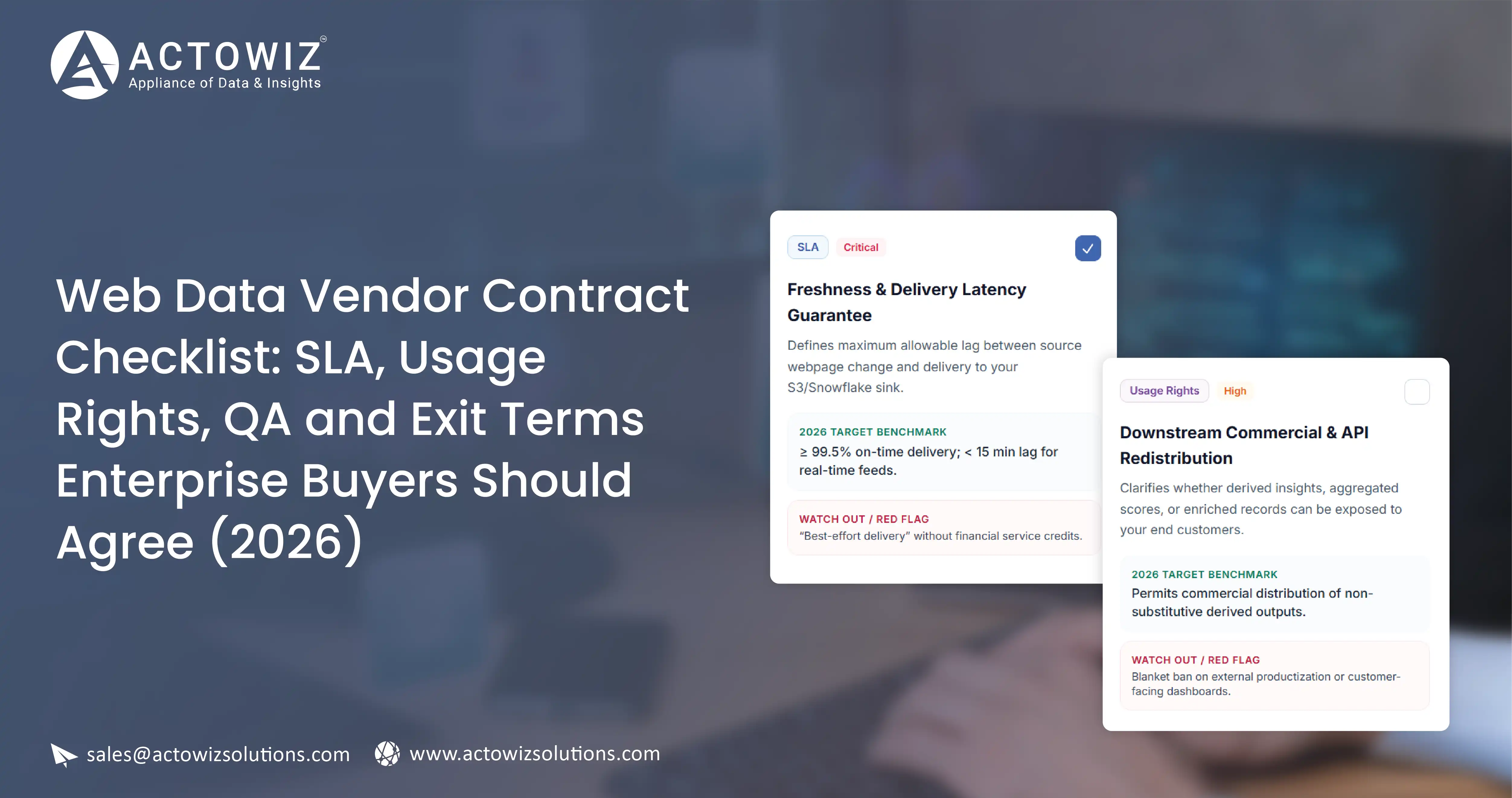
A good SLA schedule reads like a test specification. Each line has a metric, a target, a measurement method and a consequence. The figures below are placeholders for negotiation, not market benchmarks; set them from your pilot data.
| SLA element |
How to define it |
Example wording to negotiate |
| Delivery time |
Clock time and time zone for each feed |
Daily file in S3 by [06:00 local time] |
| Freshness |
Max age of a record at delivery |
Prices captured within [X hours] of delivery |
| Mandatory field fill rate |
Share of records with non-null price, stock, URL, SKU |
At least [X%] per delivery, measured on full file |
| Duplicate rate |
Duplicate records by agreed key |
Below [X%] per delivery |
| Site-change repair |
Time from detection to restored feed |
Severity 1 within [X business hours]; backfill where source permits |
| Support response |
Acknowledgement by severity |
Severity 1 within [X hours] |
| Service credit |
Percentage of monthly fee per missed SLA |
[X%] per breach, capped at [Y%] per month |
Three practical tips:
- Measure on the vendor's QA report and your own checks. Ask for a per-delivery QA summary (row counts, fill rates, failed sources) so disputes rest on shared numbers.
- Exclude what the vendor cannot control, but narrowly. A source being down for everyone is fair force majeure; a vendor's proxy or infrastructure failure is not.
- Link chronic failure to exit. For example, missing the same SLA in several consecutive months could trigger a right to terminate without penalty.
Usage rights, ownership and confidentiality
This is where procurement and legal most often talk past each other. Separate three layers:
- The source content. Neither you nor the vendor owns a retailer's product pages. The contract should confirm the vendor collects only publicly available business data and does not claim to transfer rights it does not have.
- The delivered dataset. Agree the licence you receive: internal use only, use by affiliates, use by named agencies, inclusion in client-facing reports, and use for training internal models. If you need exclusivity on a custom dataset, say so and expect it to be priced.
- The collection code and infrastructure. Most managed vendors keep ownership of their crawlers. If you need the code, write it into the SOW as a deliverable; otherwise ask for a handover pack of schemas and mappings.
On confidentiality, the information you share (SKU lists, competitor sets, target cities, pricing logic) can be more sensitive than the data you receive. Make confidentiality mutual and survive termination.
Termination, exit and data handover
Exit terms are signed when relationships are friendly and used when they are not. Agree them now:
- Termination for convenience with a defined notice period, and termination for cause after an uncured material breach.
- Final delivery of all paid-for data up to the termination date.
- Handover pack: field dictionary, schema files, product-matching tables and the historical archive in an agreed format.
- Transition support for a defined period at agreed rates, so a new provider can run in parallel.
- Deletion: the vendor deletes your confidential inputs and confirms in writing, subject to legal retention needs.
Quick contract checklist
- Scope schedule with sources, countries, fields, cadence
- Delivery format, channel and schema-change notice
- Pilot, sample and acceptance criteria
- QA metrics with measurement method
- Site-change repair times and backfill rules
- SLA credits, caps and chronic-failure exit
- Licence and permitted users of the dataset
- Public-data-only collection commitments
- Mutual confidentiality and security annex
- Exit: final delivery, handover pack, deletion
Choosing a provider that will sign these terms
A vendor's willingness to put numbers in an SLA schedule tells you a lot. When you evaluate a managed provider, ask for a sample QA report, a sample delivery in your target format and an example of how a recent site change was handled. Actowiz Solutions runs managed web scraping services and custom data extraction for enterprise teams, with delivery through API, S3, Snowflake, BigQuery or CSV, documented QA checks and a sample dataset typically within 48 hours of agreeing scope. Contract terms such as SLAs, credits and usage rights are agreed per engagement.
Ready to paper a web data deal with measurable SLAs, clear usage rights and a defined exit? Talk to our team about scope, QA reports and contract terms.
Contact Us Today!
Frequently Asked Questions
What is a web data vendor contract?
It is the set of agreements (usually an MSA, SOW, scope schedule and SLA schedule) that defines what web data a provider collects, how and when it is delivered, the quality standards, your usage rights and what happens at exit.
Should a web scraping SLA guarantee 100% accuracy?
Usually not. Websites change and sometimes show errors themselves. A realistic SLA defines measurable thresholds such as fill rate, duplicate rate and freshness, plus repair times and credits when thresholds are missed.
Who owns the data delivered by a web data vendor?
It depends on the contract. Typically you receive a licence to use the delivered dataset for agreed purposes, while the vendor keeps its collection code. Spell out sharing, AI-training and resale rights explicitly.
What happens when a source website changes its layout?
A good contract makes detection and repair the vendor's responsibility within agreed time limits, with backfill where the source still allows it. New sources or fields are handled as priced change requests.
Do I need a data processing agreement for web data?
Only if personal data is in scope. Most price, stock and catalogue projects use public business data only. If personal data is involved, laws such as the GDPR require specific processor terms. Check with your counsel.
Is this checklist legal advice?
No. It is general guidance to help buyers prepare. Have qualified legal counsel in your jurisdiction review any web data vendor contract.
Conclusion
You can also reach us for all your mobile app scraping, data collection, web scraping , and instant data scraper service requirements!
 Actowiz Solutions

 By industry
 Pricing & Promotions
 Brand & Intelligence
 Digital Shelf & Search
 Assortment
 For Retailers
 E-Commerce Dashboard
 Flipkart Insights (Live)
 Grocery Intelligence
.svg) Grocery Price (U.S.)
.svg) Quick Commerce (India)
 Food & Restaurant
 Fashion Intelligence
 Automotive
 Travel & Hospitality
 Real Estate
 Food Delivery Intelligence
 OTT & Streaming
 Fuel & EV Charging Price Tracker
 By Use Case
 Pricing Intelligence
 Digital Shelf Analytics
 MAP Monitoring
 Cross-Border Price Parity
 Share of Search
 Review Sentiment
 Kitchen Market Gaps
 Dynamic Pricing / AI Repricing
 Promotions & Deals Alerts
 B2B / POI & Lead Data
 AI Search Visibility Dashboard
 Baby Products on Quick Commerce
 Hotel & Flight Rate Parity
 By Region
 Flipkart Real-Time Insights
 Quick Commerce — Zepto · Blinkit
 Pincode Price Tracker
 GCC Q-Commerce — Talabat · Noon
 UK Grocery — Tesco, Sainsbury's, Asda
 AU Grocery — Coles & Woolworths
 Marketplace Scrapers
 Developer APIs
 Universal APIs
 Delivery & SDKs
 Knowledge Center
 Guides & Playbooks
 Downloads & Tools
 Trust & Company


 4.8/5 Average Rating
 50+ Video Testimonials
 92% Client Retention
 50+ Countries Served