🎃 HALLOWEEN OFF Spooky Savings Event! Get FLAT 20% OFF on all Web Scraping & Data Extraction Plans 20% OFF Web Scraping Plans!
Ends in: 00d : 00h : 00m : 00s
🦇
👻
🎃 Spooktacular Limited Offer

Don’t Let High Data Costs Haunt You! 🎃

Get FLAT 20% OFF

T&C Apply

Scrape competitor prices, monitor MAP, and extract real-time datasets at a spooky discount this Halloween.

Offer Expires In:
00d : 00h : 00m : 00s
⚡ Claim 20% Discount Now
🎃
Promo Code Copied!
SPOOKY30 (20% OFF Applied)
Core services
Enterprise Data Extraction

Scalable web, app and AI-powered collection across 40+ countries.

All 58 services →
New 2026
AI Training Data

Corpus building with provenance and opt-out compliance.

Learn more →
Free pilot
24-hour sample

We run collection on your own sources before you commit.

Get a sample →
58Services
40+Countries
DEVELOPER

Ready-Made Scrapers

Pre-built for top platforms. Self-serve, no setup.

View All →
TRY FREE

API Playground

Test endpoints instantly. No credit card.

Start Free →
28Tools
2SDKs
icons Delivery & SDKs
Streaming Crawl API Scheduler Realtime Alerts Webhook Delivery 🐍 Python SDK 💚 Node.js SDK
Need it managed instead?

Fixed monthly retainer, named engineer, no per-request metering.

Managed Data API →
HOT

Case Studies

How brands use Actowiz, with named outcomes.

Read →
FREE

Sample Datasets

Real output, no signup.

Download →
NEW

ROI Calculator

Model the return on a data engagement.

Calculate →
Home Depot India Weekly E-Commerce Dataset

Introduction

A shopper in Riyadh asks an AI assistant which of two retailers has the better price on a specific washing machine. Both retailers list it. One listing the assistant collected is in Arabic, one in English. Unless something upstream decided those are the same product, the assistant either answers about one retailer, or reports two products and no comparison.

That decision — same product or not — is the whole problem. GCC platforms almost universally run bilingual catalogues, and the two language versions of a single listing are rarely field-for-field equivalent. Any price index, coverage report or AI answer built on GCC data is only as good as the layer that links them.

Four ways the same product diverges across languages

The divergence is not simply "one is a translation of the other." Four distinct patterns show up, and they need different handling.

Different titles, not translated titles. The English title and the Arabic title are frequently written by different people, or generated by different processes, at different times. The Arabic one may include the category word and omit the model number. The English one may lead with the model number and omit the capacity. They are two descriptions of one product, not two renderings of one string.

Different attribute completeness. This is the most consequential difference and the least discussed. The English variant of a listing often carries a fuller structured attribute set — because the seller filled that form first, or because the platform's attribute taxonomy was built in English and the Arabic labels were added later. The Arabic variant may have half the specification fields populated. If you collect only Arabic, your field completeness looks poor. If you collect only English, you never see it.

Transliterated versus translated brand names. A brand name in a GCC listing may appear in Latin script, in Arabic script as a phonetic transliteration, or both in the same title. Descriptive brand elements are sometimes translated rather than transliterated. Critically, transliteration into Arabic script has no single canonical form: Arabic short vowels are usually unwritten, and several consonant choices are defensible for the same foreign sound. So one brand can appear in Arabic script in multiple spellings across a single platform, all of them legitimate. Never assume a brand's Arabic-script rendering — collect the forms that actually appear on the platform and treat them as observed aliases.

Different prices or availability. Less common, but real. Where the two language versions are backed by separate catalogue records rather than one record with two label sets, they can drift. A promotion applied to one and not the other, or stock that updates on one path only. When you see this, it tells you something about the platform's architecture, and it means you cannot treat either version as authoritative for price.

Why string matching fails here

Home Depot India Weekly E-Commerce Dataset

The usual fallback for product matching is fuzzy text similarity on titles. In a bilingual Arabic-English catalogue it fails for structural reasons, not tuning reasons.

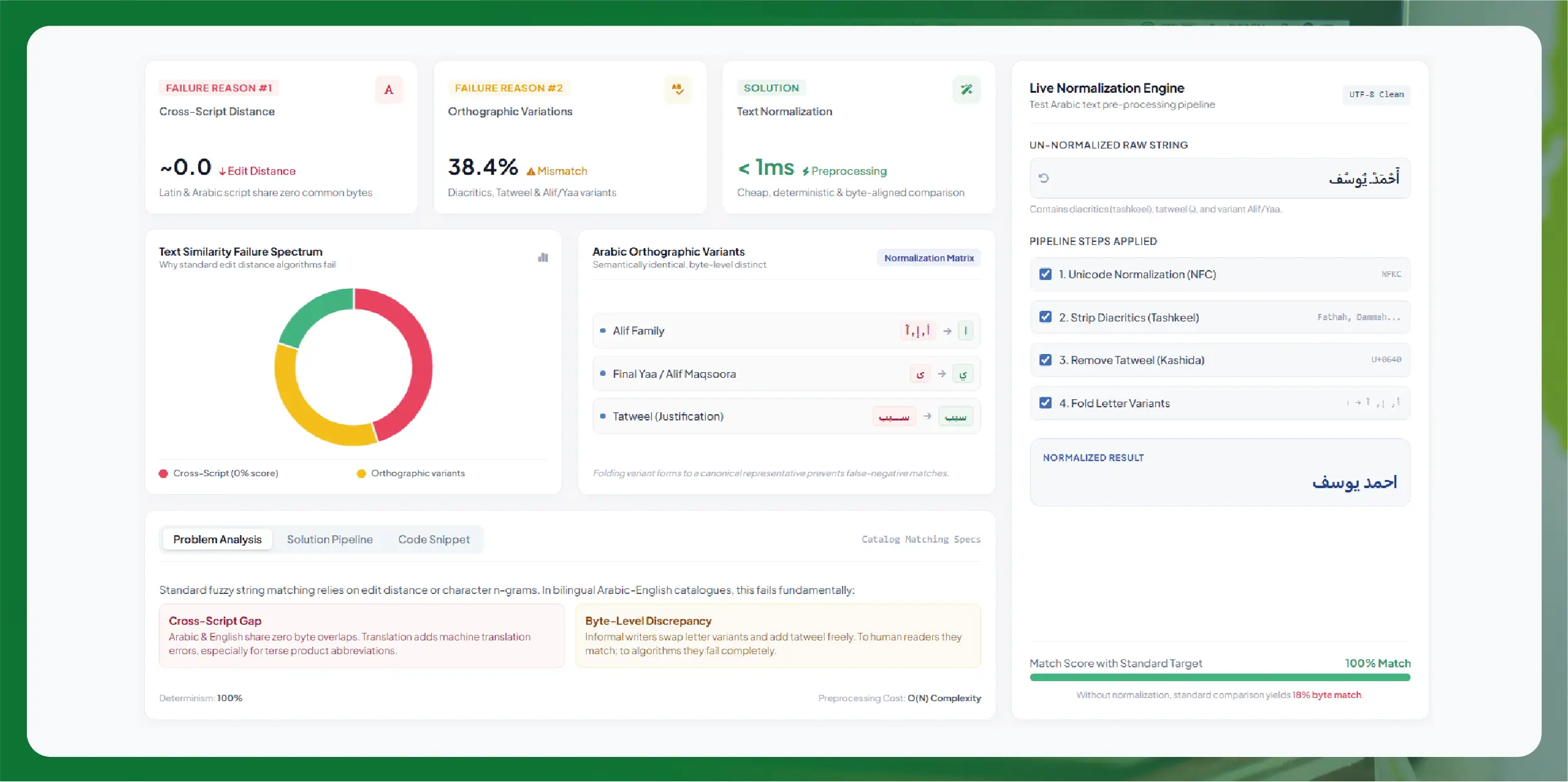
Cross-script similarity is undefined. An Arabic-script title and a Latin-script title share almost no characters, so edit distance and character n-gram similarity both return near zero for identical products. Translating one side first introduces its own errors, and machine translation of terse, abbreviated product titles is unreliable precisely where precision matters.

Within Arabic script, a further problem: Arabic text has orthographic variation that is semantically irrelevant but byte-level significant. Optional diacritics may be present or absent. Certain letters have variant forms that writers use interchangeably in informal text — the alif family and the final yaa are the common cases. The tatweel character, used to stretch words for justification, inserts bytes that carry no meaning. Two spellings of the same word can therefore differ in bytes while being identical to a reader.

So before any Arabic text comparison, normalise: apply Unicode normalisation, strip diacritics, strip tatweel, and fold the known letter-variant families to a single form. This is a well-established preprocessing step and it is cheap. It does not solve cross-script matching, but it makes Arabic-to-Arabic comparison meaningful.

Right-to-left text with Latin fragments

GCC product titles routinely mix directions: Arabic-script words running right-to-left with a Latin model number or measurement embedded left-to-right. This is normal, correct text. It causes three practical problems.

Display corruption in your own tools. A mixed-direction string rendered in a tool without bidirectional text support shows fragments in the wrong visual order. Analysts then "correct" it, and corrupt the data. Store the original string untouched, and fix the renderer rather than the data.

Invisible control characters. Bidirectional text sometimes carries embedded direction-control marks. They are zero-width and invisible, and they break exact-match comparison and join keys silently. Strip them in the normalisation step, and keep the original.

Model number extraction is actually easier. The Latin fragment inside an Arabic title is usually the model number or a measurement, and it is trivially isolatable by script. This is a useful signal, not a nuisance. A regular expression that pulls Latin-script and digit runs out of an Arabic title gives you a candidate model number with high precision.

Units and sizes expressed differently

The two language versions frequently express the same measurement differently. Volume might appear as a Latin unit abbreviation in the English title and as an Arabic unit word in the Arabic title. Numerals themselves can be written with Western digits or Eastern Arabic-Indic digits, and both appear on GCC platforms, sometimes on the same page.

The normalisation here is straightforward and high-value: map Eastern Arabic-Indic digits to Western digits, map both Arabic and English unit words and abbreviations to a single controlled unit code, and convert to a canonical unit per dimension. Once that is done, capacity, weight and dimensions become language-independent — which makes them the strongest matching signal you have in this region.

The matching pipeline

Order matters. Run cheap, high-precision steps first and reserve text similarity for what survives.

Stage Signal Precision Notes
1 External identifier — GTIN, EAN, UPC, or platform SKU where exposed Highest Validate check digits; watch for parent identifiers shared across variants
2 Normalised numeric attributes — capacity, weight, dimensions, power rating High Language-independent after unit normalisation; match on tuples, not single values
3 Extracted model number — Latin/digit runs from either title High Normalise case, strip separators; beware of model families sharing a prefix
4 Brand alias resolution — observed Arabic and Latin forms mapped to one brand ID Medium-high Build the alias table from observed data; never from assumption
5 Image similarity Medium Useful tiebreaker where sellers reuse manufacturer imagery
6 Text similarity within the same script, after normalisation Low-medium Last resort; never across scripts without a translation step you have evaluated

Every match gets a confidence score and a record of which stage produced it. That provenance is what lets you report share of bilingual listing pairs linked by identifier separately from share linked by text similarity only — and the second number is where your error budget lives.

A field schema carrying both variants

The instinct is to pick a canonical language and normalise everything to it. Resist it. Choosing English loses the Arabic attribute values that only exist on the Arabic variant and the Arabic-script brand aliases you need for search-side work. Choosing Arabic loses the fuller English specification sets. The answer is to keep both and link them.

Field Type Notes
product_key string Internal cross-language product identity
platform string Platform identifier
country string ISO 3166-1 alpha-2; GCC listings are country-scoped
listing_url_ar / listing_url_en string Both language URLs where they differ
title_ar_raw / title_en_raw string Original strings, unmodified
title_ar_norm string Diacritics and tatweel stripped, letter variants folded, control marks removed
brand_id string Resolved brand identity
brand_forms_observed array Every Arabic-script and Latin-script form seen, with counts
model_number_extracted string From Latin/digit runs
external_ids object Keyed by scheme, with validation status
attributes object Per attribute: value, unit code, source language, extraction confidence
attribute_completeness_ar / _en number Populated-field ratio per language variant
price_value / price_currency number / string As collected; currency as ISO code, never inferred
availability_scope string Whether availability is national, city-level or unspecified
match_stage / match_confidence string / number Provenance of the cross-language link
collected_at timestamp Per language variant, separately

Note the two completeness fields. Reporting them separately is how you discover that your Arabic listings are underspecified, which is usually actionable and usually news.

What this means for brand monitoring in the GCC

If you monitor your GCC shelf in English only, you are measuring a partial shelf. Specifically, you will miss listings that exist only in Arabic, understate your own coverage where the Arabic variant is the one that surfaces in Arabic-language search, and miss the attribute gaps on your Arabic variants that make your products invisible to filtered browsing and to AI assistants answering in Arabic.

Three metrics worth tracking, once both variants are collected and linked:

  • share of your SKUs present in both language variants per platform
  • attribute completeness gap between your Arabic and English variants
  • share of your listings where Arabic and English price disagree at the same timestamp

The third should be near zero. Where it is not, you have found a platform or seller integration problem that nobody was looking for.

Actowiz Solutions collects both language variants of GCC listings as separate observations, links them through the identifier-first pipeline above, and reports completeness and price agreement per language.

FAQ

Why does fuzzy text matching fail on Arabic and English product listings?

The two titles share almost no characters, so character-based similarity returns near zero for identical products. Within Arabic script, optional diacritics, interchangeable letter variants and the tatweel character mean two spellings of the same word can differ in bytes. Normalisation fixes the second problem; only identifiers and numeric attributes reliably solve the first.

Should I treat the Arabic or the English listing as canonical?

Neither. The English variant usually carries a fuller structured attribute set, while the Arabic variant carries the brand spellings and category terms that Arabic-language search and Arabic-language AI answers depend on. Keep both as separate observations, link them with a shared product key, and report completeness for each.

What is the most reliable matching signal for GCC product data?

External identifiers first, then normalised numeric attributes such as capacity, weight and dimensions. Numeric attributes are language-independent once you have mapped Eastern Arabic-Indic digits to Western digits and folded Arabic and English unit words into a single unit vocabulary.

Conclusion

You can also reach us for all your mobile app scraping, data collection, web scraping, and instant data scraper service requirements!

Coverage spans the major regional platforms and country-level catalogues, with the original Arabic strings preserved alongside normalised forms.
Contact Us Today!
Social Proof That Converts

Trusted by Global Leaders Across Q-Commerce, Travel, Retail, and FoodTech

Our web scraping expertise is relied on by 4,000+ global enterprises including Zomato, Tata Consumer, Subway, and Expedia — helping them turn web data into growth.

4,000+ Enterprises Worldwide
50+ Countries Served
20+ Industries
Join 4,000+ companies growing with Actowiz →
Real Results from Real Clients

Hear It Directly from Our Clients

Watch how businesses like yours are using Actowiz data to drive growth.

▶
1 min
★★★★★
"Actowiz Solutions offered exceptional support with transparency and guidance throughout. Anna and Saga made the process easy for a non-technical user like me. Great service, fair pricing!"
TG
Thomas Galido
Co-Founder / Head of Product at Upright Data Inc.
▶
2 min
★★★★★
"Actowiz delivered impeccable results for our company. Their team ensured data accuracy and on-time delivery. The competitive intelligence completely transformed our pricing strategy."
II
Iulen Ibanez
CEO / Datacy.es
▶
1:30
★★★★★
"What impressed me most was the speed — we went from requirement to production data in under 48 hours. The API integration was seamless and the support team is always responsive."
FC
Febbin Chacko
-Fin, Small Business Owner
icons 4.8/5 Average Rating
icons 50+ Video Testimonials
icons 92% Client Retention
icons 50+ Countries Served

Join 4,000+ Companies Growing with Actowiz

From Zomato to Expedia — see why global leaders trust us with their data.

Why Global Leaders Trust Actowiz

Backed by automation, data volume, and enterprise-grade scale — we help businesses from startups to Fortune 500s extract competitive insights across the USA, UK, UAE, and beyond.

icons
7+
Years of Experience
Proven track record delivering enterprise-grade web scraping and data intelligence solutions.
icons
4,000+
Projects Delivered
Serving startups to Fortune 500 companies across 50+ countries worldwide.
icons
200+
In-House Experts
Dedicated engineers across scrapers, AI/ML models, APIs, and data quality assurance.
icons
9.2M
Automated Workflows
Running weekly across eCommerce, Quick Commerce, Travel, Real Estate, and Food industries.
icons
270+ TB
Data Transferred
Real-time and batch data scraping at massive scale, across industries globally.
icons
380M+
Pages Crawled Weekly
Scaled infrastructure for comprehensive global data coverage with 99% accuracy.

AI Solutions Engineered
for Your Needs

→
LLM-Powered Attribute Extraction: High-precision product matching using large language models for accurate data classification.
→
Advanced Computer Vision: Fine-grained object detection for precise product classification using text and image embeddings.
→
GPT-Based Analytics Layer: Natural language query-based reporting and visualization for business intelligence.
→
Human-in-the-Loop AI: Continuous feedback loop to improve AI model accuracy over time.
icons Product Matching icons Attribute Tagging icons Content Optimization icons Sentiment Analysis icons Prompt-Based Reporting

Connect the Dots Across
Your Retail Ecosystem

We partner with agencies, system integrators, and technology platforms to deliver end-to-end solutions across the retail and digital shelf ecosystem.

icons
Analytics Services
icons
Ad Tech
icons
Price Optimization
icons
Business Consulting
icons
System Integration
icons
Market Research
Become a Partner →

Popular Datasets — Ready to Download

Browse All Datasets →
icons
Amazon
eCommerce
Free 100 rows
icons
Zillow
Real Estate
Free 100 rows
icons
DoorDash
Food Delivery
Free 100 rows
icons
Walmart
Retail
Free 100 rows
icons
Booking.com
Travel
Free 100 rows
icons
Indeed
Jobs
Free 100 rows

Latest Insights & Resources

View All Resources →
thumb
Blog

Promo & Coupon Data API 2026 - How Consumer Brands Improve Discount Strategies and Compliance Tracking

Promo & Coupon Data API 2026: Help Consumer Brands Track Discounts, Analyze Promotions, Optimize Pricing, and Strengthen Compliance Tracking

thumb
Case Study

How a Leading Brand Built a Smarter Car Marketplace with Japan Used-Car Pricing API for an East African Market

Japan Used-Car Pricing API for an East African market helps car marketplaces access accurate pricing data, compare vehicles, and make smarter decisions.

thumb
Report

Scrape India Restaurant Market Map 2026 - Comprehensive Swiggy and Zomato Listings by City

Scrape India Restaurant Market Map 2026: Swiggy & Zomato Restaurant Listings, Market Trends, City-Wise Data & Competitive Insights

Start Where It Makes Sense for You

Whether you're a startup or a Fortune 500 — we have the right plan for your data needs.

icons
Enterprise
Book a Strategy Call
Custom solutions, dedicated support, volume pricing for large-scale needs.
icons
Growing Brand
Get Free Sample Data
Try before you buy — 500 rows of real data, delivered in 2 hours. No strings.
icons
Just Exploring
View Plans & Pricing
Transparent plans from $500/mo. Find the right fit for your budget and scale.
Get in Touch
Let's Talk About
Your Data Needs
Tell us what data you need — we'll scope it for free and share a sample within hours.
  • icons
    Free Sample in 2 HoursShare your requirement, get 500 rows of real data — no commitment.
  • icons
    Plans from $500/monthFlexible pricing for startups, growing brands, and enterprises.
  • icons
    US-Based SupportOffices in New York & California. Aligned with your timezone.
  • icons
    ISO 9001 & 27001 CertifiedEnterprise-grade security and quality standards.
Request Free Sample Data
Fill the form below — our team will reach out within 2 hours.
+1 ▼
✓ Free 500-row sample · No credit card · Response within 2 hours

Request Free Sample Data

Our team will reach out within 2 hours with 500 rows of real data — no credit card required.

+1 ▼
✓ Free 500-row sample · No credit card · Response within 2 hours