🎃 HALLOWEEN OFF Spooky Savings Event! Get FLAT 20% OFF on all Web Scraping & Data Extraction Plans 20% OFF Web Scraping Plans!
Ends in: 00d : 00h : 00m : 00s
🦇
👻
🎃 Spooktacular Limited Offer

Don’t Let High Data Costs Haunt You! 🎃

Get FLAT 20% OFF

T&C Apply

Scrape competitor prices, monitor MAP, and extract real-time datasets at a spooky discount this Halloween.

Offer Expires In:
00d : 00h : 00m : 00s
⚡ Claim 20% Discount Now
🎃
Promo Code Copied!
SPOOKY30 (20% OFF Applied)
Core services
Enterprise Data Extraction

Scalable web, app and AI-powered collection across 40+ countries.

All 58 services →
New 2026
AI Training Data

Corpus building with provenance and opt-out compliance.

Learn more →
Free pilot
24-hour sample

We run collection on your own sources before you commit.

Get a sample →
58Services
40+Countries
DEVELOPER

Ready-Made Scrapers

Pre-built for top platforms. Self-serve, no setup.

View All →
TRY FREE

API Playground

Test endpoints instantly. No credit card.

Start Free →
28Tools
2SDKs
icons Delivery & SDKs
Streaming Crawl API Scheduler Realtime Alerts Webhook Delivery 🐍 Python SDK 💚 Node.js SDK
Need it managed instead?

Fixed monthly retainer, named engineer, no per-request metering.

Managed Data API →
HOT

Case Studies

How brands use Actowiz, with named outcomes.

Read →
FREE

Sample Datasets

Real output, no signup.

Download →
NEW

ROI Calculator

Model the return on a data engagement.

Calculate →
Zoomcar Data Intelligence 2026: Rental Market Insights

Introduction

Consumer brands need accurate, timely promotional data to understand competitor discounts, evaluate coupon performance, and identify potential compliance issues across websites and mobile apps. A well-designed Promo & Coupon Data API 2026 can help teams collect, standardize, and analyze publicly available promotional information, while Promotions & Offers Data Scraping Services can support monitoring across digital channels where permitted. The goal is not simply to gather more data; it is to turn changing offers into reliable evidence for pricing, marketing, and compliance decisions.

Promotions can vary by retailer, location, customer eligibility, app, and campaign period. A discount displayed on a product page may have different conditions from a coupon available only to app users or members. Without structured records of the offer, its conditions, and when it was observed, teams may compare unlike promotions or overlook important restrictions.

For consumer goods companies, e-commerce leaders, pricing analysts, and compliance teams, a practical monitoring program should connect offer collection with product matching, validation, historical tracking, and human review. The following guide explains how to build that workflow using verifiable industry data, measurable processes, and clear operational controls.

How can brands capture promotional changes as they happen?

Zoomcar Data Intelligence 2026: Rental Market Insights

Consumer brands need to know not only which promotions competitors advertise, but also when an offer begins, what conditions apply, and whether it changes during a campaign. A Real-time coupon and promotional Data intelligence API can structure publicly accessible offer information into records that pricing, marketing, and compliance teams can compare. In practice, “real-time” should be defined by the collection frequency and source availability; it should not imply that every retailer updates at the same instant.

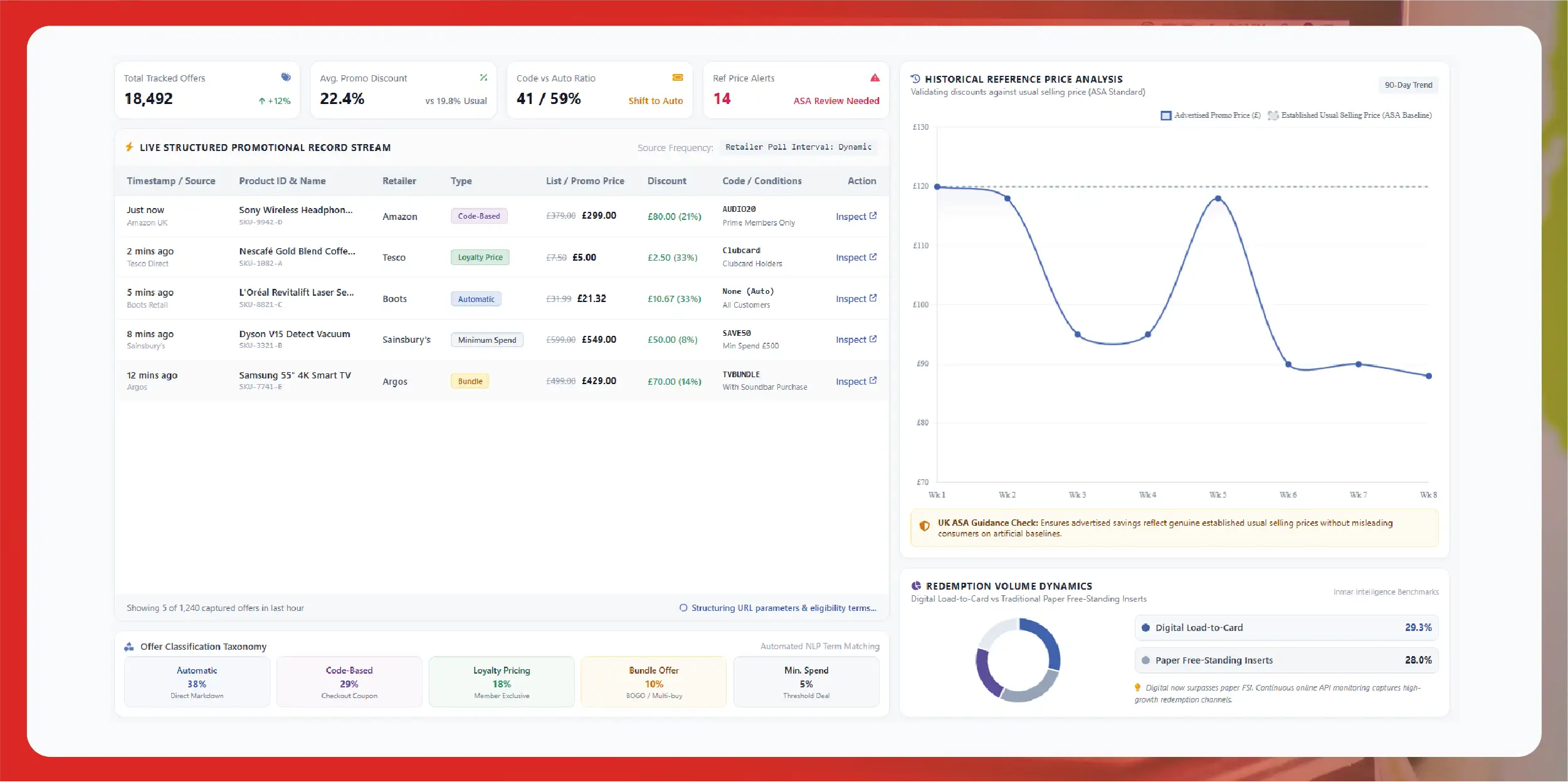
A useful record contains the product identifier, retailer, listed price, promotional price, discount amount, coupon code where visible, eligibility conditions, start and end dates when published, source URL, and observation timestamp. It should also distinguish an automatic discount from a code-based offer, a loyalty-member price, a bundle promotion, or a minimum-spend deal.

Historical data makes the workflow more valuable. A team can compare an offer against its earlier observations, determine whether a discount is new or recurring, and check whether the advertised saving is based on a meaningful reference price. This is important because pricing rules differ by jurisdiction. The UK’s Advertising Standards Authority, for example, says reference prices should represent a genuine established usual selling price and should not mislead consumers (ASA guidance on promotional savings claims).

The commercial opportunity is visible in historical coupon research. Inmar Intelligence reported that digital load-to-card coupons represented 29.3% of coupon redemption volume in 2020, slightly above paper free-standing inserts at 28% (Supermarket News, reporting Inmar’s analysis). For brands, this shift supports monitoring digital offers alongside traditional promotions.

What should brands collect from consumer apps?

Consumer app discount & promotion Data Collection should capture the full offer context rather than just a coupon headline. A mobile screen may display a percentage discount while placing eligibility conditions elsewhere in the purchase flow. If the dataset records only “20% off,” analysts may miss whether the saving requires a first order, a minimum basket value, a particular payment method, or a membership.

A reliable collection workflow starts with a defined list of approved public sources and clear product-matching rules. For each observation, teams should retain the displayed offer, relevant conditions, product or SKU, retailer, app or web channel, collection timestamp, and source reference. Where a price or coupon requires login, location access, or account-specific eligibility, the record should reflect those limitations rather than presenting the offer as universally available.

Mobile promotions also need consistency checks. Google Play’s promotional-content guidance says the offer details and promotional assets should be consistent; for example, a tagline advertising an 80% discount should not conflict with a description that presents a different offer (Google Play promotional content guidance). Brands can apply the same principle internally by checking that a campaign’s headline, discount amount, eligibility rules, and redemption instructions agree across channels.

This data helps answer practical questions: Are app-only discounts deeper than website offers? Do competitors promote different product variants? Does a coupon appear to remain visible after its stated end date? Which offers require manual review? These are observable questions, not assumptions about conversion or profitability. Actual business outcomes should be validated against a brand’s own campaign and sales data.

How can discount data support pricing decisions?

A Discount data API for pricing intelligence helps teams compare like-for-like offers, measure price gaps, and understand how promotional tactics change over time. The key requirement is product identity. Comparing different pack sizes, flavours, shades, model numbers, or bundle quantities can create a misleading picture of who offers the lower price.

For matched products, calculate the absolute difference between the reference price and competitor price, then calculate the percentage difference against a clearly defined reference. Keep regular price, promotional price, and coupon-adjusted price in separate fields. A coupon-adjusted price should only be calculated when its conditions are known and the buyer’s eligibility can be established.

The need for careful interpretation is supported by real-world market research. In a 2024 report, RRD’s CPG and Grocery Consumer Report found that 58% of surveyed consumers agreed they were trying not to deviate from shopping lists to control costs. The report also said 43% were willing to travel farther to save on groceries. These findings reflect the report’s surveyed population, not every consumer or market (RRD, 2024 CPG and Grocery Consumer Report).

A structured pricing dataset helps analysts separate a competitor’s temporary campaign from a broader price change. It can also reveal whether a discount is limited to one retailer or appears across several channels. However, observed prices alone do not establish why a competitor changed its price, whether a campaign is profitable, or how much incremental demand it generated. Those conclusions require additional business evidence.

Analysis metric How to calculate or interpret it Business use
Absolute price difference Reference price minus observed competitor price Quantify the currency gap
Percentage price difference Price difference divided by reference price, multiplied by 100 Compare gaps across price levels
Coupon-adjusted price Eligible price after applying a verified coupon Compare conditional offers fairly
Offer duration Time between verified first and last observations, subject to source coverage Review campaign timing
Product match confidence Match based on identifiers, pack size, variant, and description Reduce false comparisons

For the 2026 workflow, Promo & Coupon Data API 2026 should therefore be treated as a structured data capability, not as a guarantee of live access to every promotion. Its value depends on source coverage, collection intervals, validation rules, and the quality of the underlying product matches.

How can brands identify promotional risks before they spread?

A Coupon monitoring API for consumer brands can help teams identify offer records that deserve investigation, including expired coupons that remain publicly visible, inconsistent discount claims, missing eligibility details, or conflicting promotional information across channels. Automated monitoring does not determine legal compliance by itself. It creates a consistent evidence trail that helps the responsible teams prioritize review.

The first step is to translate internal campaign rules and relevant market requirements into checks. These may include whether the stated discount matches the calculated price reduction, whether a minimum spend is disclosed, whether an offer’s end date has passed, and whether the same campaign carries consistent terms across the brand’s website and app. A flagged record should include the source, timestamp, relevant text, and the reason it was flagged so a reviewer can reproduce the check.

Regulatory guidance demonstrates why these checks matter. The US Federal Trade Commission states that advertising claims must be truthful, non-deceptive, and evidence-based (FTC advertising and marketing guidance). Its guidance on discounts also explains that when a promotion is restricted to certain people, such as rewards-program members, the price offered to everyone should not be presented as though the restricted discount were generally available (FTC pricing-promotion FAQ).

For Indian e-commerce businesses, the context includes the Consumer Protection (E-Commerce) Rules, 2020. In July 2021, India’s Ministry of Commerce and Industry reported that complaints concerning deep discounting, predatory pricing, and misuse of market dominance had been referred to relevant agencies for examination (Press Information Bureau, Government of India). This does not mean every discount is problematic. It highlights why brands should maintain transparent, reviewable promotional records.

A useful risk process separates detection, validation, and decision. Automated rules detect unusual records; a human checks the offer and its context; authorized teams decide whether corrective action is necessary.

How can teams track promotions across mobile and web channels?

A Promotion tracking API for Consumer Apps should connect offer observations across channels without assuming that the same promotion has identical conditions everywhere. A coupon may be available on a retailer’s website but not in its app, or it may be restricted to new customers, selected locations, or a particular checkout method. Teams should preserve those differences rather than merging records solely because the discount percentage looks similar.

A sound workflow can follow five steps:

  • Discover: Identify approved retailer pages, public app content, and promotional landing pages relevant to the product categories being monitored.
  • Collect: Capture visible prices, coupon details, eligibility conditions, timestamps, and source references at an appropriate interval.
  • Normalize: Standardize currencies, dates, product identifiers, discount formats, and retailer names.
  • Validate: Check product matches, expiry information, conflicting prices, and missing conditions.
  • Alert and review: Route meaningful changes to pricing, marketing, or compliance owners, with enough context to verify the finding.

A historical view helps teams understand how digital offers have developed. The table below brings together published coupon indicators from 2020 to 2026. The figures are not a single continuous dataset: they use different measures, periods, and source methodologies, so they should not be interpreted as a directly comparable annual series.

Year Published indicator What it tells brands
2020 Digital load-to-card coupons represented 29.3% of US coupon redemption volume, according to Inmar data reported by Supermarket News. Digital redemption had become a major promotional channel. Source
2021 Inmar reported digital coupons accounted for 33% of redemption volume in the first half of 2021. Digital coupons continued to lead in the reported redemption mix. Source
2022 Inmar reported digital coupons held a 34% share of redemption in its 2022 Promotion Industry Analysis. Digital redemption remained an important part of the reported coupon landscape. Source
2023 RRD’s 2024 consumer report compares several shopping behaviours with June 2023, including a five-point rise in preference for mailed ads or postcards by August 2024. Promotion channels should be evaluated using consumer evidence, not assumptions that every shopper prefers digital. Source
2024 Vivvix reported capturing 6.5 billion digital coupons delivering nearly $104 billion in incentives in the first half of 2024. Digital promotion activity can be extensive and diverse across product categories. Source
2025 GrabOn’s 2026 coupon-usage report uses its own Google Search Console data covering July 2025 to June 2026. India-focused monitoring can use local search and coupon signals, but its measures should not be equated with US redemption statistics. Source
2026 NIQ published an India pricing and promotion report on 14 May 2026, examining price sensitivity, promotion effectiveness, and price-pack architecture. Current analysis should consider price packs and promotion effectiveness alongside headline discounts. Source

For brands, Promo & Coupon Data API 2026 is most useful when monitoring is linked to clear business questions: Which offers changed since the previous collection? Which competitors use conditional discounts? Which product-price gaps persist across multiple observations? Which records require a compliance review? The answer should come from verified observations and defined rules, not from assumptions about competitors’ intent.

What makes mobile offer intelligence reliable?

Coupon and discount intelligence for mobile apps is most effective when collection quality, offer context, and historical consistency are treated as equally important. A coupon code without its minimum order value, eligibility restrictions, or expiry details may be unusable for comparison. Likewise, an app-exclusive price should not be treated as a general market price if access is limited to eligible users.

A robust dataset should preserve the distinction between observed facts and calculated metrics. The displayed discount is an observed value; a percentage price gap is calculated from a selected reference; a suspected inconsistency is a review flag. Keeping these categories separate allows analysts to trace a conclusion back to its source and reduces the risk of reporting estimates as facts.

Data quality checks should cover duplicate records, missing timestamps, stale observations, variant mismatches, inconsistent currencies, and conflicting promotional conditions. Where a source blocks access, requires authentication, or changes its layout, the system should record the collection limitation rather than silently treating missing data as proof that an offer no longer exists. Collection should also respect applicable law, website terms, platform policies, and privacy requirements.

Mobile app stores have their own promotional rules. Google Play’s developer policy says app offers must be transparent and that material subscription terms, including price and renewal conditions, should be clearly communicated (Google Play Developer Programme Policy). Although those rules apply in their stated platform context, they illustrate a broader operational principle: an offer’s terms are part of the offer and should be monitored alongside its headline.

A practical quality dashboard can report the share of records with complete conditions, successful product matches, valid timestamps, and traceable source references. It can also measure how quickly a detected change is reviewed. These are measurable process indicators; they should not be confused with revenue uplift or compliance outcomes unless those outcomes have been independently established.

How can Actowiz Solutions support promotional data monitoring?

Actowiz Solutions can help consumer brands design data collection workflows that organize publicly available promotional information for pricing analysis, competitor monitoring, and internal review. The appropriate setup depends on the sources involved, required update frequency, target markets, product categories, and the fields analysts need to compare.

Promotion Data tracking for Consumer Apps can be structured around a defined data schema, consistent collection schedules, and validation rules. Rather than treating every discount as an isolated observation, teams can build a historical view of offers and trace changes to their original sources. The workflow can be tailored to the brand’s monitoring requirements and the technical accessibility of each source.

Key areas of support can include:

  • Promotional data collection: Capture publicly available coupon codes, advertised discounts, offer conditions, and visible product prices from approved sources.
  • Website and app monitoring: Organize observations from relevant digital channels while respecting access restrictions and applicable platform requirements.
  • Product matching and normalization: Standardize product names, variants, pack sizes, prices, currencies, and retailer identifiers to improve comparison quality.
  • Historical tracking: Preserve dated observations to help teams distinguish newly detected changes from offers seen previously.
  • Quality assurance: Flag incomplete records, inconsistent prices, potential expiry issues, and product mismatches for review.
  • Structured data delivery: Prepare validated records for downstream dashboards, analytics platforms, or internal pricing systems, depending on the agreed scope.

A Promo & Coupon Data API 2026 workflow should be designed around specific decisions rather than raw record volume. A pricing manager may need a reliable view of comparable competitor prices, while a compliance team may need evidence of advertised conditions and the date an offer was observed. These use cases require different validation rules and review processes.

Actowiz Solutions can help define the required fields, source coverage, collection frequency, and output format before implementation. Data availability and update speed depend on the source, access method, and agreed requirements; collection should not be presented as guaranteed real-time coverage across every platform.

Conclusion

Consumer brands can improve discount decisions by combining structured offer collection, accurate product matching, historical comparisons, and clearly defined compliance checks. The published research discussed above shows that digital coupons have become an important part of promotional activity, while regulatory guidance emphasizes truthful pricing claims and transparent offer conditions.

A reliable monitoring process should record what was observed, where it appeared, when it was collected, and which conditions applied. It should distinguish raw source information from calculated metrics and route potential inconsistencies to qualified reviewers. This gives pricing, marketing, and compliance teams a more traceable foundation for evaluating campaigns without assuming that every discount is comparable or every flagged offer represents a violation.

Brands looking to strengthen Promo & Trade Promotion Compliance Tracking can connect promotional records with documented review rules and retain evidence for further investigation. Combining Web Scraping, Mobile App Scraping, and a validated Real-time dataset can support a more consistent view of public digital offers, subject to source availability, access permissions, and applicable requirements.

Ready to improve your promotional data workflow? Contact Actowiz Solutions to discuss your requirements for coupon monitoring, offer tracking, competitor pricing analysis, and structured promotional data collection.

You can also reach us for all your mobile app scraping, data collection, web scraping, and instant data scraper service requirements!

Social Proof That Converts

Trusted by Global Leaders Across Q-Commerce, Travel, Retail, and FoodTech

Our web scraping expertise is relied on by 4,000+ global enterprises including Zomato, Tata Consumer, Subway, and Expedia — helping them turn web data into growth.

4,000+ Enterprises Worldwide
50+ Countries Served
20+ Industries
Join 4,000+ companies growing with Actowiz →
Real Results from Real Clients

Hear It Directly from Our Clients

Watch how businesses like yours are using Actowiz data to drive growth.

▶
1 min
★★★★★
"Actowiz Solutions offered exceptional support with transparency and guidance throughout. Anna and Saga made the process easy for a non-technical user like me. Great service, fair pricing!"
TG
Thomas Galido
Co-Founder / Head of Product at Upright Data Inc.
▶
2 min
★★★★★
"Actowiz delivered impeccable results for our company. Their team ensured data accuracy and on-time delivery. The competitive intelligence completely transformed our pricing strategy."
II
Iulen Ibanez
CEO / Datacy.es
▶
1:30
★★★★★
"What impressed me most was the speed — we went from requirement to production data in under 48 hours. The API integration was seamless and the support team is always responsive."
FC
Febbin Chacko
-Fin, Small Business Owner
icons 4.8/5 Average Rating
icons 50+ Video Testimonials
icons 92% Client Retention
icons 50+ Countries Served

Join 4,000+ Companies Growing with Actowiz

From Zomato to Expedia — see why global leaders trust us with their data.

Why Global Leaders Trust Actowiz

Backed by automation, data volume, and enterprise-grade scale — we help businesses from startups to Fortune 500s extract competitive insights across the USA, UK, UAE, and beyond.

icons
7+
Years of Experience
Proven track record delivering enterprise-grade web scraping and data intelligence solutions.
icons
4,000+
Projects Delivered
Serving startups to Fortune 500 companies across 50+ countries worldwide.
icons
200+
In-House Experts
Dedicated engineers across scrapers, AI/ML models, APIs, and data quality assurance.
icons
9.2M
Automated Workflows
Running weekly across eCommerce, Quick Commerce, Travel, Real Estate, and Food industries.
icons
270+ TB
Data Transferred
Real-time and batch data scraping at massive scale, across industries globally.
icons
380M+
Pages Crawled Weekly
Scaled infrastructure for comprehensive global data coverage with 99% accuracy.

AI Solutions Engineered
for Your Needs

→
LLM-Powered Attribute Extraction: High-precision product matching using large language models for accurate data classification.
→
Advanced Computer Vision: Fine-grained object detection for precise product classification using text and image embeddings.
→
GPT-Based Analytics Layer: Natural language query-based reporting and visualization for business intelligence.
→
Human-in-the-Loop AI: Continuous feedback loop to improve AI model accuracy over time.
icons Product Matching icons Attribute Tagging icons Content Optimization icons Sentiment Analysis icons Prompt-Based Reporting

Connect the Dots Across
Your Retail Ecosystem

We partner with agencies, system integrators, and technology platforms to deliver end-to-end solutions across the retail and digital shelf ecosystem.

icons
Analytics Services
icons
Ad Tech
icons
Price Optimization
icons
Business Consulting
icons
System Integration
icons
Market Research
Become a Partner →

Popular Datasets — Ready to Download

Browse All Datasets →
icons
Amazon
eCommerce
Free 100 rows
icons
Zillow
Real Estate
Free 100 rows
icons
DoorDash
Food Delivery
Free 100 rows
icons
Walmart
Retail
Free 100 rows
icons
Booking.com
Travel
Free 100 rows
icons
Indeed
Jobs
Free 100 rows

Latest Insights & Resources

View All Resources →
thumb
Blog

Promo & Coupon Data API 2026 - How Consumer Brands Improve Discount Strategies and Compliance Tracking

Promo & Coupon Data API 2026: Help Consumer Brands Track Discounts, Analyze Promotions, Optimize Pricing, and Strengthen Compliance Tracking

thumb
Case Study

How a Leading Brand Built a Smarter Car Marketplace with Japan Used-Car Pricing API for an East African Market

Japan Used-Car Pricing API for an East African market helps car marketplaces access accurate pricing data, compare vehicles, and make smarter decisions.

thumb
Report

Scrape India Restaurant Market Map 2026 - Comprehensive Swiggy and Zomato Listings by City

Scrape India Restaurant Market Map 2026: Swiggy & Zomato Restaurant Listings, Market Trends, City-Wise Data & Competitive Insights

Start Where It Makes Sense for You

Whether you're a startup or a Fortune 500 — we have the right plan for your data needs.

icons
Enterprise
Book a Strategy Call
Custom solutions, dedicated support, volume pricing for large-scale needs.
icons
Growing Brand
Get Free Sample Data
Try before you buy — 500 rows of real data, delivered in 2 hours. No strings.
icons
Just Exploring
View Plans & Pricing
Transparent plans from $500/mo. Find the right fit for your budget and scale.
Get in Touch
Let's Talk About
Your Data Needs
Tell us what data you need — we'll scope it for free and share a sample within hours.
  • icons
    Free Sample in 2 HoursShare your requirement, get 500 rows of real data — no commitment.
  • icons
    Plans from $500/monthFlexible pricing for startups, growing brands, and enterprises.
  • icons
    US-Based SupportOffices in New York & California. Aligned with your timezone.
  • icons
    ISO 9001 & 27001 CertifiedEnterprise-grade security and quality standards.
Request Free Sample Data
Fill the form below — our team will reach out within 2 hours.
+1 ▼
✓ Free 500-row sample · No credit card · Response within 2 hours

Request Free Sample Data

Our team will reach out within 2 hours with 500 rows of real data — no credit card required.

+1 ▼
✓ Free 500-row sample · No credit card · Response within 2 hours