Core services
Enterprise Data Extraction

Scalable web, app and AI-powered collection across 40+ countries.

All 58 services →
New 2026
AI Training Data

Corpus building with provenance and opt-out compliance.

Learn more →
Free pilot
24-hour sample

We run collection on your own sources before you commit.

Get a sample →
58Services
40+Countries
DEVELOPER

Ready-Made Scrapers

Pre-built for top platforms. Self-serve, no setup.

View All →
TRY FREE

API Playground

Test endpoints instantly. No credit card.

Start Free →
28Tools
2SDKs
icons Delivery & SDKs
Streaming Crawl API Scheduler Realtime Alerts Webhook Delivery 🐍 Python SDK 💚 Node.js SDK

Need it managed instead?

Fixed monthly retainer, named engineer, no per-request metering.

Managed Data API →
HOT

Case Studies

How brands use Actowiz, with named outcomes.

Read →
FREE

Sample Datasets

Real output, no signup.

Download →
NEW

ROI Calculator

Model the return on a data engagement.

Calculate →
Food delivery commission and menu price markup analysis for restaurants

Introduction

Canadian grocery is a market where a handful of large groups run dozens of banners, prices change by province and postal code, and every Quebec listing may show up in French. For a CPG brand, that makes "what is my product actually selling for?" a hard question to answer from sales data alone.

Canada grocery price data is a structured, regularly refreshed record of the public shelf price, flyer price, displayed member price, unit price and stock status of your SKUs and competitor SKUs across Canadian retailers such as Loblaws, Sobeys, Metro, Walmart.ca and Amazon.ca – captured by store or postal code, matched across English and French listings, and delivered in CAD.

This guide explains which retailers and banners matter, which fields to collect, how to handle bilingual matching and regional pricing, how to plan for key seasons, what Canadian privacy law means for this kind of data, and what to ask any provider about SLA, QA and delivery.

Why does Canada grocery price data matter for CPG brands in 2026?

Food delivery commission and menu price markup analysis for restaurants

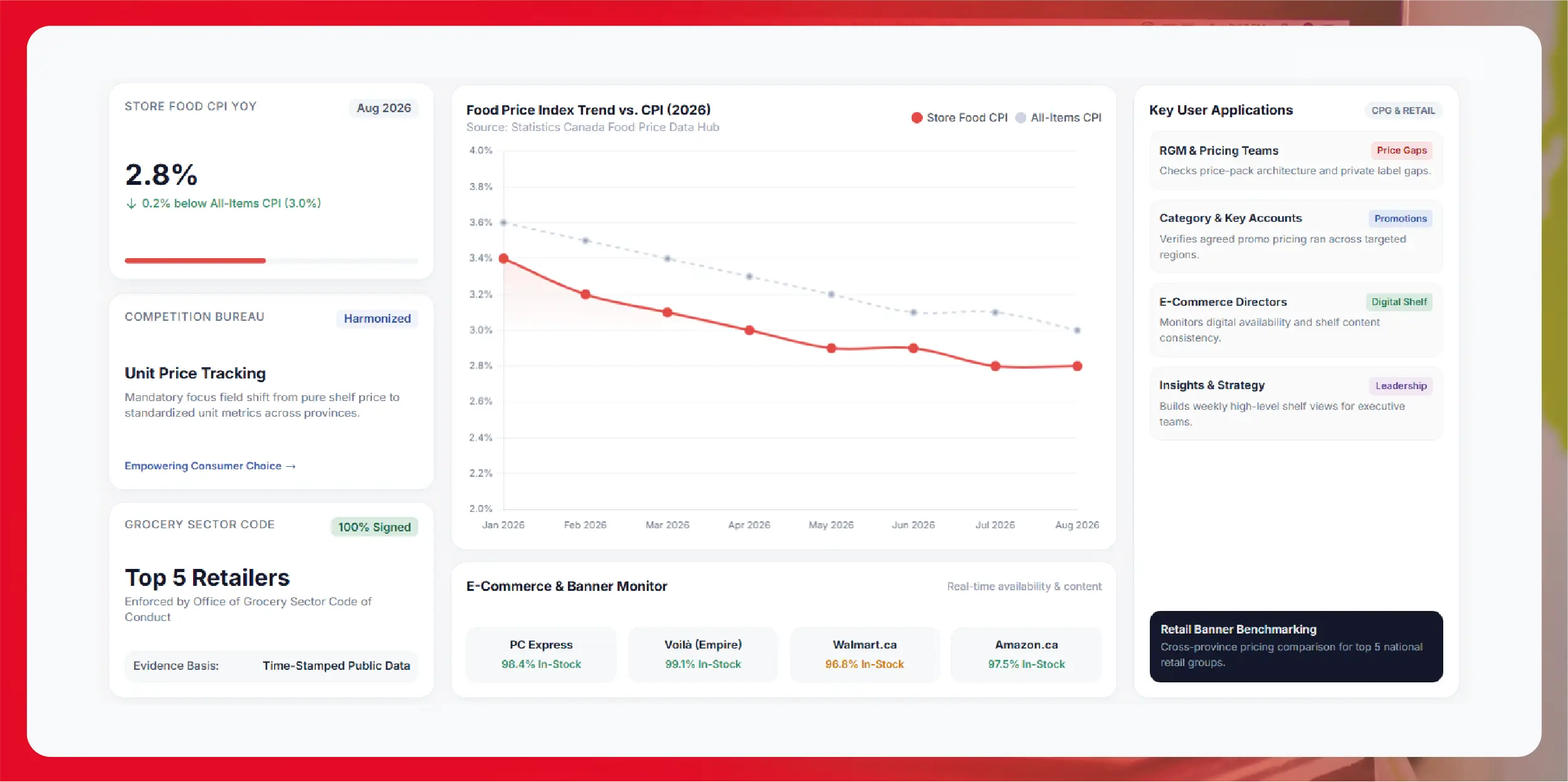
Food prices are still a national talking point. Statistics Canada's Food Price Data Hub reports that prices for food purchased from stores rose 2.8% year over year in August 2026, against 3.0% for the all-items CPI (source: https://www.statcan.gc.ca/en/topics-start/food-price). When shoppers and the media watch grocery prices this closely, retailers react fast with flyers and price-match offers, and brands need to see those moves the same week.

Regulators are watching too. In June 2023 the Competition Bureau Canada published its retail grocery market study and recommended, among other things, "accessible and harmonized unit pricing requirements to empower consumer choice" (source: https://www.canada.ca/en/competition-bureau/news/2023/06/competition-bureau-makes-recommendations-to-promote-competition-in-canadas-grocery-industry.html). Unit price is now a field brands should track, not just shelf price.

The Grocery Sector Code of Conduct also changes the conversation between suppliers and retailers. According to an Agriculture and Agri-Food Canada Question Period note received in June 2026, the Code reached full implementation and enforcement on 1 January 2026, run by the Office of the Grocery Sector Code of Conduct, and Canada's five largest retailers have signed on (source: https://search.open.canada.ca/qpnotes/record/aafc-aac%2CAAFC-2026-QP-00011). Independent, time-stamped public price evidence helps commercial teams prepare for fact-based conversations with retail partners.

Who typically uses this data:

  • Revenue growth management (RGM) and pricing teams checking price-pack architecture and price gaps against private label.

  • Category and key account managers verifying that agreed promotions ran at the agreed price, in the agreed regions.
  • E-commerce directors watching availability and content on PC Express, Voilà, Walmart.ca and Amazon.ca.
  • Insights and strategy leads building a weekly view of the shelf for leadership.
  • Large retailers benchmarking their own banners against competitors by province.

Which Canadian retailers and banners should you track?

Most national CPG brands need coverage across the three large grocery groups, the mass and club channels, marketplaces, and drug and value chains. Banners under the same parent often price differently, so tracking the parent alone is not enough.

Retailer / banner group Banners and sites to track Typical price signal Notes for CPG teams
Loblaw Loblaws, No Frills, Real Canadian Superstore, PC Express, Shoppers Drug Mart Shelf price, weekly flyer, displayed PC Optimum offers where public Discount vs conventional banners can differ for the same SKU; PC Express prices depend on the chosen store
Sobeys (Empire) Sobeys, Safeway, FreshCo, IGA (Quebec), Voilà Shelf price, flyer, displayed Scene+ offers where public IGA Quebec listings are French-first; Voilà is the online grocery channel
Metro Metro, Food Basics, Super C Shelf price, weekly flyer Strong Ontario and Quebec footprint; Super C is a Quebec discount banner
Walmart Canada Walmart.ca Online price, rollbacks, stock status Prices can vary by selected store or postal code
Costco Canada Costco.ca Public online shelf price and pack size Shelf prices only; club-pack sizes need unit-price normalization. No item-to-UPC/GTIN mapping is offered
Amazon Canada Amazon.ca Price, seller, Buy Box, deals Third-party sellers can undercut or overprice brand listings
Canadian Tire Canadian Tire Price, flyer, stock Relevant for snacks, beverages, household and seasonal lines
Giant Tiger Giant Tiger Shelf price, flyer Value channel, often a price floor reference

Coverage is always scoped per project: you tell us which banners, provinces and categories matter, and we confirm feasibility before work starts.

What fields should Canada grocery price data include?

A useful feed captures more than one price per product. These are the fields we recommend for CPG and retail teams:

  • Product identity – retailer product ID, product title in English and/or French, brand, size, pack count, and GTIN/UPC only where the retailer displays it publicly.
  • Regular shelf price (CAD) – the everyday price shown on the product page.
  • Promotional price and mechanic – sale price, multi-buy ("2 for $7"), percentage off, and promo start/end dates where shown.
  • Flyer presence – whether the SKU appears in the weekly flyer, the page or section, and the flyer price.
  • Displayed member price – PC Optimum or Scene+ offers only where they are shown publicly on the page without logging in. Personalised, in-app or login-only offers are excluded.
  • Unit price – price per 100 g, 100 mL or per unit as displayed, plus our normalized unit price for comparisons across pack sizes.
  • Location – banner, store ID or postal code used, city and province.
  • Availability – in stock, out of stock, limited, or not listed.
  • Digital shelf signals – search rank for key category terms, content completeness, rating and review count.
  • Capture metadata – timestamp, source URL and a screenshot reference for audit.

How do you handle bilingual listings, regional prices and unit pricing?

This is where most Canadian price projects either succeed or fail.

Bilingual product matching. The same product may appear as "Original Peanut Butter 1 kg" on one site and "Beurre d'arachide original 1 kg" on IGA Quebec or a French Metro page. Matching uses brand, size, pack count, variant and, where public, the GTIN/UPC – not titles alone. French accents, "format familial" wording and size written as "1 kg" vs "1000 g" are normalized before matching, and low-confidence matches go to human review.

Regional prices by province and postal code. Many retailer sites set price and availability by the store or postal code a visitor chooses. A sound design picks a fixed panel of locations – for example, several postal codes in Ontario, Quebec, BC, Alberta and Atlantic Canada – and collects each SKU against the same panel every cycle. That keeps week-on-week comparisons fair.

Unit pricing. Pack sizes differ across banners, and Costco.ca club packs are a clear case. We keep the retailer's displayed unit price and add a normalized unit price, so a 1.5 kg club pack and a 500 g conventional pack can be compared on one line.

Collect, clean, match, check. In practice the pipeline runs in four steps:

  • Collect public pages on a fixed schedule from the agreed locations.
  • Clean prices, units and promo text (English and French) into standard fields.
  • Match each listing to your master product list, with confidence scores.
  • Run QA checks – missing prices, sudden price jumps, duplicate rows, broken stores – before delivery.

How should you plan by region and season?

Canadian promotions follow a national calendar with strong regional differences. This table summarises how teams typically adjust cadence.

Period / region What changes Suggested cadence What to watch
Weekly flyer cycle (all provinces) New flyer week, usually Thursday or Friday start depending on banner and region Weekly flyer capture + daily online price on priority SKUs Flyer price vs online price; promo depth vs agreed plan
Canada Day long weekend (late June–early July) BBQ, beverages, snacks, condiments Daily for featured categories Multi-buy mechanics, stock-outs
Back to School (August–September) Lunch-box snacks, juice, bread, cereal Daily or several times a week Private-label price gaps
Thanksgiving (October) Turkey, baking, dairy, produce Daily in the two weeks before Regional price differences, loss leaders
Black Friday (November) Non-food at Walmart.ca, Amazon.ca, Canadian Tire, Costco.ca, Shoppers Several times a day on key SKUs Deal prices, Buy Box changes, seller activity
Boxing Day / Boxing Week (late December) Household, health and beauty, beverages Several times a day Short-lived deals, stock status
Quebec French-first listings; IGA, Metro, Super C important Same cadence, French parsing Matching accuracy for French titles
Western and Atlantic Canada Different banner mix (e.g. Safeway in the West) Same panel each cycle Regional price gaps vs Ontario

Flyer start days vary by banner and region, so we confirm them during scoping rather than assume them.

What can CPG brands and retailers do with this data?

  • Promotion compliance. Check that the agreed promo price, mechanic and timing actually appeared in the flyer and online, by banner and province.
  • Price gap monitoring. Track your SKU against private label (President's Choice, No Name, Compliments, Selection, Great Value) and key competitors per unit.
  • Regional pricing review. See where a product sells at a higher shelf price in one province than another, and whether that matches your strategy.
  • Price-pack architecture. Compare price per 100 g across sizes and banners to spot where packs compete with each other.
  • Availability and digital shelf. Spot out-of-stocks and missing listings on PC Express, Voilà, Walmart.ca and Amazon.ca before they cost a promo week.
  • Retailer benchmarking. Large retailers can compare their banners' prices against competitors on a matched basket.
  • Fact base for retailer conversations. Time-stamped, screenshot-backed public prices support calmer, evidence-led discussions with retail partners.

In a recent anonymised project, a retail brand needed Sobeys and Walmart product, price, promotion and availability data to support assortment and pricing decisions; the delivery covered matched products and regular refreshes.

Is collecting Canada grocery price data legal?

This section is general information, not legal advice. Please check with your own counsel.

Public grocery prices, promotions, flyers, unit prices and product details are business information about products, not information about people. Canada's federal private-sector privacy law, PIPEDA, sets rules for how organizations collect, use and disclose personal information in commercial activity; the Office of the Privacy Commissioner of Canada explains it here: https://www.priv.gc.ca/en/privacy-topics/privacy-laws-in-canada/the-personal-information-protection-and-electronic-documents-act-pipeda/. Some provinces, including Quebec, have their own private-sector privacy laws, so legal teams usually confirm which law applies.

How we keep projects on the right side of these lines:

  • Public business data only. No shopper accounts, no logins, no personal data of individuals.
  • Member prices only where publicly displayed. Personalised PC Optimum or Scene+ offers inside apps or accounts are out of scope.
  • Reviews without personal details. If review text is in scope, reviewer names and profiles are not collected.
  • Respect for site terms and load. Polite request rates and a review of each source before collection.
  • Clear usage rights. Data is delivered for your internal analysis under an agreed licence.

Build or buy: how do you choose a Canada grocery price data provider?

Some teams start with an in-house scraper for one retailer. It often works – until you add store selection, French pages, flyer formats, daily schedules and site changes across fifteen banners. At that point, maintenance becomes the real cost.

Question to ask Why it matters in Canada What good looks like
Which banners, provinces and postal codes are covered? Prices differ by banner and location A written coverage list per retailer and location panel
How fresh is the data? Flyers change weekly; Black Friday deals change daily Daily, weekly or intraday options per SKU tier
How are English and French listings matched? Quebec listings are often French-first Attribute-based matching with confidence scores and human review
What QA runs before delivery? Wrong prices lead to wrong decisions Automated checks plus spot checks, and a QA report with each delivery
What is the SLA? Weekly reviews need data on time An agreed delivery window and an agreed process when a source changes
What delivery formats are offered? Data must land in your stack API, CSV/JSON, or direct delivery to S3, Snowflake, BigQuery or Azure
How is data secured and licensed? Procurement and legal reviews Access controls, encrypted transfer, clear usage terms
Can we see a sample first? Proves fit before contract A sample on your own SKUs within 48 hours of scoping

Actowiz Solutions runs managed data feeds and APIs for Canadian grocery and retail sources, with dashboards available through Actowiz Metrics. Typical engagements start with a priority SKU list and a location panel, then scale by category or banner once the sample is approved.

Frequently Asked Questions

What is Canada grocery price data?

It is a structured record of public shelf, flyer, member and unit prices, plus stock status, for products at Canadian retailers, captured by store or postal code and delivered on a fixed schedule in CAD.

Which Canadian retailers can you cover?

Typical scopes include Loblaws, No Frills, Real Canadian Superstore, PC Express, Shoppers Drug Mart, Sobeys, Safeway, FreshCo, IGA Quebec, Voilà, Metro, Food Basics, Super C, Walmart.ca, Costco.ca, Amazon.ca, Canadian Tire and Giant Tiger. Final coverage is confirmed per project.

Can you track PC Optimum and Scene+ member prices?

Only where member offers are publicly displayed on product or flyer pages without logging in. Personalised or account-only offers are not collected.

Do you match products between English and French listings?

Yes. We match on brand, size, pack count, variant and public GTIN/UPC where shown, normalize French text and units, and send low-confidence matches to human review.

Can you map Costco.ca items to UPC or GTIN codes?

No. For Costco.ca we collect public shelf prices and pack details only. Comparisons use normalized unit prices rather than barcode mapping.

How fast can we get a sample?

After a short scoping call, we can usually deliver a sample on your own SKUs, banners and postal codes within 48 hours.

Need Canadian grocery price and promotion data you can trust? Request an enterprise sample (24-hour turnaround) or book a scoping call. Use your company email and tell us your categories, retailers and banners, provinces or postal codes, and refresh frequency. We will reply with coverage, delivery options (API, CSV/JSON, S3, Snowflake, BigQuery or Azure) and a sample plan.
Contact Us Today!

Conclusion

You can also reach us for all your mobile app scraping, data collection, web scraping, and instant data scraper service requirements!

Social Proof That Converts

Trusted by Global Leaders Across Q-Commerce, Travel, Retail, and FoodTech

Our web scraping expertise is relied on by 4,000+ global enterprises including Zomato, Tata Consumer, Subway, and Expedia — helping them turn web data into growth.

4,000+ Enterprises Worldwide
50+ Countries Served
20+ Industries
Join 4,000+ companies growing with Actowiz →
Real Results from Real Clients

Hear It Directly from Our Clients

Watch how businesses like yours are using Actowiz data to drive growth.

▶
1 min
★★★★★
"Actowiz Solutions offered exceptional support with transparency and guidance throughout. Anna and Saga made the process easy for a non-technical user like me. Great service, fair pricing!"
TG
Thomas Galido
Co-Founder / Head of Product at Upright Data Inc.
▶
2 min
★★★★★
"Actowiz delivered impeccable results for our company. Their team ensured data accuracy and on-time delivery. The competitive intelligence completely transformed our pricing strategy."
II
Iulen Ibanez
CEO / Datacy.es
▶
1:30
★★★★★
"What impressed me most was the speed — we went from requirement to production data in under 48 hours. The API integration was seamless and the support team is always responsive."
FC
Febbin Chacko
-Fin, Small Business Owner
icons 4.8/5 Average Rating
icons 50+ Video Testimonials
icons 92% Client Retention
icons 50+ Countries Served

Join 4,000+ Companies Growing with Actowiz

From Zomato to Expedia — see why global leaders trust us with their data.

Why Global Leaders Trust Actowiz

Backed by automation, data volume, and enterprise-grade scale — we help businesses from startups to Fortune 500s extract competitive insights across the USA, UK, UAE, and beyond.

icons
7+
Years of Experience
Proven track record delivering enterprise-grade web scraping and data intelligence solutions.
icons
4,000+
Projects Delivered
Serving startups to Fortune 500 companies across 50+ countries worldwide.
icons
200+
In-House Experts
Dedicated engineers across scrapers, AI/ML models, APIs, and data quality assurance.
icons
9.2M
Automated Workflows
Running weekly across eCommerce, Quick Commerce, Travel, Real Estate, and Food industries.
icons
270+ TB
Data Transferred
Real-time and batch data scraping at massive scale, across industries globally.
icons
380M+
Pages Crawled Weekly
Scaled infrastructure for comprehensive global data coverage with 99% accuracy.

AI Solutions Engineered
for Your Needs

→
LLM-Powered Attribute Extraction: High-precision product matching using large language models for accurate data classification.
→
Advanced Computer Vision: Fine-grained object detection for precise product classification using text and image embeddings.
→
GPT-Based Analytics Layer: Natural language query-based reporting and visualization for business intelligence.
→
Human-in-the-Loop AI: Continuous feedback loop to improve AI model accuracy over time.
icons Product Matching icons Attribute Tagging icons Content Optimization icons Sentiment Analysis icons Prompt-Based Reporting

Connect the Dots Across
Your Retail Ecosystem

We partner with agencies, system integrators, and technology platforms to deliver end-to-end solutions across the retail and digital shelf ecosystem.

icons
Analytics Services
icons
Ad Tech
icons
Price Optimization
icons
Business Consulting
icons
System Integration
icons
Market Research
Become a Partner →

Popular Datasets — Ready to Download

Browse All Datasets →
icons
Amazon
eCommerce
Free 100 rows
icons
Zillow
Real Estate
Free 100 rows
icons
DoorDash
Food Delivery
Free 100 rows
icons
Walmart
Retail
Free 100 rows
icons
Booking.com
Travel
Free 100 rows
icons
Indeed
Jobs
Free 100 rows

Latest Insights & Resources

View All Resources →
thumb
Blog

Web Data RFP Checklist: How to Write an RFP for Web Data Collection (2026)

Use this web data RFP checklist to define scope, sources, fields, SLA, QA and pricing models, then score vendors fairly.

thumb
Case Study

How Sensitive Skin Skincare Product Data API Helps Brands Track Cleansers, Serums, Moisturizers, and Sunscreens

Sensitive Skin Skincare Product Data API helps brands track cleansers, serums, moisturizers, and sunscreens with structured product data.

thumb
Report

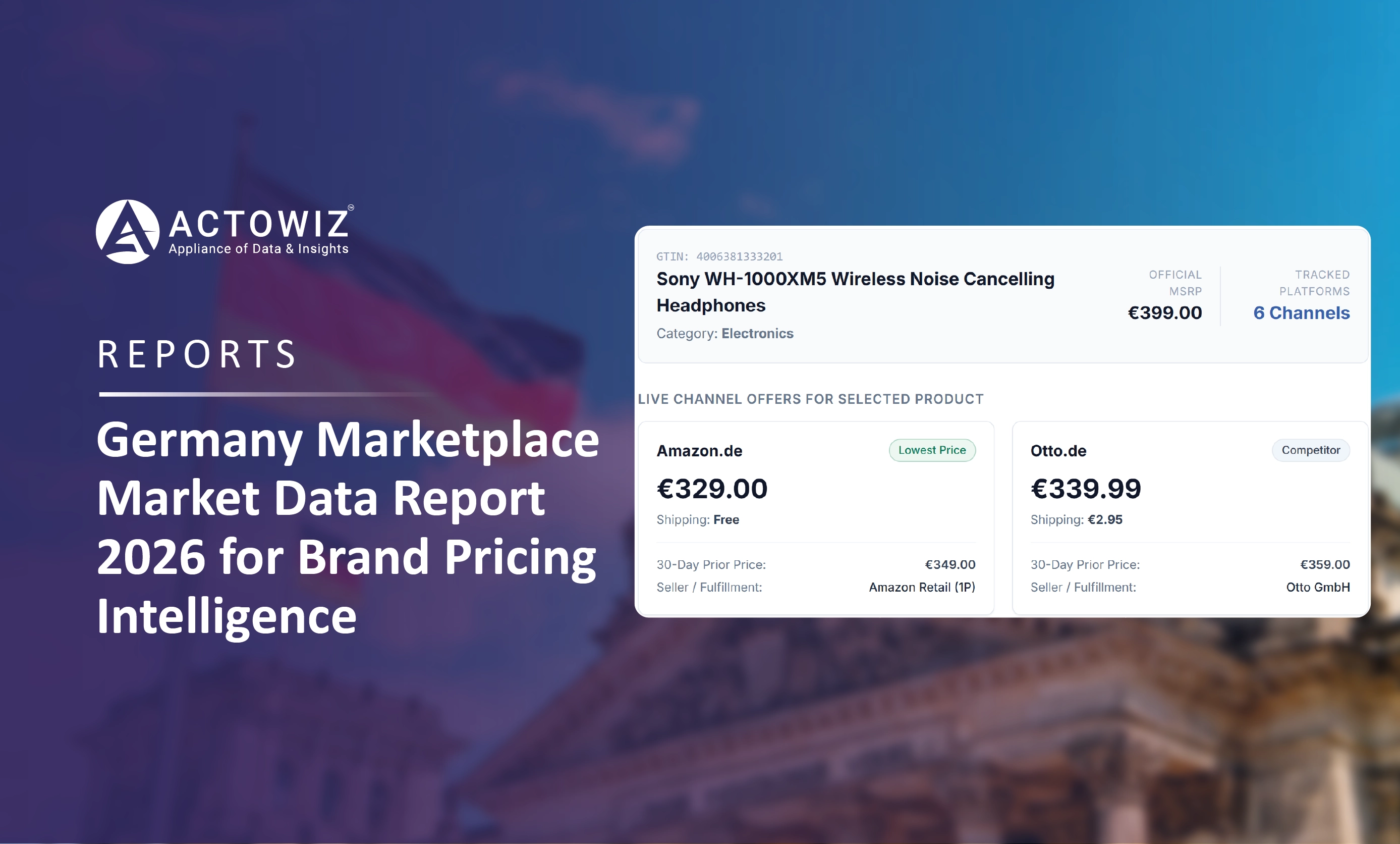
Germany Marketplace Market Data Report 2026 for Brand Pricing Intelligence

German marketplace data report 2026: online retail size, Amazon.de, Otto, Kaufland and Zalando price signals, PAngV rules and peak seasons.

Start Where It Makes Sense for You

Whether you're a startup or a Fortune 500 — we have the right plan for your data needs.

icons
Enterprise
Book a Strategy Call
Custom solutions, dedicated support, volume pricing for large-scale needs.
icons
Growing Brand
Get Free Sample Data
Try before you buy — 500 rows of real data, delivered in 2 hours. No strings.
icons
Just Exploring
View Plans & Pricing
Transparent plans from $500/mo. Find the right fit for your budget and scale.
Get in Touch
Let's Talk About
Your Data Needs
Tell us what data you need — we'll scope it for free and share a sample within hours.
  • icons
    Free Sample in 2 HoursShare your requirement, get 500 rows of real data — no commitment.
  • icons
    Plans from $500/monthFlexible pricing for startups, growing brands, and enterprises.
  • icons
    US-Based SupportOffices in New York & California. Aligned with your timezone.
  • icons
    ISO 9001 & 27001 CertifiedEnterprise-grade security and quality standards.
Request Free Sample Data
Fill the form below — our team will reach out within 2 hours.
+1 ▼
✓ Free 500-row sample · No credit card · Response within 2 hours

Request Free Sample Data

Our team will reach out within 2 hours with 500 rows of real data — no credit card required.

+1 ▼
✓ Free 500-row sample · No credit card · Response within 2 hours