Introduction
Travellers rarely buy a flight, a hotel and a holiday package in isolation. They compare the whole trip to a destination. Yet many commercial teams still track airfares, hotel rates and package prices in separate tools, owned by separate people, refreshed on separate schedules.
Competitive travel intelligence is the structured, repeated collection of live public prices, availability and promotions for flights, hotels and packages from competitor and channel websites, organised by destination, travel date and point of sale. It shows OTAs, tour operators, hotels and airlines where they are over- or under-priced today and where to act.
This 2026 competitive travel intelligence guide explains which sources matter, which data fields to capture, how to design a destination-level collection grid, and how to decide between building and buying. It covers live, publicly displayed prices only, collected going forward.
Why Destination-Level Travel Intelligence Matters in 2026
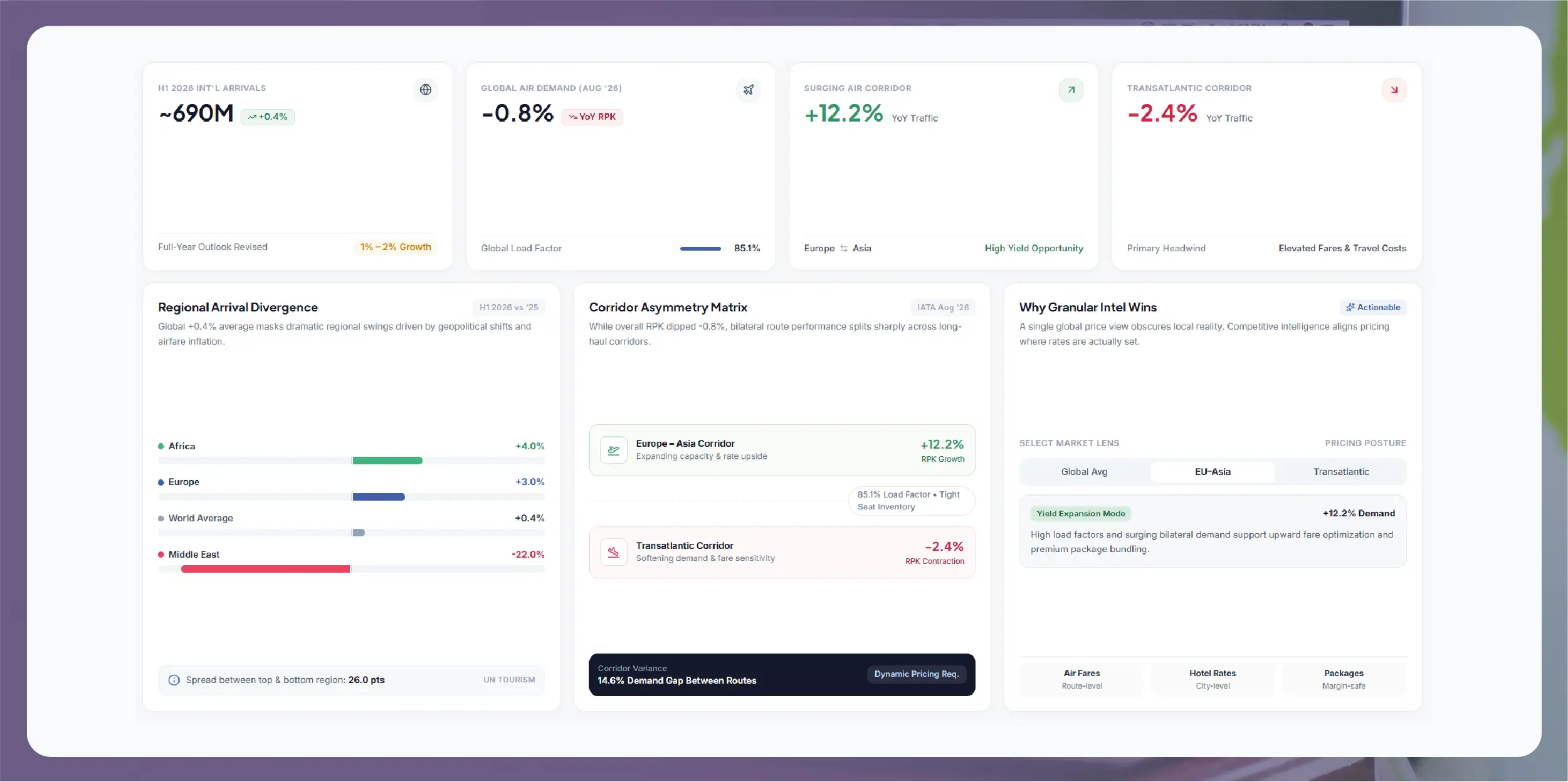
Demand in 2026 is uneven, and it shifts quickly by region. According to UN Tourism's World Tourism Barometer (September 2026), international arrivals grew only about 0.4% in the first half of 2026, to roughly 690 million. Results ranged from +4% in Africa and +3% in Europe to −22% in the Middle East. UN Tourism also lowered its full-year growth outlook to 1–2% and pointed to higher air fares and travel costs as a drag on momentum .
Air travel shows the same pattern. IATA reported that global passenger demand (RPK) fell 0.8% year on year in August 2026, with a load factor of 85.1%. Europe–Asia traffic grew 12.2%, while transatlantic traffic fell 2.4%.
When some corridors grow and others shrink, a single global price view hides the real story. Prices move destination by destination. Competitive travel intelligence makes those moves visible at the level where you actually set fares, rates and package prices.
What Competitive Travel Intelligence Is, and Who Uses It
Competitive travel intelligence turns scattered public prices into a comparable dataset. Each record answers a simple question: what did a traveller see, on which site, for which trip, at what moment?
Typical users of competitive travel intelligence include:
- OTAs – to check price competitiveness against other OTAs and supplier websites, and to spot gaps in inventory.
- Tour operators – to benchmark package prices against "build your own" flight-plus-hotel combinations and rival operators. Tour operator data scraping can support the collection of publicly displayed package information.
- Hotel groups – to watch rates and rate parity across brand sites and OTAs for their comp set in each destination.
- Airline commercial teams – to see how competitors price the same route, fare brand and travel date on public websites.
- Travel-tech companies – to feed comparison, pricing or forecasting products with clean, timestamped market data.
The value comes from comparison. A hotel rate means little on its own. Next to the flight price and the package price for the same dates, it tells you whether your product is good value for that trip.
The Sources That Matter and How They Differ
Each type of travel website shows prices in a different way. A sound competitive travel intelligence programme samples several types for each destination, because the same trip can carry different prices, fees and conditions depending on where it is shown.
| Source type |
What it shows |
Strengths |
Watch-outs |
| Airline websites |
Public fares by route, date, cabin and fare brand |
Direct supplier price; fare brand and baggage detail |
Prices change often; fees may appear late in the booking path |
| OTAs |
Flights, hotels and sometimes packages |
Broad coverage; shows what many travellers compare |
Taxes and fees shown differently by market; sorting is influenced by ranking |
| Metasearch sites |
Prices from many sellers for one search |
Fast market snapshot across sellers |
Displayed price may differ from the seller's final price |
| Hotel brand websites |
Public best available rates and room types |
Shows the hotel's own public rate |
Exclude member or logged-in rates; compare like-for-like rate plans |
| Tour-operator websites |
Package prices (flight + hotel + extras) by departure |
Only reliable view of bundled pricing |
Prices often per person, with board basis and transfers bundled in |
For every source, collect only what an anonymous visitor can see without logging in. Member-only, loyalty or corporate rates are outside scope.
The 12 Data Fields to Capture
A useful competitive travel intelligence dataset is consistent across sources. These are the fields we recommend for a destination-level, multi-product view:
- Fare – the total public airfare shown, with currency and whether taxes are included.
- Fare class or fare brand – for example basic, standard or flexible, as named on the site.
- Baggage – cabin and checked-bag allowance included in the fare.
- Hotel rate – the nightly and total stay price, with tax treatment noted.
- Room type – standardised to common groups such as standard double, superior or suite.
- Board basis – room only, breakfast, half board, full board or all-inclusive.
- Cancellation policy – refundable or non-refundable, and the free-cancellation deadline if shown.
- Availability – whether the flight, room or package is bookable, plus any "few left" signals.
- Package price – the bundled price, per person or per booking, with what is included.
- Promotions – discounts, strike-through prices, promo labels and free extras.
- Timestamp – the exact date and time of collection, so every price can be placed in time.
- Point of sale – the country, language and currency the search was run from.
Two context fields support all of the above: the search parameters (origin, destination, travel dates, length of stay, number of travellers) and the source URL or channel name.
How to Design a Collection Grid, Then Clean and Match the Data
In competitive travel intelligence, the collection grid decides what you see. A grid that is too thin misses moves; a grid that is too wide wastes budget on searches nobody uses.
Build the Grid in Four Dimensions
- Routes and destinations – start with your top destinations by revenue or growth, then add the main origin markets for each.
- Stay dates – cover weekdays and weekends, peak events and shoulder periods. Use a fixed length of stay per product (for example 3, 7 or 14 nights).
- Lead times – sample searches at set distances before departure, such as 7, 14, 30, 60 and 90 days out.
- Points of sale – run searches from the countries where your customers book, because prices and fees can differ by market.
Multiply these dimensions and the search count grows fast. A practical rule is to start narrow, check which cuts drive decisions, and expand only those.
Clean and Match
Raw prices are not comparable until they are matched. Key steps:
- Hotel matching – map the same property across sites using name, address and coordinates, not name alone.
- Room and board mapping – normalise free-text room names and board basis into standard groups.
- Flight matching – match on flight numbers, departure times and fare brand, not only on route.
- Currency and tax normalisation – convert to a reference currency at a recorded rate and flag whether taxes and fees are included.
- Quality checks – flag outliers, missing fields and failed searches before data reaches dashboards.
Because the data is collected going forward, trend lines build up over time from your own timestamped records. Past prices that were never collected cannot be recreated, so start the grid early for the seasons you care about.
Strategy by Product and Destination Type
Not every destination needs the same competitive travel intelligence treatment. The table below gives a starting point.
| Product / destination type |
Main question |
Priority fields |
Suggested refresh |
| Short-haul city breaks |
Are we competitive on flight + hotel for weekends? |
Fare, fare brand, hotel rate, cancellation |
Daily for near-term dates |
| Long-haul leisure |
How do packages compare with self-built trips? |
Package price, fare, board basis, baggage |
Several times a week |
| Beach and all-inclusive |
Are rival operators discounting peak weeks? |
Package price, board basis, promotions, availability |
Daily in booking peaks |
| Business-heavy cities |
Do weekday rates and flexible fares move together? |
Hotel rate, room type, fare brand, cancellation |
Daily on weekdays |
| Event-driven destinations |
How fast do prices rise before the event? |
Availability, hotel rate, fare, timestamp |
Intraday close to the event |
Refresh rates are suggestions only. Set them by how often your own team can act on the results.
Use Cases
Common ways teams put competitive travel intelligence to work:
- Package price positioning – compare your package with rival packages and with the cheapest public flight plus hotel for the same dates.
- Rate parity and channel checks – see whether a hotel's public rate on its brand site matches the OTAs in each point of sale.
- Promotion tracking – log when competitors launch sales, which destinations they push and how deep the discounts look.
- Route and capacity signals – watch availability and fare brands on key routes to spot tightening or softening demand.
- Destination merchandising – feature destinations where your total trip price is strongest this week.
- Product input for travel-tech – power comparison or alert features with clean, timestamped live prices.
Results depend on the grid, sources and how quickly teams act.
Legal and Compliance Basics
Competitive travel intelligence should stay on clearly safe ground:
- Collect only publicly available prices and availability that an anonymous visitor can see.
- Do not log in, use accounts, or collect member, loyalty or corporate rates.
- Do not collect personal data about travellers or staff.
- Respect each website's terms, rate limits and technical controls, and keep request volumes reasonable.
- Store the timestamp, point of sale and source for each record so findings can be checked.
- Take legal advice for your own jurisdictions and use case.
This guide does not cover access to airline reservation systems or archives of past fares. The focus is live public prices collected from now on.
Build vs Buy
Building a competitive travel intelligence pipeline in-house gives full control, but travel sites change layouts often, render prices with heavy scripts and vary by market. Keeping many sources, points of sale and lead times running needs ongoing engineering effort.
| Factor |
Build in-house |
Buy a managed data service |
| Time to first data |
Weeks to months, depending on sources |
Usually faster, as collectors and matching exist |
| Maintenance |
Your team fixes breakages |
Provider maintains collectors |
| Matching and cleaning |
You design hotel, room and flight mapping |
Often included as part of delivery |
| Control |
Full control of logic and storage |
Defined by the agreed schema and delivery |
| Best for |
Teams with spare data engineering capacity |
Teams that want data, not scrapers |
For competitive travel intelligence, many teams mix both: they buy the collection and matching layer and keep analysis and pricing decisions in-house. Actowiz Solutions can deliver structured travel price data through an API, scheduled files or dashboards. Coverage example.
Frequently Asked Questions
What Is Competitive Travel Intelligence?
It is the repeated collection and comparison of live public flight, hotel and package prices, availability and promotions from competitor and channel websites, organised by destination, date and point of sale.
Can I Get Past Airfares for Previous Seasons?
No. This approach covers live public prices collected going forward. Your trend history builds up from the date collection starts, so it helps to begin before the seasons that matter most.
Which Websites Should I Track for One Destination?
Usually a mix of airline sites, major OTAs, a metasearch site, hotel brand sites for your comp set and the leading tour operators for that market.
How Often Should Competitive Travel Intelligence Data Be Refreshed?
It depends on lead time and volatility. Near-term dates and event periods may need daily or intraday checks; far-out dates can often be checked weekly.
Does It Include Member or Loyalty Rates?
No. Only prices visible to an anonymous visitor without logging in are collected.
 Actowiz Solutions

 By industry
 Pricing & Promotions
 Brand & Intelligence
 Digital Shelf & Search
 Assortment
 For Retailers
 E-Commerce Dashboard
 Flipkart Insights (Live)
 Grocery Intelligence
.svg) Grocery Price (U.S.)
.svg) Quick Commerce (India)
 Food & Restaurant
 Fashion Intelligence
 Automotive
 Travel & Hospitality
 Real Estate
 Food Delivery Intelligence
 OTT & Streaming
 Fuel & EV Charging Price Tracker
 By Use Case
 Pricing Intelligence
 Digital Shelf Analytics
 MAP Monitoring
 Cross-Border Price Parity
 Share of Search
 Review Sentiment
 Kitchen Market Gaps
 Dynamic Pricing / AI Repricing
 Promotions & Deals Alerts
 B2B / POI & Lead Data
 AI Search Visibility Dashboard
 Baby Products on Quick Commerce
 Hotel & Flight Rate Parity
 By Region
 Flipkart Real-Time Insights
 Quick Commerce — Zepto · Blinkit
 Pincode Price Tracker
 GCC Q-Commerce — Talabat · Noon
 UK Grocery — Tesco, Sainsbury's, Asda
 AU Grocery — Coles & Woolworths
 Marketplace Scrapers
 Developer APIs
 Universal APIs
 Delivery & SDKs
 Knowledge Center
 Guides & Playbooks
 Downloads & Tools
 Trust & Company
.webp)







































 4.8/5 Average Rating
 50+ Video Testimonials
 92% Client Retention
 50+ Countries Served