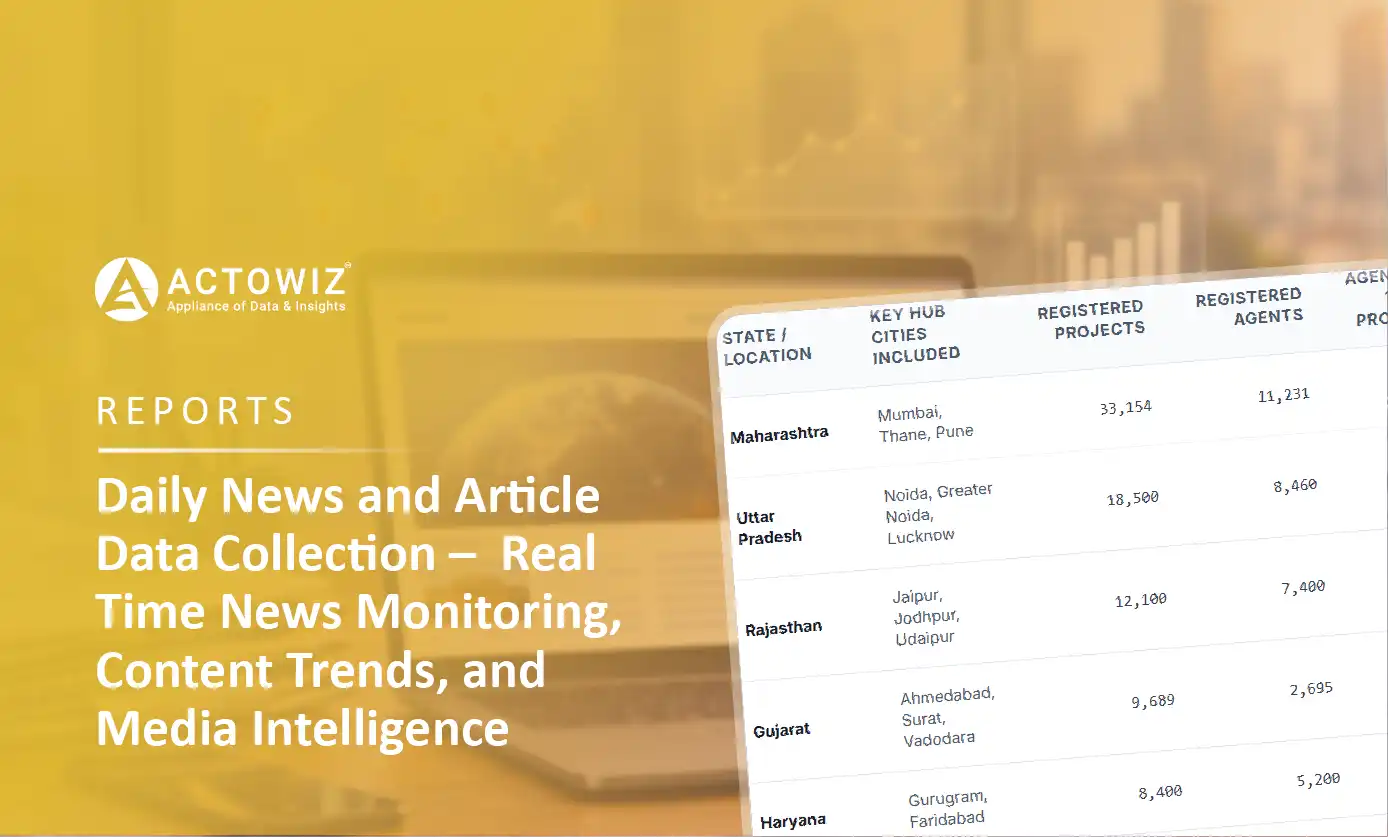
Discover Daily News and Article Data Collection for real-time news monitoring, content analysis, trend tracking, and actionable media intelligence insights.
Daily News and Article Data Collection enables businesses, publishers, researchers, and media intelligence teams to organize news coverage, monitor emerging topics, and analyze how stories evolve across digital publications. Through Data Intelligence Services, Actowiz Solutions can help organizations structure publicly accessible news information into research-ready datasets that support media monitoring, competitive analysis, and content intelligence.
The volume and speed of digital publishing make manual news tracking difficult to scale. Organizations may need to follow multiple publishers, industries, languages, and geographic markets while maintaining accurate publication timestamps and source attribution. A consistent collection framework helps analysts distinguish newly published stories from updates, syndicated copies, and duplicate URLs.
News data also requires careful interpretation. Article counts do not automatically measure public interest, news credibility, or audience reach. A useful research process combines source metadata, publication times, topic classifications, and documented collection methods. Where full-text access is restricted, organizations should collect only permitted fields and respect copyright, publisher terms, robots directives, and applicable data protection requirements.
This report explains how businesses can build a structured news intelligence workflow, validate collected information, and analyze historical media trends. It also presents verified industry indicators from 2020 through 2026 where available, without treating general internet usage or platform activity as a direct measure of news article volume.
News/Articles Data Scraping From websites helps researchers organize relevant article information from permitted online sources into a consistent format. Depending on the source's access conditions, collected fields may include article headlines, URLs, publisher names, publication timestamps, author names, section labels, and article text where reuse is authorized. AI-Powered Scraping Services can support classification, entity recognition, and duplicate detection, but automated outputs should be checked for errors.
A practical workflow begins with a defined list of publishers and topics. Collection rules identify relevant pages, capture permitted fields, normalize timestamps, and retain the original source URL. Quality checks can then flag missing titles, malformed dates, repeated articles, and unexpected changes in page structure.
The scale of online information makes disciplined collection particularly important. The International Telecommunication Union (ITU) estimated that approximately 5.4 billion people, or 67% of the world's population, used the internet in 2023. The organization estimated that 5.5 billion people, or 68% of the world's population, were online in 2024. These figures describe internet use, not the number of published news articles. Source: ITU Facts and Figures 2024.
| Year | Verified global internet-use indicator | Relevance to news research |
|---|---|---|
| 2020 | ITU estimated 4.9 billion people online | Provides digital-access context |
| 2021 | ITU estimated 4.9 billion people online | Shows the scale of connected audiences |
| 2022 | ITU estimated 5.3 billion people online | Supports the broader digital-publishing context |
| 2023 | ITU estimated 5.4 billion people online | Provides a global connectivity benchmark |
| 2024 | ITU estimated 5.5 billion people online | Establishes the latest verified figure in this cited series |
| 2025 | A comparable verified figure is not provided here | Consult the relevant ITU release before reporting |
| 2026 | A full-year figure is not established here | Avoid projecting annual results from earlier figures |
Source: ITU statistical publications. These are internet-use indicators, not news-production statistics.
For media analysts, the practical lesson is to prioritize source coverage, consistent metadata, and reliable timestamps rather than assume that a larger dataset is automatically more representative.
A useful news dataset needs more than headlines and links. The workflow should Extract article URLs, categories, keywords and publication timestamps alongside publisher names, authors, language, and update indicators whenever those fields are available and permitted.
Article URLs provide source traceability. Categories help group stories into topics such as business, politics, health, technology, and energy. Keywords and named entities support search and classification, while publication timestamps allow analysts to order stories and measure how coverage develops. A separate last-updated field is valuable because an article's original publication time may differ from its latest revision.
The Reuters Institute Digital News Report 2025 documents the growing role of social platforms, video, and online aggregators in news consumption. Its findings underline why source, format, topic, and timestamp fields should be retained rather than flattening every item into a headline-only record.
The following Pew Research Center figures show how often US adults said they got news from social media. They illustrate the changing context for digital news discovery, not the volume of articles published.
| Year | Often get news from social media | Sometimes | Rarely | Never |
|---|---|---|---|---|
| 2020 | 23% | 30% | 18% | 29% |
| 2021 | 19% | 29% | 19% | 32% |
| 2022 | 17% | 33% | 20% | 29% |
| 2023 | 19% | 31% | 19% | 31% |
| 2024 | 25% | 29% | 18% | 28% |
| 2025 | 21% | 32% | 19% | 27% |
| 2026 | 26% | 33% | 17% | 23% |
Source: Pew Research Center, Social Media and News Fact Sheet. Figures may not total 100% because of rounding or nonresponses.
For data teams, a practical schema should retain both the original value and the normalized value. For example, preserve the publisher's timestamp and store a separate standardized UTC timestamp. This makes time-zone conversions transparent and supports reliable cross-country comparisons.
Organizations that collect news and article data from multiple websites daily need a repeatable collection schedule, source-level tracking, and robust duplicate detection. The Daily News and Article Data Collection process should record when each item was first discovered, when it was last checked, and whether the publisher has updated the original article.
A multi-source system can encounter several versions of the same story: a wire-service report republished by another outlet, an article updated without changing its URL, or separate articles covering the same event. These cases require different treatment. Exact duplicates can be removed from headline counts, while legitimate updates and independent coverage should remain identifiable.
The Reuters Institute's 2025 report found that weekly news reach was distributed across multiple online networks. In its global sample, 36% used Facebook and 30% used YouTube for news weekly; Instagram and WhatsApp each reached 19%, while TikTok reached 16%. These are audience-use figures, not website publication counts.
| Year | Global social-video news consumption | Any-video news consumption |
|---|---|---|
| 2020 | 52% | 67% |
| 2021 | Not specified in the cited summary | Not specified |
| 2022 | Not specified in the cited summary | Not specified |
| 2023 | Not specified in the cited summary | Not specified |
| 2024 | Not specified in the cited summary | Not specified |
| 2025 | 65% | 75% |
| 2026 | No comparable figure established here | No comparable figure established here |
Source: Reuters Institute, Digital News Report 2025. The 2021–2024 entries are intentionally unreported because the cited summary does not provide annual values.
For operational reporting, teams should measure successful collection rate, source coverage, duplicate rate, missing metadata, and time between publication and detection. They should also distinguish source outages from genuine declines in publishing activity.
This approach gives media analysts a more accurate picture of coverage changes and reduces the risk of presenting repeated syndication as a surge in independent reporting.
Collect full-text news articles and metadata from websites only when the source permits the intended access and use. Full-text collection can support detailed topic analysis, entity extraction, and research workflows, but access to a webpage does not automatically grant permission to reproduce or redistribute its content.
A responsible pipeline should distinguish headline-and-metadata collection from full-text storage. For each publisher, document permitted access methods, applicable terms, copyright restrictions, retention rules, and whether the article body can be stored or used for downstream processing. When full-text access is unavailable or restricted, metadata or authorized feeds may provide a suitable alternative.
The Reuters Institute Digital News Report 2025 describes a media environment in which news use is spread across websites, social networks, aggregators, and video platforms. That diversity increases the value of source-level metadata, particularly when analysts need to compare how different outlets cover the same event.
| Year | US adults who often got news from social media | Research implication |
|---|---|---|
| 2020 | 23% | Establish a baseline for social news use |
| 2021 | 19% | Compare with the previous survey year |
| 2022 | 17% | Track changes in reported behavior |
| 2023 | 19% | Maintain consistent definitions |
| 2024 | 25% | Record the survey period when interpreting changes |
| 2025 | 21% | Distinguish audience use from publisher output |
| 2026 | 26% | Use the latest cited survey result, not as a global estimate |
Source: Pew Research Center, Social Media and News Fact Sheet. The figures represent US adults' self-reported news use, not article counts.
For practical implementation, maintain separate fields for headline, excerpt, article body, author, source URL, publication date, update date, and usage permissions. Apply access controls to stored content and retain only the information needed for the stated research purpose.
This helps publishers, research firms, and corporate communications teams create useful media intelligence while respecting source restrictions and maintaining traceable records.
A daily news article dataset from multiple sources should retain article-level history rather than simply replacing yesterday's data with today's snapshot. The Daily News and Article Data Collection workflow should preserve first-seen dates, source timestamps, update records, classification versions, and deduplication decisions.
Historical retention makes it possible to measure topic frequency, compare publisher coverage, identify recurring sources, and study how reporting develops around major events. However, analysts must distinguish the date an article was published from the date their system collected it. These timestamps answer different questions and should not be merged.
Pew Research Center's long-running social media news survey provides an example of a consistently defined series. It reported that 23% of US adults often got news from social media in 2020, compared with 21% in 2025 and 26% in 2026. The figures reflect self-reported behavior, and survey results should be interpreted within the population and methodology specified by the source. Source: Pew Research Center.
| Year | Often get news from social media | Change from previous year |
|---|---|---|
| 2020 | 23% | Baseline |
| 2021 | 19% | −4 percentage points |
| 2022 | 17% | −2 percentage points |
| 2023 | 19% | +2 percentage points |
| 2024 | 25% | +6 percentage points |
| 2025 | 21% | −4 percentage points |
| 2026 | 26% | +5 percentage points |
Source: Pew Research Center. Changes are calculated from the reported rounded percentages. They should not be interpreted as changes in news article volume.
A historical collection system should also record source additions and removals. If a publisher enters the monitoring set midway through a reporting period, its contribution should not be compared with a full-year source without accounting for the coverage difference.
Useful reporting metrics include articles collected per source, unique stories after deduplication, topic distribution, update frequency, missing-field rates, and collection success. Every report should disclose the monitored sources and dates, ensuring that users can reproduce the analysis and understand its limits.
To Collect multilingual news articles for media monitoring, organizations need language-aware collection, text normalization, and classification methods that preserve the original meaning of each article. Multilingual monitoring can help global businesses, public relations teams, researchers, and risk analysts compare coverage across markets without treating different languages as interchangeable.
A suitable dataset should retain the original headline and text where permitted, detected language, source country when reliably known, publication timestamp, translated fields where used, and the method applied for translation or classification. Translation should be stored separately from the source text so analysts can review the original wording.
News consumption itself differs across markets and platforms. The Reuters Institute's 2025 report found that 65% of its global sample consumed social video for news and 75% consumed any video for news, up from 52% and 67%, respectively, in 2020. These figures indicate a change in news-consumption formats, but they do not establish the volume of multilingual articles published. Source: Reuters Institute.

| Year | Global social-video news consumption | Global any-video news consumption |
|---|---|---|
| 2020 | 52% | 67% |
| 2021 | Not specified in the cited summary | Not specified |
| 2022 | Not specified in the cited summary | Not specified |
| 2023 | Not specified in the cited summary | Not specified |
| 2024 | Not specified in the cited summary | Not specified |
| 2025 | 65% | 75% |
| 2026 | Comparable figure not verified here | Comparable figure not verified here |
Source: Reuters Institute, Digital News Report 2025. Missing years are not estimated.
For reliable cross-language analysis, validate language detection, preserve local publication times, and evaluate whether category and sentiment models perform consistently across languages. Machine translation can miss cultural context, idioms, and distinctions in tone, so high-impact findings should be checked by qualified reviewers when feasible.
A multilingual monitoring program should also document geographic coverage and language gaps. This prevents a dataset dominated by English-language publishers from being mistakenly presented as representative of worldwide news coverage.
Actowiz Solutions can help businesses design structured workflows for news research, media intelligence, and digital content monitoring.
Its approach can be tailored to the sources, languages, publication frequency, metadata fields, and analytical objectives relevant to each project.
A Daily News & Article Data Collection from 24 Websites project can be scoped around a defined list of publishers and approved sources. The number of websites should be confirmed during project planning, and actual coverage will depend on source accessibility, permitted collection methods, and technical constraints. The Daily News and Article Data Collection workflow should include transparent reporting of which sources were checked, when they were checked, and which records were successfully captured.
Key capabilities to consider include:
For publishers, communications teams, market researchers, and corporate intelligence departments, the main objective is to transform scattered digital information into organized, traceable evidence. The collection methodology should remain documented so that results can be reviewed and limitations understood.
Reliable news intelligence depends on consistent collection, accurate metadata, source transparency, and careful interpretation. Tracking headlines alone is not enough. Businesses need to know where an article originated, when it was published, whether it was updated, how it relates to other stories, and whether the information can be used for their intended purpose.
A well-designed Daily News and Article Data Collection program can help organizations monitor relevant coverage, discover emerging topics, and compare reporting across publications. Combining Web Scraping Services, a Web Crawling service, and Web Data Mining within a clearly defined and compliant workflow can support structured collection, content classification, and historical analysis.
Actowiz Solutions can help businesses evaluate suitable sources, define collection requirements, establish data-quality checks, and prepare datasets aligned with their media monitoring objectives. The right solution depends on source permissions, language coverage, reporting frequency, and the intended use of the collected information.
Ready to build a structured news intelligence workflow? Contact Actowiz Solutions to discuss a tailored data collection solution for your business!
Our web scraping expertise is relied on by 4,000+ global enterprises including Zomato, Tata Consumer, Subway, and Expedia — helping them turn web data into growth.
Watch how businesses like yours are using Actowiz data to drive growth.
From Zomato to Expedia — see why global leaders trust us with their data.
Backed by automation, data volume, and enterprise-grade scale — we help businesses from startups to Fortune 500s extract competitive insights across the USA, UK, UAE, and beyond.
We partner with agencies, system integrators, and technology platforms to deliver end-to-end solutions across the retail and digital shelf ecosystem.
Inventory Optimization AI Agent 2026 helps businesses improve stock planning, forecast demand, reduce inventory waste, and make smarter replenishment decisions.
Explore how Travel Price Comparison Data Scraping helps travel brands monitor fares, compare rates, and gain real-time competitive pricing insights.
Discover Daily News and Article Data Collection for real-time news monitoring, content analysis, trend tracking, and actionable media intelligence insights.
Whether you're a startup or a Fortune 500 — we have the right plan for your data needs.