Core services
Enterprise Data Extraction

Scalable web, app and AI-powered collection across 40+ countries.

All 58 services →
New 2026
AI Training Data

Corpus building with provenance and opt-out compliance.

Learn more →
Free pilot
24-hour sample

We run collection on your own sources before you commit.

Get a sample →
58Services
40+Countries
DEVELOPER

Ready-Made Scrapers

Pre-built for top platforms. Self-serve, no setup.

View All →
TRY FREE

API Playground

Test endpoints instantly. No credit card.

Start Free →
28Tools
2SDKs
icons Delivery & SDKs
Streaming Crawl API Scheduler Realtime Alerts Webhook Delivery 🐍 Python SDK 💚 Node.js SDK
Need it managed instead?

Fixed monthly retainer, named engineer, no per-request metering.

Managed Data API →
HOT

Case Studies

How brands use Actowiz, with named outcomes.

Read →
FREE

Sample Datasets

Real output, no signup.

Download →
NEW

ROI Calculator

Model the return on a data engagement.

Calculate →
Coverage · GCC

Zone-level coverage across the Gulf

This is the region where the geographic question is hardest and least discussed, because there is no off-the-shelf unit to fall back on.

The Gulf has no pincode equivalent. Addressing is landmark, building-name and GPS based, and delivery platforms define their own zones which do not map to any official geography. So a GCC panel cannot inherit a boundary system the way an Indian or European one can — the zones have to be defined, documented and held, and a vendor who does not tell you how theirs were defined has given you a geography you cannot audit.

This is the region where the geographic question is hardest and least discussed, because there is no off-the-shelf unit to fall back on.

Free pilot on your own sources, returned in 24 hours. No card, no trial clock — and you keep the sample data either way.

Zone definitions documented, not inherited Ramadan as a phase, with dates that move Six markets, never pooled
gcc_zone_definition.json LIVE FEED
// there is no official boundary to inherit, so we define and document {"market": "AE", "city": "Dubai", "zone_id": "AE-DXB-Z04", "zone_label": "Business Bay / Downtown corridor", "definition_basis": "observation_points_with_coordinates", "observation_points": 6, "catchment_character": "high_density_expat_residential", "maps_to_official_boundary": false, "note": "no pincode equivalent exists — this zone is ours and it is documented"} {"market": "SA", "city": "Riyadh", "zone_id": "SA-RUH-Z02", "catchment_character": "national_family_residential", "note": "different assortment demand from expat-dense zones — not an income proxy"} {"cross_market_pooling": false, "markets": ["AE", "SA", "QA", "KW", "OM", "BH"], "caution": "six markets. a GCC average describes none of them"}
the zone definition document, issued before a quotebecause a zone you cannot audit is a geography you cannot defend
Our Data Powers
B2C Marketplace
amazon
D2C + Marketplace
NYKAA
D2C + Marketplace
Walmart
FMCG Marketplace
udaan
Food Delivery
Uber Eats
Quick Commerce
blinkit
Taxi Aggregator
Uber
E-Commerce
Tmall

Key facts at a glance

The core problem
No pincode equivalent. Nothing to inherit
Addressing
Landmark, building name and GPS pin, not postal
Platform zones
Each platform defines its own. They do not align
What we do
Define zones by observation points, and document them
Ramadan
A phase, not a season. Dates move roughly eleven days a year
Dayparts
Shaped by prayer times, which shift daily and vary by city
The GCC
Six markets. Pooling them describes none of them
Catchment
Expat and national zones differ in assortment, not just income
6markets, never pooledUAE, Saudi, Qatar, Kuwait, Oman, Bahrain
0official boundaries to inheritwhich is why zones are documented
11days Ramadan moves each yearso phase alignment beats calendar alignment
24hfree pilot on your own zonesbefore the definitions are fixed

Key takeaways

  • The core problem: No pincode equivalent. Nothing to inherit
  • Addressing: Landmark, building name and GPS pin, not postal
  • Platform zones: Each platform defines its own. They do not align
  • What we do: Define zones by observation points, and document them
  • Ramadan: A phase, not a season. Dates move roughly eleven days a year
  • Dayparts: Shaped by prayer times, which shift daily and vary by city

Last verified 5 August 2026 by the Actowiz Solutions Data Engineering team.

Definition

Why the geography has to be defined rather than chosen

In India you can say "pincode 400050" and everyone means the same area. In Germany you can say "10117". In the Gulf there is no equivalent that a delivery dataset can use.

  • Postal codes exist on paper in some Gulf states but are not used for delivery, and consumers frequently do not know theirs.
  • Addressing is landmark and building based — a tower name, a nearby mall, a GPS pin dropped in an app.
  • Every platform defines its own delivery zones, and those do not align with each other or with any administrative boundary.

What that means for a dataset

If a vendor gives you GCC data "by area", the first question is whose areas. If the answer is a platform's own zones, your cross-platform comparison is already broken, because each platform's zones are different shapes.

How we handle it

We define zones ourselves from observation points with coordinates, group them by catchment character, and issue the definitions as a document before quoting. Every record carries zone_id and the zone definition is auditable.

maps_to_official_boundary is false on every GCC zone, stated rather than implied. A zone that claims to be an official area when no such area exists is a fiction that will eventually be discovered by someone trying to join it to census data.

The design decisions

Six things a Gulf panel has to get right

Only the last one overlaps with how coverage works elsewhere.

Zones defined, not inherited

Because there is nothing to inherit.

  • Defined from observation points with coordinates
  • Grouped by catchment character, documented before quoting
  • maps_to_official_boundary false, stated not implied
  • Held fixed once agreed, with changes logged

Ramadan as a phase

Not a season, and the dates move.

  • Roughly eleven days earlier each year
  • days_from_ramadan_start on every record
  • Year-over-year aligned on phase, not on calendar date
  • Baseline must be collected BEFORE the period starts

Prayer-time dayparts

The schedule is a design decision.

  • Prayer times shift daily and vary by city
  • A fixed-hour daily sample lands inside closures at random
  • Multi-daypart observation with the daypart recorded
  • likely_prayer_window derived and labelled as derived

Six markets, never pooled

A GCC average describes none of them.

  • Market on every record, with FX where currencies differ
  • Assortment, pricing and promotional calendars all differ
  • Cross-market comparison as a deliberate join
  • Regional rollup computed on request, detail retained underneath

Expat and national catchments

An assortment difference, not an income one.

  • Different product demand, not simply different spend
  • Catchment character recorded per zone
  • Panels stratified across both, not weighted to one
  • Which matters more depends on your category

Seasonal extremes

Summer changes behaviour, not just volume.

  • Extreme heat shifts ordering toward delivery and toward evenings
  • Category mix moves, not just order counts
  • Worth reading a summer series against a winter one deliberately
  • Observation timestamps precise enough to support that
Service scope

What the ecommerce data scraping service includes

A managed engagement, not a tool licence. We own the pipeline and everything that breaks in it.

✓ Included in every engagement

  • Zones defined from observation points and documented before quoting
  • Catchment character recorded per zone
  • Explicit statement that zones map to no official boundary
  • Six markets kept separate, with rollups computed on request
  • Ramadan phase fields on every record
  • Multi-daypart scheduling with prayer-window flags labelled as derived
  • Source discovery, scoping and a written collection plan
  • Free pilot on your own sources before any commitment
  • Full pipeline build, hosting and proxy infrastructure
  • Schema design, validation and sampled human QA on every run
  • Ongoing maintenance when source layouts change — our cost, not yours
  • Delivery to your warehouse, bucket, SFTP or API endpoint
  • Documented methodology and compliance notes for your legal review

× Not included — stated upfront

  • Any claim that a zone corresponds to an administrative area
  • A pooled GCC average presented as a market price
  • A prayer-time closure asserted as the cause of a store being closed
  • Demographic data about individuals in any zone
  • A Ramadan comparison against a baseline that was never observed
  • Anything behind a login, paywall or credentialed session
  • Personal data beyond a documented lawful basis
  • Licensed third-party datasets we do not hold rights to
  • Guarantees about fields a source simply does not publish
Schema

What travels with every GCC observation

The geographic and temporal fields. Product fields are on the platform pages.

Geographic and temporal fields, GCC panels
Field Type What it captures Refresh
market string AE, SA, QA, KW, OM or BH. Never pooled Every record
city string The city the zone belongs to Every record
zone_id / zone_label string Our zone, with a human-readable label Every record
definition_basis string How this zone was defined Per zone document
maps_to_official_boundary constant Always false in the GCC. Stated, not implied Every record
catchment_character string Expat-dense, national family, mixed, commercial Every record
serviceable boolean Whether the platform delivers to this zone at all Every record
observed_at timestamp With the local offset retained Every record
daypart string Derived from the local observation time Every record
likely_prayer_window boolean Derived and labelled as derived, never a stated cause Every record
ramadan_period / days_from_ramadan_start boolean / number For phase-aligned comparison Every record

days_from_ramadan_start exists because the dates move roughly eleven days each year. A year-over-year comparison aligned on calendar date compares Ramadan to a normal week, which is not a comparison at all.

Coverage

Where zone-level design applies in the Gulf

Everywhere delivery is involved, and a few places it is not.

Quick commerce and grocery deliveryFood delivery — Talabat, Keeta, HungerStation, DeliverooHypermarket and supermarket online — Carrefour, LuluPharmacy and health deliveryRide-hailing route panels — Careem and othersRetail store locators and catchment mappingFuel and convenience retailRestaurant menu and promotion trackingRamadan and Eid campaign monitoringCross-market GCC price gap analysis

Cross-market GCC price gap analysis is the one clients most often expect to be simple and is not. The same brand at the same retailer prices differently in Dubai and Riyadh for reasons including import route, local competition and VAT treatment, and a regional average smooths away exactly the thing being asked about. Request a source we don't list →

Markets served

Countries and markets where this service is in highest demand

We deliver into 40+ countries. These are the markets where this particular service is requested most, and the reason demand concentrates there.

Highest-demand markets for this service, and why demand concentrates there
Market Why demand concentrates here

North America

United StatesCanadaMexico

United Kingdom & Ireland

United KingdomIreland

Western Europe

GermanyFranceNetherlandsBelgiumSpainItalySwitzerlandAustria

Nordics

SwedenNorwayDenmarkFinland

Middle East

United Arab EmiratesSaudi ArabiaQatarKuwaitIsrael

Asia Pacific

SingaporeAustraliaNew ZealandJapanSouth KoreaMalaysiaIndonesiaThailandVietnamPhilippines

South Asia

IndiaBangladeshSri LankaPakistan

LATAM

BrazilArgentinaChileColombia

Africa

South AfricaNigeriaKenyaEgypt

We run production collection across 40+ countries. Coverage depth varies by market and by source, so we confirm what is actually available for your specific markets during scoping rather than claiming uniform global coverage. Ask about a market we don't list →

Who buys this data

Who this matters to

Mostly people running a Gulf programme who have inherited a geography they cannot explain.

Regional Category Manager

FMCG and consumer brands
The problem

Runs six markets and is asked for one GCC number.

What we deliver

Market on every record with a rollup computed on request, detail retained.

Metric that moves

Market-level accuracy

Pricing Lead

Retail and brands
The problem

Needs to know whether a Dubai price is comparable to a Riyadh one.

What we deliver

Per-market records with FX where currencies differ, never pooled.

Metric that moves

Comparison validity

Trade Marketing

Consumer brands
The problem

Ramadan is the single largest commercial period and the dates move.

What we deliver

Phase-aligned fields, and a baseline collected before the period starts.

Metric that moves

Campaign measurement

Head of Ecommerce

Regional retail
The problem

Zone-level assortment differs by catchment character.

What we deliver

Panels stratified across expat and national zones rather than weighted to one.

Metric that moves

Assortment relevance

Analyst

Consultancies and investors
The problem

Has to defend a geography they did not design.

What we deliver

Zone definitions issued as a document, auditable rather than asserted.

Metric that moves

Defensible basis

Data Lead

Any
The problem

Wants to join platform data to other regional datasets.

What we deliver

The honest answer that GCC zones do not map to official boundaries.

Metric that moves

Join realism

Use cases

What a Gulf panel supports

And one thing it deliberately does not.

Cross-market price gap analysis, done properly

Per-market records with FX where currencies differ, so a Dubai-versus-Riyadh gap is measured rather than smoothed into a regional average that answers nothing.

Outcome: The comparison clients actually want, on a valid basis.

Ramadan performance, phase-aligned

days_from_ramadan_start on every record so year-over-year compares equivalent phases, since aligning on calendar date compares Ramadan to a normal week.

Outcome: A year-over-year read that means something.

Catchment-relevant assortment

Zones stratified across expat-dense and national-family character, which differ in what they buy rather than only in what they spend.

Outcome: Range decisions on the right segmentation.

What it does not support

A join to census or administrative data. GCC zones are ours and do not map to official boundaries — stated on every record rather than discovered later by an analyst.

Outcome: An honest limit, declared upfront.

Engagement examples

Two engagements, anonymised

Clients rarely permit naming. These are real engagement shapes with identifying detail removed, so you can judge whether the work resembles your situation.

Examples are anonymised at client request. Named references are available on request under NDA. See published case studies →

The 24-hour sample — run on your sources, not ours

Before you commit to anything, we run this service against your own sources and send you the output. If the coverage isn't there, the sample will show you that too — which is the point. We would rather lose the deal at the pilot than at month three.

  • Real extraction from your actual sources
  • Returned within 24 hours
  • Coverage and QA note included
  • You keep the data either way
  • No card, no trial clock
  • Named engineer on the call
Get my free sample Book a 20-min scoping call Reply within one business day. Reference calls available under NDA.
How we engage

Three ways to engage us

Same collection pipeline and QA underneath. The difference is who holds the schedule and how the data reaches you.

Managed service (most common)

We own the collection, the QA and the delivery. You receive clean data on a schedule and never touch a scraper.

  • Dedicated engineer assigned to your account
  • Site changes fixed by us, not reported to you
  • Scheduled delivery to your warehouse or S3
  • Named contact on Slack or email

Best fit: Teams who need the data, not the infrastructure.

API access

The same collection pipeline exposed as an authenticated REST endpoint your systems query directly.

  • On-demand and scheduled endpoints
  • Rate limits agreed to your load profile
  • Sandbox keys for integration testing
  • Versioned schema with deprecation notice

Best fit: Product and engineering teams building on live data.

One-time or project extraction

A defined pull for a specific question — market sizing, diligence, a pitch, a one-off audit.

  • Fixed scope agreed in writing upfront
  • Single delivery with full QA report
  • Methodology documented for your records
  • Converts to managed if you want continuity

Best fit: Research, strategy and diligence work with a deadline.

Pricing

Every engagement is quoted individually, because the honest answer depends on your scope: how many sources, how many records, how often, and how the data reaches you. We scope it with you, run a free pilot on your own sources, and then quote a fixed monthly figure — no per-request metering and no overage billing when volumes move. Request a quote and you will have a number after one call.

Build vs buy

Whose zones are you using?

This is the question to ask any Gulf data vendor, and the answers differ more than you would expect.

In-house build vs self-serve tool vs Actowiz managed service
Consideration In-house scraping team Generic proxy / DIY tool Actowiz managed feed
Time to first usable data 6–12 weeks of engineering before anything is trustworthy Days, but output needs manual cleanup before use Free pilot in 24 hours, production in 5–10 business days
Who fixes it when a source changes Your engineers, at the cost of their roadmap You do — tools report failures, they don't resolve them We do, same business day, inside the retainer
Data quality assurance Whatever your team has time to build None beyond HTTP success Schema validation plus sampled human QA on every run
Compliance documentation Rarely produced, then requested urgently by legal Not provided; terms risk sits with you Sources, method and lawful basis documented for review
Accountability Distributed across a team with other priorities A support ticket queue A named engineer and an account owner
True annual cost Engineer salaries, proxies, hosting, ongoing maintenance Low licence fee plus significant hidden analyst time One fixed monthly retainer, quoted after scoping

Ramadan is the hardest scheduling problem in the region

Ramadan is the largest commercial period in the Gulf calendar, and it is the one most likely to be measured wrongly.

The dates move

Ramadan shifts roughly eleven days earlier each year against the Gregorian calendar. A year-over-year comparison aligned on calendar date will, within a few years, be comparing Ramadan to an ordinary week. That is not a weak comparison; it is not a comparison.

Every record carries ramadan_period and days_from_ramadan_start so a series can be analysed by phase.

The pattern inverts

Ordering concentrates around iftar and suhoor. Daytime demand collapses and late-night demand rises. Promotional intensity climbs sharply. Assortment shifts — dates, dairy, staples and gifting categories move differently from the rest of the year.

Pooling Ramadan with the surrounding months produces averages describing neither period.

The part clients most often get wrong

The baseline has to be collected before the period starts. A Ramadan analysis commissioned during Ramadan has no baseline, and one reconstructed afterwards is a comparison against a period nobody observed.

If Ramadan matters to your year, the collection needs to be running by the preceding month. That is a scheduling fact rather than a commercial one, and we would rather say it early than take the engagement and explain later.


Expat and national catchments buy differently, not just more or less

Gulf panels are frequently stratified by income proxy — affluent, mid, value. In this region that misses the more useful distinction.

Expat-dense zones and national-family zones differ in what they buy, not simply in how much they spend.

  • Category mix differs across cuisine staples, packaged formats and brand familiarity.
  • Basket size and frequency differ, with household structure driving pack-size preference.
  • Brand recognition differs — international brands that dominate one catchment can be marginal in the other.

We record catchment_character per zone and stratify panels across both rather than weighting toward whichever is easier to observe. Which matters more depends entirely on your category, and it is worth deciding deliberately at panel design rather than discovering it in the results.

A note on what this is not

Catchment character describes a delivery area's commercial profile, drawn from what is sold and offered there. It is not demographic data about individuals, and we do not collect any. It is a label on a zone, not a claim about people.

How it works

How a GCC panel gets designed

The zone definitions come before the quote, because they are the thing you are buying.

Tell us the markets and the cities

Six markets is rarely the right scope. Most programmes are two or three, and which ones changes the design.

We propose zones and document how they were defined

With observation points, catchment character and the explicit statement that they do not map to official boundaries.

Free pilot within 24 hours on your own zones

Real extraction so you see assortment and price variation across catchment characters rather than a description of it.

Agree the daypart schedule

This is a real decision in the Gulf. Prayer-time closures and Ramadan phases both argue for multi-daypart sampling rather than a fixed hour.

Fix the panel and start before Ramadan if it matters

A Ramadan analysis needs a baseline from the preceding period. Commissioning during Ramadan means there is nothing to compare against.

Formats & destinations

Geographic and temporal fields travel with the product data in whatever format is agreed. The zone definition document is supplied before quoting.

Compliance & data ethics

Zone definitions describe delivery areas, not individuals. Catchment character is a commercial label on a zone drawn from what is sold there, not demographic data about people. We collect no personal data in any market.

Service commitments

What we commit to, in writing

These are contractual, not marketing copy. They appear in the engagement document.

Service level commitments written into every managed engagement
Commitment What we hold ourselves to
Pilot turnaround A real sample from your own sources within 24 hours of scoping, at no cost.
Go-live Production collection running within 5–10 business days of sign-off.
Delivery punctuality 99.5% on-schedule delivery, measured monthly and reported to you.
Breakage response Source layout changes triaged same business day; critical sources inside 4 hours.
Data quality Schema validation on every run plus sampled human QA before any delivery leaves us.

Escalation A named engineer and an account owner, not a shared ticket queue.
Change requests Field additions and source changes handled inside the retainer, not re-quoted.
Exit Your historical data exported in full on request. No lock-in, no export fee.

Why teams pick Actowiz for this work

  • Engineers, not a dashboard. You get people who fix breakages, not a self-serve tool you maintain yourself.
  • We tell you what we can't do. Scope limits and coverage gaps are stated before you sign, not discovered in month three.
  • QA is part of the service. Schema validation and sampled human review run before delivery, every run.
  • Compliance is documented. Sources, method and lawful basis written down so your legal team can review them.
  • Fixed monthly cost. No per-request metering, no surprise overage on a month when a competitor adds SKUs.
  • Six years, 40+ countries. Long-running production pipelines across retail, travel, mobility and finance.
Definitions

Terms used on this page

Plain definitions of the terms used on this page, so procurement and legal reviewers are working from the same vocabulary as your data team.

FAQ

GCC coverage: frequently asked questions

Starting with the question most vendors are not asked.

Ours, and they are documented. There is no pincode equivalent in the Gulf — addressing is landmark and GPS based, and every platform defines its own delivery zones which do not align with each other.

If a vendor gives you GCC data 'by area', ask whose areas. If the answer is a platform's own zones, your cross-platform comparison is already broken because each platform's zones are different shapes.

No, and we state that on every record rather than leaving it to be discovered. maps_to_official_boundary is false throughout.

A zone claiming to be an official area where no such area exists is a fiction that will eventually be found by someone trying to join it to demographic data.

Because the six markets differ in assortment, pricing, promotional calendar and currency. The same brand at the same retailer prices differently in Dubai and Riyadh for reasons including import route, local competition and VAT treatment.

A regional average smooths away exactly the thing most clients are asking about. We compute rollups on request with the market detail retained underneath.

As a phase, with days_from_ramadan_start on every record. The dates move roughly eleven days earlier each year, so a year-over-year comparison aligned on calendar date will within a few years be comparing Ramadan to an ordinary week.

The part clients most often get wrong: the baseline has to be collected before the period starts. Commissioning during Ramadan means there is nothing to compare against.

Because prayer times shift daily and vary by city, and restaurants close around them. A fixed-hour daily sample lands inside a closure at random, producing an availability series that mostly measures your sampling time.

We sample across dayparts and flag likely_prayer_window as a derived field — it says the observation sits in a window where closures are common, not that a store closed for that reason.

No. It is a commercial label on a delivery zone, drawn from what is sold and offered there. It describes an area's product profile, not the people in it, and we collect no personal data in any market.

We quote individually. Market count is the dominant driver rather than zone count, because each market needs its own currency, calendar and category handling.

One scoping call, a zone definition document before quoting, a free pilot within 24 hours, then a fixed monthly quote. Request a zone proposal.

Ask us whose zones you would be buying

Tell us the markets and cities. We return a zone definition document — how each was defined, its catchment character, and the explicit note that it maps to no official boundary.

If Ramadan matters to your year, mention it early. The baseline has to be collected before the period, not during it.
Social Proof That Converts

Trusted by Global Leaders Across Q-Commerce, Travel, Retail, and FoodTech

Our web scraping expertise is relied on by 4,000+ global enterprises including Zomato, Tata Consumer, Subway, and Expedia — helping them turn web data into growth.

4,000+ Enterprises Worldwide
50+ Countries Served
20+ Industries
Join 4,000+ companies growing with Actowiz →
Real Results from Real Clients

Hear It Directly from Our Clients

Watch how businesses like yours are using Actowiz data to drive growth.

1 min
★★★★★
"Actowiz Solutions offered exceptional support with transparency and guidance throughout. Anna and Saga made the process easy for a non-technical user like me. Great service, fair pricing!"
TG
Thomas Galido
Co-Founder / Head of Product at Upright Data Inc.
2 min
★★★★★
"Actowiz delivered impeccable results for our company. Their team ensured data accuracy and on-time delivery. The competitive intelligence completely transformed our pricing strategy."
II
Iulen Ibanez
CEO / Datacy.es
1:30
★★★★★
"What impressed me most was the speed — we went from requirement to production data in under 48 hours. The API integration was seamless and the support team is always responsive."
FC
Febbin Chacko
-Fin, Small Business Owner
icons 4.8/5 Average Rating
icons 50+ Video Testimonials
icons 92% Client Retention
icons 50+ Countries Served

Join 4,000+ Companies Growing with Actowiz

From Zomato to Expedia — see why global leaders trust us with their data.

Why Global Leaders Trust Actowiz

Backed by automation, data volume, and enterprise-grade scale — we help businesses from startups to Fortune 500s extract competitive insights across the USA, UK, UAE, and beyond.

icons
7+
Years of Experience
Proven track record delivering enterprise-grade web scraping and data intelligence solutions.
icons
4,000+
Projects Delivered
Serving startups to Fortune 500 companies across 50+ countries worldwide.
icons
200+
In-House Experts
Dedicated engineers across scrapers, AI/ML models, APIs, and data quality assurance.
icons
9.2M
Automated Workflows
Running weekly across eCommerce, Quick Commerce, Travel, Real Estate, and Food industries.
icons
270+ TB
Data Transferred
Real-time and batch data scraping at massive scale, across industries globally.
icons
380M+
Pages Crawled Weekly
Scaled infrastructure for comprehensive global data coverage with 99% accuracy.

AI Solutions Engineered
for Your Needs

LLM-Powered Attribute Extraction: High-precision product matching using large language models for accurate data classification.
Advanced Computer Vision: Fine-grained object detection for precise product classification using text and image embeddings.
GPT-Based Analytics Layer: Natural language query-based reporting and visualization for business intelligence.
Human-in-the-Loop AI: Continuous feedback loop to improve AI model accuracy over time.
icons Product Matching icons Attribute Tagging icons Content Optimization icons Sentiment Analysis icons Prompt-Based Reporting

Connect the Dots Across
Your Retail Ecosystem

We partner with agencies, system integrators, and technology platforms to deliver end-to-end solutions across the retail and digital shelf ecosystem.

icons
Analytics Services
icons
Ad Tech
icons
Price Optimization
icons
Business Consulting
icons
System Integration
icons
Market Research
Become a Partner →

Popular Datasets — Ready to Download

Browse All Datasets →
icons
Amazon
eCommerce
Free 100 rows
icons
Zillow
Real Estate
Free 100 rows
icons
DoorDash
Food Delivery
Free 100 rows
icons
Walmart
Retail
Free 100 rows
icons
Booking.com
Travel
Free 100 rows
icons
Indeed
Jobs
Free 100 rows

Latest Insights & Resources

View All Resources →
thumb
Blog

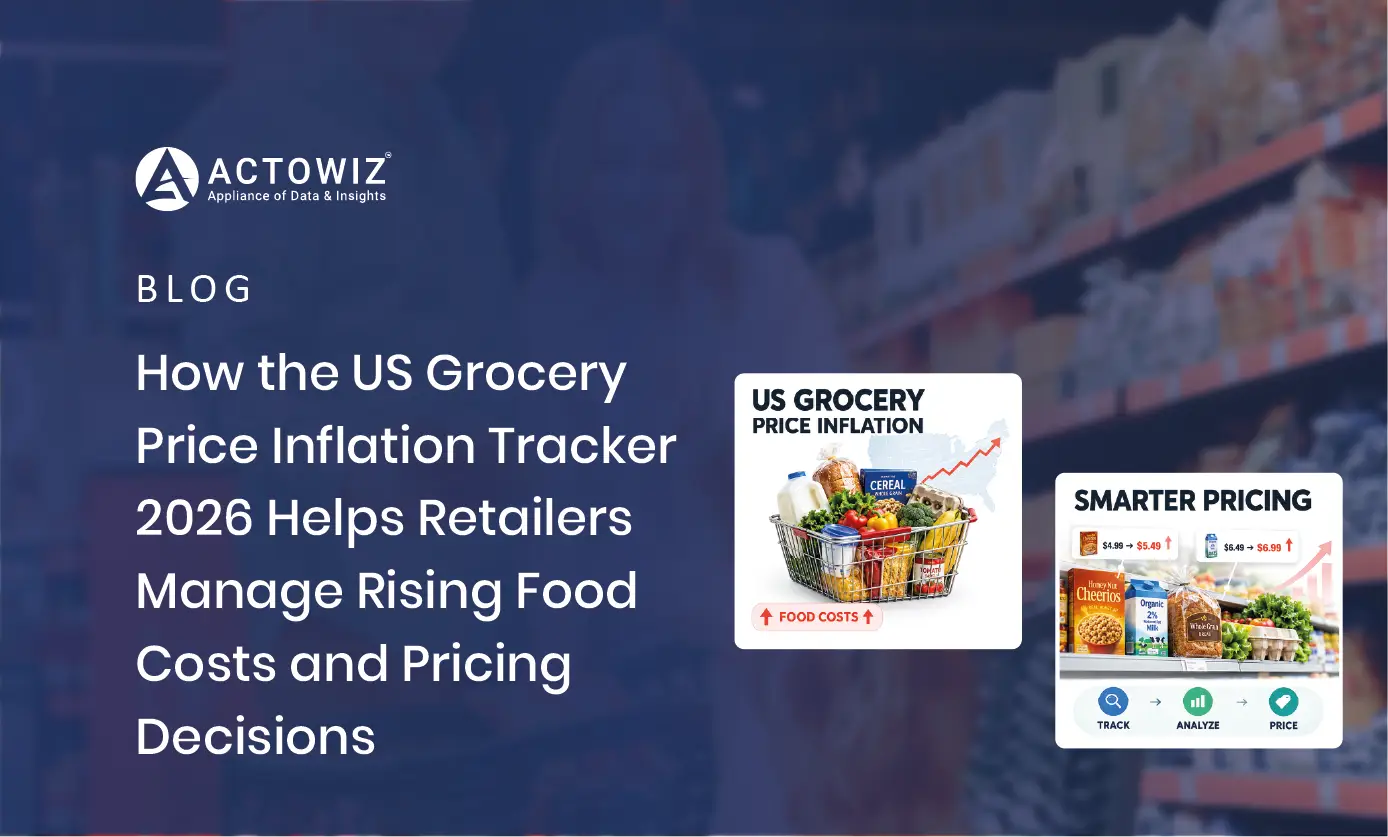
How the US Grocery Price Inflation Tracker 2026 Helps Retailers Manage Rising Food Costs and Pricing Decisions

Track the US Grocery Price Inflation Tracker 2026 to monitor food price trends, category changes, and inflation insights for smarter decisions.

thumb
Case Study

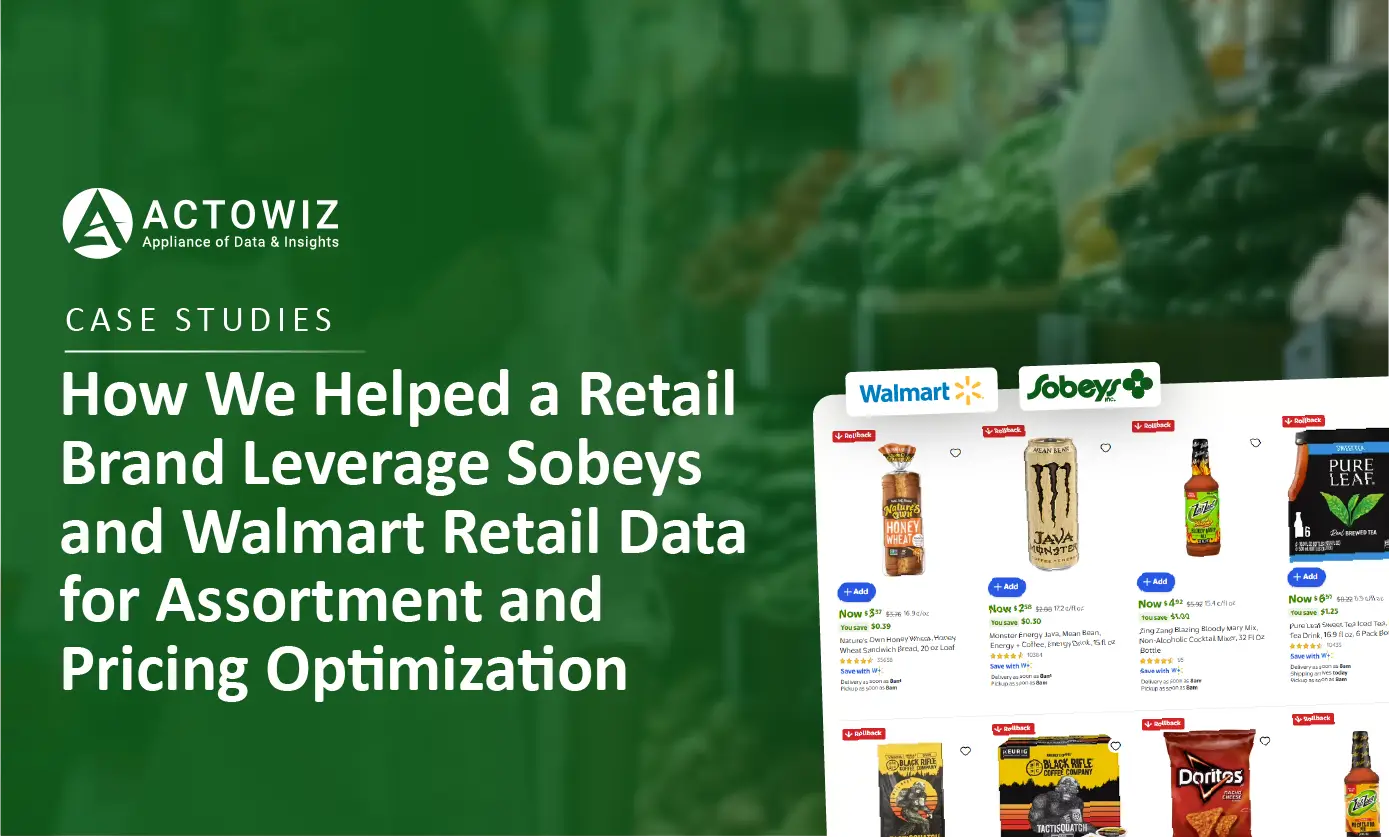
How We Helped a Retail Brand Leverage Sobeys and Walmart Retail Data for Assortment and Pricing Optimization

Discover how Sobeys and Walmart retail data scraping helps brands track prices, products, promotions, and assortment for smarter retail decisions.

thumb
Report

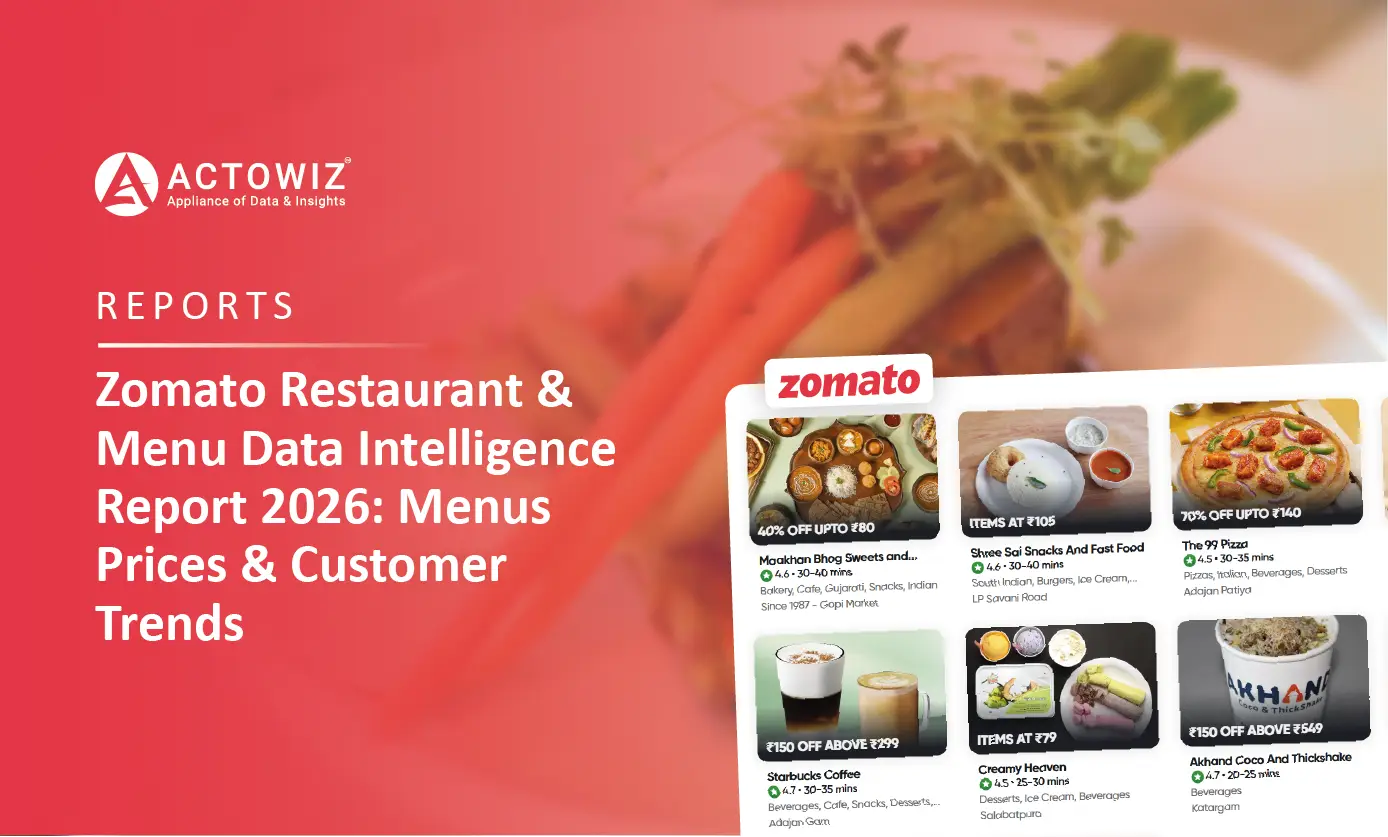
Zomato Restaurant & Menu Data Intelligence Report 2026

Zomato Restaurant & Menu Data Intelligence Report 2026 reveals restaurant, menu, pricing, ratings, and food delivery trends for smarter decisions.

Start Where It Makes Sense for You

Whether you're a startup or a Fortune 500 — we have the right plan for your data needs.

icons
Enterprise
Book a Strategy Call
Custom solutions, dedicated support, volume pricing for large-scale needs.
icons
Growing Brand
Get Free Sample Data
Try before you buy — 500 rows of real data, delivered in 2 hours. No strings.
icons
Just Exploring
View Plans & Pricing
Transparent plans from $500/mo. Find the right fit for your budget and scale.
Get in Touch
Let's Talk About
Your Data Needs
Tell us what data you need — we'll scope it for free and share a sample within hours.
  • icons
    Free Sample in 2 HoursShare your requirement, get 500 rows of real data — no commitment.
  • icons
    Plans from $500/monthFlexible pricing for startups, growing brands, and enterprises.
  • icons
    US-Based SupportOffices in New York & California. Aligned with your timezone.
  • icons
    ISO 9001 & 27001 CertifiedEnterprise-grade security and quality standards.
Request Free Sample Data
Fill the form below — our team will reach out within 2 hours.
+1
Free 500-row sample · No credit card · Response within 2 hours

Request Free Sample Data

Our team will reach out within 2 hours with 500 rows of real data — no credit card required.

+1
Free 500-row sample · No credit card · Response within 2 hours