Introduction
Restaurant-tech teams keep asking the same thing: "Can we send you a list of Google Maps restaurant links and get back the menu, the rating and the latest reviews as clean data?" The answer is yes for most public listing fields, with some clear limits.
Short answer: A Google Maps restaurant data API takes place URLs, CIDs or search areas as input and returns public listing data: name, address, hours, category, price level, rating, review count, review text, photos and menu items where the listing shows them. It refreshes on a schedule and should never return reviewer personal data beyond what you truly need. Our Google Maps search results scraper and Google Maps reviews scraper cover the two collection layers this guide describes.
This guide explains what is publicly visible on a Google Maps restaurant listing, how input by URL or CID works, how Google Maps compares with Zomato, Swiggy and Tripadvisor, and how to set refresh rates, privacy rules and build-vs-buy choices for your team.
Who uses Google Maps restaurant data – and why now?
Google Maps is often the first place a diner checks a restaurant. Its listings mix owner-supplied details with diner contributions. Google said in 2020 that it received more than 20 million contributions a day and had popular-dish data for more than a million restaurants worldwide (Source: https://blog.google/products/maps/google-maps-101-how-contributed-content-makes-maps-helpful/).
Quality control is also visible at scale. Google says it blocked or removed over 292 million policy-violating reviews in 2025 (Source: https://www.seroundtable.com/google-maps-spam-fighting-2025-41176.html). That matters for anyone who analyses reviews: what you capture today may change tomorrow, so dates and refresh rules count.
- POS and menu-management platforms. Check whether a merchant's public menu and hours on Google Maps match the menu held in their system.
- Food-discovery and booking apps. Enrich restaurant profiles with ratings, review counts, price level and service options such as dine-in or delivery.
- Restaurant-tech analytics. Track rating trends and review themes for chains, franchisees or a city segment.
- FMCG and HoReCa sales teams. Build outlet lists by cuisine and area, then prioritise by popularity signals such as review counts.
- Multi-location brands. Audit hundreds of their own listings for wrong hours, missing menus or unanswered reviews.
What data can you get from a Google Maps restaurant listing?
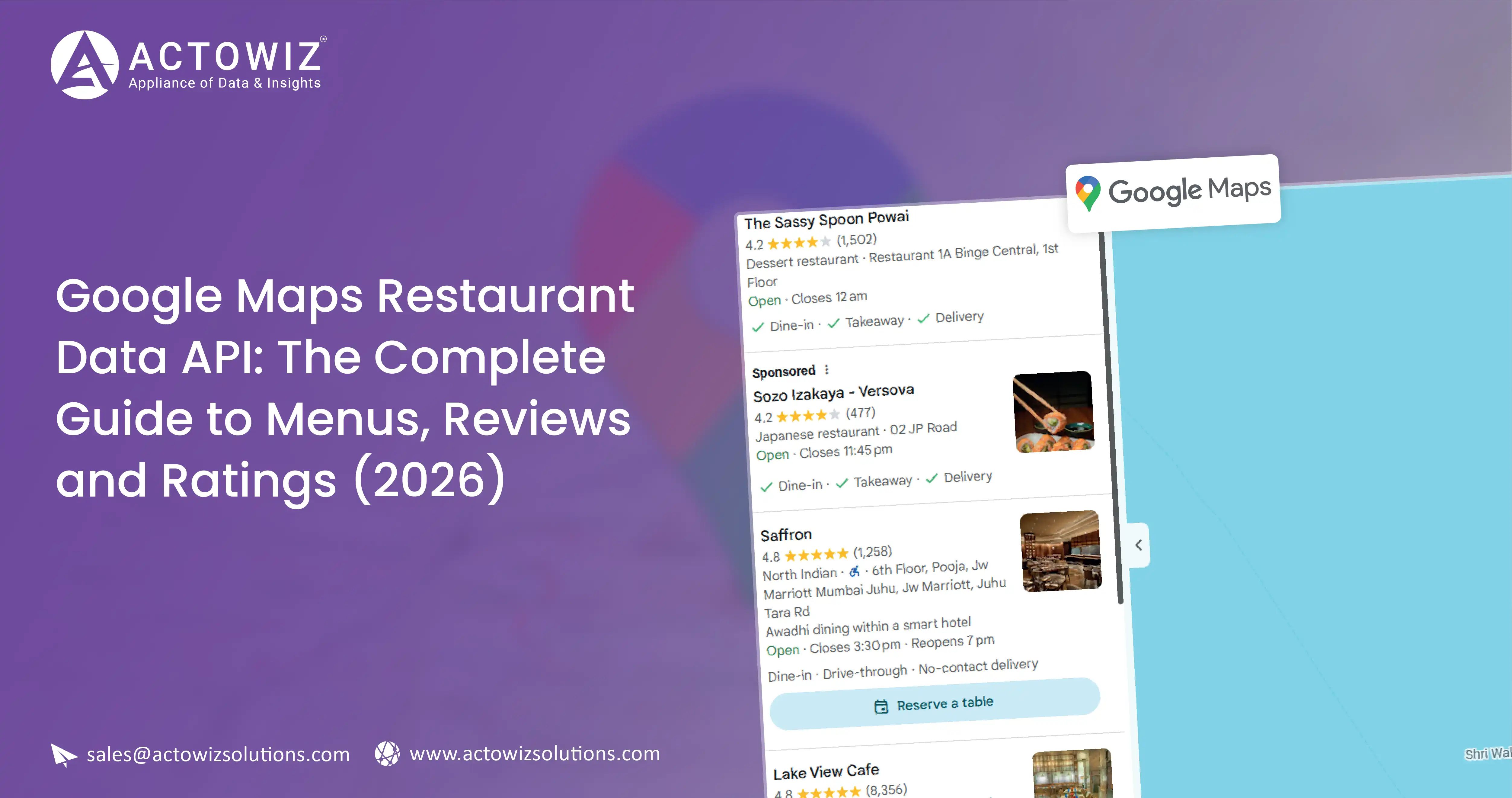
What is visible depends on the listing, the country and what the owner and diners have added. The core fields below are publicly shown on most restaurant listings:
- Business details. Name, full address, coordinates, phone (business number), website, Google Maps URL, place ID / CID and primary category such as "South Indian restaurant".
- Opening hours. Regular weekly hours, special hours for holidays and a "permanently closed" or "temporarily closed" flag where shown.
- Rating and review count. The star rating (1.0–5.0) and total number of ratings. Google's own Places API describes the rating as based on user reviews and the count as reviews with or without text (Source: https://developers.google.com/maps/documentation/places/web-service/reference/rest/v1/places).
- Review text. Review body, star score, review date, owner reply and reply date. Reviewer names are visible on the page, but most business use cases do not need them – see the privacy section.
- Service options and attributes. Dine-in, takeaway, delivery, reservations, vegetarian options, breakfast, lunch, dinner and similar flags.
- Price level. The price band shown on the listing, where available.
- Menu. Structured menu sections, items, descriptions and prices when the owner has used the menu editor; otherwise a menu link or menu photos. Google's help page explains that owners can add items, link to an external menu, or upload photos, and that Google may transcribe menu data from a restaurant's website (Source: https://support.google.com/business/answer/9455840?hl=en).
- Photos and dish tags. Photo URLs and counts. Google Maps has also started to match food photos to menu items, sometimes with tags such as "Popular" or "Vegetarian" (Source: https://tech.yahoo.com/general/articles/google-maps-now-identifies-menu-142502470.html).
| Field |
Example value |
Notes |
| place_name |
Example Dosa House |
As shown on the listing |
| google_cid / place_id |
Numeric CID / text place ID |
Stable key for refresh and matching |
| address, lat, lng |
Full address + coordinates |
Normalise per country format |
| category |
South Indian restaurant |
Primary + secondary categories |
| hours_json |
{"mon": "11:00–23:00", …} |
Structured weekly hours |
| rating, rating_count |
4.3, 1,284 |
Snapshot with captured_at date |
| price_level |
₹₹ / ££ |
Band, not an exact price |
| service_flags |
dine_in, takeaway, delivery |
Only flags shown on listing |
| menu_section, item_name, item_price |
Dosas, Masala Dosa, ₹180 |
Only when a structured menu is visible |
| review_text, review_rating, review_date |
Text, 5, 2026-10-12 |
Reviewer name anonymised or dropped |
One important gap: Google's official Places API returns a maximum of five reviews per place, sorted by relevance, and has no full menu field – only a flag for a children's menu (Source: https://developers.google.com/maps/documentation/places/web-service/reference/rest/v1/places). Teams that need full review histories or menu items usually look at the public listing itself.
How does input by place URL or CID work?
Most restaurant-tech buyers already have a list of restaurants. The simplest model is "bring your own list":
- Send the inputs. Google Maps place URLs, CIDs, place IDs, or a search such as "restaurants in Indiranagar, Bengaluru".
- Resolve each place. Short links and share links are expanded and every place is mapped to one stable ID, so duplicates collapse into one record.
- Capture the listing. Business details, hours, rating, review count, attributes and the menu tab are captured with a timestamp.
- Capture reviews. Choose the scope: newest N reviews, reviews since a date, or all visible reviews for a one-time backfill.
- Normalise. Prices, hours, currencies and categories are cleaned into a fixed schema, and menu items are split into section, item and price.
- Deliver. JSON via API endpoint, scheduled CSV/Excel, or a push to S3, BigQuery or a webhook.
A typical request from a POS or menu-management team in India looks like this: a few hundred Google Maps URLs, menu items plus the latest reviews, delivered as JSON for each URL. That fits the URL-input model well.
Google Maps vs Zomato, Swiggy and Tripadvisor: which source for which field?
No single platform covers every field. Use Google Maps for broad coverage and business details, and add a delivery or travel platform where it adds depth. What each source shows varies by market and listing, so check a sample before you scale. Our restaurant outlet intelligence across Google Maps, Zomato and Swiggy work shows how these sources are reconciled.
| Data need |
Google Maps |
Zomato |
Swiggy |
Tripadvisor |
| Coverage |
Dine-in, takeaway and delivery outlets, chains and independents |
Restaurants in its markets, dine-in and delivery |
Delivery restaurants in India |
Strong for tourist and dine-in venues |
| Hours and business details |
Yes, owner-maintained |
Yes |
Delivery hours / availability |
Yes, on many listings |
| Ratings and review counts |
Yes |
Yes, dining and delivery ratings shown |
Yes, delivery ratings |
Yes, plus city ranking |
| Review text |
Yes |
Yes |
Limited |
Yes |
| Menu items and prices |
Only where structured menu exists; else photos or link |
Yes, delivery menus |
Yes, delivery menus with add-ons |
Sometimes, often a menu link |
| Best used for |
Outlet universe, hours checks, reputation tracking |
Menu and price depth in India |
Delivery menus and offers in India |
Tourist-area reputation |
For Indian food-delivery menus, Zomato and Swiggy usually give deeper item-level price data than Google Maps. Note that we collect only public listing data from these apps. We do not offer order or POS integration with Swiggy or Zomato.
Refresh cadence and limits
Not every field in a Google Maps restaurant data API changes at the same speed. Match the refresh rate to the decision the data supports, not to the fastest possible schedule.
| Data type |
Suggested refresh |
Typical limits to plan for |
| Business details, category, address |
Monthly |
Owner edits and Google edits can change fields without notice |
| Opening hours and closed flags |
Weekly; daily before holidays |
Special hours may only appear close to the date |
| Rating and review count |
Weekly |
Counts can drop when reviews are removed |
| New reviews |
Daily or weekly (since last run) |
Visible order and filters change; removed reviews disappear |
| Menu items and prices |
Weekly or monthly |
Many listings have only menu photos or a link, not item data |
| Photos and dish tags |
Monthly |
Dish tagging is not available on every listing or app version |
Plan for listings without structured menus. In that case the feed can return the menu link and photo URLs, or capture the menu from the restaurant's own website as a separate source.
Reviewer privacy: public business data, not personal profiles
Reviews are about a business, but they are written by people. A responsible Google Maps restaurant data API should focus on the business, not on the reviewer.
- Drop or anonymise reviewer names. Replace names with a hashed token if you need to count unique reviewers; otherwise drop them.
- No reviewer profile links or IDs. Do not collect reviewer profile URLs, photos, Local Guide levels or their other reviews.
- Keep text for analysis only. Use review text for themes and sentiment, and avoid republishing it in your own product.
- Check local law. India's DPDP Act excludes some personal data that a person has made public themselves (Source: https://dpdp.myndsolution.com/wiki/act/section-3/), but GDPR and UK GDPR still apply in Europe. Data minimisation is the safe default everywhere.
- Respect site terms. Collect only publicly visible pages, with no login bypass, and follow the platform's terms and your legal team's advice.
Use cases by team
Here is how different teams put a Google Maps restaurant data API to work:
- Menu accuracy checks. Compare the Google Maps menu and hours with your POS menu and flag mismatches before diners see them.
- Restaurant onboarding. Pre-fill a new merchant's profile from their public listing to save sales and onboarding time.
- Reputation dashboards. Track rating, review count and review themes weekly for every outlet in a chain.
- Market sizing. Count restaurants by cuisine, area and price level before entering a new city.
- Field sales targeting. Give HoReCa sales teams outlet lists ranked by review count as a popularity proxy.
For review-specific collection, see our reviews API. For prebuilt location and POI files, see our Google Maps and Yelp location and POI datasets.
Build vs buy: official API, DIY scraper or managed feed?
| Option |
Good for |
Watch out for |
| Google Places API |
Business details, rating, hours, up to 5 reviews in your own app |
No full menu items; review cap; usage-based billing and display terms |
| DIY scraper |
Small one-off pulls by an in-house team |
Layout changes, blocking, maintenance and QA time |
| Managed data feed / API |
Repeat feeds across many URLs and cities with QA |
Define fields, refresh and privacy rules in the contract |
When you compare providers, ask for a sample on your own URLs, a field list with fill rates, a clear refresh schedule, and a written note on how reviewer data is handled. Actowiz offers a ready Google Maps scraper and a custom Google Maps restaurant data API feed that can combine Google Maps with delivery platforms.
Have a list of Google Maps restaurant URLs and need clean menu, rating and review data back? Request a sample on your own URLs and we will confirm fields, fill rates and refresh options.
Contact Us Today!
Frequently Asked Questions
Can I get the full menu of a restaurant from Google Maps?
Only when the listing shows a structured menu with sections, items and prices. Many listings show a menu link or menu photos instead. In those cases a feed can return the link and photo URLs, or capture the menu from the restaurant's website.
Does the official Google Places API return all reviews?
No. Google's documentation says a maximum of five reviews can be returned per place, sorted by relevance. Teams that need more review history usually collect the public listing on a schedule.
Can I send Google Maps URLs as input?
Yes. Place URLs, share links, CIDs and place IDs can all be resolved to one stable ID, so the same restaurant is not counted twice. You can also start from a search area and cuisine.
Do you collect reviewer names or profiles?
We recommend not to. Reviewer names can be dropped or replaced by a hashed token, and reviewer profile links, photos and IDs are excluded. The focus is public business data.
How often should Google Maps restaurant data be refreshed?
Weekly works for ratings, review counts and hours for most teams. New reviews can run daily. Menus and business details often need only a monthly refresh.
Is Google Maps or Zomato better for restaurant menu data in India?
For delivery menus with item prices, Zomato and Swiggy usually show more detail. Google Maps is better for broad outlet coverage, hours and reputation. Many teams combine both.
Conclusion
You can also reach us for all your mobile app scraping, data collection, web scraping , and instant data scraper service requirements!
 Actowiz Solutions

 By industry
 Pricing & Promotions
 Brand & Intelligence
 Digital Shelf & Search
 Assortment
 For Retailers
 E-Commerce Dashboard
 Flipkart Insights (Live)
 Grocery Intelligence
.svg) Grocery Price (U.S.)
.svg) Quick Commerce (India)
 Food & Restaurant
 Fashion Intelligence
 Automotive
 Travel & Hospitality
 Real Estate
 Food Delivery Intelligence
 OTT & Streaming
 Fuel & EV Charging Price Tracker
 By Use Case
 Pricing Intelligence
 Digital Shelf Analytics
 MAP Monitoring
 Cross-Border Price Parity
 Share of Search
 Review Sentiment
 Kitchen Market Gaps
 Dynamic Pricing / AI Repricing
 Promotions & Deals Alerts
 B2B / POI & Lead Data
 AI Search Visibility Dashboard
 Baby Products on Quick Commerce
 Hotel & Flight Rate Parity
 By Region
 Flipkart Real-Time Insights
 Quick Commerce — Zepto · Blinkit
 Pincode Price Tracker
 GCC Q-Commerce — Talabat · Noon
 UK Grocery — Tesco, Sainsbury's, Asda
 AU Grocery — Coles & Woolworths
 Marketplace Scrapers
 Developer APIs
 Universal APIs
 Delivery & SDKs
 Knowledge Center
 Guides & Playbooks
 Downloads & Tools
 Trust & Company

































 4.8/5 Average Rating
 50+ Video Testimonials
 92% Client Retention
 50+ Countries Served