Introduction
Restaurant reservation data is a time-stamped record of the table slots, party sizes and booking offers that restaurants show publicly on reservation platforms and their own websites. Restaurant groups, analysts and dining-offer teams use it to measure demand by day and time, benchmark discounts and see which platform gives diners the best deal.
Reservation pages are a live signal of demand. When prime Friday slots vanish days ahead, a restaurant is busy. When a venue offers deep discounts on weekday lunches, it is filling empty seats. Tracked over weeks, these signals tell you more about a dining market than menus or ratings alone.
This guide covers who uses reservation data, how the main platforms differ, the fields to collect, how to read the results and the compliance rules that matter most in this category.
Who uses reservation and offer data
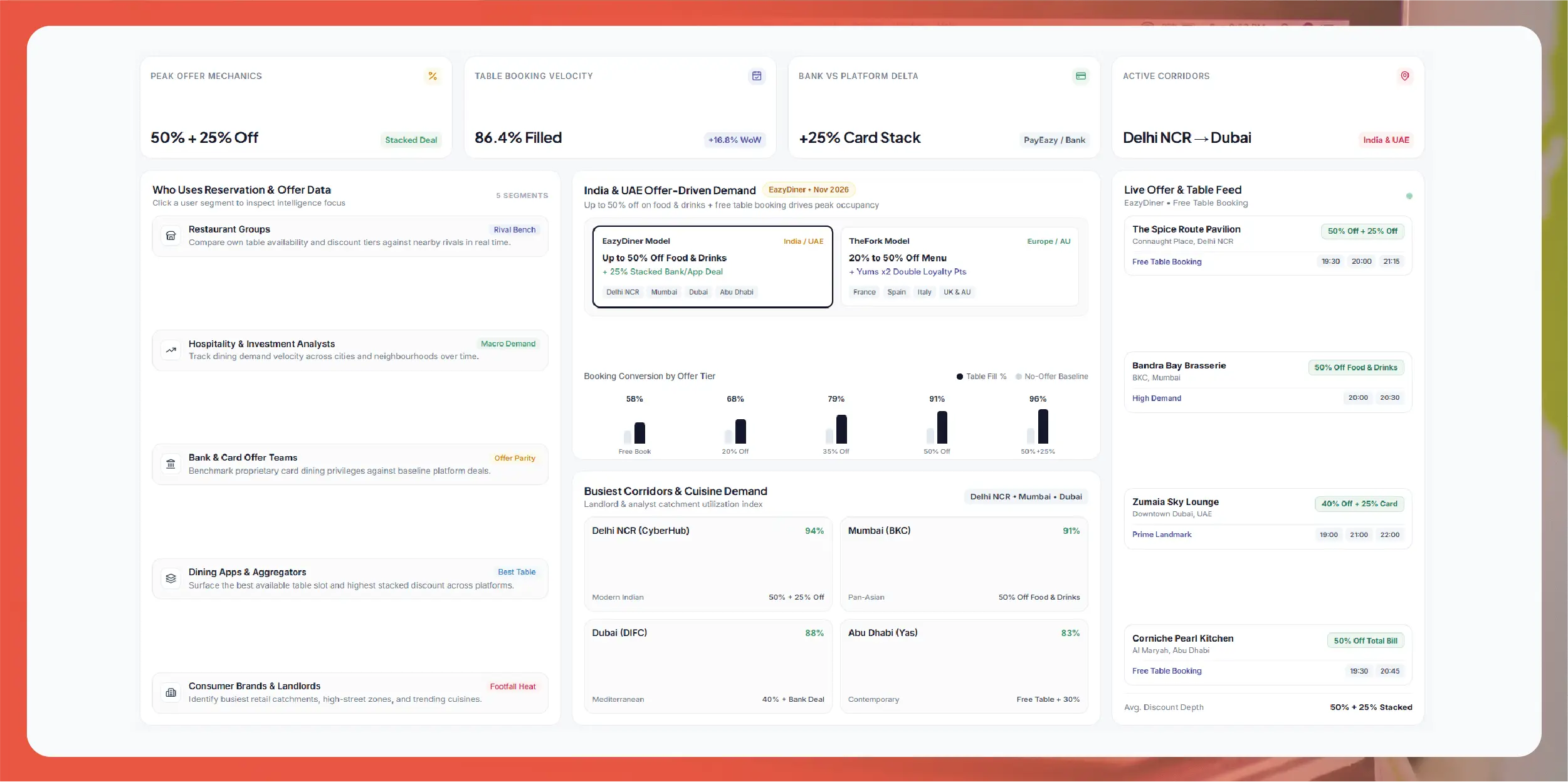
- Restaurant groups – compare their own availability and offers with nearby rivals.
- Hospitality and investment analysts – track demand in a city or neighbourhood over time.
- Bank and card offer teams – check how their dining offers compare with platform deals.
- Dining apps and aggregators – help users find the best available table and offer across platforms.
- Consumer brands and landlords – understand which areas and cuisines are busiest.
In India, demand is often driven by offers. EazyDiner's homepage, for example, promotes "up to 50% off on food and drinks" and free table booking, shows restaurant cards with stacked deals such as "50% off + 25% off", and lists booking cities from Delhi NCR to Dubai and Abu Dhabi (EazyDiner, accessed 17 November 2026). In Europe, TheFork's homepage highlights "up to 50% off" with many listings showing discounts of 20% to 50%, plus double loyalty points ("Yums x2") on some restaurants, across countries including France, Spain, Italy, the UK and Australia (TheFork, accessed 17 November 2026). For India-focused dining deal analysis, see restaurant offers data for India.
Platforms compared
| Platform |
Main markets |
Typical public signals |
Collection note |
| OpenTable |
US, UK and others |
Time slots by party size, booking offers |
Terms prohibit robots and scrapers without authorisation – we do not collect without a permitted route |
| Resy |
US and others |
Time slots, notify lists |
Review terms before any collection |
| TheFork |
Europe, Australia |
Discount levels, loyalty point offers, ratings |
Review terms; country sites differ |
| EazyDiner |
India, UAE |
Offers, bank deals, booking options, cuisine and area filters |
Review terms; offers change by day and time |
| District (Zomato) |
India |
Dining offers and table booking |
Review terms before any collection |
| Restaurant's own website |
All |
Booking widget slots, set menus, events |
Often the simplest permitted source |
Platform features and terms change often, so treat this table as a starting point and confirm each source in a pilot. Restaurant discovery data, such as a Google Maps restaurant data API, can also help build and match a restaurant list across locations.
The fields to collect
- restaurant_id, name, address and city – matched across platforms
- platform and source URL – where the data came from
- cuisine, area and price band – for fair comparisons
- date and time slot – the slot being checked
- party size – availability often differs for 2, 4 and 6 guests
- slot status – available, limited or not shown
- offer text and offer type – percentage off, set menu, bank or card offer, loyalty points
- offer conditions – days, times, minimum spend, bank card needed
- rating and review count – as a demand and quality proxy
- captured_at and lead time – when you checked, and how many days before the slot
History builds from the start of collection. A few weeks of data is needed before day-of-week patterns become clear. Restaurant ratings and review trends can add another comparison layer through restaurant ratings data for QSR and APAC markets.
How to set up tracking
Step 1 – Define the restaurant set. Pick your own outlets plus 10–30 competitors per area, matched by cuisine and price band.
Step 2 – Choose the slot grid. For example, lunch and dinner slots for the next 14 days, for party sizes 2 and 4.
Step 3 – Set the cadence. Once or twice a day is enough for most offer tracking; demand studies may add a check close to service time.
Step 4 – Match restaurants across platforms. Names and addresses differ slightly; match on name, address and phone where shown, then review low-confidence matches.
Step 5 – Normalise offers. Turn free text such as "50% off + 25% off" into structured fields: base discount, extra discount, conditions.
Step 6 – Report. Build weekly views of availability by day and slot, and offer depth by area and platform.
Reading the data
| Pattern |
Likely meaning |
Action |
| Prime slots gone days ahead |
Strong demand |
Test fewer discounts at peak times |
| Deep discounts on weekday lunch |
Filling quiet periods |
Compare your own off-peak strategy |
| Same restaurant, different offers by platform |
Platform-funded or channel-specific deals |
Check where diners get the best value |
| Offers stacked with bank cards |
Bank partnerships drive bookings |
Review card-offer partnerships |
| Average offer depth by city |
Not publicly benchmarked |
Use for market benchmarking |
Use cases
- Competitor offer benchmarking – see what discounts rivals run, on which days and platforms.
- Best-offer finder – show diners the best available offer for a restaurant across platforms where collection is permitted.
- Demand mapping – compare slot availability by neighbourhood, cuisine and day.
- Bank offer audits – check that card and bank dining offers appear as agreed.
- New-site research – study demand and pricing in an area before opening.
For UK-focused restaurant research, structured UK restaurant directory and menu data can complement reservation tracking with restaurant locations, cuisines and menu information.
A weekly dining market report
Most teams need one clear page a week, not a raw data dump. A simple layout works well:
- Availability heatmap – share of checked slots available, by day of week and time, for your outlets and competitors.
- Offer depth by platform – average and maximum discount shown, by area and cuisine.
- New and ended offers – which restaurants started or stopped a deal this week.
- Bank and card offers – which partners appear most often, and on which days.
- Watch list – competitors whose availability or offers changed sharply.
Keep the same restaurant set and slot grid each week, so changes reflect the market rather than a change in what you measured. After two or three months you will see clear seasonal and day-of-week patterns.
Common mistakes
- Treating "no slot shown" as "fully booked". Some restaurants release tables late or keep walk-in seats. Label the status as observed, not inferred.
- Ignoring party size. A table for two may be free when a table for six is not.
- Comparing offers without conditions. "50% off" on a weekday lunch is not the same as a dinner deal.
- Poor restaurant matching. Branches of the same chain are easy to mix up.
- Collecting too often. Hourly checks add cost and load without adding much insight for most uses.
- Skipping the terms review. In this category, platform terms differ sharply.
Legal and compliance basics
Compliance matters more here than in most categories. OpenTable's terms of use, revised 22 July 2026, say users may not use any robot, spider, scraper or AI technology to access, copy or monitor its services except as expressly authorised (OpenTable, accessed 17 November 2026). Other platforms have their own rules. Before any collection, Actowiz Solutions reviews each platform's terms and robots rules and uses only permitted routes, such as restaurants' own websites, official partner feeds or sources whose terms allow it.
Never make, hold or cancel bookings to test availability. Collect only public data; do not log in, and do not collect diner names, reviews with personal details or any other personal data. We provide data only – there is no booking service, POS or order integration.
Build vs buy
A one-off check of a few restaurants can be done by hand. Tracking hundreds of venues across several platforms, matching them, normalising offer text and keeping every source compliant is a data operation. Actowiz Solutions delivers restaurant availability and offer data as CSV, JSON, dashboard or API, scoped to the sources that can be collected properly.
Frequently Asked Questions
What is restaurant reservation data?
It is a record of the public table slots, party sizes and booking offers that restaurants show on reservation platforms and their own websites.
Can you collect data from OpenTable?
OpenTable's terms prohibit automated access without its authorisation, so we do not collect it without a permitted route. We confirm the right source for each platform in a pilot.
Can you track dining offers in India?
Yes, subject to each platform's terms. Offer text, conditions and bank deals can be tracked from permitted sources.
Can you make or manage bookings?
No. We provide data only. We do not make bookings or integrate with POS or ordering systems.
How often should availability be tracked?
Once or twice a day suits most offer and demand studies; add checks near service times only if needed.
 Actowiz Solutions

 By industry
 Pricing & Promotions
 Brand & Intelligence
 Digital Shelf & Search
 Assortment
 For Retailers
 E-Commerce Dashboard
 Flipkart Insights (Live)
 Grocery Intelligence
.svg) Grocery Price (U.S.)
.svg) Quick Commerce (India)
 Food & Restaurant
 Fashion Intelligence
 Automotive
 Travel & Hospitality
 Real Estate
 Food Delivery Intelligence
 OTT & Streaming
 Fuel & EV Charging Price Tracker
 By Use Case
 Pricing Intelligence
 Digital Shelf Analytics
 MAP Monitoring
 Cross-Border Price Parity
 Share of Search
 Review Sentiment
 Kitchen Market Gaps
 Dynamic Pricing / AI Repricing
 Promotions & Deals Alerts
 B2B / POI & Lead Data
 AI Search Visibility Dashboard
 Baby Products on Quick Commerce
 Hotel & Flight Rate Parity
 By Region
 Flipkart Real-Time Insights
 Quick Commerce — Zepto · Blinkit
 Pincode Price Tracker
 GCC Q-Commerce — Talabat · Noon
 UK Grocery — Tesco, Sainsbury's, Asda
 AU Grocery — Coles & Woolworths
 Marketplace Scrapers
 Developer APIs
 Universal APIs
 Delivery & SDKs
 Knowledge Center
 Guides & Playbooks
 Downloads & Tools
 Trust & Company







































 4.8/5 Average Rating
 50+ Video Testimonials
 92% Client Retention
 50+ Countries Served