Core services
Enterprise Data Extraction

Scalable web, app and AI-powered collection across 40+ countries.

All 58 services →
New 2026
AI Training Data

Corpus building with provenance and opt-out compliance.

Learn more →
Free pilot
24-hour sample

We run collection on your own sources before you commit.

Get a sample →
58Services
40+Countries
DEVELOPER

Ready-Made Scrapers

Pre-built for top platforms. Self-serve, no setup.

View All →
TRY FREE

API Playground

Test endpoints instantly. No credit card.

Start Free →
28Tools
2SDKs
icons Delivery & SDKs
Streaming Crawl API Scheduler Realtime Alerts Webhook Delivery 🐍 Python SDK 💚 Node.js SDK
Need it managed instead?

Fixed monthly retainer, named engineer, no per-request metering.

Managed Data API →
HOT

Case Studies

How brands use Actowiz, with named outcomes.

Read →
FREE

Sample Datasets

Real output, no signup.

Download →
NEW

ROI Calculator

Model the return on a data engagement.

Calculate →
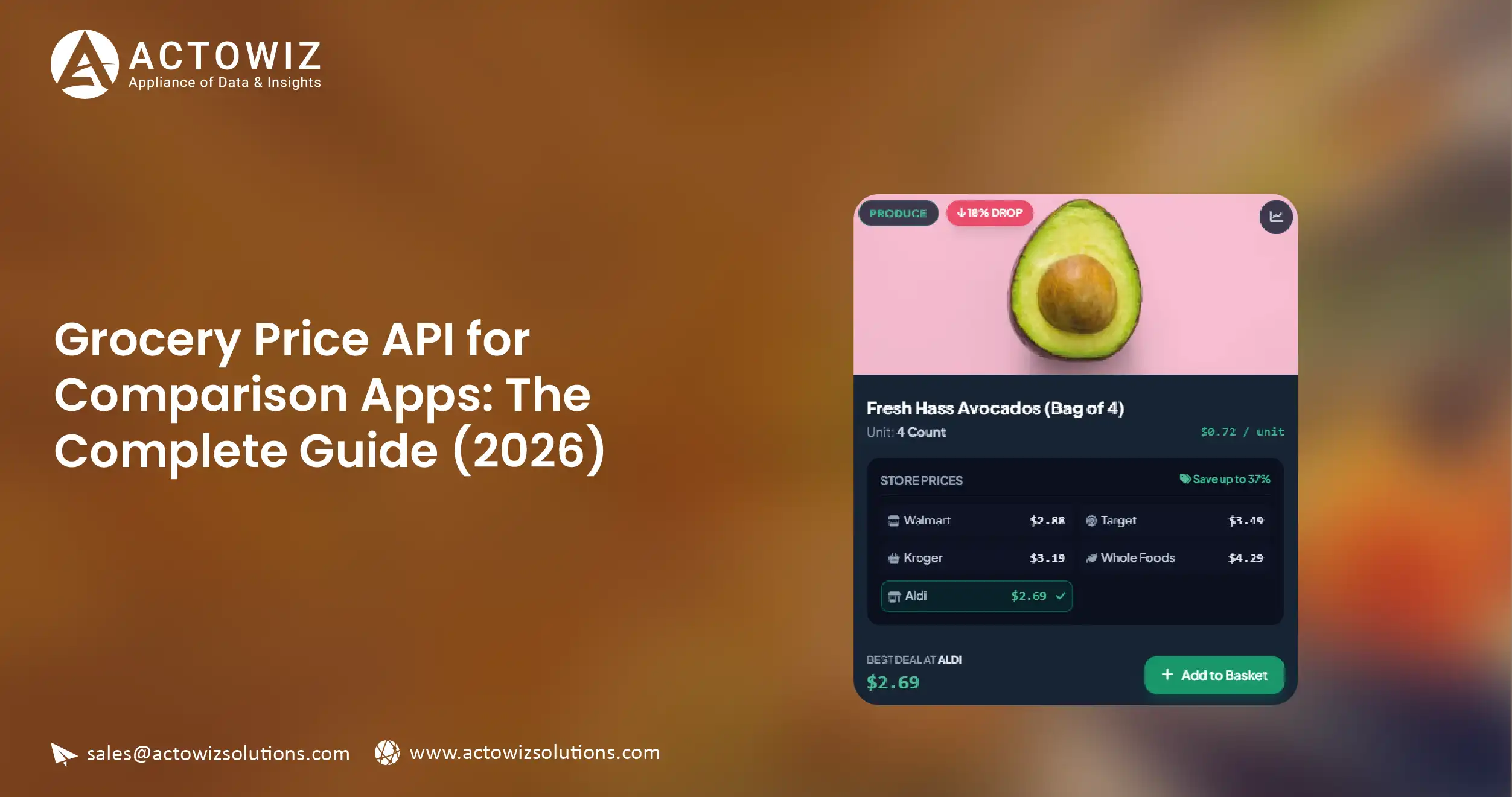
Grocery price API for comparison apps showing store-level prices across US retailers

Introduction

A grocery price API for comparison apps is a feed that returns the current online price, promotion, availability and pack size of a grocery product at a specific store or ZIP code, keyed to a UPC/GTIN so the same item can be matched across Walmart, Kroger, Target, Aldi and other US retailers. It powers smart-list, deal and budgeting apps.

Demand is rising because more grocery spending now flows through screens. Brick Meets Click reported US eGrocery sales of $12.7 billion in December 2025, with online taking 19.0% of total grocery spending that month Brick Meets Click. Shoppers who browse online also expect apps to tell them where a basket is cheapest.

This guide explains which retailers matter, which fields a grocery price API should return, how UPC matching works, what store-level online prices can and cannot tell you, and how to decide between building and buying.

What Is a Grocery Price API and Who Needs One?

A grocery price API is a structured, repeatable feed of product-level grocery data, usually JSON over REST or scheduled files, that an app can query by product, store or ZIP code. It replaces manual price checks and brittle one-off scripts.

In recent inquiries to Actowiz, the teams asking for this data were almost all building consumer products rather than retail pricing tools:

  • Smart grocery-list apps that suggest the cheapest store for a household's weekly list.
  • Markdown and deal apps that surface promotions and clearance prices near the user.
  • Budgeting and meal-planning apps that cost a recipe or basket at local stores.
  • Barcode-scan apps that look up a UPC/EAN and show nearby prices and pack sizes.
  • Pilot teams that need a written data spec before committing to a feed.

All of them share one need: the same product, matched reliably, priced at the store the user actually shops.

Which US Grocery Retailers Matter and How Do They Differ?

Each US grocer exposes prices differently, so a grocery price API has to handle store selection, membership models and marketplace layers separately. The table below summarises what comparison apps typically collect.

Retailer / platform How prices vary What to collect Watch-outs
Walmart By store and fulfilment mode Store price, rollback flag, pickup/delivery availability Separate Walmart 1P offers from marketplace sellers
Target By store Store price, Circle-style offer text, availability Some offers need an account; collect public offer text only
Kroger banners By store and banner Regular price, sale price, loyalty-promo text Loyalty prices shown publicly should be labelled separately
Albertsons / Safeway By store and banner Regular price, club/digital promo text, size Many banners share one catalogue but not one price

Aldi By store region Shelf-style online price, weekly specials Smaller, private-label-heavy assortment
Costco By warehouse / delivery ZIP Online prices and pack size only Prices only – no item-number to UPC mapping offered
Instacart By retailer storefront and ZIP Storefront price, promo, availability Retailer-set prices may differ from in-store
Amazon Fresh By delivery ZIP Price, deal flag, unit price, stock Delivery-area availability changes quickly

For banner-specific detail, see our Walmart data scraping service, our Albertsons grocery data page and our guide to scraping Amazon Fresh grocery delivery data.

What Data Fields Should a Grocery Price API Return?

A useful grocery price API returns the price plus every attribute an app needs to prove two listings are the same product and to compare them fairly per unit. These are the fields consumer-app teams ask for most often:

  • Product identifiers – UPC/EAN/GTIN where the retailer exposes it, plus the retailer's own product ID and URL.
  • Store and location – store ID, banner, address, ZIP code and fulfilment mode (pickup, delivery, ship).
  • Regular price – the everyday online price at that store.
  • Promotional price and promo text – sale price, multi-buy wording ("2 for $5"), start and end dates where shown.
  • Unit price – price per ounce, pound, count or fluid ounce, normalised to one unit system.
  • Pack size – net quantity, count and unit, parsed from the title or size field.
  • Availability – in stock, low stock or out of stock, as displayed for that store.
  • Product content – title, brand, category path and image URL for display.
  • Timestamp – when the record was captured, so stale prices can be flagged.
Field Description Example
gtin UPC/EAN/GTIN normalised to 14 digits 00012345678905
retailer Retailer or banner name Safeway
store_id Retailer store identifier 1234
zip_code ZIP the price applies to 94107
regular_price Everyday online price (USD) 4.99
promo_price Promotional price, if any 3.99

promo_text Offer wording as displayed Buy 2, save $1

unit_price Normalised price per unit 0.31 per oz
pack_size Net quantity and unit 16 oz
availability Stock status shown in_stock
image_url Public product image link https://…
captured_at Collection timestamp (UTC) 2026-10-07T06:00:00Z

How Does UPC, EAN and GTIN Product Matching Work?

Product matching works by normalising every barcode to a single GTIN format, matching exact identifiers first, and only then falling back to brand, size and title similarity. Without this step, a comparison app compares the wrong products.

According to GS1, UPC and EAN are simply alternate names for GTIN-12 and GTIN-13, and the GTIN is the number encoded in the barcode GS1. Padding both to 14 digits lets a scanned EAN match a retailer's UPC.

A practical matching pipeline has four layers:

  • Exact GTIN match – where both retailers expose the barcode, this is the strongest link.
  • Brand + size + variant match – used when one side has no barcode; size must be parsed and normalised first.
  • Title similarity with rules – catches wording differences, but flavour, count and organic flags must agree.
  • Human review queue – low-confidence pairs are checked before they reach the app.

Private-label products (Great Value, Kroger brand, Signature Select and similar) rarely have a cross-retailer equivalent, so most apps compare them on unit price and attributes rather than claiming an exact match. For Costco, Actowiz collects online prices and pack sizes only; we do not offer Costco item-number to UPC/GTIN mapping.

Online Prices vs Shelf Prices: What Can Store-Level Data Tell You?

Store-level online data from a grocery price API tells you what a retailer shows on its website or app for a chosen store or ZIP at capture time. It is not a scan of the physical shelf, and the two can differ.

Instacart, for example, states that retailers set item prices on its marketplace, that some may differ from in-store prices, and that some in-store promotions do not apply online Instacart Help. Weighted items such as produce can also change at checkout.

For an honest app experience:

  • Label prices as "online price at [store], checked [time]".
  • Keep retailer-site prices and delivery-platform prices in separate fields.
  • Show the capture timestamp and refresh often for volatile categories.
  • Treat loyalty or digital-coupon prices as conditional offers, not the base price.

How Do You Collect, Clean and Deliver the Data?

Reliable grocery price data comes from a repeatable pipeline: choose stores, collect on a schedule, normalise, match, check quality and deliver in the format the app consumes. The six steps below form a typical setup.

  • Map ZIP codes to stores – pick the stores per retailer that represent your users' locations.
  • Schedule collection – daily for most categories, more often for promotions or fast-moving delivery storefronts.
  • Parse and normalise – split pack size, convert units, compute unit price and standardise promo text.
  • Match products – apply the GTIN-first matching layers described above.
  • Run quality checks – flag sudden price jumps, missing images, empty stock fields and duplicate listings.
  • Deliver – REST API, JSON or CSV files, or a cloud bucket drop, with a change log per run.

Refresh needs depend on what the app promises its users:

App use case Suggested refresh Must-have fields
Weekly smart grocery list Daily gtin, regular_price, unit_price, store_id
Deal / markdown alerts Several times a day for promo categories promo_price, promo_text, availability
Barcode scan and compare Daily, plus on-demand for top items gtin, pack_size, image_url, zip_code
Recipe or meal-plan costing Daily or weekly unit_price, pack_size, category
Pilot or proof of concept One-off sample, then weekly Full field list from the written spec

Our US grocery ZIP and store-level price comparison case study shows how this pipeline runs across many US chains.

How Are Comparison Apps Using Grocery Price Data?

Grocery price data is used to answer one question for the shopper: where is this item, or this basket, cheapest near me right now? These anonymised examples reflect requests Actowiz received recently.

  • A US smart-grocery-list startup wanted store-level prices across major chains so the app could rank stores for a user's weekly list.
  • A markdown-focused shopping app asked for UPC/EAN/GTIN lookup with store-level price, promotions, availability, pack size and images through an API, starting with a free trial.
  • A pilot team requested a written data specification first, so engineers could plan the integration before a paid feed.
  • A consumer app needed Albertsons-banner data, while another asked for Amazon and Target grocery coverage.

Legal and Compliance Basics

Collect only publicly available product and price information, respect each site's terms, and run a legal review before launch. Responsible collection keeps the feed sustainable.

  • Focus on public business data: products, prices, promotions, stock status and images links.
  • Do not collect shoppers' personal data, reviewer identities or account-only content.
  • Do not bypass logins, paywalls or technical access controls.
  • Check image usage rights before displaying retailer images in your app.
  • Prefer official retailer or partner programmes where one fits your needs.

This section is general information, not legal advice.

Build vs Buy: Choosing a Grocery Price API Provider

Building in-house gives full control but means maintaining parsers, store maps and matching logic for every retailer as sites change. Buying a managed grocery price API shifts that upkeep to a provider so your team can focus on the app.

Factor Build in-house Managed provider
Time to first data Weeks per retailer Sample often in days
Maintenance Your engineers fix breakages Provider monitors and repairs
UPC matching You build and review Delivered with match confidence
Store coverage Grows slowly Scoped to your ZIP list
Cost model Engineering time + infrastructure Subscription or per-scope quote

When you evaluate a provider, ask for:

  • A free sample for your own ZIP codes and product list.
  • A written field spec with definitions, refresh times and null handling.
  • Clear separation of regular, promo and loyalty prices.
  • Match-confidence scores and a review process for uncertain pairs.
  • Honest coverage statements, including what is not offered.

Actowiz's grocery data scraping service covers these points for US chains and delivery platforms.

Frequently Asked Questions

Is there a free grocery price API for US retailers?

A few retailers run developer programmes with their own terms and limits, but none covers every chain. Most comparison apps combine sources or use a managed grocery price API with a free sample to test coverage first.

Can a grocery price API return prices by ZIP code?

Yes. Prices are collected for specific stores or delivery ZIP codes, so the API can return the online price at the store nearest each user.

How accurate are online grocery prices compared with in-store shelf prices?

They reflect what the retailer shows online at capture time. Shelf prices, in-store-only promotions and weighted items can differ, so apps should label prices as online prices with a timestamp.

Can you match products by UPC or EAN across retailers?

Yes, where retailers expose barcodes. UPC and EAN are normalised to GTIN-14, exact matches come first, and brand-size-title rules handle the rest. Costco is covered for prices only, without item-number to UPC mapping.

How often should grocery prices be refreshed?

Daily suits most list and budgeting apps. Deal and markdown apps usually refresh promotional categories several times a day.

You can also reach us for all your mobile app scraping, data collection, web scraping, and instant data scraper service requirements!

Send us your ZIP codes, retailers and a short product list, and we will return a sample grocery price feed with UPC matching and a written field spec. Contact sales to request your sample.
Get a free sample dataset
Social Proof That Converts

Trusted by Global Leaders Across Q-Commerce, Travel, Retail, and FoodTech

Our web scraping expertise is relied on by 4,000+ global enterprises including Zomato, Tata Consumer, Subway, and Expedia — helping them turn web data into growth.

4,000+ Enterprises Worldwide
50+ Countries Served
20+ Industries
Join 4,000+ companies growing with Actowiz →
Real Results from Real Clients

Hear It Directly from Our Clients

Watch how businesses like yours are using Actowiz data to drive growth.

▶
1 min
★★★★★
"Actowiz Solutions offered exceptional support with transparency and guidance throughout. Anna and Saga made the process easy for a non-technical user like me. Great service, fair pricing!"
TG
Thomas Galido
Co-Founder / Head of Product at Upright Data Inc.
▶
2 min
★★★★★
"Actowiz delivered impeccable results for our company. Their team ensured data accuracy and on-time delivery. The competitive intelligence completely transformed our pricing strategy."
II
Iulen Ibanez
CEO / Datacy.es
▶
1:30
★★★★★
"What impressed me most was the speed — we went from requirement to production data in under 48 hours. The API integration was seamless and the support team is always responsive."
FC
Febbin Chacko
-Fin, Small Business Owner
icons 4.8/5 Average Rating
icons 50+ Video Testimonials
icons 92% Client Retention
icons 50+ Countries Served

Join 4,000+ Companies Growing with Actowiz

From Zomato to Expedia — see why global leaders trust us with their data.

Why Global Leaders Trust Actowiz

Backed by automation, data volume, and enterprise-grade scale — we help businesses from startups to Fortune 500s extract competitive insights across the USA, UK, UAE, and beyond.

icons
7+
Years of Experience
Proven track record delivering enterprise-grade web scraping and data intelligence solutions.
icons
4,000+
Projects Delivered
Serving startups to Fortune 500 companies across 50+ countries worldwide.
icons
200+
In-House Experts
Dedicated engineers across scrapers, AI/ML models, APIs, and data quality assurance.
icons
9.2M
Automated Workflows
Running weekly across eCommerce, Quick Commerce, Travel, Real Estate, and Food industries.
icons
270+ TB
Data Transferred
Real-time and batch data scraping at massive scale, across industries globally.
icons
380M+
Pages Crawled Weekly
Scaled infrastructure for comprehensive global data coverage with 99% accuracy.

AI Solutions Engineered
for Your Needs

→
LLM-Powered Attribute Extraction: High-precision product matching using large language models for accurate data classification.
→
Advanced Computer Vision: Fine-grained object detection for precise product classification using text and image embeddings.
→
GPT-Based Analytics Layer: Natural language query-based reporting and visualization for business intelligence.
→
Human-in-the-Loop AI: Continuous feedback loop to improve AI model accuracy over time.
icons Product Matching icons Attribute Tagging icons Content Optimization icons Sentiment Analysis icons Prompt-Based Reporting

Connect the Dots Across
Your Retail Ecosystem

We partner with agencies, system integrators, and technology platforms to deliver end-to-end solutions across the retail and digital shelf ecosystem.

icons
Analytics Services
icons
Ad Tech
icons
Price Optimization
icons
Business Consulting
icons
System Integration
icons
Market Research
Become a Partner →

Popular Datasets — Ready to Download

Browse All Datasets →
icons
Amazon
eCommerce
Free 100 rows
icons
Zillow
Real Estate
Free 100 rows
icons
DoorDash
Food Delivery
Free 100 rows
icons
Walmart
Retail
Free 100 rows
icons
Booking.com
Travel
Free 100 rows
icons
Indeed
Jobs
Free 100 rows

Latest Insights & Resources

View All Resources →
thumb
Blog

Web Data RFP Checklist: How to Write an RFP for Web Data Collection (2026)

Use this web data RFP checklist to define scope, sources, fields, SLA, QA and pricing models, then score vendors fairly.

thumb
Case Study

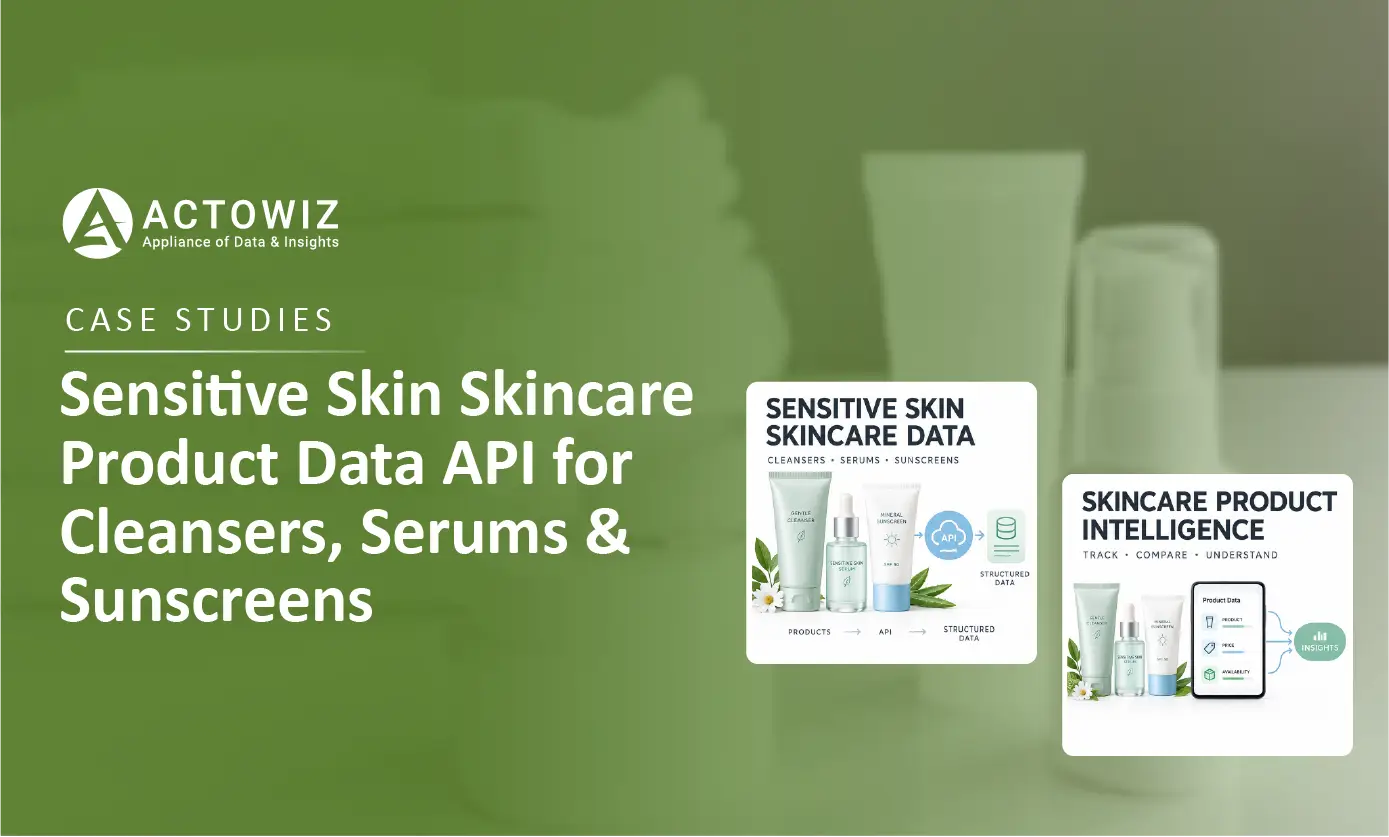
How Sensitive Skin Skincare Product Data API Helps Brands Track Cleansers, Serums, Moisturizers, and Sunscreens

Sensitive Skin Skincare Product Data API helps brands track cleansers, serums, moisturizers, and sunscreens with structured product data.

thumb
Report

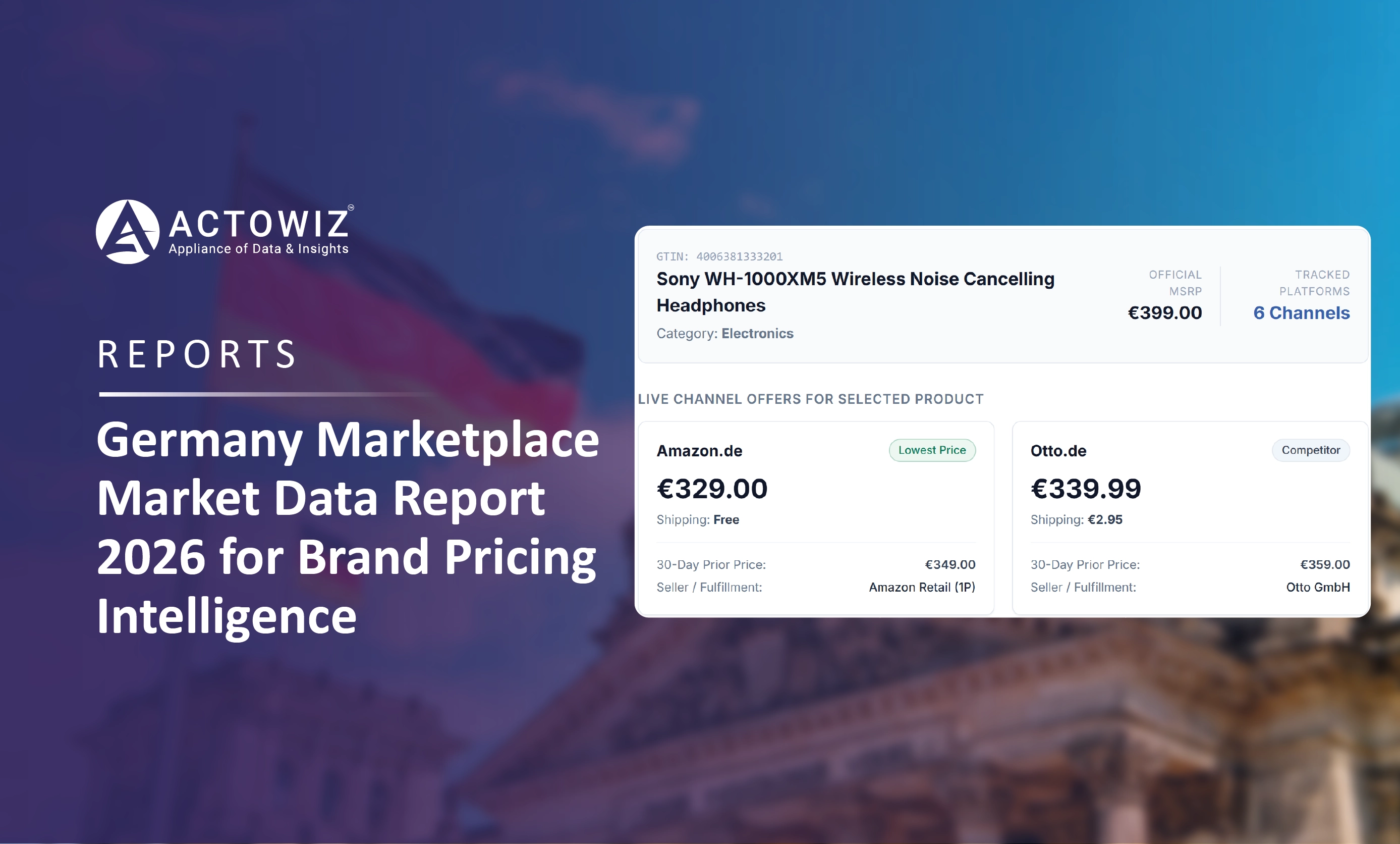
Germany Marketplace Market Data Report 2026 for Brand Pricing Intelligence

German marketplace data report 2026: online retail size, Amazon.de, Otto, Kaufland and Zalando price signals, PAngV rules and peak seasons.

Start Where It Makes Sense for You

Whether you're a startup or a Fortune 500 — we have the right plan for your data needs.

icons
Enterprise
Book a Strategy Call
Custom solutions, dedicated support, volume pricing for large-scale needs.
icons
Growing Brand
Get Free Sample Data
Try before you buy — 500 rows of real data, delivered in 2 hours. No strings.
icons
Just Exploring
View Plans & Pricing
Transparent plans from $500/mo. Find the right fit for your budget and scale.
Get in Touch
Let's Talk About
Your Data Needs
Tell us what data you need — we'll scope it for free and share a sample within hours.
  • icons
    Free Sample in 2 HoursShare your requirement, get 500 rows of real data — no commitment.
  • icons
    Plans from $500/monthFlexible pricing for startups, growing brands, and enterprises.
  • icons
    US-Based SupportOffices in New York & California. Aligned with your timezone.
  • icons
    ISO 9001 & 27001 CertifiedEnterprise-grade security and quality standards.
Request Free Sample Data
Fill the form below — our team will reach out within 2 hours.
+1 ▼
✓ Free 500-row sample · No credit card · Response within 2 hours

Request Free Sample Data

Our team will reach out within 2 hours with 500 rows of real data — no credit card required.

+1 ▼
✓ Free 500-row sample · No credit card · Response within 2 hours