Core services
Enterprise Data Extraction

Scalable web, app and AI-powered collection across 40+ countries.

All 58 services →
New 2026
AI Training Data

Corpus building with provenance and opt-out compliance.

Learn more →
Free pilot
24-hour sample

We run collection on your own sources before you commit.

Get a sample →
58Services
40+Countries
DEVELOPER

Ready-Made Scrapers

Pre-built for top platforms. Self-serve, no setup.

View All →
TRY FREE

API Playground

Test endpoints instantly. No credit card.

Start Free →
28Tools
2SDKs
icons Delivery & SDKs
Streaming Crawl API Scheduler Realtime Alerts Webhook Delivery 🐍 Python SDK 💚 Node.js SDK

Need it managed instead?

Fixed monthly retainer, named engineer, no per-request metering.

Managed Data API →
HOT

Case Studies

How brands use Actowiz, with named outcomes.

Read →
FREE

Sample Datasets

Real output, no signup.

Download →
NEW

ROI Calculator

Model the return on a data engagement.

Calculate →
Hotel points vs cash rate data: collecting comparable award and cash rates

Introduction

Most points-versus-cash comparisons are invalid, and the reason is procedural rather than analytical. The two sides were collected under different conditions.

The cash rate came from a non-refundable advance-purchase plan. The award rate came from a standard flexible booking. The cash rate excluded a resort fee that the award path charges anyway. The two observations were taken six hours apart, during which the cash rate moved.

Divide one by the other and you get a cents-per-point figure that looks authoritative and means nothing.

This post is about the collection discipline that makes the comparison hold: what has to be identical on both sides, how to pin a rate plan, how to handle fees, and what cadence reveals rate movement before a stay date.

The comparability problem

For a points-versus-cash observation to be valid, seven things must match across both sides:

Dimension Requirement Why it breaks otherwise
Property Same property ID, not same brand Brand-level rates differ by property
Stay dates Same check-in and check-out Award and cash calendars differ by date
Room type Same room category and bed configuration Award inventory is often a base room only
Cancellation policy Same refundability Non-refundable cash versus flexible award is not a fair pair
Occupancy Same adults and children Occupancy changes both rate and eligibility
Rate plan One pinned plan held across the series Plan mix causes phantom volatility
Collection moment Same collection window, minutes apart Cash rates move intraday

The last row is the one most often ignored. A cash rate is a live quote. Collecting the award side in the morning and the cash side in the evening introduces a gap larger than many of the differences being studied.

Practical rule: collect both sides inside the same request window, and store a shared observation_group_id so the pair is provable, not assumed.

Rate-plan proliferation and how to pin one

A single property on a single date routinely exposes many rate plans:

  • Standard flexible rate
  • Member or loyalty-program rate
  • Advance purchase, non-refundable
  • Breakfast-included package
  • Longer-stay or multi-night discounted rate

  • Corporate or negotiated rate, where publicly quotable
  • Promotional rate tied to a campaign window

These are not variations of one price. They are different products. A series that takes "the cheapest available rate" each day will jump whenever the plan mix changes, and the jump will be read as a rate movement.

The fix is to pin a plan definition and hold it for the life of the series. A workable default:

Baseline plan: lowest publicly available rate that is fully refundable, room-only, standard base room category, double occupancy, no loyalty membership required.

Then run a second series for the member rate if that comparison matters. Two clean series beat one contaminated one.

Record the plan you actually captured in rate_plan_label and rate_plan_normalised, along with the attributes that define it. When a property stops offering the pinned plan on a date, record a null with a reason code rather than substituting a different plan.

Taxes, resort fees and the paths that differ

Hotel points vs cash rate data: collecting comparable award and cash rates

This is where the comparison most often quietly breaks.

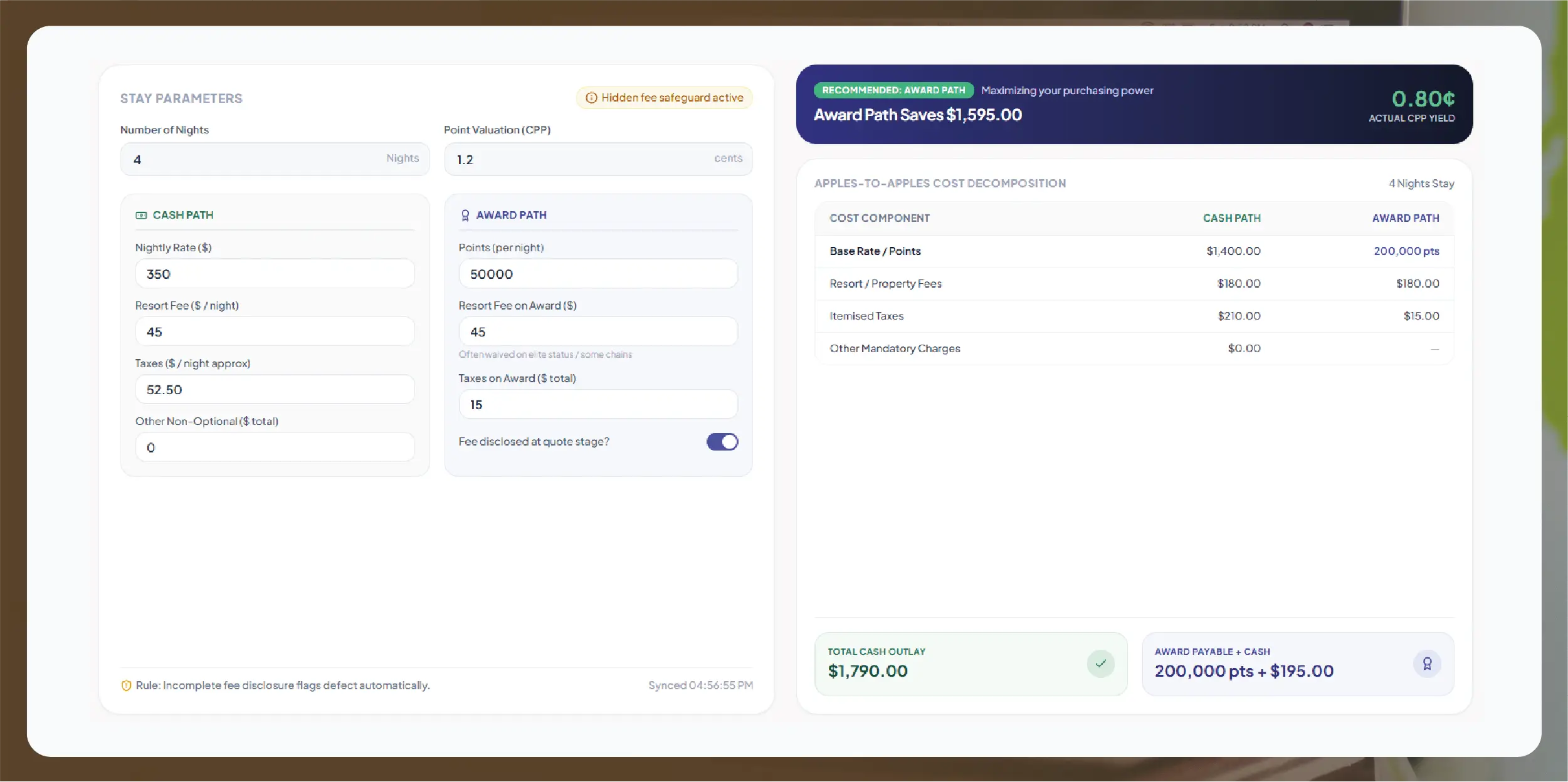
On the cash path, the quoted nightly rate frequently excludes taxes and a mandatory property fee, both added later in the flow. On the award path, the points cover the room but the mandatory fee may still be payable in cash, and taxes may be handled differently.

So the correct comparison is not points versus nightly rate. It is:

Points required plus cash payable on the award path, against total cash payable on the cash path.

That means capturing, on both sides:

  • Nightly rate or points, per night
  • Taxes, itemised where the source itemises them
  • Mandatory property or resort fee, and whether it is per night or per stay
  • Any other non-optional charge
  • A derived total for the full stay

If a source does not expose the fee at the quote stage, record fee_disclosed_at_quote = false and mark the total as incomplete. An incomplete total labelled as incomplete is useful. An incomplete total labelled as a total is a defect.

Award availability as a separate signal

Award price and award availability are two different things, and conflating them produces bad conclusions.

A property may show no award nights on a date because the award bucket is closed, while cash rooms remain plentiful. That is an availability event, not a pricing event. A property may also show award nights at a high points level, which is a pricing event.

Store them separately:

  • award_available — boolean
  • award_points_per_night — integer, null when unavailable
  • award_unavailable_reason — enum where the source gives one

Availability alone answers a useful question about the share of sampled property-nights with award availability, by market and booking window. That figure is often more actionable than any cents-per-point number, because it tells a traveller whether the redemption is even possible.

The field schema

Field Type Notes
observation_group_id string Links the points and cash observation of one pair
property_id_source string Source's own property identifier
property_name string As published
brand / chain_program string Loyalty program that governs the award
city / country string Normalised market fields
check_in_date / check_out_date date Stay window
nights integer Derived
booking_window_days integer Days between collected_at and check-in
occupancy_adults / occupancy_children integer Queried, not inferred
room_category_raw / room_category_normalised string As shown / mapped to controlled vocabulary
path enum cash or award
rate_plan_label / rate_plan_normalised string Source plan name / pinned plan definition
is_refundable boolean From the displayed policy
cash_rate_per_night decimal, nullable Cash path only
award_points_per_night integer, nullable Award path only
award_cash_copay decimal, nullable Cash payable on the award path
taxes_total / mandatory_fee_total decimal, nullable For the stay
fee_basis enum per_night or per_stay
fee_disclosed_at_quote boolean Completeness marker
total_cash_for_stay decimal, nullable Derived; null if incomplete
award_available boolean Separate from price
collected_at timestamp UTC, to the second

Deriving cents per point, and its caveats

The derivation is simple:

value_per_point = (total_cash_for_stay_cash_path − award_cash_component) / total_points_required

The caveats are not simple, and any published figure should carry them:

  • It is a single-observation figure, valid for one property, one date, one plan, one occupancy. It does not generalise to a program.
  • It is sensitive to the cash plan pinned. A refundable baseline yields a higher figure than a non-refundable one. Say which you used.
  • It ignores earning forgone. An award stay usually earns no points and may not count toward status. That is a real cost the ratio omits.
  • It is undefined when award availability is closed. Excluding unavailable nights biases the distribution upward, because the nights that disappear are often the high-demand ones.
  • Report a distribution, not a mean. The useful output is percentiles across sampled property-nights, not a single headline number.

Point five is the one that changes decisions. A mean hides the cases where redemption is clearly worthwhile.

Collection cadence

Rate movement before a stay date is the phenomenon most people actually want to see, and it requires cadence rather than coverage.

A defensible pattern for each property-date cell:

Booking window Cadence Purpose
0 to 7 days out Daily Late movement and closeout behaviour
8 to 30 days out Every 2 days Main repricing zone
31 to 90 days out Weekly, same weekday Baseline trend
91 to 365 days out Monthly, same weekday Award chart and season anchors

Hold the weekday constant on the sparse tiers. Weekday and weekend rates differ enough that a shifting weekday will generate a fake trend.

What the cadence actually reveals

Cadence is not just refresh hygiene. Each tier answers a different question, and knowing which one you are answering prevents overclaiming.

The daily near-term tier shows closeout behaviour. As a stay date approaches, a property either drops its rate to fill remaining rooms or holds firm and lets them go empty. That decision is visible only if you are sampling every day in the final week, and it is the single most commercially interesting pattern in hotel rate data.

The two-day tier over the 8-to-30-day window shows the main repricing zone. Most revenue-management adjustments land here, and this is where a points-versus-cash gap typically widens or closes.

The weekly and monthly tiers are anchors, not trend data. Their job is to establish where a property started, so that near-term movement can be measured against something. Do not attempt to read week-to-week volatility from a monthly series.

One more reason cadence matters: award availability is not static either. A property with award nights open at 90 days out can have them closed at 10 days out, or the reverse. Without a cadence that spans booking windows, you cannot tell whether a closed award night was always closed or closed recently — and those are very different findings for anyone deciding when to book.

Finally, keep the collection time of day consistent within each tier. Rates move intraday, and a series that drifts from morning collection to evening collection over several weeks will show a trend that is an artefact of your own scheduler.

Sampling design across properties and markets

You cannot cover every property. Choose a panel and keep it stable.

  • Stratify by market, with a fixed property count per market so no market dominates.
  • Stratify by tier within market: upper-upscale, upscale, midscale, as the program defines them.
  • Include control properties in low-demand markets, where a rate change is more likely programmatic than demand-driven.
  • Hold the panel fixed across periods. Adding properties mid-series changes the composition and breaks period comparisons.
  • Track panel attrition. Properties leave programs and change brands; record the exit rather than silently dropping the row.

Common failure modes: substituting a different room category when the base room sells out; letting a promotional plan enter the pinned series; collecting the two paths hours apart; and reporting a mean cents-per-point across a panel with heavy availability gaps.

Actowiz Solutions builds paired award-and-cash hotel rate collection with rate-plan pinning, shared observation grouping across both paths, fee and tax capture, and availability recorded as a distinct field. Feeds are delivered on a defined cadence per booking-window tier, through scheduled delivery or API.

We collect public-facing published rates and record the conditions of each observation, so the comparison you publish is one you can defend.

Frequently Asked Questions

Why do points and cash rates have to be collected at the same moment?

Because cash rates are live quotes that move intraday. If the award side is captured hours after the cash side, part of the measured gap is elapsed time rather than a real difference. Pairing both observations under a shared identifier makes the comparison provable.

What is rate-plan pinning and why does it matter?

Pinning means fixing one plan definition, such as the lowest publicly available refundable room-only rate at double occupancy, and holding it across the whole series. Without it, the plan mix changes between collections and the resulting jumps are misread as genuine rate movement.

Why report a distribution of cents-per-point rather than an average?

Because the figure varies widely by property, date and booking window, and nights with closed award availability drop out of the calculation entirely. An average hides both the variance and the selection effect, while percentiles across sampled property-nights show where redemption actually pays off.

You can also reach us for all your mobile app scraping, data collection, web scraping, and instant data scraper service requirements!

Request a free sample dataset of paired award-and-cash hotel rates with rate-plan pinning and fee capture.
Get a free sample dataset
Social Proof That Converts

Trusted by Global Leaders Across Q-Commerce, Travel, Retail, and FoodTech

Our web scraping expertise is relied on by 4,000+ global enterprises including Zomato, Tata Consumer, Subway, and Expedia — helping them turn web data into growth.

4,000+ Enterprises Worldwide
50+ Countries Served
20+ Industries
Join 4,000+ companies growing with Actowiz →
Real Results from Real Clients

Hear It Directly from Our Clients

Watch how businesses like yours are using Actowiz data to drive growth.

▶
1 min
★★★★★
"Actowiz Solutions offered exceptional support with transparency and guidance throughout. Anna and Saga made the process easy for a non-technical user like me. Great service, fair pricing!"
TG
Thomas Galido
Co-Founder / Head of Product at Upright Data Inc.
▶
2 min
★★★★★
"Actowiz delivered impeccable results for our company. Their team ensured data accuracy and on-time delivery. The competitive intelligence completely transformed our pricing strategy."
II
Iulen Ibanez
CEO / Datacy.es
▶
1:30
★★★★★
"What impressed me most was the speed — we went from requirement to production data in under 48 hours. The API integration was seamless and the support team is always responsive."
FC
Febbin Chacko
-Fin, Small Business Owner
icons 4.8/5 Average Rating
icons 50+ Video Testimonials
icons 92% Client Retention
icons 50+ Countries Served

Join 4,000+ Companies Growing with Actowiz

From Zomato to Expedia — see why global leaders trust us with their data.

Why Global Leaders Trust Actowiz

Backed by automation, data volume, and enterprise-grade scale — we help businesses from startups to Fortune 500s extract competitive insights across the USA, UK, UAE, and beyond.

icons
7+
Years of Experience
Proven track record delivering enterprise-grade web scraping and data intelligence solutions.
icons
4,000+
Projects Delivered
Serving startups to Fortune 500 companies across 50+ countries worldwide.
icons
200+
In-House Experts
Dedicated engineers across scrapers, AI/ML models, APIs, and data quality assurance.
icons
9.2M
Automated Workflows
Running weekly across eCommerce, Quick Commerce, Travel, Real Estate, and Food industries.
icons
270+ TB
Data Transferred
Real-time and batch data scraping at massive scale, across industries globally.
icons
380M+
Pages Crawled Weekly
Scaled infrastructure for comprehensive global data coverage with 99% accuracy.

AI Solutions Engineered
for Your Needs

→
LLM-Powered Attribute Extraction: High-precision product matching using large language models for accurate data classification.
→
Advanced Computer Vision: Fine-grained object detection for precise product classification using text and image embeddings.
→
GPT-Based Analytics Layer: Natural language query-based reporting and visualization for business intelligence.
→
Human-in-the-Loop AI: Continuous feedback loop to improve AI model accuracy over time.
icons Product Matching icons Attribute Tagging icons Content Optimization icons Sentiment Analysis icons Prompt-Based Reporting

Connect the Dots Across
Your Retail Ecosystem

We partner with agencies, system integrators, and technology platforms to deliver end-to-end solutions across the retail and digital shelf ecosystem.

icons
Analytics Services
icons
Ad Tech
icons
Price Optimization
icons
Business Consulting
icons
System Integration
icons
Market Research
Become a Partner →

Popular Datasets — Ready to Download

Browse All Datasets →
icons
Amazon
eCommerce
Free 100 rows
icons
Zillow
Real Estate
Free 100 rows
icons
DoorDash
Food Delivery
Free 100 rows
icons
Walmart
Retail
Free 100 rows
icons
Booking.com
Travel
Free 100 rows
icons
Indeed
Jobs
Free 100 rows

Latest Insights & Resources

View All Resources →
thumb
Blog

Hotel Points vs Cash Prices: Collecting Comparable Rate Data

How to collect hotel award and cash rates that are actually comparable: rate-plan pinning, fee handling, cadence design, and cents-per-point caveats.

thumb
Case Study

How Sensitive Skin Skincare Product Data API Helps Brands Track Cleansers, Serums, Moisturizers, and Sunscreens

Sensitive Skin Skincare Product Data API helps brands track cleansers, serums, moisturizers, and sunscreens with structured product data.

thumb
Report

Quick Commerce Availability Index Q4 2026: Market Data Report for Top 50 FMCG Brands Across 10 Indian Cities

Quick commerce availability index for Q4 2026: OOS rate, listing coverage and price index for 50 FMCG brands across 10 Indian cities.

Start Where It Makes Sense for You

Whether you're a startup or a Fortune 500 — we have the right plan for your data needs.

icons
Enterprise
Book a Strategy Call
Custom solutions, dedicated support, volume pricing for large-scale needs.
icons
Growing Brand
Get Free Sample Data
Try before you buy — 500 rows of real data, delivered in 2 hours. No strings.
icons
Just Exploring
View Plans & Pricing
Transparent plans from $500/mo. Find the right fit for your budget and scale.
Get in Touch
Let's Talk About
Your Data Needs
Tell us what data you need — we'll scope it for free and share a sample within hours.
  • icons
    Free Sample in 2 HoursShare your requirement, get 500 rows of real data — no commitment.
  • icons
    Plans from $500/monthFlexible pricing for startups, growing brands, and enterprises.
  • icons
    US-Based SupportOffices in New York & California. Aligned with your timezone.
  • icons
    ISO 9001 & 27001 CertifiedEnterprise-grade security and quality standards.
Request Free Sample Data
Fill the form below — our team will reach out within 2 hours.
+1 ▼
✓ Free 500-row sample · No credit card · Response within 2 hours

Request Free Sample Data

Our team will reach out within 2 hours with 500 rows of real data — no credit card required.

+1 ▼
✓ Free 500-row sample · No credit card · Response within 2 hours